


Best Fertilizer for Fall Overseeding: Picks, Rates, and Timing
The best fertilizer for fall overseeding depends on what is already in your soil. A starter fertilizer makes sense when the lawn needs phosphorus and local rules allow it. If the soil already has enough phosphorus, a suitable phosphorus-free lawn fertilizer is usually a better choice.
The bags can make this decision look harder than it is. “Starter,” “fall lawn food,” and “winterizer” describe different uses, but none tells you everything you need to know. Check the nutrient numbers, your grass type, and what you have already applied before buying another feed.
This guide focuses on overseeding cool-season lawns such as tall fescue, Kentucky bluegrass, perennial ryegrass, and fine fescues. Adding winter ryegrass to a dormant warm-season lawn is a different project. Do not apply a cool-season fall feeding plan to Bermuda or zoysia without checking local guidance.
Best Fertilizer for Fall Overseeding: Compare These Options
A starter that works well for your neighbor may add nutrients your lawn does not need. That is why the choices below are organized around the job each can do. The comparisons draw on published product information and Extension guidance; they are not claims of hands-on testing.
Which option fits your overseeding project?
| Option | Analysis | Useful when | Main limitation |
|---|---|---|---|
| Scotts Turf Builder Starter Food for New Grass | 24-25-4 | You need a straightforward phosphorus-containing starter. | Adds unnecessary phosphorus where soil levels are already sufficient or high. |
| Jonathan Green Veri-Green Starter Fertilizer for Seeding & Sodding | 12-18-8 | You want a starter that includes some slow-release nitrogen. | A lower analysis does not automatically make it safer or more suitable. |
| Scotts Turf Builder Triple Action Built For Seeding | 21-22-4, plus mesotrione | You need its labeled weed prevention and both existing and seeded grass are compatible. | Herbicide restrictions make it unsuitable for some lawns. |
| Seed-compatible phosphorus-free lawn fertilizer | Middle number is 0; other nutrients vary. | Soil phosphorus is adequate or excessive, or local guidance calls for avoiding it. | Nitrogen rate and potassium content still need to suit the lawn. |
1. Scotts Turf Builder Starter Food for New Grass: A Straightforward Starter
The 24-25-4 starter formulation is intended for new grass and reseeding projects. Consider it when phosphorus is needed and permitted. Check the full product name, because similarly branded weed-control formulas have different directions.
2. Jonathan Green Veri-Green Starter: An Option With Some Slow-Release Nitrogen
This 12-18-8 seeding and sodding fertilizer is labeled for overseeding and includes some slow-release nitrogen. Consider it if your lawn needs phosphorus and you want that type of feeding. Use the coverage directions on its bag, even if you have used another starter before.
The smaller first number does not mean you can spread it more generously. How much nitrogen reaches the lawn depends on both the percentage and the amount you apply. Check the bag in hand if an online listing gives different details.
3. Triple Action Built For Seeding: Only When Weed Prevention Is Needed
The seeding-specific fertilizer with mesotrione combines a 21-22-4 fertilizer with weed prevention. Its directions identify compatible grasses, including tall fescue, Kentucky bluegrass, perennial ryegrass, and certain fine fescues. Choose it when its weed prevention serves a real need, rather than assuming extra ingredients make it a better fertilizer.
Check the existing lawn as carefully as the seed mix. The product is not for Bermuda or zoysia lawns, even if you plan to add a compatible ryegrass. Follow the actual pesticide label for species, timing, application, watering, and reentry requirements.
4. Phosphorus-Free Lawn Fertilizer: Often the Better Fit for High-Phosphorus Soil
You do not have to buy a starter simply because you are planting seed. If a soil test shows enough phosphorus, a suitable fertilizer with a zero middle number can supply needed nitrogen without adding more phosphorus. Check that the product allows your intended use and contains no herbicide that interferes with the seed.
The advice on overseeding soil that already has high phosphorus supports using a low- or no-phosphorus lawn fertilizer. Do not substitute a high-phosphorus product simply because it is advertised for roots. Seedlings need access to nutrients, but adding nutrients already present in adequate amounts is not the same as correcting a shortage.
Check These Details Before Buying a Bag
Soil Phosphorus, Potassium, and pH
A recent laboratory soil test can help identify whether phosphorus or potassium is needed and whether soil acidity needs attention. Tell the laboratory that you are overseeding an existing lawn and identify the grass. Recommendations for a vegetable bed or completely new seedbed are not interchangeable with lawn-overseeding advice.
Lime is another purchase that should wait for a reason. When choosing fertilizer from soil-test results, check the pH recommendation as well as the nutrient advice. Fall overseeding does not automatically mean the lawn needs lime.
Fertilizer Already Applied
Check your lawn-care records before adding a starter. An early-fall feeding, fertilizer supplied by a lawn service, or a seed-and-fertilizer combination all count toward the nutrient supply. Adding a full starter application on top can deliver more nitrogen than you intended.
A product called lawn food still counts as fertilizer. Our guide to plant food and fertilizer labels explains why the names can be misleading. Include every feeding when you work out what the lawn has already received.
Local Fertilizer Rules
Some states and municipalities restrict lawn phosphorus, application dates, nutrient amounts, or use near water. An exception for establishing a new lawn does not necessarily apply to overseeding intact turf. Check the rules where the lawn is located before purchasing or applying fertilizer.
For example, the turfgrass seeding nutrient guidelines distinguish overseeding existing turf from establishing grass on disturbed bare ground. That distinction can affect whether a soil test is required before applying phosphorus. Do not treat every seeding project as having the same exemption.
Starter Fertilizer vs. Fall Fertilizer: Which Should You Use?
A starter fertilizer is intended to support establishment, while a fall maintenance fertilizer is usually marketed for an existing lawn. Their nutrient contents can overlap, and the package name alone doesn’t determine suitability. A maintenance product without phosphorus may fit an overseeding project when the soil already supplies enough phosphorus.
The same caution applies to “winterizer” products. More potassium is not automatically better if your soil already has enough. Compare the actual analysis, application rate, and intended use.
There is no need to buy a starter and a winterizer as an automatic two-bag routine. Work out what the lawn needs at seeding first. Decide on any later feeding after checking growth, the first application, local recommendations, and seasonal restrictions.
How Much Fertilizer Should You Apply?
Read the units carefully before measuring anything. A recommendation for one pound of nitrogen does not mean one pound of fertilizer. Use the product label, local turf advice, and applicable nutrient limits together to work out a suitable amount.
The calculation is straightforward: pounds of nitrogen applied = pounds of fertilizer applied × nitrogen percentage as a decimal. For phosphorus and potassium calculations, fertilizer labels express their amounts as phosphate and potash. Use the same units as your soil-test recommendation.
A Worked Coverage Example
A 15-pound bag of the 24-25-4 starter discussed above lists coverage of 5,000 square feet. That works out to 3 pounds of product per 1,000 square feet. At that coverage, it supplies 0.72 pounds of nitrogen, 0.75 pounds of phosphate, and 0.12 pounds of potash per 1,000 square feet.
Those numbers explain what the stated coverage delivers; they are not a dose for every lawn. Check whether that application suits your soil recommendations and local limits, as well as your exact bag. If the nutrients do not fit, choose another formulation rather than applying more than directed.
Measure the Lawn, Not the Entire Property
Subtract the house, driveway, patio, and planting beds from the area you plan to treat. For a 2,000-square-foot lawn, a product applied at 3 pounds per 1,000 square feet would require 6 pounds total. That arithmetic applies only when the stated product rate is appropriate.
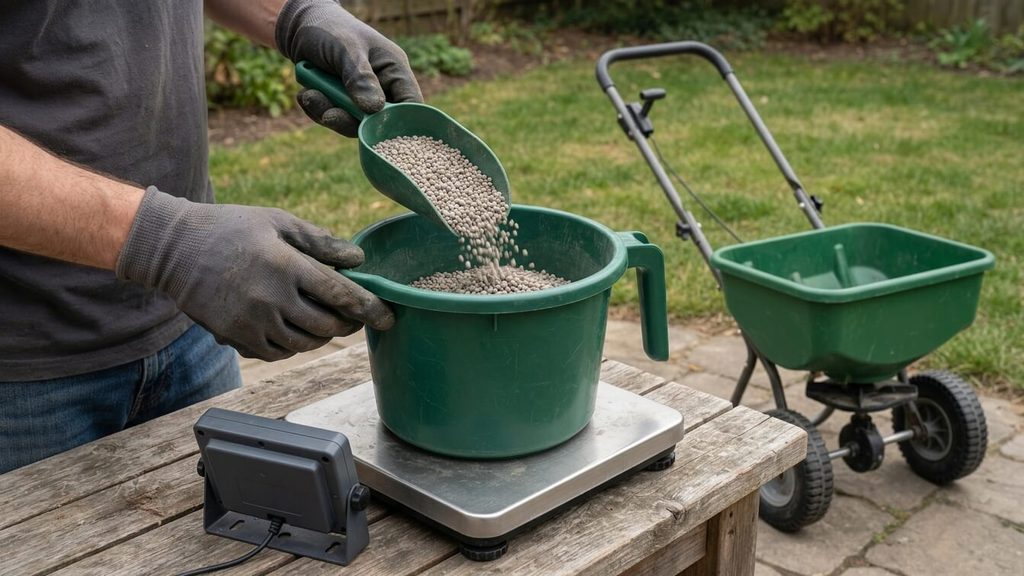
If you only need part of the bag, measure out that amount before filling the spreader. Keep the remainder in its original container, following the storage directions. Emptying the bag onto the lawn is not a harmless way to use up leftovers.
When to Apply Fertilizer During Fall Overseeding
For a suitable plain starter, application close to seeding is common. The lawn-establishment recommendations allow starter fertilizer just before or just after seeding. There is usually no reason to wait several days unless your product or local guidance calls for it.
A fertilizer containing herbicide may have a more specific sequence. Follow that product’s label instead of assuming all starters work the same way. Keep seed and fertilizer applications separate unless a product is designed to combine them.
Choose the Seeding Window First
Late summer through early fall is generally favorable for cool-season lawn overseeding, but the dates vary by region and grass. The regional lawn-improvement guidance illustrates how even nearby locations can have different preferred windows. Use your local Extension recommendations to choose the window rather than assuming September works everywhere.
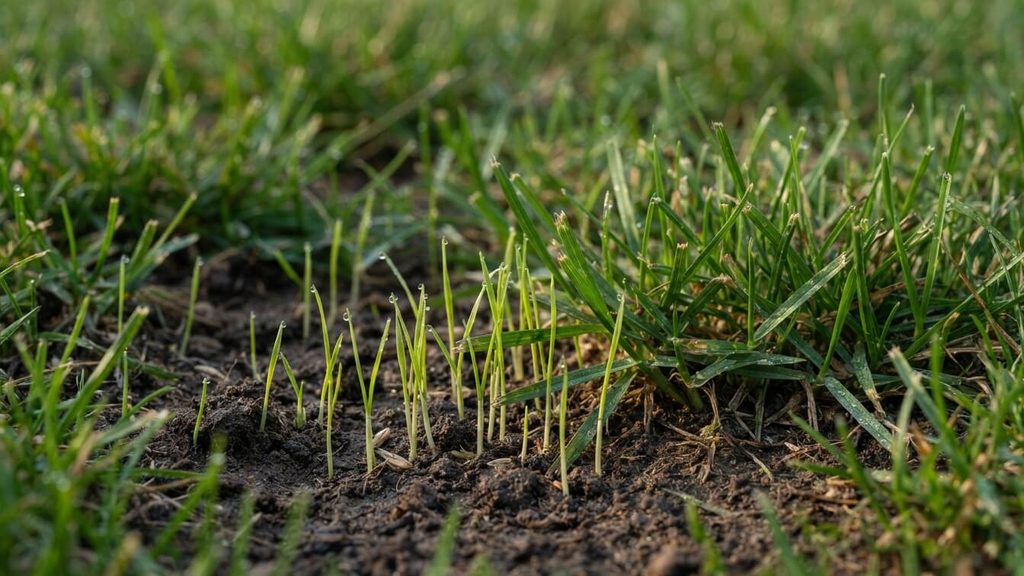
Kentucky bluegrass usually establishes more slowly than perennial ryegrass. Allow for the slowest species in your mix rather than judging the whole lawn by the first green shoots. A heavier feed will not make up for starting after the useful growing window has closed.
If large areas need replacing rather than overseeding, compare the timing and care involved in planting sod in the fall. Sod still needs suitable rooting conditions and reliable watering. It does not remove the risks of starting too late.
How to Overseed and Fertilize Without Wasting Either Product
1. Find Out Why the Lawn Is Thin
Look for compacted soil, heavy shade, drainage problems, disease history, or repeated traffic. New seed may struggle for the same reason the existing grass declined. Correct what you can before spending money on another feeding.
2. Prepare for Seed-to-Soil Contact
Mow and manage debris according to the grass and renovation method, without unnecessarily scalping the lawn. Core aeration or slit seeding may help where compaction or poor soil contact is a problem. Even a well-chosen fertilizer cannot fix seed left sitting on a dense mat of thatch.
3. Apply Seed and Fertilizer at Their Separate Rates
Use the seed bag’s overseeding rate and the fertilizer bag’s directions. Calibrate the spreader for each material, because grass seed and fertilizer granules do not flow alike. Do not borrow a setting from a different product or spreader model.
4. Spread Evenly and Clean Up
Keep the spreader moving while the gate is open, and close it before stopping or turning sharply. Avoid overlapping full-rate passes or spilling fertilizer in one place. Sweep stray granules off pavement and back onto an appropriately treated lawn area without creating a concentrated pile.
5. Keep the Seedbed Moist
Newly seeded areas need different watering from established lawns. Follow watering guidance for establishing grass to keep the seed zone moist without saturating it or washing seed away. Weather and soil conditions determine whether several light watering sessions are needed.
As the seedlings develop, gradually water less often and more deeply. If you planted a mixture, keep checking the slower-germinating grass as well as the first shoots. Adjust the timer to what the soil needs instead of leaving the same setting in place all season.
When Should You Fertilize Again After Overseeding?
Before giving the lawn a second feed, look at how it is growing and check the first product’s instructions. That fertilizer may still be releasing nutrients, or cool weather may have slowed establishment. A calendar reminder is a good time to check the lawn, not a reason to fertilize regardless of what you find.
Some establishment programs include a later light nitrogen feeding. The lawn-establishment guidance linked earlier, for example, describes a follow-up several weeks after the starter application. Before following a similar schedule, check your product’s feeding interval, local recommendations, and how much fertilizer you are still allowed to apply that season.
Do not repeatedly apply phosphorus-rich starter fertilizer unless recommendations support the additional phosphorus. Record the initial product, amount, and date. That makes the next decision much easier.
Common Reasons Overseeding Disappoints
If the lawn still looks patchy, resist the urge to add more fertilizer straight away. Seed may have dried out, washed away, or never reached the soil. Check those possibilities and the weather conditions before deciding that nutrients are the problem.
A fast burst of growth in the existing lawn is not proof that the seedlings have established. Continue mowing appropriately so established grass does not overwhelm the new growth. Avoid heavy traffic while seedlings are vulnerable.
Repeated failure beneath dense trees can point to light and root competition. Fertilizer cannot make a shade-intolerant grass suitable for the site. In difficult locations, a different planting or mulched bed may be more practical than overseeding every fall.
A final check before filling the spreader
- Confirm that your grass and local climate suit fall overseeding.
- Use soil-test guidance to decide whether phosphorus is needed.
- Account for fertilizer and herbicides already applied.
- Check the exact product label for seeding compatibility.
- Measure the lawn and the required product separately.
- Check local nutrient restrictions, the forecast, and access to irrigation.
- Keep fertilizer off pavement, drains, and water, and avoid applying before heavy rain.
Conclusion
The best fertilizer for fall overseeding is the one that fits your soil and seeding plan. A plain starter such as 24-25-4 or 12-18-8 can make sense when phosphorus is needed and permitted. A suitable phosphorus-free fertilizer is often the better choice when the soil already has enough.
Check what the lawn has already received, measure the area, and follow the directions for the product you choose. Then give the seed good soil contact, steady moisture, and enough time to establish. A carefully applied, suitable fertilizer is more useful than an extra bag added just in case.What is the best starter fertilizer for fall overseeding?
A plain lawn starter that matches your soil needs is a good starting point. Options include the 24-25-4 and 12-18-8 products discussed above. If soil phosphorus is already adequate or high, a suitable phosphorus-free fertilizer may be more appropriate.
Can I apply grass seed and fertilizer on the same day?
Often, yes, when the fertilizer permits use at seeding. Apply each at its own rate and follow any product-specific sequence or watering directions. Herbicide-containing products require additional checks for grass compatibility and timing.
Can I use regular fall fertilizer instead of starter fertilizer?
Yes, an appropriate plain fall lawn fertilizer can fit when it supplies needed nutrients and is suitable for the seeding project. A phosphorus-free product can be useful where soil phosphorus is sufficient. Check the label rather than assuming every fall fertilizer or winterizer is suitable for new grass.
Can too much starter fertilizer damage new grass?
Yes, excessive applications can injure grass and increase nutrient losses. Measure the lawn and follow the product rate, accounting for previous feeding. More fertilizer will not correct poor seed contact, drought, shade, or late planting.
Is 10-10-10 a good fertilizer for overseeding in fall?
It can work in some establishment programs, but it isn’t automatically the best fall fertilizer for overseeding. It supplies phosphorus whether or not your soil needs it, and the application must meet label directions and local limits. Choose based on soil recommendations and nutrient delivery rather than numbers alone.