


How to Choose the Right Lawn Mower for Your Midvale, Utah Yard
Choosing a lawn mower in Midvale, Utah starts with your property, not the biggest deck, highest horsepower, or newest features. A mower should match your grass coverage, the yard’s shape, the terrain, and how much time you want to spend mowing. Homeowners comparing chainsaws for sale in Midvale can use the same practical approach: choose outdoor equipment based on the work it must do and the space available to store it.
A compact lawn behind a townhome, for example, may call for a lightweight walk-behind mower that turns easily. A larger lot with open turf may justify a wider deck or a riding mower. Take a few minutes to measure the grassy area, note narrow gates and landscaping, and think about where the mower will live between uses.
Start With The Yard, Not The Mower
No single mower fits every Midvale property. Measure the lawn itself rather than relying on total lot size, since driveways, patios, planting beds, and structures do not need mowing. Also consider how often grass grows, whether the yard has trees or tight turns, and how easily equipment can pass through gates. Matching a mower to your yard, goals, and preferences is more useful than choosing based solely on cutting width or power source.
Match Mower Size To Lawn Size
Lawn size affects cutting time, deck width, battery capacity, and operator comfort, but it is only the starting point. A wide mower can cut fewer passes across an open lawn, while a smaller machine may be faster overall in a crowded space.
Small Lawns
Reel mowers, compact corded models, and lightweight battery mowers can be practical choices.
Medium Lawns
Self-propelled walk-behind mowers can reduce pushing effort while retaining good control around beds and trees.
Large Lawns
Riding mowers, lawn tractors, and zero-turn mowers can make sense where there is enough open turf to use them efficiently.
Complex Lawns
Give turning ability, gate clearance, and maneuverability more weight than deck width alone.
Compare Common Mower Types
Walk-Behind and Reel Mowers
Push mowers are straightforward choices for smaller, mostly level yards. Self-propelled versions help on larger lawns, mild slopes, or for anyone who wants less effort while walking. Manual reel mowers operate quietly and have few components to maintain, but they work best when grass is kept from becoming overly tall, and the ground is fairly even.
Riding and Zero-Turn Mowers
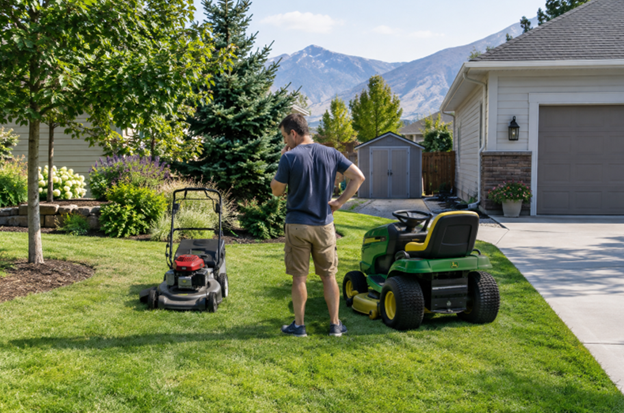
Riding mowers are designed for larger areas where a walk-behind mower would take too long. Zero-turn models offer quick directional changes around open areas and landscape features, but they require room to maneuver and time to learn the controls. Before buying either style, confirm that it will fit through access points and into the intended storage area.
Choose A Power Source
The power source affects noise, maintenance, runtime, starting procedure, and storage needs. Gas mowers can support longer mowing sessions but need fuel and routine engine maintenance. Battery mowers are quieter and avoid gasoline and oil changes, but battery runtime and charging plans still matter. Corded electric mowers offer continuous power for smaller yards but require careful cord management. Manual reel mowers are simple to operate but require more physical effort in thick, damp, or tall grass.
Consider Slopes, Obstacles, And Grass Type
Terrain can matter more than acreage. Flat lawns suit most mowers, while slopes, uneven ground, and obstacles demand precise control and stable footing. Check wheel size, traction, deck clearance, and access around trees, fences, beds, and narrow yards. Thick or fast-growing grass may require frequent mowing or stronger cutting power.
Wet grass can clump beneath the deck, reduce traction, and cause uneven cuts. When possible, mow after the lawn dries and avoid cutting too much at once. The University of Maine Extension recommends removing no more than one-third of the grass blade per mowing.
Focus On Useful Features
Useful features make regular mowing easier, safer, or more effective. Prioritize the features you will actually use each week.
- Adjustable cutting-height settings for changing seasonal conditions.
- Mulching, bagging, or side-discharge capability based on your cleanup preferences.
- Foldable handles or compact designs for limited garage or shed space.
- Comfortable grips, responsive controls, and a starting method that suits the operator.
- Accessible deck areas that simplify post-use cleaning.
- Battery compatibility with other outdoor tools, if you prefer a shared battery platform.
The mower is only one part of regular lawn care, so it can also help you learn how to efficiently clean up any yard when planning seasonal mowing, leaf removal, debris cleanup, and general turf maintenance.
Plan For Storage And Maintenance
The right mower must be easy to handle after the lawn is cut. Measure the storage area before choosing a wide-deck machine or riding mower. Keep the mower clean, inspect blades and fasteners regularly, and follow the owner’s manual for oil, filters, belts, batteries, and seasonal storage. Sharp blades cut cleanly, while dull blades can tear grass instead of cutting it cleanly.
Follow Basic Mowing Safety Steps
- Clear the lawn of sticks, stones, toys, and other debris before starting.
- Keep children, pets, and bystanders away from the mowing area.
- Wear sturdy shoes and appropriate eye protection.
- Do not mow in poor visibility or on ground that is dangerously wet or slippery.
- Turn the mower off before clearing a blockage or inspecting the blade area.
- Use slopes only as directed in the mower’s owner’s manual.
Use A Simple Buying Checklist
- How much grass needs to be cut?
- Is the lawn open, sloped, uneven, or filled with obstacles?
- How long should a typical mowing session take?
- Will the mower fit through gates and into storage?
- Which power source fits your maintenance routine?
- Are replacement blades, batteries, filters, and other parts readily available?
- Which features will be used consistently rather than occasionally?
Make The Final Choice
The best lawn mower for a Midvale yard is not necessarily the largest or most advanced option. It is the one that fits the property, feels controllable to operate, can be realistically stored and maintained, and helps make mowing a routine task rather than an all-day project.