



Average Size of a Backyard Pool: Complete Guide (With Real Numbers)
Imagine yourself in your backyard on a hot July day. The sun is shining bright, and you have nothing on your mind except the thought of a swimming pool near you. A lot of questions arise though: How big should the pool be? Is there even enough space for it? How much space do I really need?
This is a common dilemma. In fact, it’s the mental starting point for hundreds of thousands of homeowners every year. Besides, one of the first things that they ask themselves is: what is the average size of a backyard pool?
It is a straightforward question. But the response is quite complicated — because the size of your pool depends on the dimensions of your yard, how you want to use the pool, your budget, local zoning regulations, and a handful of other factors that are often hidden by the initial sales pitch of pool contractors.
We’re going to make it very simple for you. After reading this guide, not only will you find out what the average backyard swimming pool dimensions are, but also how pool shapes can change the amount of usable space, what a screened-in pool deck does to your calculations, and how to determine the right pool size for you.
You may also want to read How to Choose the Right Size Garden Shed for Backyard. It looks at a related part of the topic and gives you a few more practical ideas to consider.
Here we go.
What Is the Average Size of a Backyard Pool?
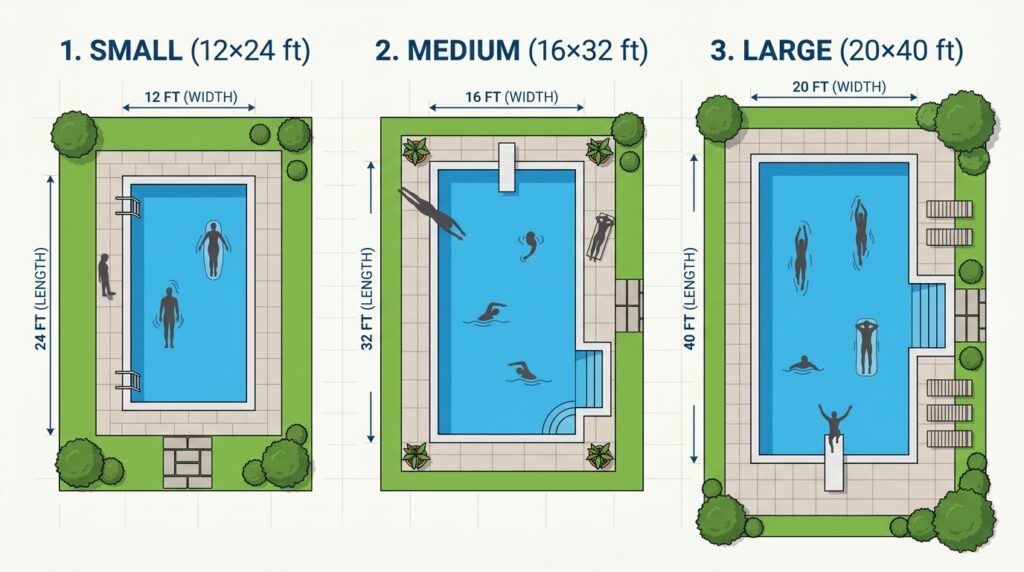
The most commonly cited average size of a backyard swimming pool in the residential market is 12 feet by 24 feet on the smaller end, scaling up to 16 feet by 32 feet for a mid-size family pool, with larger installations reaching 20 feet by 40 feet or beyond.
According to the Association of Pool & Spa Professionals (APSP), now operating as Pool & Hot Tub Alliance (PHTA), the most popular inground pool dimensions for residential use cluster around the 14×28 to 16×32 foot range. That gives a surface area of roughly 392 to 512 square feet — enough room for a family to swim comfortably without dominating the entire yard.
But here’s the thing: “average” is almost a meaningless number if you don’t understand the context behind it.
A 12×24 pool in a small urban backyard feels spacious. That same pool on a half-acre lot with ambitious kids looks like a puddle. Size is always relative to your yard, your family, and your goals.
You might also find Fire Flower: 18 Best Flowers That Look Like Flames relevant here. It looks at a neighboring topic and offers extra guidance that supports the points in this article.
The Numbers Behind the Average
| Pool Category | Typical Dimensions | Surface Area | Best For |
|---|---|---|---|
| Small / Plunge | 10×20 to 12×24 ft | 200–288 sq ft | Tight yards, couples, cooling off |
| Mid-Size (Most Common) | 14×28 to 16×32 ft | 392–512 sq ft | Family of 4–5, casual swimming |
| Large / Recreational | 18×36 to 20×40 ft | 648–800 sq ft | Entertaining, laps, active families |
| Lap Pool | 8–10 ft wide × 40–75 ft long | 320–750 sq ft | Fitness, long narrow yards |
| Freeform/Custom | Varies | 400–900+ sq ft | Aesthetic/resort-style yards |
These numbers reflect inground pools. Above-ground pools, which are significantly less expensive and faster to install, typically range from 12 to 24 feet in diameter (round) or 12×24 feet (oval) — very similar footprint to entry-level inground pools.
Average Size of a Backyard Swimming Pool by Type
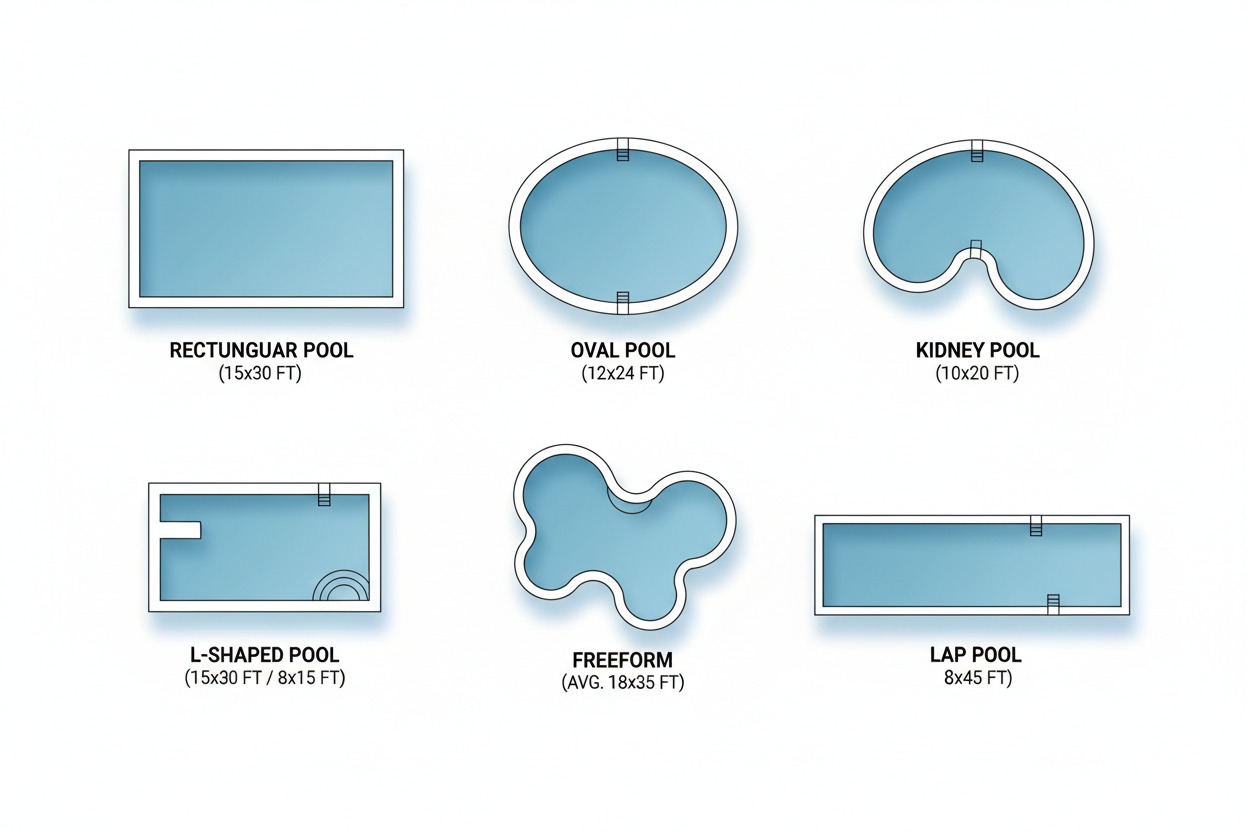
Not all pools are equal — and shape matters as much as square footage. Here’s how average dimensions break down across the most popular pool types.
Rectangular Pools
Rectangular pools are considered the gold standard when it comes to residential swimming. They are not only efficient but also offer maximum space for swimming per square foot. Besides, they are compatible with almost any pool equipment layout.
Typically, a rectangular backyard pool is 16 feet wide and 32 feet long. That means it has a water surface area of 512 square feet. This is the most preferred pool size for a family because it satisfies the needs for lap swimming, playing games, and lounging at the same time.
Smaller rectangular pools — like a 12×24 or a 10×20 – are getting more and more popular in urban and suburban yards where the outdoor space is limited. Large-sized pools at 18×36 or 20×40 are usually found in homes with ample outdoor space or where entertaining is a priority.
Depth profile matters too. Most residential rectangular pools feature a shallow end of 3 to 3.5 feet and a deep end of 5 to 8 feet, with a gradual slope between them. Depths beyond 8 feet are rare in residential pools today — diving boards have largely been phased out due to liability concerns, as noted by the American Red Cross aquatic safety guidelines.
Kidney-Shaped Pools
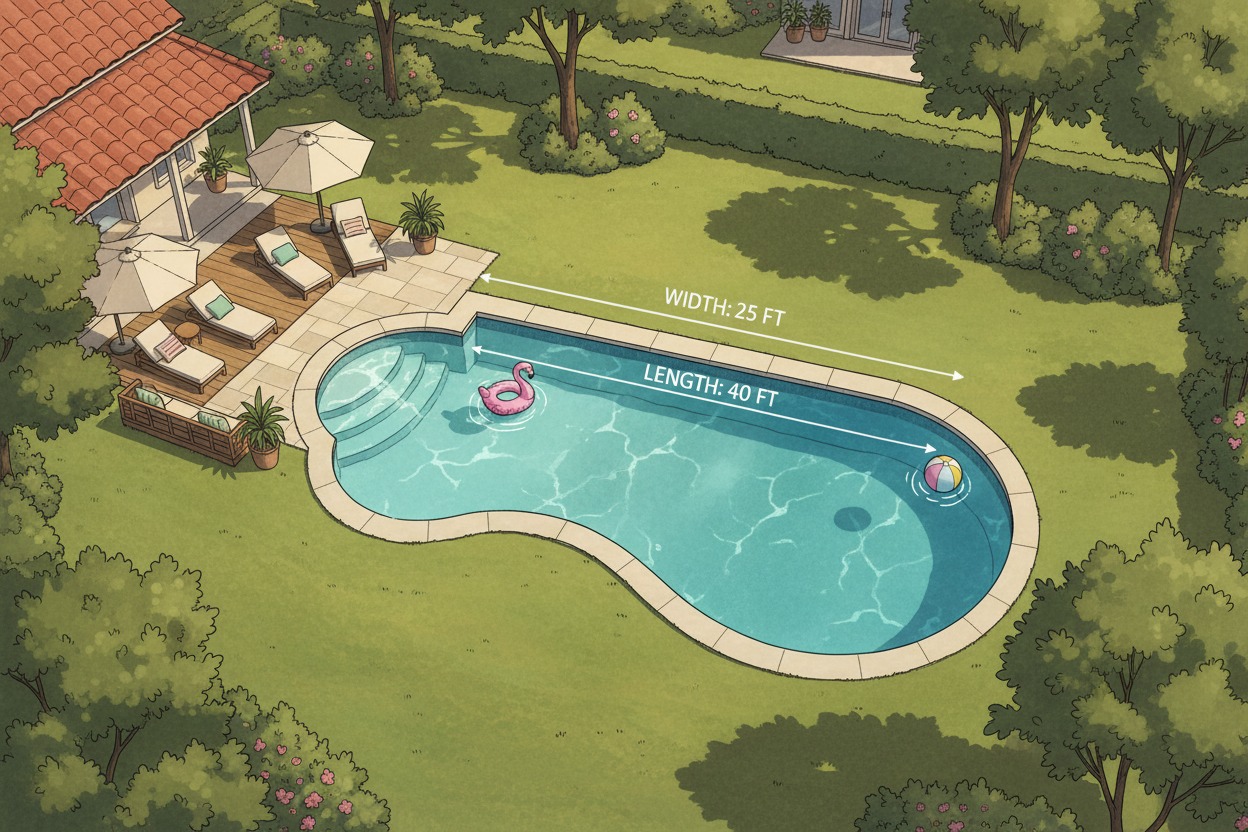
Kidney-shaped pools have been the hallmark of mid-century residential design. They are organically curved and aesthetically softer when compared to their rectangular counterparts. Usually, they measure 15 feet wide by 30 feet long, but due to their irregular shape, the actual swimming area is less than that of a similarly-sized rectangle.
Moreover, the characteristic concave “pinch” is not only for the look but also functions as a natural divider between a shallow lounging area and a deeper swimming zone, which is a very practical feature liked by many families.
The major disadvantage: kidney pools are difficult (and therefore, more expensive) to cover, and pool cleaning robots are often unable to clean the curves properly. So, if you are shopping around, get price estimates for both shapes before making your decision.
L-Shaped Pools
L-shaped pools solve a specific problem: they give you both a lap swimming lane and a shallow recreational area within a single footprint. Average dimensions run around 16×30 feet for the main section plus a 10×16-foot shallow wing, giving a total surface area of around 640 square feet.
They’re particularly popular with households where adults want to swim laps while kids play in the shallows — essentially two pools in one layout.
Freeform Pools
Freeform pools — organic, lagoon-style shapes with irregular curves — prioritize aesthetics over pure swimming efficiency. The average size of a freeform backyard pool is broadly 400 to 600 square feet of water surface, but dimensions are custom by nature.
These pools are usually paired with rock features, waterfalls, grottos, and tropical landscaping. If the pool is meant to be a visual centerpiece more than an athletic facility, freeform is worth the premium.
Lap Pools
Lap pools are a niche but growing category. Designed strictly for fitness swimming, they prioritize length over width. The average residential lap pool is 8 to 10 feet wide and 40 to 75 feet long.
They’re a practical solution for narrow lots where a conventional pool won’t fit, or for homeowners who want a pool primarily for exercise. According to USA Swimming, competition lanes are 8 feet wide — so a standard 8-foot-wide residential lap pool gives you one proper lane.
Plunge Pools
Plunge pools are compact, typically 8×12 feet to 10×20 feet, and are designed for cooling off rather than active swimming. They’ve exploded in popularity over the past several years, particularly in urban markets and drought-prone regions where water conservation matters.
They’re also significantly cheaper to build, heat, and maintain — making them an attractive entry point for homeowners who want the lifestyle of a pool without the full-size commitment.
What Is the Average Size of a Backyard?
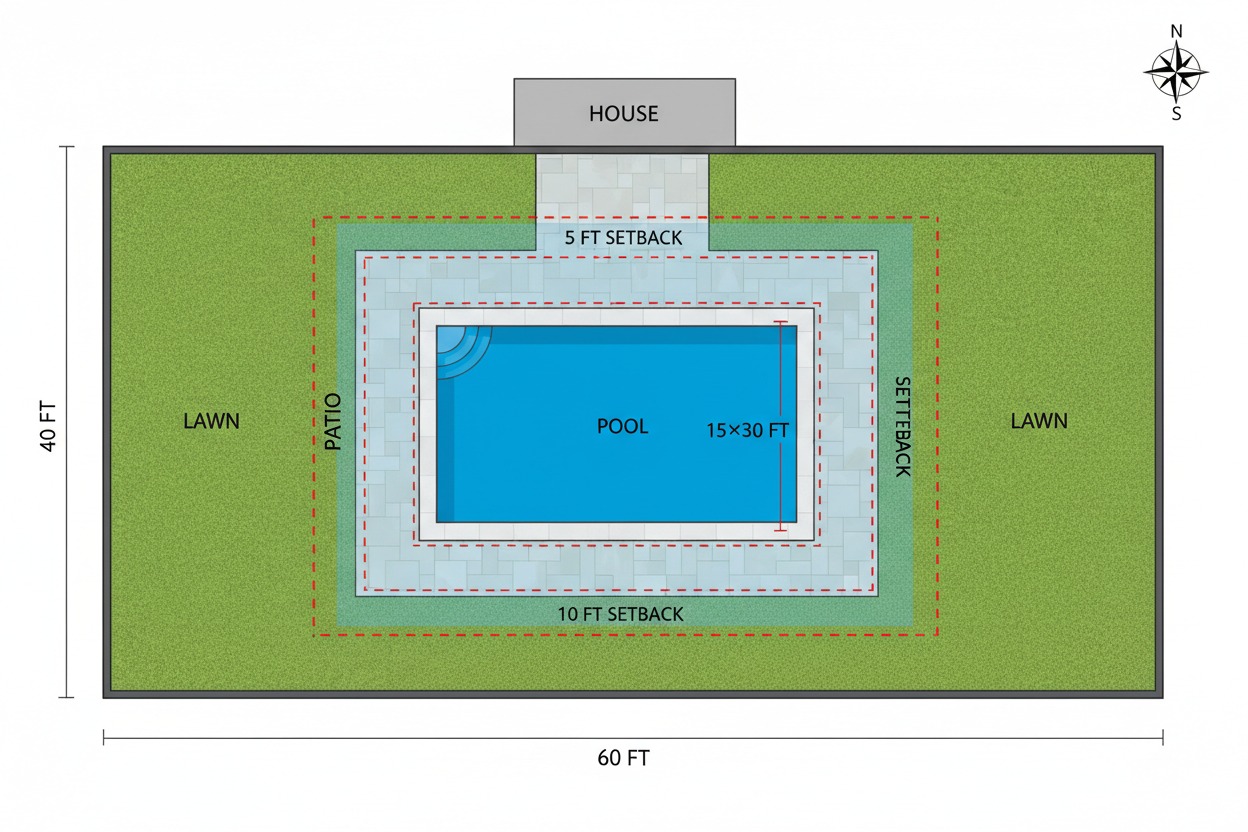
Before sizing your pool, you need to know your actual backyard dimensions — because you can’t build a 16×32 pool in a 20×30 yard. How Much Space Do You Need for a Backyard Archery Range?
The average residential lot in suburban areas sits around 0.17 to 0.25 acres total, but that includes the house, driveway, front yard, and side yards. The backyard specifically tends to run 40 to 60 feet wide and 50 to 80 feet deep, based on typical suburban subdivision layouts.
That sounds like plenty of room — and it usually is for a mid-size pool. But there are critical deductions to account for:
Required setbacks: Most local zoning codes require pools to be set back 5 to 15 feet from property lines, and 10 to 15 feet from the house foundation. Check your local municipality’s building department for exact rules — they vary significantly by jurisdiction.
Deck/patio space: A pool without adequate deck space is frustrating to use. Most pool designers recommend at least 3 to 4 feet of deck on all sides as a minimum, with 5 to 8 feet being far more comfortable for furniture, towels, and foot traffic.
Equipment space: Pool equipment (pump, filter, heater) needs its own dedicated space — typically 4×8 feet minimum — accessible but tucked away from high-traffic areas.
When you do the math, a 40×60 backyard can comfortably fit a 14×28 or 16×32 pool with reasonable deck space, required setbacks, and equipment room. Go much larger, and you’re sacrificing greenspace or violating setback rules.
The 25–33% Rule of Thumb
A widely used guideline in pool design is that the pool surface area should equal roughly 25 to 33% of the total backyard square footage. So:
- 1,200 sq ft backyard → Pool up to ~300–400 sq ft (roughly 12×25 to 14×28)
- 2,000 sq ft backyard → Pool up to ~500–660 sq ft (roughly 16×32 to 18×36)
- 3,000 sq ft backyard → Pool up to ~750–990 sq ft (custom large pool territory)
This isn’t a hard rule — it’s a proportion guide to help the pool feel balanced within the landscape rather than consuming it.
Average Size of a Backyard Screened-In Deck with Pool
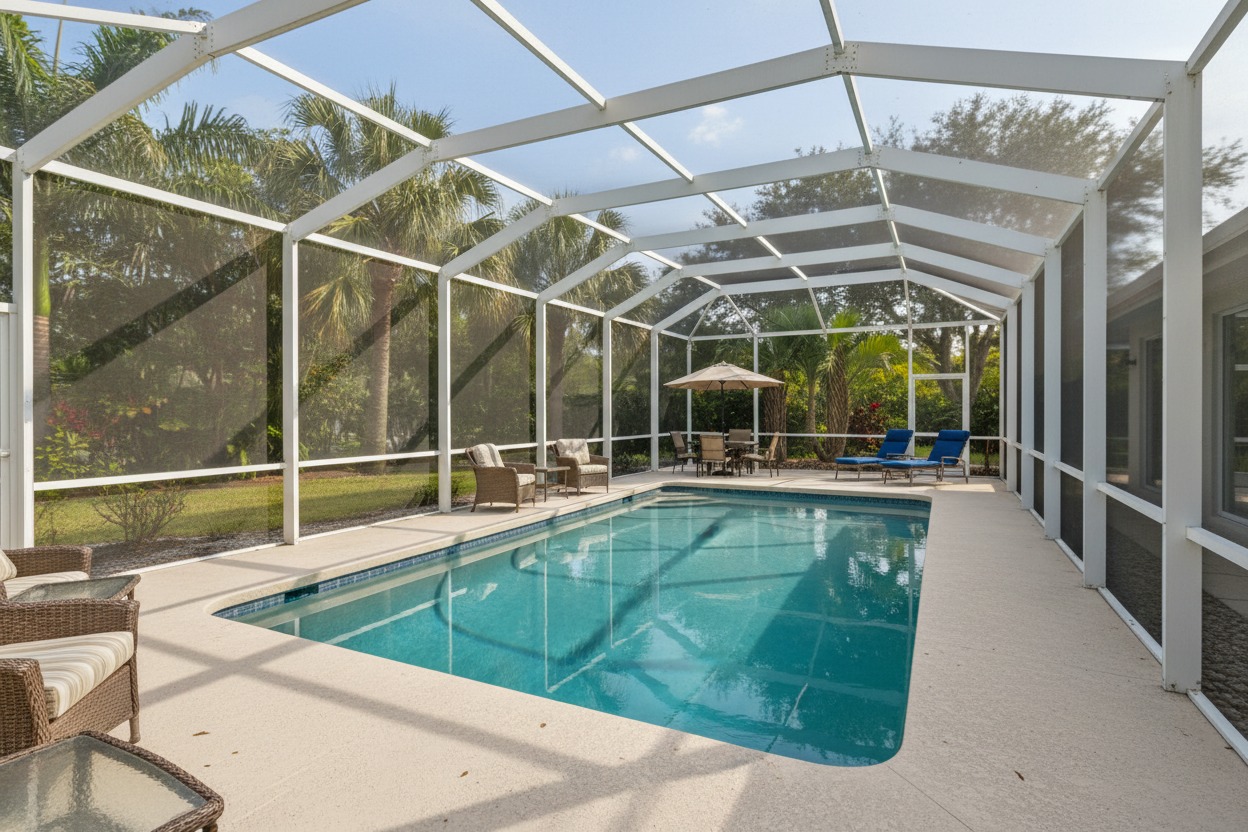
Screened-in pool enclosures — often called “pool cages” or “Florida rooms” — add a whole new dimension to the sizing conversation. They’re extremely popular in the Southeast, particularly in Florida, where mosquito pressure and year-round outdoor living make them a near-standard feature.
The average size of a backyard screened-in deck with pool is considerably larger than the pool itself, because the enclosure must contain both the pool and adequate patio/deck space around it.
Typical Screened Enclosure Dimensions
| Enclosure Type | Typical Size | Notes |
|---|---|---|
| Small / Basic | 20×30 ft | Minimal deck space, tight fit |
| Mid-Size (Most Common) | 24×40 ft to 28×44 ft | Comfortable deck + pool |
| Large / Resort-Style | 30×50 ft to 40×60 ft | Outdoor kitchen, seating areas |
A typical setup places a 14×28 or 16×32 pool inside a 24×40 or 28×44 screened enclosure, leaving 5 to 8 feet of deck on three sides and a bit more on the entry side for furniture and lounging.
What the Screen Enclosure Adds to Your Budget
Screened enclosures typically add $8,000 to $30,000+ to a pool project, depending on size, roof height, and material quality. According to HomeAdvisor’s cost data, the national average for a pool enclosure runs around $10,000 to $15,000 for a standard residential installation.
The structural footprint also matters for permits. Most jurisdictions require a separate permit for the enclosure in addition to the pool permit, and setback rules may apply to the structure itself, not just the water.
Benefits of a Screened-In Pool Area
Beyond bug control, screened enclosures:
- Dramatically reduce pool debris (leaves, dirt, pollen), lowering cleaning time
- Provide UV filtering, reducing sun exposure during midday swimming
- Extend the swimming season in cooler climates by trapping warmth
- Increase home resale value in markets where they’re standard
The Florida Building Code has specific requirements for screen enclosure construction that are worth reviewing if you’re in that region, as wind-load ratings and anchoring methods are tightly regulated.
How Pool Size Affects Cost
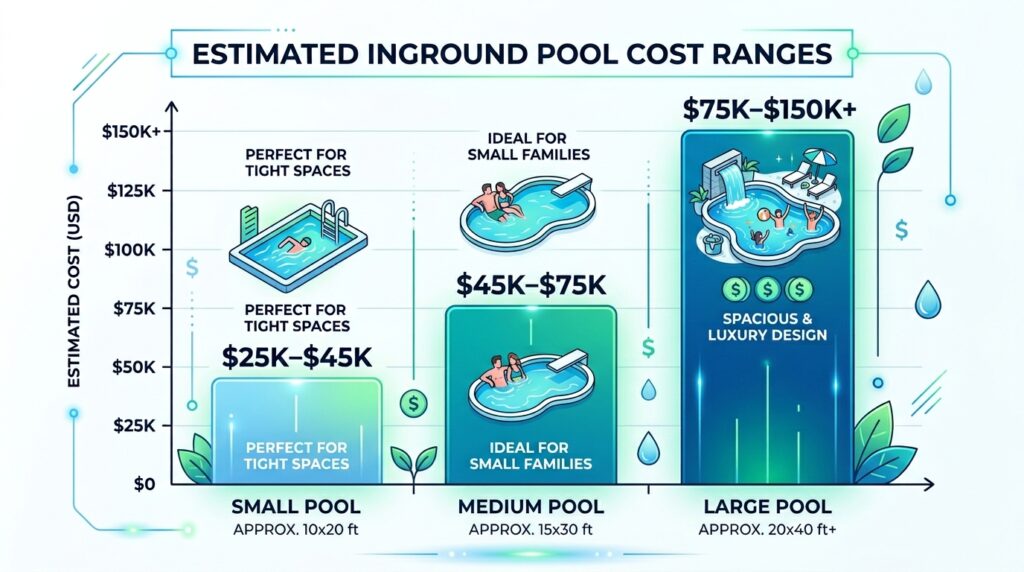
Pool size and price are directly linked — but size is only one variable in a complex cost equation. Here’s how the numbers typically break down.
Inground Pool Cost by Size
According to data from Fixr and HomeAdvisor, typical inground pool installation costs run:
| Pool Size | Estimated Cost Range | Notes |
|---|---|---|
| 10×20 ft | $25,000–$40,000 | Basic installation, minimal features |
| 12×24 ft | $30,000–$50,000 | Entry-level family pool |
| 14×28 ft | $40,000–$65,000 | Most popular size range |
| 16×32 ft | $50,000–$80,000 | Mid-size with room to entertain |
| 18×36 ft | $65,000–$100,000 | Larger family/entertaining setup |
| 20×40 ft | $80,000–$150,000+ | Premium installation |
These are base costs for the pool structure itself. They don’t include:
- Decking/patio: $5,000–$25,000+
- Landscaping: $3,000–$15,000
- Fencing (often legally required): $1,500–$10,000
- Heating system: $2,500–$8,000
- Pool lighting: $1,500–$6,000
- Permit fees: $500–$4,000 depending on jurisdiction
- Screen enclosure (if applicable): $8,000–$30,000+
Material type also significantly affects cost:
- Vinyl liner pools: Least expensive to build ($25,000–$45,000 mid-size), but liners need replacement every 7–12 years
- Fiberglass pools: Mid-range upfront ($45,000–$85,000), lower long-term maintenance
- Gunite/concrete pools: Most customizable, highest cost ($55,000–$100,000+), longest lifespan
Annual Operating Costs
Bigger pools cost more to run — every year, indefinitely. According to the U.S. Department of Energy’s guidelines on pool heating, annual pool operating costs (chemicals, water, electricity, heating) typically run:
- Small pool (under 300 sq ft): $1,200–$2,500/year
- Mid-size pool (300–500 sq ft): $2,500–$4,500/year
- Large pool (500+ sq ft): $4,000–$7,000+/year
These are averages — your actual costs depend heavily on your climate, whether you heat the pool, your local utility rates, and how diligently you maintain chemical balance.
How to Choose the Right Pool Size for Your Backyard
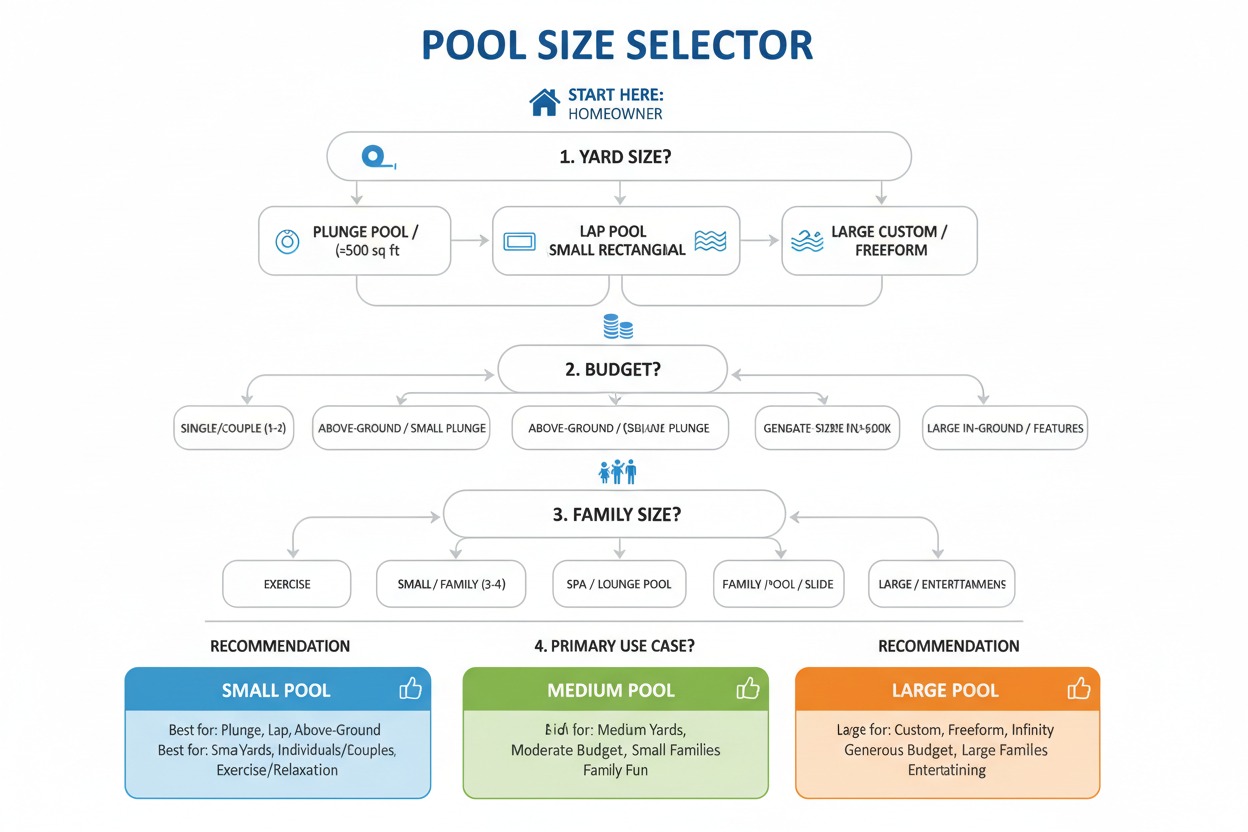
Knowing the averages is useful. But choosing your pool size requires a more systematic approach. Here are the key factors to work through.
Factor 1: Your Actual Yard Dimensions
Step outside and measure your backyard before doing anything else. You need:
- Total backyard width and depth
- Distance from the house to the back property line
- Distance from side property lines
- Location of any existing structures, trees, or utilities
Then subtract required setbacks (typically 5–15 feet from all property lines and 10–15 feet from the house). What remains is your buildable pool zone — and your pool plus deck needs to fit within it.
Factor 2: How You Plan to Use the Pool
This is the most overlooked factor in pool sizing. Ask yourself honestly:
Swimming laps? You need at least 30–40 feet of unobstructed length. A 14×28 pool works; a 12×20 does not.
Kids playing? Width matters. A 16-foot-wide pool gives kids room to play games side-by-side. A 10-foot-wide pool feels cramped with three kids in it.
Entertaining adults? Consider adding a tanning ledge, shallow conversation area, or steps with flat seating — these take pool space but add enormous lifestyle value.
Fitness and lap swimming? Consider a purpose-built lap pool rather than a wider recreational pool.
Primarily aesthetic / relaxation? A plunge pool or spa might serve you better than a large unused pool.
Factor 3: Long-Term Budget
Many homeowners focus entirely on the build cost and overlook ongoing costs. A larger pool that strains your operating budget will frustrate you for years. Be honest about what you can sustain annually in chemicals, electricity, and maintenance.
A well-maintained 14×28 pool that you genuinely enjoy will give you more satisfaction than a neglected 20×40 pool that’s always green and half-empty.
Factor 4: Future Plans
Are you planning to landscape extensively? Build a covered patio or outdoor kitchen? Have more children? Sell the home in five years?
A pool that’s right-sized today might feel cramped if your family grows — or it might be a selling asset that commands a premium in five years. According to Redfin’s real estate research, a pool adds anywhere from 5% to 8% to home value in warm climates — but oversized pools that consume the entire yard can actually be a turn-off for buyers who want grass space.
Factor 5: Local Climate
In warm climates (Florida, Texas, Arizona, California), pools are used 8–12 months per year and justify higher upfront investment in size and features.
In northern climates where pools are open only 4–5 months per year, many homeowners find that a smaller, well-featured pool gives better value than a large pool that sits covered half the year.
Standard Pool Dimensions: A Room-by-Room Analogy
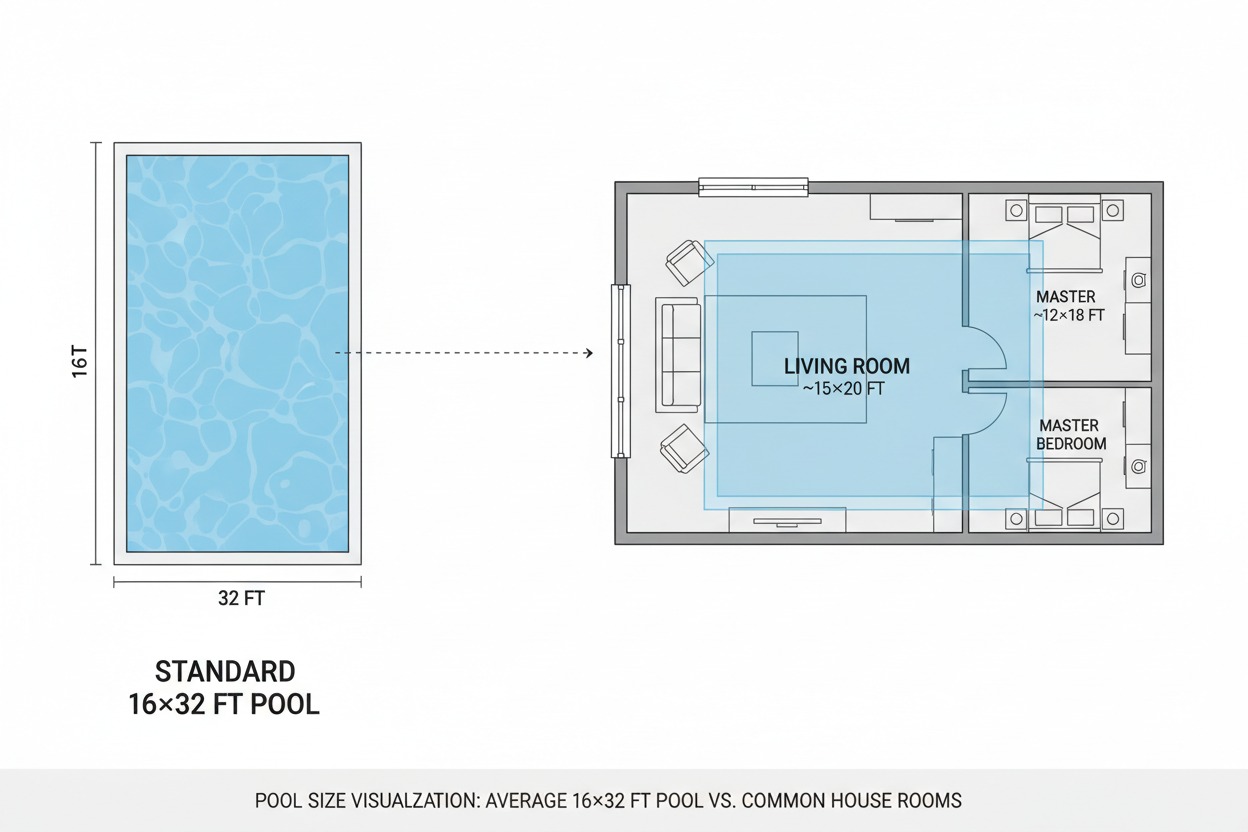
Abstract square footage numbers are hard to visualize. Here’s a way to make the numbers click.
A 16×32-foot pool has 512 square feet of water surface. For context:
- That’s slightly larger than an average master bedroom (typically 300–400 sq ft)
- Roughly equal to a standard two-car garage (400–500 sq ft)
- About two-thirds of a typical living room + dining room combined
A 12×24 foot pool at 288 sq ft is:
- Similar in size to a large master bedroom or studio apartment bedroom
- Smaller than most two-car garages
A 20×40 foot pool at 800 sq ft is:
- Larger than many one-bedroom apartments
- Equivalent to a modest single-car garage plus a full bedroom
Thinking about it this way helps: when you’re standing at the edge of your 40×60 backyard trying to picture where a pool would go, imagine fitting two master bedrooms (for a 16×32 pool) into that space. That’s a realistic mental model.
Above-Ground Pool Sizes: What’s Average?
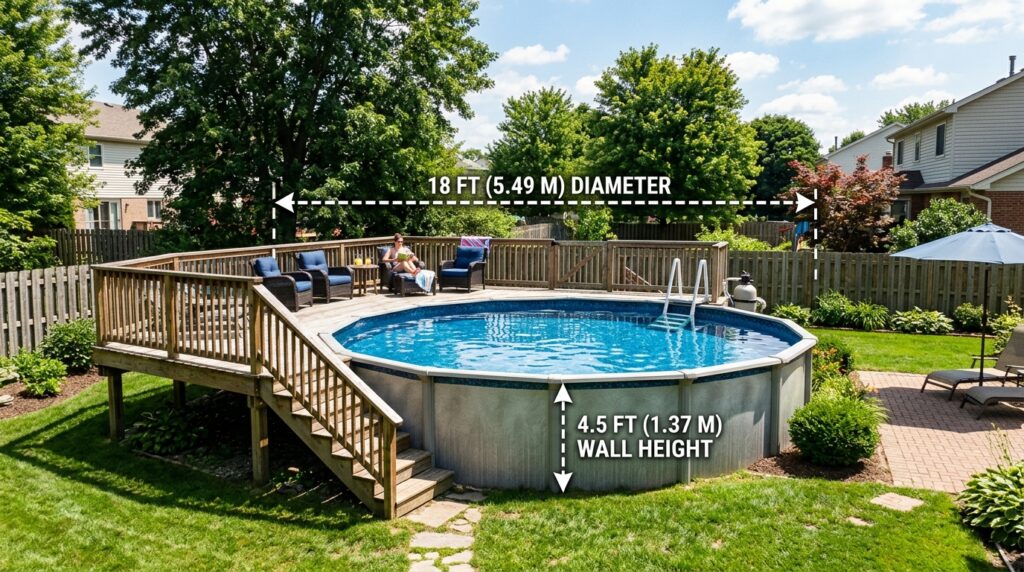
Above-ground pools are a completely different category — dramatically less expensive, faster to install, and removable. But they still come in a wide range of sizes worth understanding.
Round Above-Ground Pools
Round pools are the most common above-ground option. Standard sizes include:
- 12 feet diameter — entry-level, fits 2–3 people comfortably
- 15 feet diameter — the most popular mid-size
- 18 feet diameter — comfortable for a family
- 21 feet diameter — large family option
- 24 feet diameter — the largest common round size
A 15-foot diameter round pool has roughly 177 square feet of surface area — smaller than most inground options but perfectly adequate for casual cooling off.
Oval Above-Ground Pools
Oval pools mimic the proportions of inground rectangular pools while retaining the structural simplicity of above-ground design. Common sizes:
- 12×24 feet — equivalent footprint to entry-level inground
- 15×30 feet — popular mid-size oval
- 18×33 feet — larger family option
Wall heights for above-ground pools are typically 48 inches (4 feet) or 52 inches — shallow enough that diving is impossible and safety is more naturally enforced.
Cost Advantage
A quality above-ground pool with installation typically costs $3,000 to $8,000 for the pool itself — a fraction of inground costs. Add a wood or composite deck surround ($3,000–$10,000) and you’re still significantly under inground pricing for a comparable lifestyle experience.
Pool Depth: What’s Standard?
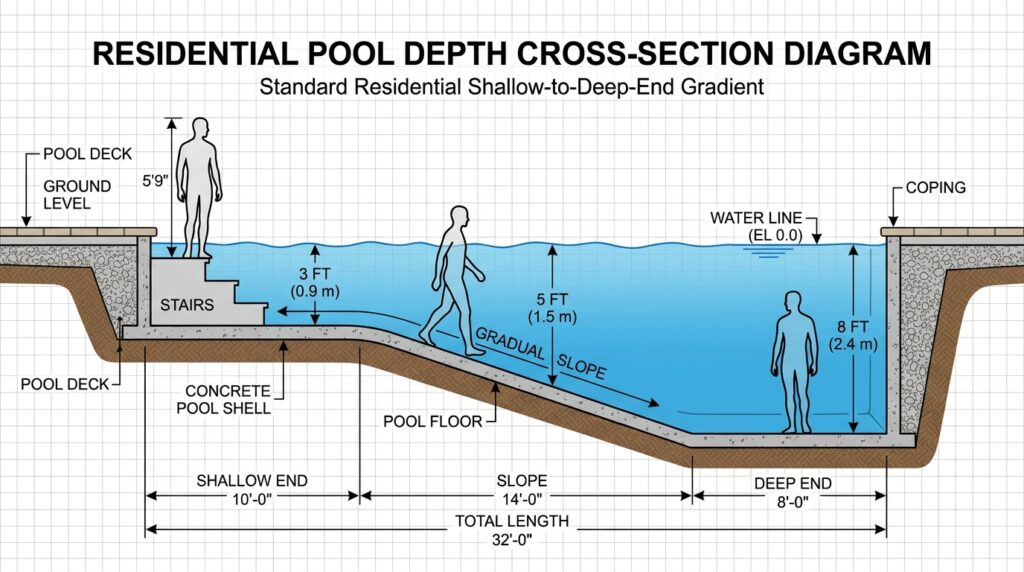
Pool dimensions aren’t just length and width — depth is equally important, both for safety and for how the pool feels to use.
Standard Residential Pool Depths
Shallow end: 3 to 3.5 feet is the most common shallow end depth for residential pools. This is safe for small children to stand in (with adult supervision), comfortable for wading, and appropriate for pool steps and tanning ledges.
Mid-pool transition: Most pools gradually slope from shallow to deep across the length, with a midpoint around 4 to 5 feet — comfortable for adults to stand, ideal for water volleyball and casual swimming.
Deep end: The typical residential deep end runs 5 to 8 feet. The American Red Cross recommends a minimum depth of 9 feet for any pool with a diving board — but diving boards have become increasingly rare in residential pools due to liability and insurance concerns. Many modern pools max out at 5 to 6 feet deep to reduce excavation costs and keep the pool accessible for non-swimmers.
Uniform depth pools: Plunge pools, lap pools, and some modern pool designs use a consistent depth throughout — typically 4 to 5 feet — rather than a shallow-to-deep gradient. This simplifies construction and is perfectly functional for adult recreational swimming.
Does Deeper Mean More Expensive?
Yes, significantly. Excavation costs are one of the largest variables in pool pricing, and every additional foot of depth adds to those costs. Going from a 5-foot deep end to an 8-foot deep end can add $3,000 to $8,000 to your total project cost, depending on soil conditions and equipment access.
Unless you have a specific reason for a deep end (competitive diving, specific water sports), most families find a 5 to 6-foot deep end perfectly adequate.
Zoning, Permits, and Setback Rules
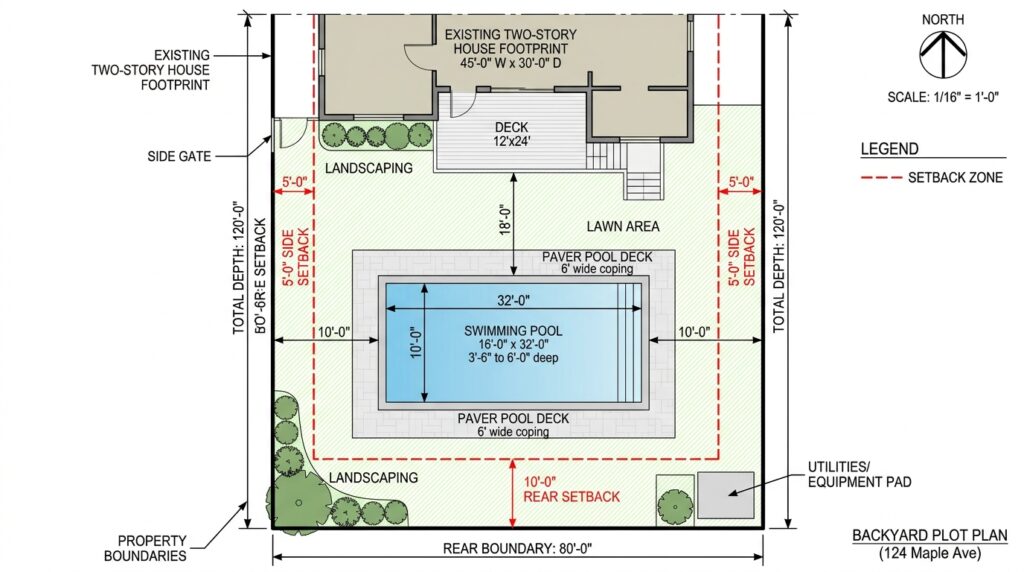
One of the most common and costly mistakes homeowners make is planning a pool size without first understanding local regulations. Size limitations often aren’t about your backyard — they’re about what your municipality will approve.
Common Regulatory Requirements
Building permits: Virtually every jurisdiction requires a building permit for an inground pool. Permit fees vary widely — typically $500 to $4,000 — and the permit process ensures your pool meets structural, electrical, and safety codes.
Setback requirements: Local zoning codes specify minimum distances between the pool edge and property lines, structures, and easements. Typical requirements:
- 5 to 10 feet from the rear and side property lines
- 10 to 15 feet from the house foundation
- Utility easements must remain unobstructed — usually 5–10 feet wide along property edges
Fencing requirements: Most jurisdictions legally require a pool fence — typically 4 feet high minimum with a self-closing, self-latching gate. The Consumer Product Safety Commission (CPSC) provides federal guidelines that many states have adopted or built upon.
Drain requirements: Modern pools must meet Virginia Graeme Baker Pool and Spa Safety Act requirements for anti-entrapment drains — a federal law that applies to all new residential pool installations.
How to Check Your Local Rules
Before finalizing any pool size decision:
- Visit your local municipality’s building or planning department website
- Search your address in the county GIS/zoning map (most counties have this publicly online)
- Call your HOA if applicable — HOA rules can be more restrictive than local zoning
- Talk to a licensed pool contractor who works regularly in your area — they’ll know the local quirks
Skipping this step and discovering mid-project that your planned pool violates setback rules is an expensive and stressful situation to avoid.
Expert Tips for Sizing Your Backyard Pool

Here are the insights that separate homeowners who love their pool from those who wish they’d done things differently.
Tip 1: Visit a Pool Builder’s Showroom or Model Home. Nothing replaces standing next to a real pool. If you’re debating between 14×28 and 16×32, go measure the difference in person. Two feet of width feels different from a spreadsheet perspective.
Tip 2: Rent a Can of Spray Paint. Before signing a contract, have your pool contractor spray-paint the proposed pool outline on your actual grass. Walk around it. Sit in chairs where your deck will be. This eliminates sizing regrets more effectively than any digital rendering.
Tip 3: Think About the Deck, Not Just the Water. Homeowners consistently underestimate the deck space they’ll want. A pool with generous deck space (6–8 feet on all sides) is exponentially more enjoyable than a pool crammed into its minimum setback zone. If you’re going to size down the pool to fit the budget, prioritize keeping the deck proportional.
Tip 4: Get Three Bids — and Compare Scope, Not Just Price. Pool bids are notoriously difficult to compare apples-to-apples. Make sure each contractor quotes the same size, depth profile, material type, equipment specifications, and included features. Price differences often reflect scope differences, not contractor quality.
Tip 5: Plan for the Equipment Pad. Pool equipment takes up more space than most people expect — and it needs clearance for service access. Work with your designer to position equipment where it’s accessible but not dominating the yard or butting up against the fence.
Tip 6: Consider Future Resale. A pool that occupies 60–70% of a small backyard can be a liability when selling, especially to buyers with young children or dogs. If your yard is on the smaller side, a tastefully sized pool with remaining greenspace will photograph better and appeal to a broader buyer pool.
Tip 7: Account for Chemical Storage and Equipment Access. Chemical storage needs a dedicated, ventilated space — not a corner of your garage where they’ll react with car fumes. Plan for this in your overall backyard layout.
Pros and Cons of Different Pool Sizes
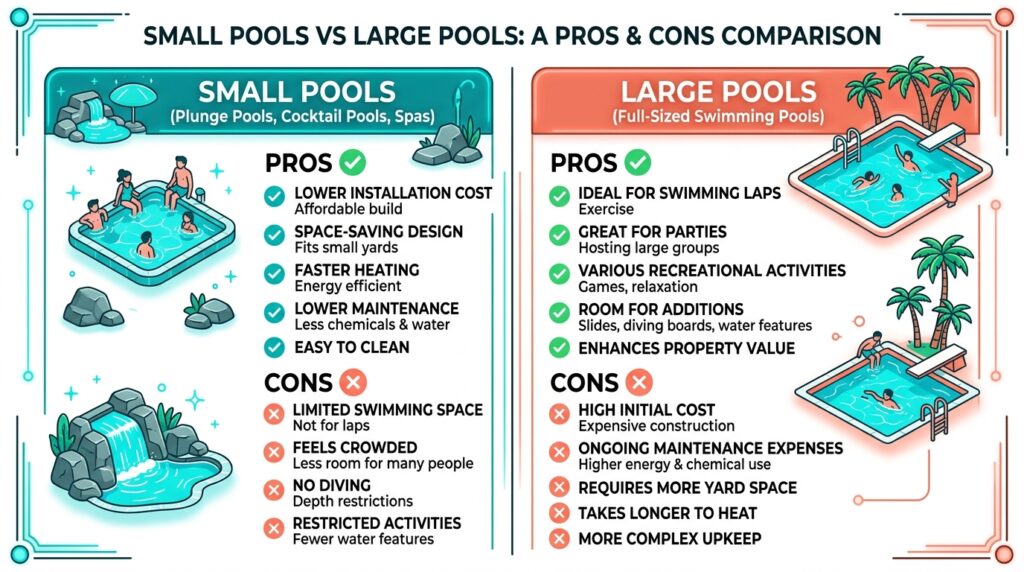
Small Pool (Under 300 sq ft / 10×20 to 12×24)
| ✅ Pros | ❌ Cons |
|---|---|
| Lower build cost | Limited swimming space |
| Lower operating costs | Can feel crowded with multiple adults |
| Faster to heat | Less visual impact |
| Less chemical volume needed | Not suitable for lap swimming |
| Fits in smaller yards | May not meet some buyers’ expectations |
| Faster to clean | Lower resale premium |
Mid-Size Pool (300–512 sq ft / 14×28 to 16×32)
| ✅ Pros | ❌ Cons |
|---|---|
| Sweet spot for most families | Mid-range cost — not cheap |
| Adequate for laps and play | Requires meaningful yard space |
| Better visual presence | Higher chemical and utility costs than small |
| Strong resale value in warm climates | Still may feel small for large gatherings |
| Versatile design options | Requires proper setback planning |
Large Pool (500+ sq ft / 18×36 to 20×40)
| ✅ Pros | ❌ Cons |
|---|---|
| Excellent for entertaining | High build cost |
| Room for all ages simultaneously | High annual operating costs |
| Statement piece in the landscape | Requires large yard |
| Maximum flexibility | May overwhelm smaller properties |
| Great for active families | Cleaning and maintenance is labor-intensive |
Real-World Examples: Pool Sizes in Context
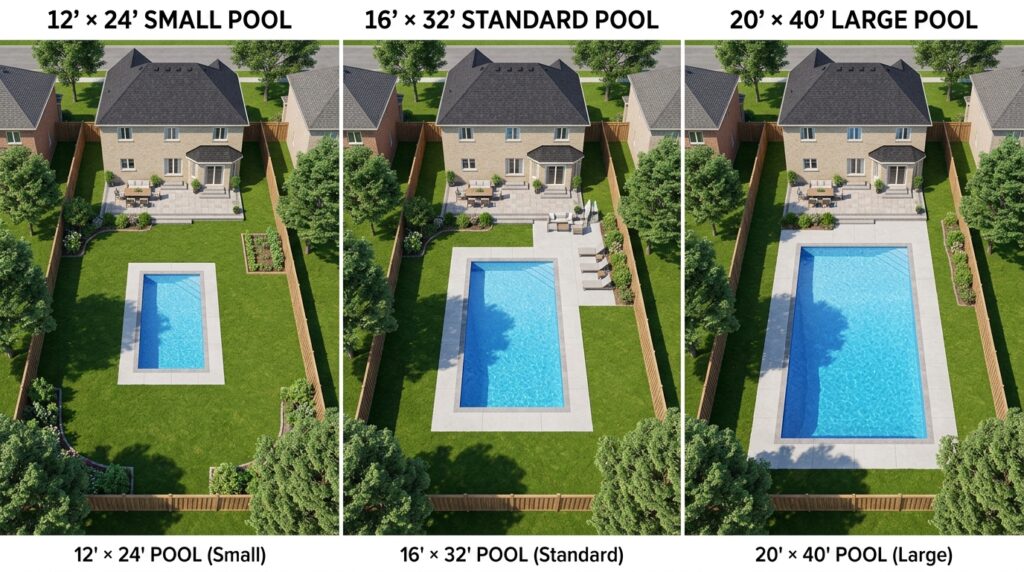
To make all of this concrete, here are three realistic scenarios.
Scenario 1 — The Urban Backyard Lot: 30×50 feet backyard / Family: Couple, no kids / Goal: Relaxation and aesthetics
A 10×20 plunge pool fits comfortably after setbacks, leaving 6 feet of deck on all sides. Cost: approximately $28,000–$40,000. The pool serves as a focal point of a designed outdoor living space — with the remaining backyard used for a small dining terrace and container garden.
Scenario 2 — The Suburban Family Yard Lot: 45×70 feet backyard / Family: Two adults, three kids / Goal: Family swimming and summer entertaining
A 16×32 pool with a 5-foot patio surround fits within the space after setbacks. Cost: approximately $55,000–$75,000. The family adds a screened enclosure (another $12,000) to manage bug pressure, resulting in a total screened pool area of approximately 26×44 feet.
Scenario 3 — The Large Suburban Property Lot: 80×100 feet backyard / Family: Active family of 6, frequent entertaining / Goal: Resort-style outdoor living
An 18×36 pool with an adjacent 8×10 spa, outdoor kitchen, and 8-foot deck surround on all sides. Total pool deck footprint approximately 3,200 square feet. Cost: approximately $120,000–$160,000, including landscaping and hardscaping.
Frequently Asked Questions
Q1: What is the average size of a backyard pool?
The most common average size of a backyard swimming pool for residential use is 16 feet wide by 32 feet long (512 square feet), according to industry data from the Pool & Hot Tub Alliance. Smaller entry-level pools typically run 12×24 feet, while larger installations reach 20×40 feet or more. The right size depends on your yard dimensions, family size, how you plan to use the pool, and your budget.
Q2: What is the minimum backyard size needed for a pool?
Most pool contractors recommend a minimum backyard of 30×40 feet to accommodate even a small inground pool after accounting for required setbacks (5–15 feet from property lines), a usable deck surround, and equipment space. Practically speaking, a yard under 1,000 square feet makes standard inground pool installation very difficult — though plunge pools and above-ground pools remain viable options.
Q3: What is the average size of a backyard screened-in deck with pool?
A typical residential screened pool enclosure (with the pool inside it) runs approximately 24×40 to 28×44 feet — containing both a mid-size pool (14×28 or 16×32) and 5–8 feet of patio on the sides and ends. Larger resort-style enclosures can reach 30×50 to 40×60 feet when outdoor kitchens and extended living areas are included.
Q4: How deep should a backyard pool be?
The standard residential pool features a 3 to 3.5 foot shallow end and a 5 to 8 foot deep end, with a gradual slope between. For pools without diving boards (which is most residential pools today), a 5 to 6 foot deep end is typically sufficient. Uniform-depth pools — popular in plunge and lap pool designs — often settle at a consistent 4 to 5 feet throughout.
Q5: Does pool size affect home resale value?
Yes, but the relationship is nuanced. According to Redfin’s research on pool value, a pool adds approximately 5% to 8% to home value in warm-weather markets where pools are used year-round. However, an oversized pool that dominates a small yard can actually limit buyer appeal — particularly for buyers with young children or pets who prioritize lawn space. A well-proportioned pool that leaves usable greenspace tends to perform best at resale.
Conclusion
There’s no single right answer to the question of what is the average size of a backyard pool — because the best pool is the one that fits your yard, your family, your budget, and your life.
But if you need a benchmark to start from, here’s the short version:
- Most popular residential pool: 16×32 feet (512 sq ft), 5–6 foot deep end
- Most common pool shape: Rectangular
- Typical screened enclosure: 24×40 to 28×44 feet total footprint
- Sweet spot for most suburban families: 14×28 to 16×32 feet
Use the 25–33% yard coverage guideline as a starting point, get your setback rules from your local building department, and spray-paint the outline in your yard before you commit to anything.
The pool you’ll love most isn’t necessarily the biggest one — it’s the one that fits your life without financial stress, maintenance overload, or a backyard that feels like a parking lot for water.
Ready to start planning? Get at least three contractor quotes with fully scoped bids, explore your local permit requirements early, and don’t underestimate the value of good deck space.
Have questions about pool sizing specific to your yard? Share your dimensions in the comments — the community has probably dealt with a similar situation.
Also Read: How to Get Rid of Ants in Kitchen Fast