


How to Use Down to Earth All Purpose Mix 4-6-2
If you are wondering how to use down to earth all purpose mix 4-6-2, the short answer is to measure the fertilizer for your growing area, spread it evenly, mix it lightly into the soil, and water thoroughly. For a new garden bed, the manufacturer recommends 2.5 to 5 pounds per 100 square feet. Established plants can receive 2 to 4 ounces as a monthly side dressing during active growth.
The correct amount changes for pots, transplants, tomatoes, trees, and shrubs. This guide explains each application rate, shows how to measure a small garden bed, and helps you avoid adding more phosphorus than your soil or plants need.
Quick Application Guide
The following rates come from the manufacturer’s current All Purpose 4-6-2 application instructions. Check the label on your package before applying because product directions can be revised.
| Growing situation | Manufacturer’s application rate | How to apply |
|---|---|---|
| New vegetable garden or flower bed | 2.5–5 lb per 100 sq. ft. | Mix into the top 3 inches |
| New garden transplant | 1–2 tbsp per planting hole | Mix with soil and water |
| Established garden plant | 2–4 oz per plant | Side-dress monthly during active growth |
| New container planting | 1–2 tbsp per gallon of soil | Mix throughout the potting soil |
| Established container or houseplant | 1–2 tbsp per gallon of soil | Lightly mix into the surface monthly |
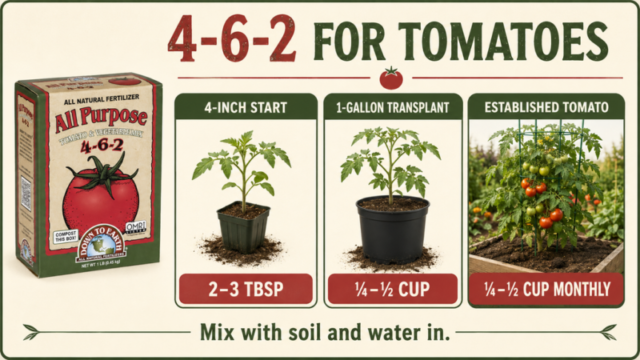
| New 4-inch tomato start | 2–3 tbsp per plant | Mix with the backfill soil |
| One-gallon tomato transplant | ¼–½ cup per plant | Mix into the planting soil |
| Established tomato plant | ¼–½ cup per plant | Side-dress monthly during active growth |
| Established tree or shrub | 1 lb per inch of trunk diameter | Spread toward the drip line, mix and water |
| New tree | 1–2 cups per planting hole | Mix thoroughly with the backfill soil |
These are label rates, not a requirement that every plant must receive the highest amount. I recommend beginning at the lower end when the soil is already fertile, compost has recently been added, or the potting mix contains fertilizer.

What Is Down to Earth All Purpose Mix 4-6-2?
Down to Earth All Purpose Mix 4-6-2 is a dry organic fertilizer intended for vegetables, flowers, herbs, containers, transplants, trees, and shrubs. The manufacturer describes it as a blend designed to supply nutrients gradually rather than functioning as an instantly available liquid feed.
The current guaranteed analysis lists:
- 4% total nitrogen
- 6% available phosphate
- 2% soluble potash
- 8% calcium
- 1% magnesium
- 2% sulfur
The formula is derived from fish bone meal, blood meal, feather meal, alfalfa meal, rock phosphate, langbeinite, and seaweed meal. It also contains humic acids derived from leonardite and is listed by the Organic Materials Review Institute for use in organic production.
What Does 4-6-2 Mean?
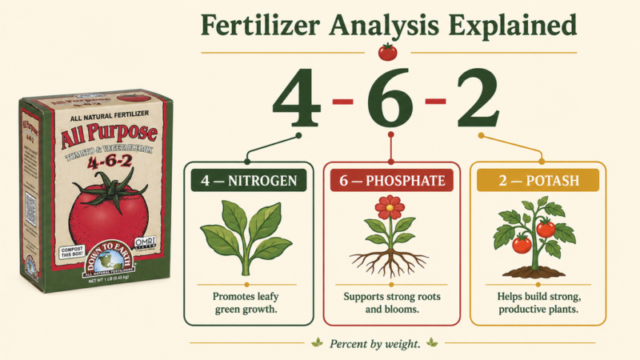
The numbers represent the fertilizer’s percentage by weight of nitrogen, available phosphate, and soluble potash. Therefore, 4-6-2 contains 4% nitrogen, 6% phosphate expressed as P₂O₅, and 2% potash expressed as K₂O.
| Label number | Nutrient | General function |
|---|---|---|
| 4 | Nitrogen | Supports green, leafy growth |
| 6 | Available phosphate | Supports energy transfer, roots, flowering, and reproduction |
| 2 | Soluble potash | Supports plant function and stress tolerance |
The numbers do not mean that you should use four parts nitrogen, six parts phosphorus, and two parts potassium. They describe the guaranteed nutrient analysis already present in the packaged fertilizer.
The Oregon State University Extension fertilizer guide explains that dry organic fertilizers generally act more slowly than liquid products. Their nutrients often depend on soil microorganisms to convert them into plant-available forms.
How to Use Down to Earth All Purpose Mix 4-6-2 Step by Step
This is a dry fertilizer, so do not treat it like a concentrated liquid plant food. It works best when measured accurately, distributed through the relevant root zone, incorporated into the soil as directed, and watered in.
1. Check Whether Your Soil Needs It
A general-purpose fertilizer is useful only when its nutrient profile fits the soil and plant. A garden soil test can show soil pH, phosphorus, potassium, organic matter, and other useful information.
This step is especially important because the product contains more phosphate than nitrogen or potash. If a soil test shows high phosphorus, repeatedly applying a 4-6-2 fertilizer may add a nutrient that the garden does not currently need.
2. Measure the Growing Area or Soil Volume
For a garden bed, multiply the length by the width to find the square footage. For a container, use the number of gallons of potting soil rather than the pot’s width alone.
Trees and shrubs use another measurement. Their rate is based on trunk diameter, with the fertilizer distributed across the root zone toward the drip line.
3. Choose the Appropriate End of the Rate Range
The lower rate is a sensible starting point for smaller plants, rich soil, recently amended beds, or potting mix that already contains nutrients. The upper rate may be appropriate for a new bed with a demonstrated nutrient need or a larger actively growing plant, provided the label and soil conditions support it.
If you are unsure, begin conservatively. You can review our fertilizer dosing guide and calculator before measuring the application.
4. Spread the Fertilizer Evenly
Do not leave the fertilizer in one concentrated mound. Spread it uniformly over the area you intend to treat, keeping concentrated granules away from the plant’s stem, crown, and exposed roots.
An even application gives roots access to nutrients throughout the growing area. It also reduces the risk of creating isolated zones with an unnecessarily high nutrient concentration.
5. Incorporate It Into the Soil
For a new garden, the manufacturer instructs you to mix the fertilizer into the top 3 inches of soil. For an established plant or container, gently scratch it into the surface without digging deeply enough to damage roots.
This incorporation step improves soil contact and reduces the chance of loose granules washing away. Dry organic ingredients need moisture and biological activity before many of their nutrients become available.
6. Water the Area Thoroughly
Water after application so the fertilizer settles into the soil and the biological breakdown process can begin. The goal is to moisten the treated root zone without creating runoff.
Avoid applying immediately before heavy rain. The Environmental Protection Agency’s guidance on managing garden fertilizer notes that improperly managed nitrogen and phosphorus can move into surface water or groundwater.
7. Record the Date
Write down the date, plant, and quantity applied. This simple habit prevents accidental repeat applications, especially when several people care for the same garden.
The manufacturer permits monthly feeding for several established plant categories during the growing season. That does not mean monthly feeding is always necessary, so monitor the plant and consider what the soil already contains.

Using 4-6-2 in Vegetable Gardens and Flower Beds
For a new bed, apply 2.5 to 5 pounds per 100 square feet and incorporate it into the top 3 inches. Prepare the soil before planting so the fertilizer is distributed throughout the future root zone rather than sitting in concentrated pockets.
Example for a 4-by-8-Foot Raised Bed
A 4-by-8-foot bed contains 32 square feet. Multiply the label rate by 0.32:
- Lower rate: 2.5 lb × 0.32 = 0.8 lb
- Upper rate: 5 lb × 0.32 = 1.6 lb
The manufacturer states that approximately 2½ cups equal 1 pound. That makes the calculated amount for a 32-square-foot bed approximately 2 to 4 cups, although weighing dry fertilizer is more accurate than relying on cup volume.
I would start near 2 cups if the bed contains compost or previously fertilized soil. Move toward the higher end only when the soil, plants, and label support the additional nutrients.
New Transplants
Add 1 to 2 tablespoons to each planting hole, mix it with the surrounding soil, and water well. Do not place a concentrated spoonful directly beneath bare roots because the product should be dispersed through the backfill.
For small starts, use the lower end of the range. Larger transplants in less fertile soil may justify the upper label rate, but plant size is only one factor.
Established Plants
Side-dress established vegetables or flowers with 2 to 4 ounces per plant once a month during active growth when feeding is needed. Apply it in a ring around the root zone, not directly against the stem.
Gently mix the granules into the surface and water afterward. Avoid deep cultivation around mature vegetables because many feeder roots sit close to the soil surface.

How to Use It for Containers and Houseplants
For a new container planting, mix 1 to 2 tablespoons into each gallon of soil. A pot filled with 5 gallons of soil would therefore use 5 to 10 tablespoons under the manufacturer’s directions.
Blend the fertilizer throughout the potting mix before placing the plant in the container. This creates a more even root-zone distribution than pouring all the fertilizer into one layer.
For an established container or houseplant, the manufacturer recommends lightly mixing 1 to 2 tablespoons per gallon into the soil surface once a month during active growth. Water the container after applying and allow excess water to drain normally.
Be Careful With Prefertilized Potting Mix
Many commercial potting mixes already contain fertilizer. Adding the full rate of another product immediately after repotting may provide more nutrients than the plant needs.
Check the potting-mix label before adding Down to Earth All Purpose Mix. I would delay or reduce supplemental feeding if the mix already promises several months of nutrition.
Use the Actual Soil Volume
A pot’s advertised size does not always equal the amount of soil currently surrounding the roots. A large root ball, drainage layer, or partly filled container can reduce the actual soil volume.
Estimate the usable potting-mix volume rather than assuming every container holds its full nominal capacity. If the volume is uncertain, choose the lower rate instead of rounding upward.

How to Use Down to Earth 4-6-2 for Tomatoes
The manufacturer provides separate instructions for tomatoes because plant size changes the suggested dose. A 4-inch start receives considerably less than an established, fruiting plant.
Four-Inch Tomato Starts
Mix 2 to 3 tablespoons with the backfill soil for each plant. Return the amended soil around the root ball and water well after planting.
Do not place the entire amount in a dense layer beneath the roots. Mixing it with backfill produces more even soil contact.
One-Gallon Tomato Transplants
Use ¼ to ½ cup for a tomato transplanted from a one-gallon container. Blend it with the backfill soil before filling around the root ball.
The lower end is a reasonable starting point in compost-rich or previously fertilized beds. You can compare the plant’s growth stage with our complete tomato fertilizer guide before deciding whether additional feeding is needed.
Established Tomato Plants
Side-dress established tomatoes with ¼ to ½ cup per plant, depending on plant size and desired growth, once a month during the growing season. Spread the granules around the outer root zone, scratch them into the surface, and water.
Do not assume that pale leaves always mean the plant needs more 4-6-2. Yellowing can also result from watering problems, root damage, disease, compacted soil, or unsuitable pH.
Using It Around Trees and Shrubs
For an established tree or shrub, the manufacturer directs users to apply 1 pound per inch of trunk diameter. Spread it from around the base outward toward the drip line, gently mix it into the soil surface, and water well.
Do not pour the full amount against the trunk. Most nutrient-absorbing roots extend through the soil beyond the immediate trunk area, so even distribution across the indicated zone matters.
For a new tree, mix 1 to 2 cups with the backfill soil. Use the amended soil to fill around the root ball and water thoroughly, rather than placing concentrated fertilizer directly against the new roots.
How Often Should You Apply It?
The label recommends monthly applications during the growing season for established garden plants, tomatoes, containers, and houseplants. “Growing season” means the period when the plant is actively producing leaves, roots, flowers, or fruit.
Slow growth during winter or dormancy usually reduces nutrient demand. Indoor houseplants may also grow very slowly in low winter light, even when the room remains warm.
Organic fertilizer does not become completely inactive after one month. Soil temperature, moisture, microbial activity, plant demand, previous applications, and potting-mix composition all affect how quickly nutrients become available.
Oregon State University Extension explains that nutrients from organic fertilizers often require microbial conversion and may become available more slowly in cold soil. Do not respond to slow early-season growth by immediately doubling the rate.
Common Mistakes to Avoid
Applying the Same Amount Everywhere
Garden beds, pots, transplants, tomatoes, and trees have separate directions. Using a garden-bed rate inside a small pot can result in a serious measuring error.
Choose the rate for the actual growing situation. Do not convert between square feet and container gallons by guessing.
Leaving Granules on the Surface
The label directs users to incorporate the product into the soil. Loose granules left on compacted soil are more likely to move with rain, irrigation, pets, wind, or routine garden activity.
Mix new-bed applications into the top 3 inches. For established plants, incorporate shallowly to avoid root damage.
Piling Fertilizer Against the Stem
A concentrated ring touching the stem or crown is not an even side dressing. Move the application outward through the active root zone and lightly mix it with soil.
For trees, distribute the measured amount outward toward the drip line. Do not create a mound at the trunk.
Assuming Organic Means Unlimited
Organic fertilizer can still be overapplied. The EPA notes that organic nutrient sources can create excessive nutrient loads when they are used improperly.
Follow the product rate and consider nutrients already supplied by compost, manure, potting mix, or another fertilizer. Organic certification describes permitted production use, not an unlimited application allowance.
Repeatedly Adding Phosphorus Without Testing
This product contains 6% available phosphate. Repeated applications may be inappropriate where soil phosphorus is already high.
The University of Minnesota Extension recommends avoiding phosphorus-containing fertilizer when testing shows levels above its stated thresholds until the soil again requires phosphorus. Local laboratories may use different testing methods, so follow the interpretation supplied with your own soil report.
Applying Before Heavy Rain
Heavy rain can move fertilizer away from the intended root zone. Choose a calm period when you can water the treated soil gently and control moisture.
Keep granules off paved surfaces and sweep accidental spills back into the intended treatment area. Do not wash spilled fertilizer into a storm drain.
Troubleshooting After Application
| What you notice | Possible explanation | Recommended response |
|---|---|---|
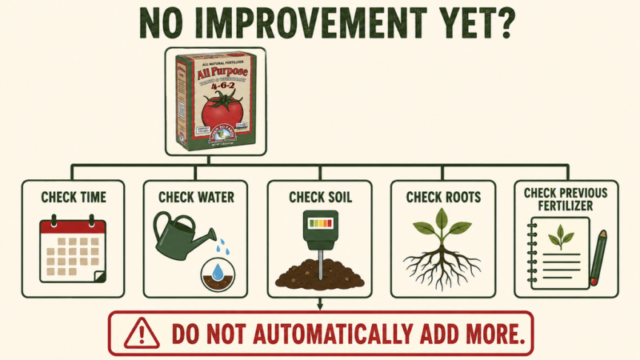
| No immediate change | Dry organic fertilizer acts gradually | Maintain normal watering and allow time |
| Plant still looks pale | Nutrient release may be slow, or the cause may not be fertility | Check watering, roots, pests, pH, and soil nutrients |
| Very leafy growth with few flowers | Too much available nitrogen may be present | Pause feeding and reassess the fertilizer program |
| Fertilizer remains visible | It was not sufficiently incorporated or watered | Lightly mix it in without disturbing roots |
| Mold or fungal growth on granules | Moist organic material may be decomposing at the surface | Mix granules into soil and improve surface airflow |
| Brown tips after several products | Combined fertilizer or salt exposure may be excessive | Stop additional feeding and review every product used |
| Granules wash away | Application preceded excessive irrigation or rain | Recover what you safely can and avoid reapplying blindly |
Do not automatically add another dose because the plant has not changed within a few days. This product is not intended to produce the same rapid response as a fully soluble liquid fertilizer.
Frequently Asked Questions
How much Down to Earth All Purpose 4-6-2 should I use per gallon?
Use 1 to 2 tablespoons per gallon of soil for new container plantings. For established container plants, lightly mix 1 to 2 tablespoons per gallon into the surface once a month during active growth when feeding is needed.
Can I mix Down to Earth 4-6-2 with water?
It is formulated as a dry fertilizer that should be mixed into soil and watered in. The manufacturer does not provide a standard dilution rate for turning it into liquid fertilizer, so do not invent a fertilizer-tea concentration.
Is Down to Earth All Purpose Mix 4-6-2 slow release?
It is a dry organic blend designed to provide nutrients steadily. Many nutrients must be processed by soil organisms, so results are generally slower than those from a fully soluble liquid fertilizer.
Can I use 4-6-2 for houseplants?
Yes. The product is labeled for houseplants and containers, but you should check whether the potting mix already contains fertilizer before adding it.
How often can I apply Down to Earth 4-6-2?
The manufacturer permits monthly application for several established plant categories during the growing season. Apply only when the plant is actively growing and the soil or growing medium can benefit from the nutrients.
Can Down to Earth 4-6-2 burn plants?
Dry organic fertilizers are generally less immediately soluble than many synthetic liquid fertilizers, but overapplication can still cause excessive nutrient levels. Measure carefully, mix it with soil, water it in, and account for other fertilizers already present.
Is 4-6-2 good for tomatoes?
It is labeled for tomato starts, one-gallon transplants, and established tomatoes. The correct rate depends on plant size, ranging from 2 to 3 tablespoons for a four-inch start to ¼ to ½ cup for larger transplants and established plants.
Conclusion
Learning how to use down to earth all purpose mix 4-6-2 begins with choosing the correct rate for the plant and growing space. Apply 2.5 to 5 pounds per 100 square feet in new beds, 1 to 2 tablespoons per gallon in containers, or the manufacturer’s plant-specific rate for transplants, tomatoes, trees, and shrubs.
Measure instead of guessing, distribute the granules evenly, incorporate them into the soil, and water afterward. Before making repeated applications, test your soil and review all the fertilizer, compost, and amendments already present.
For more help planning your next feeding, use Home Upright’s fertilizer dose calculator and application guide. A careful, lower-rate application is easier to adjust than an excessive dose your soil didn’t need.