


Best Fertilizer for Lemon Trees: What to Use, How Much, and When
Walk into any garden center, and you’ll find a whole shelf of citrus food, each bag promising bigger, juicier lemons. It’s easy to grab the prettiest one and hope for the best. But a lemon tree is pretty honest about what it’s getting. Feed it well, and you’ll see deep green leaves, plenty of blossoms, and fruit that actually stays on the branch. Feed it the wrong thing, or the right thing at the wrong time, and you’ll get yellow leaves, dropped fruit, or lemons with thick, lumpy skin.
The good part? Picking the best fertilizer for a lemon tree comes down to a few simple ideas. Once you know what to look for on the label, the shelf gets a lot less confusing.
We’ll walk through what lemon trees really need, which fertilizers work for trees in the ground and in pots, what’s different about Meyer lemons, and how much to use as your tree grows. Everything here lines up with research-based advice from university extension programs, including the University of California, the University of Florida, Clemson, and the University of Maryland.
What to know
- Nitrogen matters most, so pick a product where it’s the highest number.
- Check the label for zinc, iron, and manganese. Potted trees need magnesium too.
- Slow-release granules are the safest, least fussy option for most people.
- Pots lose nutrients every time you water, so feed them lightly and more often.
- Feeding late in the season can leave you with poor-quality fruit and rough rinds.
- More isn’t better. Too much fertilizer means weak, floppy growth and burned roots.
What Lemon Trees Actually Need From Fertilizer
Turn over any bag of fertilizer, and you’ll see three numbers, like 8-4-4. That’s the N-P-K ratio: the percentage of nitrogen (N), phosphorus (P), and potassium (K) inside. So an 8-4-4 bag is 8% nitrogen, 4% phosphorus, and 4% potassium. So an 8-4-4 bag is 8% nitrogen, 4% phosphorus, and 4% potassium. Different plants want different ratios. Vegetables like cucumbers are fed quite differently from citrus, as you’ll see in our guide to the best fertilizer for cucumbers and their ideal NPK ratios.
With lemon trees, pay the most attention to that first number. The University of California Master Gardeners call nitrogen the chief nutrient citrus needs every year, and they suggest choosing a fertilizer where nitrogen is the highest of the three. Your tree still needs phosphorus and potassium, but most garden soil already has enough. That’s why citrus blends keep those numbers lower.
Nitrogen keeps the leaves (and the lemons) coming
Nitrogen drives new leaves and shoots, and those leaves are the engine behind every flower and fruit. When a lemon tree runs low, the leaves turn pale and evenly yellowish-green, and the harvest shrinks. Mature trees in the ground need a steady supply of nitrogen every single year.
Micronutrients are small, but they show up fast
According to UC Integrated Pest Management (UC IPM), citrus sometimes runs short on micronutrients like zinc and iron, even though most other nutrients are usually fine in the soil. You’ll often spot these shortages as odd patterns on the leaves. We’ll show you how to read them later on. Manganese can also run low, especially in alkaline soil.
Potted trees need magnesium and calcium too
Pots play by different rules. Clemson Cooperative Extension points out that most water-soluble fertilizers don’t contain calcium or magnesium. So if your lemon lives in a container, you may need to add a little Epsom salt (magnesium sulfate) or garden gypsum (calcium sulfate).
Don’t forget soil pH
Here’s the part a lot of people miss. Even a perfect fertilizer can’t do much if your soil pH is off, because pH controls what the roots can actually absorb. The University of Florida IFAS guide to home citrus puts the sweet spot at about 5.5 to 6.5, which is slightly acidic. In alkaline soil, which is common across much of the Southwest, iron, zinc, and manganese get locked up even when they’re there. A soil test through your county extension office is the only way to know for sure, and it’s usually inexpensive.
The Main Types of Lemon Tree Fertilizer
There isn’t one magic bag that’s best for every tree. The right fertilizer for your lemon tree depends on a few things. Is it in the ground or in a pot? How hands-on do you want to be? And do you prefer to garden organically?
Lemon tree fertilizer types compared
| Fertilizer type | Best for | How often | Why people like it | Watch out for |
|---|---|---|---|---|
| Slow-release or controlled-release granules | In-ground and potted trees | Usually 2–3 times per growing season, per label | Steady feeding, low burn risk, very little work | Releases faster in hot, wet weather |
| Regular granular citrus fertilizer | In-ground trees | 2–3 feedings a year | Easy to find, often includes micronutrients | Easy to overdo; you have to water it in |
| Water-soluble liquid fertilizer | Potted and indoor lemon trees | Every 2–4 weeks in the growing season, per label | Exact doses and quick results | Washes out fast; often missing calcium and magnesium |
| Organic citrus fertilizer | In-ground trees and organic gardeners | 2–3 times a year, per label | Gentle, feeds the soil, hard to burn roots | Slow to work, especially in cold soil |
| Fertilizer spikes | Small, low-maintenance potted trees | Per label, usually spring and summer | No measuring, no mess | Feeds only the soil right around each spike |
Slow-release granules: the easy, forgiving choice
If you want something that works without much fuss, start here. UF/IFAS’s home citrus program highly recommends slow-release or controlled-release products for home citrus. The coated granules let nitrogen out a little at a time. That means less risk of root burn and less fertilizer washing away before your tree can use it.
Liquid fertilizer: handy, but it doesn’t last.
Liquid feeds are great for potted trees, and they’re a quick fix when a tree looks hungry. The catch is that they rinse out of the pot with every watering, so you’ll need to apply them more often. A lot of gardeners use slow-release granules as the base and add a liquid feed now and then during the big spring and summer growth spurt.
Balanced fertilizers: fine in some places
You’ll sometimes see balanced blends like 8-8-8 recommended for citrus. In fact, UF/IFAS uses an 8-8-8 with micronutrients in its schedule for Florida’s sandy soils. So a balanced product isn’t wrong. In many other parts of the country, though, the extra phosphorus just isn’t needed. Unless a soil test tells you otherwise, a nitrogen-heavy citrus formula is the better fit.
Popular Lemon Tree Fertilizers: What’s Actually in the Bag
Brand names are helpful when you’re shopping, but the label tells the real story. Here’s how some widely sold US citrus fertilizers compare, based on what the manufacturers and retailers publish. We haven’t lab-tested these, and companies do tweak their formulas from time to time, so give the bag a quick check before you buy.
Common citrus fertilizers and what their labels say
| Product | N-P-K | Type | What the label highlights | Good fit for |
|---|---|---|---|---|
| Down to Earth Citrus Mix | 6-3-3 | Organic granules (OMRI Listed) | Nitrogen-forward 2-1-1 ratio, plus secondary nutrients and selected micronutrients | Organic gardeners, in the ground or in pots |
| Espoma Organic Citrus-tone | 5-2-6 | Organic slow-release granules | Lists 5% calcium and 0.5% magnesium, plus beneficial microbes | Organic gardeners who want calcium and magnesium built in |
| Miracle-Gro Shake ‘n Feed Citrus, Avocado & Mango | 8-2-10 | Synthetic continuous-release granules | Added magnesium, sulfur, and iron; feeds up to 3 months per label | Low-effort feeding for trees in the ground or in containers |
| Jobe’s Fruit & Citrus Spikes | Varies by version (organic 3-5-5 or 4-6-6; standard 9-12-12) | Slow-release spikes | Convenient, nothing to measure | Convenience, though nitrogen isn’t the highest number |
| Liquid citrus fertilizers (various brands) | Often around 6-3-3 | Water-soluble liquid | Works quickly; usually applied every few weeks in the growing season | Potted and indoor Meyer lemon trees |
Label details come from manufacturer and retailer listings for Down to Earth Citrus Mix, Espoma Citrus-tone, and Miracle-Gro Shake ‘n Feed Citrus, Avocado & Mango.
A few things the labels won’t tell you
- The ratio matters more than the brand. Down to Earth Citrus Mix (6-3-3) is a textbook 2-1-1 ratio. Citrus-tone and Shake ‘n Feed actually have more potassium than nitrogen. They still work fine. Just base your amounts on the nitrogen number.
- Lower nitrogen means you’ll use more. To give a mature tree 1 pound of nitrogen, you’d need about 12.5 pounds of an 8% nitrogen product. With a 5% product, it’s closer to 20 pounds. Organic blends are gentle, but they’re bulky.
- Spikes are convenient, not precise. Many fruit-and-citrus spikes aren’t nitrogen-heavy, and they only feed the soil right next to each spike. They’re okay for small trees but not the most even way to feed.
- The bag’s schedule might not match the experts’. Some organic labels, including Citrus-tone, suggest a fall feeding. That’s reasonable for slow organic fertilizer, which UC IPM says can go down in fall. Just skip fast-acting synthetic nitrogen once fall arrives.
Lemon Tree Fertilizer Myths That Cost You Fruit
You’ll run into plenty of confident advice online that doesn’t hold up. Here are the myths we see most often, and what the research actually says.
- “6-6-6 is the best fertilizer for lemon trees.” A balanced 6-6-6 or 8-8-8 can work, especially in Florida’s sandy soil, which is why UF/IFAS uses balanced blends there. But in a lot of other regions, extension experts recommend a nitrogen-heavy ratio because the extra phosphorus doesn’t do much.
- “Older trees need a balanced fertilizer instead of nitrogen.” Not so. UC IPM recommends about 1 pound of actual nitrogen per year for mature citrus. Nitrogen remains the main need throughout the tree’s life.
- “Feed every two weeks, all year long.” Lemon trees slow way down in winter, indoors and out. Feeding nonstop builds up salt in pots and pushes tender growth outdoors right before cold weather.
- “Coffee grounds and banana peels are all you need.” Toss them in the compost, sure. But they don’t come close to supplying the nitrogen and micronutrients a lemon tree needs.
- “Yellow leaves mean the tree needs more fertilizer.” Sometimes. But overwatering, cold soil, and high pH can also cause yellow leaves. Feeding a waterlogged tree only makes things worse.
Best Fertilizer for a Lemon Tree in a Pot
A lemon tree in a pot is completely dependent on you. Every time you water, a little fertilizer drains out the bottom, and the small root ball can’t store much to begin with.
Here’s what to look for in the best fertilizer for a potted lemon tree:
- More nitrogen than anything else. University of Maryland Extension recommends a 2-1-1 or 3-1-1 ratio for container citrus. Clemson suggests slow-release blends like 12-6-6 or 12-4-6.
- Slow-release granules as your base. They hold up much better against frequent watering.
- Micronutrients, especially magnesium. Scan the label for magnesium, iron, zinc, and manganese.
- An acid-loving liquid feed, if you need it. Clemson notes that acidic water-soluble feeds can help fill gaps and fix deficiencies. They’re especially useful if your tap water is alkaline.
How often to feed a potted lemon tree
Advice varies a bit by product and climate, so the label always gets the final say. Here’s a good general guide:
- The UC Master Gardeners of San Luis Obispo County suggest feeding potted citrus about once a month from around February through October, following the package directions.
- University of Maryland Extension, writing for colder areas where citrus spends winter indoors, recommends at least three feedings: one in spring, one in early summer, and one in late summer. After that, stop by early fall and skip winter completely.
Best Fertilizer for a Meyer Lemon Tree
Meyer lemons are a cross between a lemon and a mandarin-type citrus, and they’re one of the most popular lemons to grow in a pot. When it comes to food, though, they’re not picky eaters. University extension programs lump them in with other citrus, and there’s no special “Meyer formula” backed by research.
So the best fertilizer for a Meyer lemon tree is the same nitrogen-rich citrus fertilizer with micronutrients we’ve been talking about. What changes is where your tree lives:
- Meyer lemon in the ground: Use the amounts by tree age in the next section. Scale them down if your tree is on dwarfing rootstock.
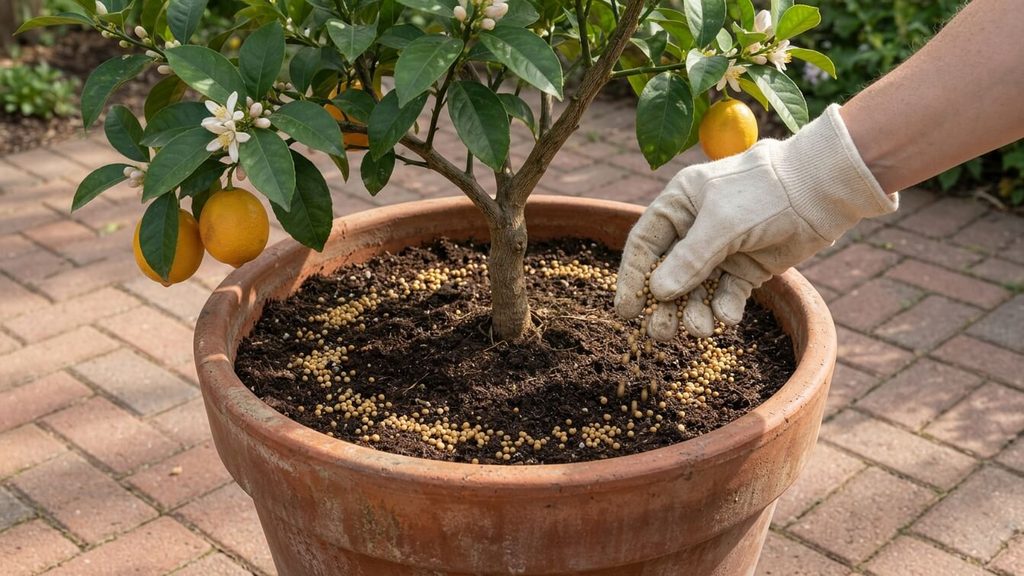
- Meyer lemon in a pot: Go with a slow-release citrus fertilizer in a 2-1-1 or 3-1-1 ratio, plus magnesium. For the best fertilizer for a potted Meyer lemon tree, start slow-release granules in spring and add light liquid feeds through midsummer.
- Meyer lemon indoors: Feed only while it’s actively growing, from spring to late summer. University of Maryland Extension also notes that indoor citrus needs bright light and a little hand-pollination to set fruit. No fertilizer can make up for a dark corner. [INTERNAL LINK OPPORTUNITY: growing a Meyer lemon tree indoors]
Best Natural and Organic Fertilizer for a Lemon Tree
If you’d rather garden organically, your lemon tree can still eat well. Organic fertilizers work especially nicely in the ground, where soil microbes break them down over time. The UC Master Gardeners of Contra Costa County even call an organic citrus fertilizer an easy choice for home gardeners.
Some good natural options:
- Organic citrus blends. These premixed bags usually combine things like feather meal, blood meal, bone meal, and kelp. They’re the simplest way to get a nitrogen-forward organic feed.
- Blood meal and other high-nitrogen meals. UC IPM says organic fertilizers like manure or blood meal can go down under the canopy in fall. They break down slowly, so the nutrients are ready when spring growth kicks in.
- Composted manure. It’s wonderful for soil, but it’s light on nitrogen. UC IPM notes that 1 pound of nitrogen equals roughly 100 pounds of composted cow manure. Think of compost as a soil builder, not a complete meal.
- Fish emulsion. University of Maryland Extension lists it as a liquid option for potted citrus, mixed into your watering can.
How natural fertilizers fit into a lemon tree routine
Organic citrus blend
Your main meal. Feed in late winter and again in spring, using the label rates for your tree’s size or age.
Compost or aged manure
Spread a thin layer under the canopy to build better soil. Keep it pulled back from the trunk.
Fish emulsion
A gentle liquid pick-me-up for potted trees in spring and summer.
Chelated micronutrients
Reach for these when leaves show signs of low iron or zinc. Many are approved for organic gardens, so check the label.
One thing to expect: organic fertilizers rely on soil microbes, and those microbes slow down in cold, soggy soil. If your tree looks pale in early spring, an organic feed might take a few weeks to kick in. That’s completely normal. Resist the urge to add more.
How Much Fertilizer Does a Lemon Tree Need?
This is where most people guess, and it’s where most problems start. Citrus feeding rates are based on pounds of actual nitrogen, not pounds of whatever’s in the bag. Once you know how much nitrogen your tree needs, you can figure out how much of any product to use.
UC IPM gives these yearly nitrogen targets for citrus in the ground, split into two or three feedings:
Yearly nitrogen for in-ground lemon trees by age
| Tree age | Actual nitrogen per year | Example: 8% nitrogen fertilizer per year |
|---|---|---|
| Year 1 | About 1 tablespoon of nitrogen fertilizer, 3 times a year | Follow label rates for newly planted trees |
| Year 2 | 0.25 lb | About 3.1 lb |
| Year 3 | 0.5 lb | About 6.25 lb |
| Year 4 | 0.75 lb | About 9.4 lb |
| Year 5 and older | 1 lb | About 12.5 lb |
The quick math for your fertilizer
Don’t worry, it’s easy:
Pounds of fertilizer per year = pounds of nitrogen needed ÷ (nitrogen percentage ÷ 100)
Say you have a mature lemon tree that needs 1 pound of nitrogen, and you’re using an 8-4-4 fertilizer. That’s 1 ÷ 0.08, or 12.5 pounds of fertilizer for the year. Split it into three feedings, and you’re putting down a little over 4 pounds each time.
Two more tips that help:
- Measure smart. UF/IFAS says a pint of mixed fertilizer weighs about a pound. They also warn against using an old 1-pound coffee can as a scoop, because it can actually hold close to 3 pounds.
- Lemons like a little extra. The University of Arizona’s citrus fertilization chart recommends adding about 10% to the total for lemon trees.
Keep in mind that advice changes with soil and climate. In Florida’s sandy soil, for example, UF/IFAS uses smaller, more frequent feedings for young trees. If your county extension office has its own citrus chart, use that. And if your tree is in a pot, skip these numbers and follow the container directions on the label.
When to Fertilize a Lemon Tree
Timing matters as much as what you buy. Lemon trees use the most nitrogen in spring, while they’re flowering and setting fruit.
For trees in the ground, UC IPM recommends:
- First feeding in January or February, right before the tree blooms.
- Second feeding in May.
- An optional third feeding in June.
Florida is a little different. Thanks to the long growing season and sandy soil, UF/IFAS spreads feedings from February through October, and the UF/IFAS Extension Levy County guidance follows the same split-feeding approach.
Wherever you live, go easy in the fall. The UC Master Gardeners of Contra Costa County warn that late-season fertilizer can hurt fruit quality, delay coloring, and give you rough rinds. Late nitrogen also pushes out soft new growth right when frost is on the way.
A simple year-round lemon tree feeding calendar
| Season | In-ground lemon tree | Potted or indoor lemon tree |
|---|---|---|
| Late winter (Jan–Feb) | First feeding, just before bloom | Start feeding again when new growth shows up; add slow-release granules |
| Spring (Mar–May) | Second feeding in May | Light liquid feeds per label; keep an eye out for pale new leaves |
| Early summer (June) | Optional third feeding | Second round of slow-release, or keep up light liquid feeds |
| Late summer (Jul–Aug) | Usually done, except in long-season areas like Florida | Last feeding of the year |
| Fall (Sep–Nov) | No fast-release nitrogen; slow organic feeds only | Stop feeding so new growth can toughen up |
| Winter (Dec) | Take a break | No feeding; give it bright light and water carefully |
This calendar follows UC IPM’s timing for trees in the ground and University of Maryland’s timing for containers. If you’re in Florida or another long-season area, your local extension schedule is the better guide.
How to Apply Fertilizer to a Lemon Tree
How you put fertilizer down makes a real difference. Do it right, and you avoid burned roots and get the nutrients where the feeder roots actually are.
For lemon trees in the ground
- Water the day before if the soil is dry. Fertilizer on dry roots is more likely to burn them.
- Measure your dose with a dedicated scoop or a kitchen scale, using the math above.
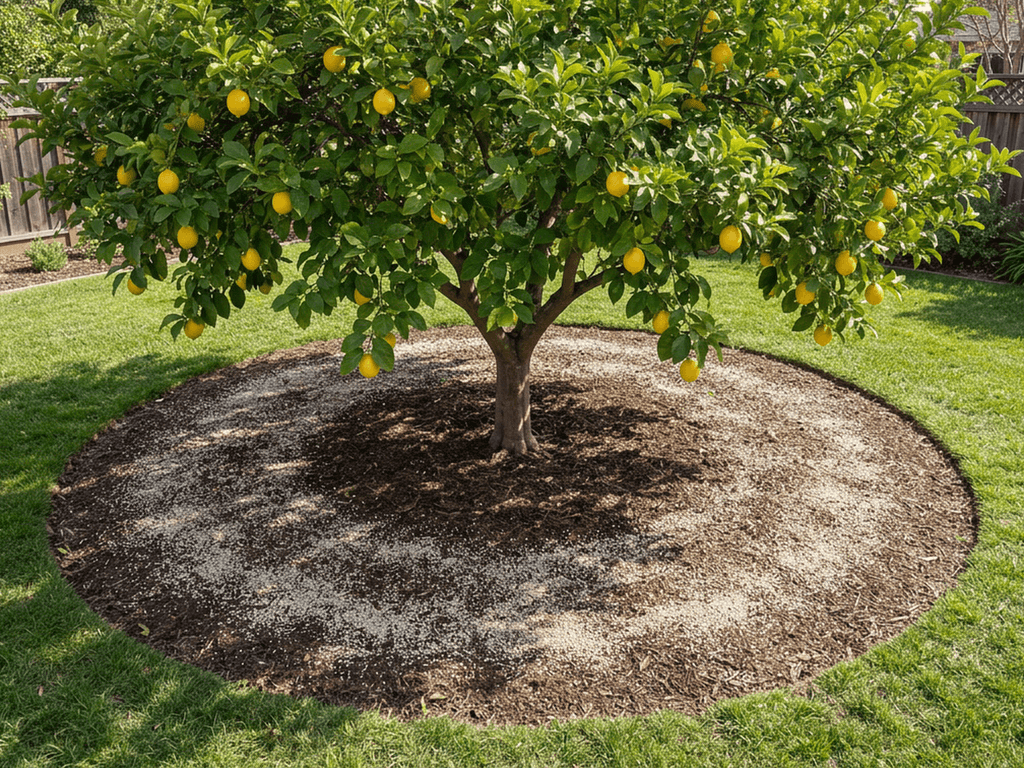
- Scatter the granules evenly from about a foot away from the trunk out to the edge of the branches, called the dripline. UF/IFAS suggests spreading a bit past the dripline as the tree gets older. Never pile fertilizer up against the trunk.
- Water it in well so it soaks down to the roots.
- Keep mulch and fertilizer away from the trunk to help prevent trunk rot.
For lemon trees in pots
- Water the pot first so the soil is evenly damp.
- Sprinkle slow-release granules over the soil, keeping them a few inches from the trunk, and scratch them lightly into the top layer.
- Mix liquid feeds exactly as the label says. Making it stronger won’t get you faster results. It just burns roots.
- Water until it runs out the bottom, then empty the saucer so the roots aren’t sitting in water.
What Your Lemon Tree’s Leaves Are Telling You
Yellow leaves send more people shopping for fertilizer than anything else. But a yellow leaf doesn’t always mean a hungry tree. The UC Master Gardeners of Alameda County point out that yellowing has many possible causes, and that cold, soggy soil slows the microbes that make nutrients available in the first place.
Common lemon tree leaf symptoms and likely causes
| What you see | Likely cause | What to do |
|---|---|---|
| Whole leaves evenly pale or yellow-green, older leaves first | Not enough nitrogen | Feed with a nitrogen-rich citrus fertilizer during the growing season |
| Young leaves yellow with green veins | Low iron, often because of high soil pH | Use chelated iron, and consider a sulfur-based soil acidifier per the label |
| Yellow patches between veins, small or narrow leaves | Low zinc | Spray chelated zinc on new spring growth, or apply zinc sulfate to the soil |
| Yellowing in winter that clears up in spring | Cold soil slowing nitrogen uptake | Wait for warmer weather and don’t overfeed to make up for it |
| Brown, crispy leaf tips or edges, white crust on the potting soil | Salt buildup from too much fertilizer | Flush the pot with plain water and cut back on feeding |
| Very dark, lush, fast growth but hardly any fruit | Too much nitrogen | Skip or reduce the next feeding and double-check your math |
Before you treat any deficiency, check your watering. Overwatering and poor drainage can cause yellow leaves that look a lot like a nutrient problem, and adding fertilizer to soggy roots adds more stress.
UF/IFAS adds that a yearly foliar spray of manganese and zinc is optional. It won’t hurt your tree, and it may help, especially in alkaline soil. For low iron, they recommend iron chelates applied to the soil.
Common Lemon Tree Fertilizing Mistakes
Most feeding problems come from a handful of habits that are easy to fix:
- Reaching for a “bloom booster.” These are high in phosphorus, but lemon trees need nitrogen most. Extra phosphorus rarely means more flowers, and it can interfere with micronutrients.
- Overdoing it. UC IPM warns that too much fertilizer causes a flush of new growth that’s more prone to problems like bacterial blast. Excess salts can burn roots too, especially in pots.
- Feeding too late in the year. Fall nitrogen can hurt fruit quality and push out frost-tender growth.
- Feeding a stressed tree. A tree that was just transplanted, is bone-dry, or is sitting in soggy soil can’t use extra nutrients. Fix the real problem first. Stress tends to stack up over time, and our article on how trees really die from drought, root damage, and accumulated stress explains why that matters.
- Feeding indoor trees in winter. Low light means slow growth so that fertilizer can build up as salt.
- Using “weed and feed” lawn products nearby. The weed killer can damage trees whose roots spread under the lawn. Stick with products labeled safe for fruit trees.
- Ignoring soil pH. If your pH is way outside 5.5 to 6.5, your tree can look hungry even when you’re feeding it correctly.
How to Pick a Lemon Tree Fertilizer at the Store
Standing in the garden aisle? Here’s a quick checklist:
- Make sure it’s labeled for citrus or fruit trees, or that nitrogen is clearly the biggest number.
- Look for a 2-1-1 or 3-1-1 ratio, like 6-3-3, 8-4-4, or 12-6-6.
- Check the fine print for micronutrients: iron, zinc, manganese, and magnesium.
- Choose slow-release or controlled-release if you want the most forgiving option, especially for pots.
- Look for “OMRI Listed” if you want a certified organic product.
- Make sure the label tells you how much to use for your setup, whether that’s by tree size in the ground or by pot size.
Final Thoughts
The best fertilizer for a lemon tree isn’t one particular brand. It’s a citrus fertilizer where nitrogen is the biggest number, ideally in a 2-1-1 or 3-1-1 ratio, with zinc, iron, manganese, and magnesium on the label. For most trees, in the ground or in a pot, slow-release granules are the safest bet. Organic blends work great too, as long as you give them a little time.
Match the amount to your tree’s age, feed most of the time from late winter through early summer, and stop by early fall. Potted and Meyer lemons need the same nutrients, just in smaller, more frequent doses. Most of all, watch the leaves. They’ll usually tell you whether your tree wants more nitrogen, a micronutrient boost, or simply better watering.
Frequently asked questions
What is the best fertilizer for a lemon tree in a pot?
A slow-release citrus fertilizer with more nitrogen than anything else, like a 2-1-1 or 3-1-1 ratio (12-6-6, for example), plus micronutrients and magnesium. Feed during the growing season as the label directs, and add a diluted liquid citrus feed if growth seems slow. Stop by early fall.
Is Miracle-Gro good for lemon trees?
Miracle-Gro’s citrus product, Shake ‘n Feed Citrus, Avocado & Mango Plant Food, is labeled 8-2-10 with added magnesium, sulfur, and iron, and it’s labeled for citrus in the ground or in containers. Their all-purpose products are safe when used as directed, but the citrus formula is a better match.
Is Espoma Citrus-tone a good fertilizer for lemon trees?
It’s a popular organic pick. The 5-2-6 formula includes calcium and magnesium and releases slowly. Since it’s only 5% nitrogen, you’ll use more of it than a higher-nitrogen product to meet your tree’s needs, so follow the label rates for your tree’s size.
How often should I fertilize a Meyer lemon tree?
In the ground, two or three times a year, mostly from late winter to early summer. In a pot, at least three times during the growing season with a slow-release product, or about monthly with a citrus fertilizer if the label allows. Don’t feed indoor Meyer lemons in winter.
Should I fertilize a lemon tree in winter?
Usually not. Cold soil slows down nutrient uptake, and indoor trees barely grow in low winter light. Late feeding can also hurt fruit quality. Pick back up in late winter or early spring, just before your tree blooms.
Why are my lemon tree’s leaves turning yellow after I fertilized?
It could be too much fertilizer, salt buildup in a pot, overwatering, cold soil, or a micronutrient issue like low iron from high pH. Check your watering and drainage first, flush potted trees with plain water, and compare the leaves with the troubleshooting table above.