


Cucumbers are fast-growing, heavy-producing plants, so good nutrition matters. But choosing the best fertilizer for cucumbers isn’t simply about finding the fertilizer with the highest numbers on the bag.
Cucumbers need nitrogen for healthy leaves and vines, but too much nitrogen can encourage excessive vine growth and reduce fruit production. University Extension recommendations also show that fertilizer needs depend on soil fertility, growing conditions, and the stage of plant development.
For gardeners without a recent soil test, 5-10-10 is a well-supported preplant option. Clemson Extension and the University of Georgia both recommend it at 3 pounds per 100 square feet when a soil test isn’t available. But that doesn’t make 5-10-10 the best choice for every cucumber plant. The right fertilizer depends on your soil, growing method, plant growth stage, and what nutrients are already available.
Quick Answer: What Is the Best Fertilizer for Cucumbers?
If you’re preparing a new cucumber bed and don’t have a recent soil test, 5-10-10 is one of the best-supported starting formulations. Clemson Extension and the University of Georgia both recommend 5-10-10 as a preplant fertilizer in this situation.
For organic gardeners, options such as Espoma Garden-Tone 3-4-4, Down To Earth Vegetable Garden 4-4-4, and Jobe’s Organics Vegetable & Tomato 2-5-3 are worth considering.
For gardeners who prefer a versatile organic fertilizer, Down To Earth All Purpose 4-6-2 is another option for vegetables, containers, and transplants. And if you prefer a fast-acting liquid fertilizer, a water-soluble vegetable fertilizer can provide readily available nutrients. The key is to match the fertilizer to the plant and soil, not assume one product works best everywhere.
Which Cucumber Fertilizer Should You Choose?
Here’s the simplest way to narrow down your options:
| Your situation | Good starting choice | Why |
|---|---|---|
| New garden bed, no recent soil test | 5-10-10 | Supported by Clemson and UGA as a pre-plant option |
| Organic vegetable garden | Espoma Garden-Tone 3-4-4 | Vegetable-specific organic granular fertilizer |
| Raised bed | Down To Earth Vegetable Garden 4-4-4 | Balanced organic vegetable fertilizer |
| Want a versatile organic fertilizer | Down To Earth All Purpose 4-6-2 | Suitable for vegetables and containers |
| Want a lower-nitrogen organic option | Jobe’s Organics 2-5-3 | Moderate nitrogen formulation for vegetables |
| Prefer liquid feeding | Water-soluble vegetable fertilizer | Fast nutrient availability |
| Lots of leaves but few cucumbers | Don’t automatically add fertilizer | Excess nitrogen may be contributing to the problem |
This table is a starting point. A soil test remains the best way to determine what nutrients your garden actually needs.
What NPK Ratio Is Best for Cucumbers?
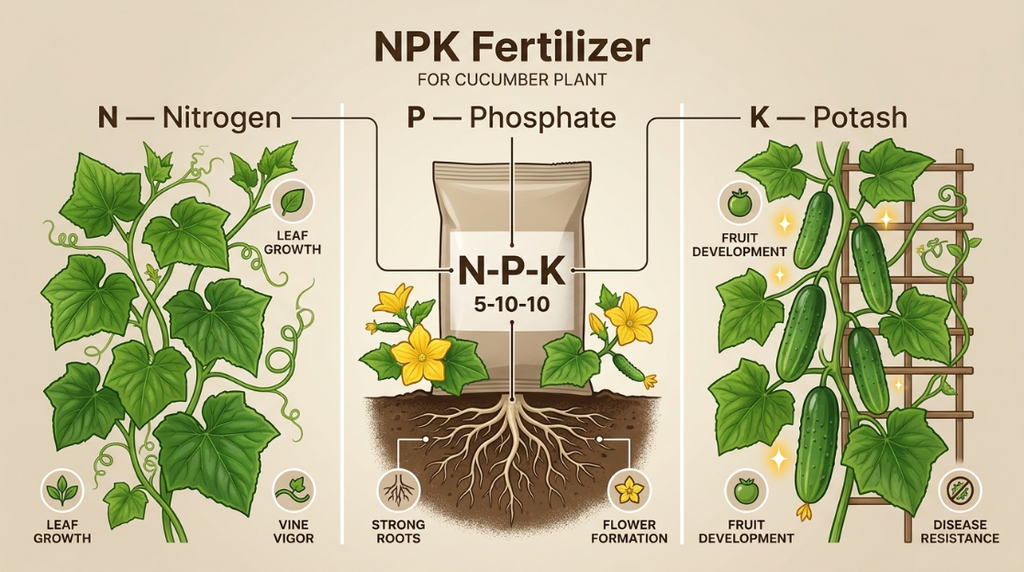
NPK refers to the three numbers printed on a fertilizer package:
- N = nitrogen
- P = phosphate
- K = potash
For example, a 5-10-10 fertilizer contains 5% nitrogen, 10% phosphate and 10% potash by fertilizer-label convention.
Nitrogen
Nitrogen supports leafy and vegetative growth. Cucumber plants need enough nitrogen to develop healthy vines and leaves. However, excessive nitrogen can produce lots of foliage while reducing fruit production. Clemson Extension specifically warns against overfertilizing cucumbers with nitrogen for this reason.
Phosphorus
Phosphorus supports root development and plant energy processes. However, adding extra phosphorus isn’t automatically beneficial. If your soil already contains sufficient phosphorus, repeatedly applying a high-phosphorus fertilizer may be unnecessary.
Potassium
Potassium supports many plant functions, including water regulation and overall plant development. The goal isn’t to maximize any one nutrient. The goal is to provide adequate nutrition based on the plant’s and soil’s needs.
6 Best Fertilizer Options for Cucumbers
1. 5-10-10: Best Preplant Starting Option
Best for: Preparing garden soil before planting
5-10-10 is one of the most useful formulations to consider when preparing a cucumber bed without a recent soil test. Clemson Extension recommends applying 3 pounds per 100 square feet before planting in this situation. UGA provides the same recommendation.
Why choose it?
- Well-supported preplant formulation
- Moderate nitrogen
- More phosphate and potash than nitrogen
- Suitable for general garden preparation
Watch out for
Don’t continue applying it automatically throughout the season. If your soil already has adequate phosphorus and potassium, you may not need additional applications.
2. Espoma Garden-Tone 3-4-4: Best Organic Granular Option
Best for: Organic vegetable gardens
Espoma Garden-Tone official product information
Espoma Garden-Tone is a 3-4-4 organic fertilizer intended for herbs and vegetables, including cucumbers. The manufacturer recommends using it before planting, 7 to 10 days after planting seedlings or transplants, and monthly for established vegetables during the specified growing period. Espoma also provides separate rates for garden beds, individual plants and containers.
Why choose it?
- Organic granular fertilizer
- Specifically listed for cucumbers
- Slow-release feeding
- Useful for general vegetable gardens
Watch out for
Organic doesn’t mean you can apply unlimited amounts. Follow the current package directions.
3. Down To Earth Vegetable Garden 4-4-4: Best for Raised Beds
Best for: Raised beds and general vegetable gardens
Down To Earth Vegetable Garden 4-4-4
This 4-4-4 organic fertilizer is designed for vegetables and works well when you want a general-purpose fertilizer for a mixed vegetable bed.
Why choose it?
- Balanced NPK
- Organic formulation
- Suitable for vegetables
- Useful for raised beds and general garden use
Watch out for
You don’t automatically need a balanced fertilizer if your soil is already nutrient-rich. Soil testing is still the better starting point.
4. Down To Earth All Purpose 4-6-2: Best Versatile Organic Option
Best for: Gardeners who grow several types of plants
Down To Earth All Purpose 4-6-2 official product information
Down To Earth All Purpose 4-6-2 is designed for vegetables, herbs, flowers, containers and transplants. It’s particularly useful if you already use the same fertilizer throughout your garden. Home Upright also has a detailed guide on how to use Down to Earth All Purpose Mix 4-6-2.
Why choose it?
- Versatile
- Organic
- Suitable for vegetables
- Can be used in containers and around transplants
Watch out for
Don’t repeatedly add phosphorus-containing fertilizer without considering your existing soil nutrient levels.
5. Jobe’s Organics Vegetable & Tomato 2-5-3: Best Lower-N Organic Option
Best for: Gardeners looking for an organic fertilizer with relatively low nitrogen
Jobe’s Organics Vegetable & Tomato official product information
Jobe’s Organics Vegetable & Tomato has an NPK analysis of 2-5-3 and is formulated for vegetables and tomatoes. The manufacturer recommends applying it every 4 to 6 weeks.
Why choose it?
- Organic
- Lower nitrogen than many general-purpose fertilizers
- Designed for vegetables
- Straightforward feeding schedule
Watch out for
Don’t choose a low-nitrogen fertilizer simply because your plant is struggling. Diagnose the problem first.
6. Water-Soluble Vegetable Fertilizer: Best for Fast Feeding
Best for: Gardeners who prefer liquid or water-soluble fertilizer
Water-soluble fertilizers are useful when you want nutrients to become available quickly. One example is Miracle-Gro’s water-soluble tomato and vegetable fertilizer, marketed for vegetables and offering a relatively concentrated NPK analysis.
Why choose it?
- Fast nutrient availability
- Easy to apply while watering
- Useful for containers and active growing situations
Watch out for
Concentrated fertilizers require accurate measuring. More fertilizer does not mean more cucumbers. Always follow the current product label.
When Should You Fertilize Cucumbers?
A simple cucumber fertilizer schedule looks like this:
Before planting
Start with a soil test if possible. If you don’t have a recent soil test, Clemson and UGA recommend 5-10-10 as a pre-plant option at 3 pounds per 100 square feet.
During early growth
Don’t automatically fertilize young plants if they’ve been planted in fertile soil or a potting mix that already contains fertilizer. Check sunlight, temperature, watering and root health first.
During active vine growth
Cucumbers may need additional nitrogen as they establish their vines. Clemson recommends side-dressing before the vines fully develop, while UGA recommends an additional nitrogen application after blooming begins.
During flowering and fruiting
Don’t automatically increase nitrogen. If your plants are producing enormous vines but few cucumbers, excessive nitrogen could be contributing to the problem.
Best Fertilizer for Cucumbers in Pots
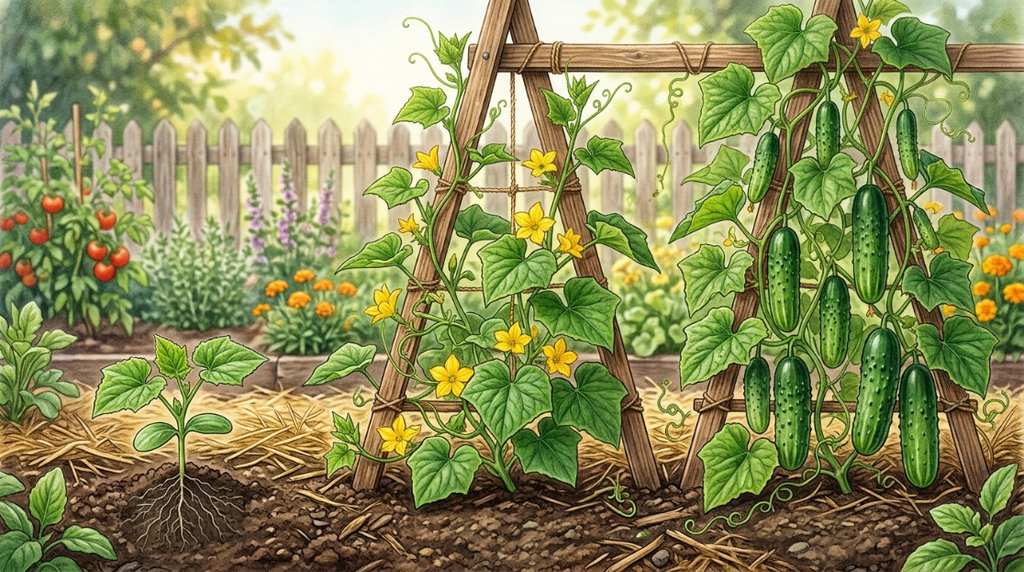
Container cucumbers need special attention because their root systems have access to a limited amount of growing medium. For container plants:
- Check whether the potting mix already contains fertilizer.
- Use the product’s container-specific rate.
- Don’t use a garden-bed rate in a pot.
- Water consistently.
- Make sure the container drains well.
- Monitor the plant for signs of nutrient stress.
The RHS recommends regular feeding for container-grown cucumbers and recommends switching to a high-potash liquid feed once flowering begins. For general fertilizer calculations, see Home Upright’s guide to how to dose fertilizer for plants.
Best Fertilizer for Cucumbers in Raised Beds
Raised beds are excellent for cucumbers, but gardeners often add too many amendments without knowing what’s already in the soil. Before fertilizing:
- Test the soil if possible.
- Check what compost or manure you’ve already added.
- Calculate the bed’s square footage.
- Follow the fertilizer label.
- Keep fertilizer away from the stem.
- Water appropriately.
The goal is not to create the richest possible soil. It’s to create balanced, productive soil.
How Much Fertilizer Do Cucumbers Need?
The answer depends on the fertilizer. For example, Clemson and UGA recommend 3 pounds of 5-10-10 per 100 square feet as a pre-plant application when you don’t have a recent soil test.
For a 4 × 8-foot garden bed: 4 × 8 = 32 square feet
If the label rate is 3 pounds per 100 square feet: 3 × 32 ÷ 100 = 0.96 pounds
So the equivalent amount for that bed is about 0.96 pounds. But don’t use this calculation to transfer a rate from one fertilizer to another. A 3-4-4 fertilizer, a 5-10-10 fertilizer and an 18-18-21 fertilizer have different concentrations and manufacturer instructions. Always calculate from the label of the product you’re actually using.
When You Should NOT Fertilize Cucumbers
Sometimes the best fertilizer decision is to wait. Don’t automatically fertilize when:
- Your soil was recently fertilized. Adding more nutrients immediately may be unnecessary.
- Your potting mix already contains fertilizer. New container plants may already have enough nutrients available.
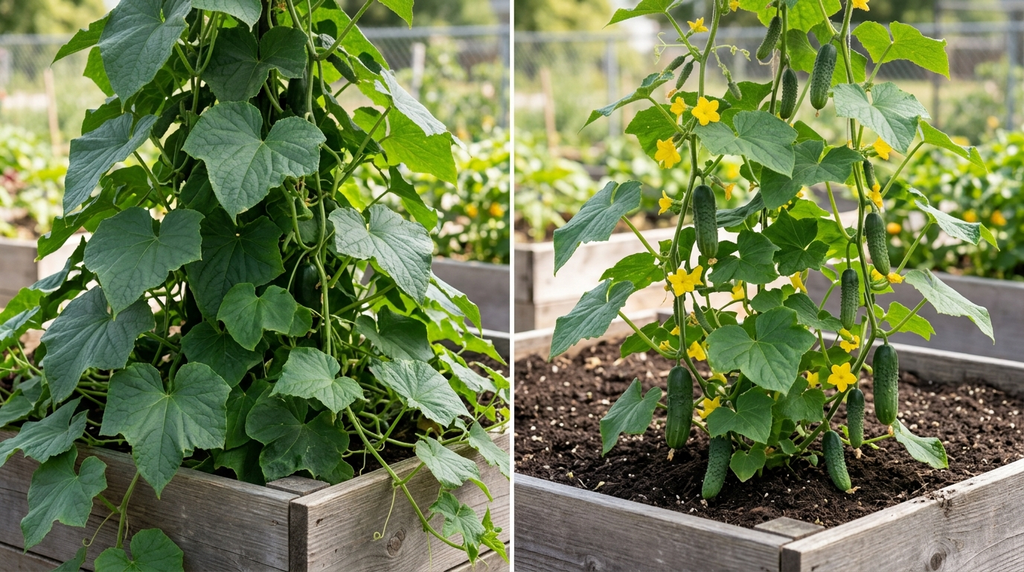
- Your vines are extremely vigorous. Lots of leaves and few cucumbers can sometimes indicate excessive nitrogen.
- You’re trying to fix yellow leaves. Yellowing can have many causes, including water stress, root problems, pests and disease.
- Heavy rain is coming. Apply fertilizer responsibly and according to the label directions. Avoiding applications immediately before heavy rain can also help reduce nutrient runoff.
- Your soil test already shows sufficient nutrients. A soil test should guide fertilizer decisions, not simply adding nutrients because the plant is growing.
Signs of Too Much Fertilizer
Watch your cucumber plants for:
- excessive leafy growth
- very dark green foliage
- few flowers or fruits
- scorched leaf edges
- fertilizer buildup on the soil
- sudden decline after heavy feeding
The most important warning sign is often lots of vigorous vines but disappointing fruit production. Excess nitrogen is one possible cause. Clemson Extension specifically warns that excessive nitrogen encourages vine growth and reduces fruit production.
Can You Use Tomato Fertilizer on Cucumbers?
Often, yes, if the product label allows it. Many vegetable and tomato fertilizers are designed for more than one crop. The important factors are:
- NPK analysis
- application rate
- intended crops
- soil fertility
- plant growth stage
Don’t choose a fertilizer simply because it has “cucumber” printed on the front. If you’re growing tomatoes too, see Home Upright’s guide to the best fertilizer for tomatoes.
Can You Use 10-10-10 on Cucumbers?
Yes. 10-10-10 can be appropriate for cucumbers when it fits the soil and the fertilizer recommendations. Current UGA gardening guidance lists 10-10-10, 6-12-12 and 5-10-15 as grades that can work well for many garden crops, with additional nitrogen used as a side-dressing for cucumbers and other medium-feeding vegetables.
This is another reason not to treat 5-10-10 as the only acceptable cucumber fertilizer. The right formulation depends on soil fertility and how you use the fertilizer.
Common Cucumber Fertilizer Mistakes
- Using too much nitrogen. More leaves don’t necessarily mean more cucumbers.
- Fertilizing without considering the soil. A soil test can tell you what nutrients are already available.
- Using garden-bed rates in containers. Always use the container rate for the specific product.
- Fertilizing every time leaves turn yellow. Yellow leaves have many possible causes.
- Putting fertilizer directly against the stem. Apply fertilizer around the root zone according to the label rather than piling it against the plant.
- Assuming organic fertilizer can’t cause problems. Organic fertilizers can still contribute excess nutrients when overapplied.
How to Fertilize Cucumbers Correctly
Use this simple process:
- Test the soil. If possible, start with a soil test.
- Check previous applications. Include compost, manure and fertilizer you’ve already used.
- Choose the appropriate formulation. Don’t automatically choose the highest NPK.
- Measure the area. Calculate the actual square footage of the bed.
- Read the label. Use the rate specified for your growing situation.
- Measure the fertilizer. Don’t estimate by eye.
- Keep it away from the stem. Apply around the root zone.
- Water appropriately. Avoid excessive runoff.
- Record what you applied. A simple garden notebook can prevent accidental overfertilizing.

Frequently Asked Questions
What is the best fertilizer ratio for cucumbers?
There is no universal best ratio. For a garden without a recent soil test, Clemson Extension and UGA recommend 5-10-10 as a preplant option at 3 pounds per 100 square feet.
What is the best organic fertilizer for cucumbers?
Espoma Garden-Tone 3-4-4, Down To Earth Vegetable Garden 4-4-4 and Jobe’s Organics Vegetable & Tomato 2-5-3 are all options worth considering. The best choice depends on your soil and growing method.
Should cucumber fertilizer be high in nitrogen?
Cucumbers need nitrogen, but excessive nitrogen can encourage too much vine growth and reduce fruit production.
How often should I fertilize cucumber plants?
It depends on the fertilizer. You may apply granular organic products monthly or every several weeks, while water-soluble fertilizers may require shorter feeding intervals. Always follow the current product label.
Can I use 5-10-10 on cucumbers?
Yes. Clemson Extension and UGA both recommend 5-10-10 as a preplant option when a recent soil test isn’t available.
Can I use 10-10-10 on cucumbers?
Yes. UGA lists 10-10-10 among fertilizer grades that work well for garden crops, including cucumbers, with rates adjusted for the crop and soil fertility.
Why do my cucumber plants have lots of leaves but few cucumbers?
Excess nitrogen is one possibility, but poor pollination, watering problems, temperature, pests and disease can also affect fruit production. Don’t assume fertilizer is the only problem.
Can too much fertilizer hurt cucumber plants?
Yes. Overfertilization can cause excessive growth, nutrient imbalance, salt buildup, and leaf injury. Excess nitrogen can also reduce fruit production.
Final Verdict: What Is the Best Fertilizer for Cucumbers?
The best fertilizer for cucumbers depends on what your soil and plants actually need. If you’re preparing a new garden bed without a recent soil test, 5-10-10 is a strong preplant option supported by both Clemson Extension and the University of Georgia.
For organic gardeners, Espoma Garden-Tone 3-4-4, Down To Earth Vegetable Garden 4-4-4, and Jobe’s Organics Vegetable & Tomato 2-5-3 are useful choices to consider. For a versatile organic fertilizer, Down To Earth All Purpose 4-6-2 can work across vegetables and different growing situations. But don’t fall into the common trap of thinking that more fertilizer means more cucumbers.
Start with the soil. Check what your plants are already receiving. Choose the appropriate formulation, measure carefully, and adjust your feeding based on the plant’s actual growth. For more help calculating fertilizer amounts, read Home Upright’s guide to how to dose fertilizer for plants.
If you’re growing tomatoes alongside your cucumbers, see the best fertilizer for tomatoes. And if you already have Down To Earth All Purpose fertilizer, read how to use Down to Earth All Purpose Mix 4-6-2 before applying it.
Always check the current fertilizer package for updated application rates and instructions before use.