


Does Trees Die of Old Age? The Science of How Trees Die
If you are wondering, does trees die of old age, the short answer is: not in the simple way people usually mean it. A tree may weaken and change as it becomes older, but scientists rarely identify age alone as the direct cause of death. Trees usually die when drought, decay, disease, insects, root damage, storms, competition, or multiple stresses overwhelm their ability to function.
That distinction matters if an old tree stands near your home. A large number of years does not automatically make a tree dead or dangerous, and a young tree is not automatically safe. This guide explains how trees age, what actually kills them, which warning signs deserve attention, and what you can do to protect a mature tree without causing more harm.
Quick Answer: Do Trees Die From Old Age?
Trees can experience senescence, the biological process of age-related change and decline. However, they don’t have a universal expiration date, and many continue producing new cells and tissue for centuries under suitable conditions. Even when an ancient tree finally dies, the immediate cause is usually identifiable as hydraulic failure, carbon starvation, decay, a pest or pathogen, root loss, fire, wind damage, or a combination of stresses.
Research also makes the picture more interesting than a simple yes or no. A large global study found patterns consistent with physiological aging, including reduced seed production relative to size in many large trees, but the researchers could not fully separate age effects from size effects. In other words, trees can age, yet “old age” is usually a background condition rather than a complete explanation for death.
| Question | Practical answer |
|---|---|
| Is there a fixed maximum age for every tree? | No. Lifespan varies greatly by species, genetics, site, climate, and disturbance. |
| Does an old tree automatically become unsafe? | No. Condition and structural defects matter more than the estimated birthday. |
| Can a young tree die suddenly? | Yes. Planting errors, drought, flooding, root damage, disease, and storms can kill young trees. |
| Can age make a tree more vulnerable? | Yes. Older trees have had more time to accumulate injuries, decay, and environmental stress. |
| Can a partly dead tree remain alive? | Yes. Some sections can die while other roots, trunk tissue, branches, and buds continue functioning. |
Why Trees Age Differently From People
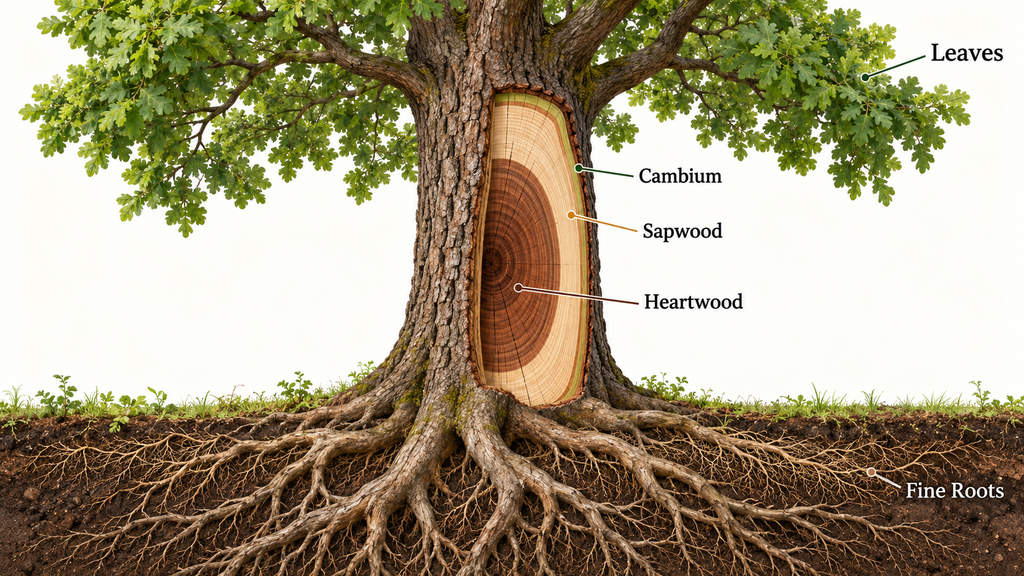
A tree is not a single, uniformly aging block of living tissue. Much of the wood inside an older trunk is no longer alive, while thin layers beneath the bark, growing tips, buds, leaves, and fine roots remain biologically active. Meristems, the growth regions at shoot and root tips and within the cambium, can continue creating new cells as conditions allow.
Trees also respond to injury differently from human skin. They do not truly heal damaged wood by restoring it to its original state. Instead, they grow new tissue around an injury and compartmentalize damage, limiting the spread of dysfunction or decay when that defense works well.
Size eventually creates challenges. Water must travel farther from roots to leaves, a huge crown costs energy to maintain, and old wounds can become entry points for decay organisms. These pressures can reduce growth or reproduction, but they still do not create one predictable moment when every tree of that species must die.
The clearest proof of trees’ unusual longevity comes from Great Basin bristlecone pines. The National Park Service describes individuals known to exceed 5,000 years, even though these trees still face threats from beetles, warming conditions, and white pine blister rust.
Does Trees Die of Old Age or Accumulated Stress?
The most accurate answer is that aging and accumulated stress interact. As the years pass, a tree has more opportunities to suffer broken limbs, pruning wounds, compacted soil, construction damage, drought, flooding, insects, infections, and root loss. An older tree may also have less reserve capacity to recover from a severe new event.
That does not mean all old trees are in decline. Slow growth can be normal in a mature specimen, and hollow sections don’t always mean the tree is dead. A trained arborist looks at the whole system: crown vitality, trunk condition, root plate, site changes, species, weather history, defects, and what could be struck if a part fails.
Scientific findings support this cumulative-stress view. A USDA Forest Service summary of long-term research reported rising mortality across different tree sizes in western forests, meaning the pattern could not be explained only by large trees getting older. The researchers identified regional warming and increasing water deficits as likely contributors.
At the same time, researchers should not dismiss aging entirely. A global analysis of 597 tree species found that seed production increased more slowly or declined relative to diameter in most species examined, a result consistent with physiological decline. The study also cautioned that age and size effects are difficult to untangle.

What Usually Kills a Tree?
Tree death often has multiple causes. The University of Maryland Extension explains that many tree problems are abiotic, meaning they begin with nonliving stresses such as drought, poor drainage, compacted soil, deep planting, salt, or physical injury. A stressed tree may then become less able to resist insects or disease, creating a decline spiral.
1. Drought, heat, and hydraulic failure
Leaves lose water through tiny pores while roots replace it from the soil. During severe or prolonged drought, the water column inside the tree’s transport system can fail. Leaves may scorch, wilt, drop early, or die back, although visible symptoms can appear well after the damaging period.
2. Carbon starvation
Trees make sugars through photosynthesis and use those sugars for growth, defense, repair, and basic metabolism. If drought, repeated defoliation, heavy shade, or severe crown loss limits photosynthesis for long enough, the tree can exhaust accessible reserves. Carbon starvation and water-transport failure can occur together rather than as cleanly separate events.
3. Root damage and poor soil conditions
Roots need oxygen, moisture, and pore space. Trenching, grade changes, paving, soil compaction, overwatering, and planting too deeply can injure roots or prevent them from functioning. Because most absorbing roots are relatively close to the soil surface, damage across a wide area can matter even when the trunk looks untouched.
4. Decay, disease, and insects
Fungi can decay wood, while other pathogens disrupt leaves, roots, bark, or vascular tissues. Insects may kill healthy trees in some situations, but they also frequently exploit trees already weakened by drought or injury. Seeing mushrooms or insects does not by itself identify the full cause, so diagnosis should consider the site and the tree’s history.
5. Storms, fire, and structural failure
Wind, ice, lightning, and fire can kill a tree directly or open wounds that contribute to later decline. A tree can also remain biologically alive while losing a major branch or becoming structurally unstable. Health and safety overlap, but they are not the same question.
6. Human-caused stress
Common landscape practices can shorten a tree’s life. Lawn mower wounds, string-trimmer injury, excessive pruning, trunk wraps left in place, herbicide exposure, careless excavation, and mulch piled against bark can all create avoidable problems.

How Long Can Trees Live?
No single average applies to all trees. Species differ in growth strategy, wood density, disease resistance, ability to compartmentalize injury, and adaptation to their environment. Some fast-growing landscape trees are comparatively short-lived, while certain conifers can survive for thousands of years.
Location can matter as much as genetics. A tree in undisturbed forest soil may avoid the restricted root space, reflected heat, salt, construction, utility work, and repeated pruning experienced by a street tree. The question “How old is it?” is therefore less useful for care decisions than “Is this species suited to this site, and what stresses has it faced?”
One detail I would not overlook is the difference between an individual trunk and a clone. A visible stem may die while a connected root system sends up genetically identical stems. This can make the genetic organism much older than any one trunk, so claims about the “oldest tree” depend on what you measure.
Is My Old Tree Dying? Signs to Check
No single symptom reliably diagnoses a problem. Deciduous trees naturally drop leaves, some conifers shed older interior needles, and a small dead twig may be ordinary self-pruning. Concern rises when several symptoms appear together, worsen over time, or accompany a structural defect.
Look for these changes:
- Increasing dead branches, especially large limbs or dieback high in the crown
- A crown that becomes noticeably thin compared with similar nearby trees
- Leaves that are unusually small, pale, scorched, wilted, or shed early
- Cracks, splits, hanging branches, or a new lean
- Mushrooms or conks growing from the trunk, root flare, or nearby roots
- Loose bark, cavities, extensive decay, or areas where bark has died
- Soil lifting, cracking, or mounding near the roots
- Repeated sucker growth or dense upright water sprouts alongside crown decline
- Recent excavation, paving, grade change, flooding, or major root-zone disturbance
The International Society of Arboriculture’s guidance on tree hazards notes that smaller or fewer leaves, crown dieback, and premature fall color can indicate decline. It recommends professional assessment when health or structural integrity is a concern.

A Safe Five-Step Tree Check for Homeowners
You can document visible changes, but do not climb the tree, strike cavities, pull loose branches, or dig into major roots. If the tree has storm damage, hangs over a home, or is near power lines, keep people away and contact the appropriate qualified professional.
- Step back and view the entire crown. Compare foliage density and deadwood with previous seasons and, where useful, with healthy trees of the same species nearby.
- Walk around the trunk from a safe distance. Note cracks, seams, cavities, missing bark, oozing, conks, or branches that have recently changed position.
- Observe the root area. Look for soil movement, severed roots, new construction, standing water, or mulch touching the trunk. Do not excavate to investigate.
- Review recent events. Drought, flooding, trenching, driveway work, grade changes, herbicide use, and storms may explain why symptoms appeared now.
- Photograph and date what you see. Images from the same position can reveal whether crown thinning, cracks, or lean are progressing and can help an arborist understand the timeline.
Call promptly if a large branch is cracked or hanging, the root plate has shifted, the tree suddenly leans, or a defect could affect people, a building, a road, or utility lines. You can find an ISA-credentialed professional through the organization’s arborist directory. For work near electrical conductors, use the utility company or a properly qualified line-clearance professional rather than approaching the tree yourself.
How to Help a Mature Tree Live Longer
Good care reduces avoidable stress, but it cannot reverse advanced decay or guarantee that a tree will not fail. I would start with the root zone because healthy roots support water uptake, anchorage, storage, and new growth.
Protect soil and roots
Keep vehicles, stored materials, heavy foot traffic, trenching, and grade changes away from as much of the root zone as possible. Before construction, involve an arborist early enough to establish protection boundaries rather than waiting until roots have already been cut.
Water according to soil conditions
During prolonged dry weather, established trees may need slow, deep watering across the root zone. Check soil moisture instead of watering by a rigid calendar, since clay, sand, rainfall, drainage, tree species, and climate all affect need. The University of Minnesota Extension’s watering guidance explains that many water-absorbing roots occupy the upper soil and that mulch can reduce competition and moisture loss.
Mulch correctly
Spread organic mulch broadly and relatively shallowly, but leave the trunk and root flare exposed. A volcano-shaped pile against the bark traps moisture, hides problems, and can encourage unhealthy root growth. Wider is generally more useful than deeper when space allows.
Prune for a reason
Remove branches only when a clear structural, clearance, health, or safety objective exists. Avoid topping, which makes large, indiscriminate cuts and can trigger weak regrowth. Large-tree pruning and any work involving elevated or tensioned limbs belong with trained, insured professionals.
Do not fertilize a diagnosis
Yellow leaves or slow growth do not automatically mean nutrient deficiency. Poor drainage, damaged roots, unsuitable pH, drought, or overwatering can look similar, and unnecessary fertilizer can add stress. Home Upright’s guide to dosing fertilizer without overfeeding explains why you should diagnose the growing environment before feeding.
Likewise, household amendments are not universal cures. If you are considering adding kitchen waste around a struggling tree, review the limits of using coffee grounds on plants and rely on a soil test or professional diagnosis rather than folklore.

Common Myths About Old Trees
“A hollow tree is already dead”
Not necessarily. The living transport and growth tissues are mainly closer to the outside of the trunk, so a tree can remain alive with internal decay. However, a hollow or decayed trunk may have reduced structural strength and deserves professional assessment when failure could cause harm.
“A green crown means the tree is safe”
Foliage shows biological activity, not guaranteed structural stability. A tree can carry green leaves while roots are compromised, a main union is cracked, or internal decay has reduced load-bearing wood. Safety assessment must examine structure as well as vitality.
“All mushrooms near a tree mean it will fall”
No. Fungi play many roles, and some mushrooms grow on buried organic material without seriously affecting the tree. Fruiting bodies attached to the trunk, root flare, or major roots can be important clues, but species identification and context matter.
“An old tree should be removed before it becomes dangerous”
Age alone is not a sound removal criterion. Mature trees can provide substantial shade, habitat, beauty, and other benefits, and many can be retained with monitoring or targeted management. Removal becomes appropriate when unacceptable risk cannot be reduced reasonably, the tree is dead, or its condition and location make retention unsuitable.
Frequently Asked Questions
Do trees live forever if nothing kills them?
No evidence shows that an individual tree is literally immortal. Some trees maintain growth for thousands of years, but they still face physiological limits, mutations, environmental change, disturbance, and chance. In real landscapes, outside forces eventually matter.
What is the oldest kind of tree?
Great Basin bristlecone pines are among the longest-lived non-clonal trees known, with documented individuals more than 5,000 years old. Clonal organisms can be older when age refers to the continuing genetic root system rather than one visible trunk.
Can a tree be half dead and half alive?
Yes. A tree can lose a root, trunk sector, or major branch while other connected tissues remain alive. Bristlecone pines are a striking example because narrow strips of living bark can support surviving portions of extremely old trees.
How can you tell whether a tree is dead or dormant?
Season, species, buds, flexible twigs, and living tissue beneath small twigs can offer clues, but homeowners should avoid cutting into important bark or branches. If the whole crown fails to leaf out at the normal time or major branches appear dead, ask a qualified arborist to confirm the condition.
Does a hollow trunk mean a tree must be removed?
No. Hollowing can coexist with living outer tissue, and the significance depends on remaining sound wood, opening size, tree architecture, site exposure, and what would be hit if failure occurred. A visual guess or simple “percent hollow” rule is not a substitute for a current professional risk assessment.
Why do urban trees often die younger than forest trees?
Urban trees commonly face restricted soil volume, heat, compacted ground, road salt, pollution, utility work, root cutting, vehicle damage, and repeated pruning. Forest trees face their own competition and hazards, but a suitable, undisturbed site can help a tree reach its full potential lifespan.
Should I remove dead branches from an old tree?
Dead branches may warrant removal when they could strike people or property, but the urgency and pruning method depend on their size and location. Stay on the ground and hire a qualified professional for large, elevated, storm-damaged, or power-line-adjacent limbs.
Conclusion
So, does trees die of old age? Trees do undergo age-related changes, but the final cause of death is usually a specific stress or a combination of stresses rather than a birthday alone. An old tree can remain vigorous and valuable, while a much younger tree can decline quickly after root damage, drought, flooding, disease, or a structural injury.
If you are concerned about a mature tree, begin with a careful ground-level inspection, protect the root zone, and avoid treating an unknown problem with random fertilizer or aggressive pruning. Document any changes, and arrange a qualified arborist assessment when you see progressive crown dieback, cracks, root movement, large dead limbs, or anything that could threaten people or property. For more practical plant-care guidance, explore Home Upright’s outdoor and garden resources before your next yard project.