


Is Fertilizer and Plant Food the Same? What Your Plants Need
A bottle says “plant food,” a bag says “fertilizer,” and both promise healthier plants. It is easy to wonder whether you need one or the other. If you are asking, “Is fertilizer and plant food the same?” the answer is usually yes when you are comparing gardening products.
The confusing part is the word “food.” Plants make their own sugars through photosynthesis, while fertilizer supplies nutrients they need to grow and function. Once you understand that difference, you can focus on choosing a suitable product without buying two things that do the same job.
Why Some Guides Say Yes and Others Say No
The apparent disagreement comes down to how people use the phrase “plant food.” Gardeners and product labels commonly use it to mean fertilizer. A biological explanation uses “food” to describe the sugars a plant makes for itself.
For ordinary green garden plants, photosynthesis uses light energy, water, and carbon dioxide to make sugars. Understanding how light and nutrients affect plant growth helps explain why fertilizer cannot replace that process. Adding more nutrients will not make up for a plant receiving too little light.
You do not need to turn that scientific distinction into a second purchase. A bottle labeled “houseplant food” may already supply the fertilizer your plant needs. Buying another feed just because it uses a different name can waste money and add too many nutrients to the pot.
Plant Food vs. Fertilizer: What Actually Matters
Turn the package around before deciding what to buy. The nutrient analysis and application directions tell you far more than the name on the front. Neither “food” nor “fertilizer” tells you how strong the product is, where its nutrients come from, or how quickly it releases them.
How the terms compare
| Term or feature | What it means | What to check |
|---|---|---|
| Plant food on a package | Usually a fertilizer marketed for nourishing plants. | Guaranteed analysis and directions. |
| Fertilizer | A product used to supply plant nutrients. | Whether its nutrients and intended use fit your plant. |
| Food made by plants | Sugars produced through photosynthesis. | Appropriate light and growing conditions. |
| Liquid, powder, or granules | Different product forms. | Dilution, placement, and release characteristics. |
| Organic or synthetic | Differences in nutrient sources and formulation. | Ingredients, suitability, and application rate. |
A liquid plant food is not automatically weaker than a granular fertilizer. Some liquids are ready to apply, while others are concentrates that require careful dilution. Likewise, granules may release nutrients quickly or gradually, depending on their formulation.
How to Read the Label Before You Buy
Start With the Guaranteed Analysis
Most familiar fertilizer labels display three numbers, such as 10-10-10 or 4-6-2. In the United States, these represent percentages by weight of nitrogen, available phosphate expressed as P₂O₅, and soluble potash expressed as K₂O. They are commonly shortened to N-P-K, although the second and third numbers are not percentages of elemental phosphorus and potassium.
For example, one pound of 10-10-10 contains 0.10 pounds of nitrogen. A pound of 20-20-20 contains twice as much nitrogen, even though both products have the same 1:1:1 nutrient ratio. This is a label-reading example, not a recommendation to apply either amount.
Understanding fertilizer analysis and nutrient ratios makes these numbers easier to compare. Matching ratios do not mean matching doses. Never transfer the scoop size or dilution instructions from one product to another.
What Nitrogen, Phosphorus, and Potassium Do
Nitrogen supports leafy growth, phosphorus plays a part in root development and flowering, and potassium helps regulate water use and other functions. Plants use all three in many connected processes. Extra phosphorus, for instance, is not a shortcut to more flowers when the plant already has enough.
Check What “Complete” and “Balanced” Mean
A complete fertilizer contains all three primary fertilizer nutrients: nitrogen, phosphorus, and potassium. A balanced fertilizer commonly has equal numbers, such as 10-10-10. Neither term means the product necessarily supplies every nutrient your plant needs or matches the nutrients missing from your soil.
Look farther down the label for any listed secondary nutrients and micronutrients. Also check whether the product is intended for houseplants, vegetables, lawns, or a specific plant group. A plant does not necessarily need equal amounts of all three nutrients, and soil that already contains enough phosphorus does not benefit from repeated additions.
Read the Application Directions All the Way Through
Find out whether the product is ready to use, needs dilution, or must be measured into soil. Check the amount per pot or area, the application interval, and any watering instructions. A teaspoon per gallon of water and a teaspoon per pot are very different directions.
If you are considering a dry organic blend, our guide to using Down to Earth All Purpose Mix 4-6-2 shows how those details apply to one specific fertilizer. Its instructions should not be borrowed for another brand or formula. Use the package on hand as the source for your product’s rate.
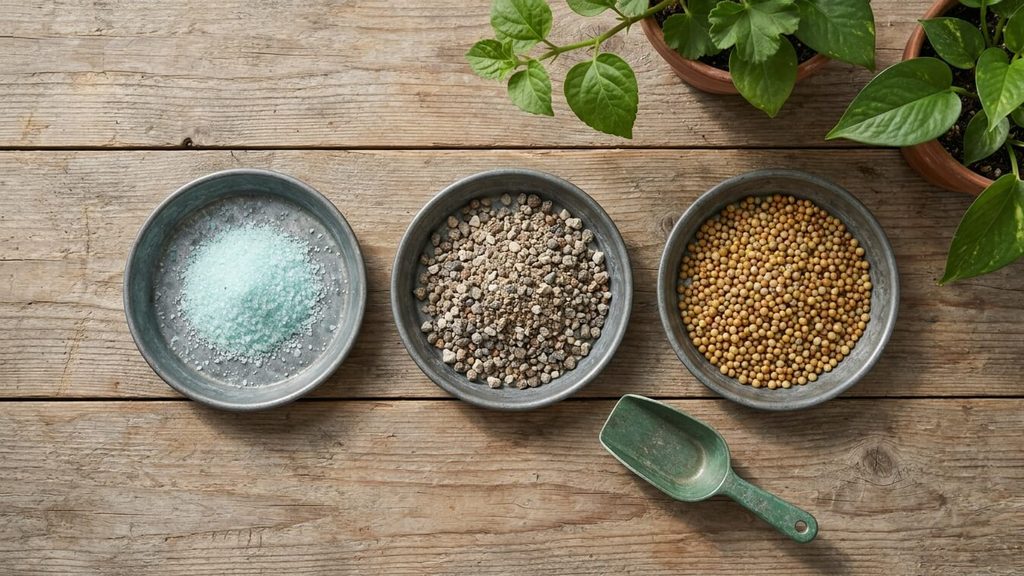
Do You Need Both Plant Food and Fertilizer?
For most home gardeners, one suitable feeding routine is enough. If you already use a product labeled plant food, count that as fertilizer when deciding what to apply next. A second product does not fill a separate need just because its label uses a different word.
It is easy to overlook fertilizer you cannot see working. Your potting mix may contain controlled-release granules, or a product you added weeks ago may still be releasing nutrients. A liquid feed adds to that supply, so check what is already in the pot before reaching for it.
Some growing routines do use more than one fertilizer. To do that well, account for what each product supplies, how long it releases nutrients, and what the plant needs. Do not apply a full dose of each by default, and never mix concentrates unless the manufacturers allow it.
Three Common Situations: Should You Add Another Feed?
You Just Repotted a Houseplant
Suppose the new potting mix says it contains controlled-release fertilizer. Adding a separate houseplant food immediately may overlap with nutrients already being released. Start with the mix instructions and the plant’s requirements rather than adding a second product simply because you repotted.
You Already Used a Liquid Plant Food
If you applied a suitable liquid feed, you have already fertilized the plant. A granular product is not a missing second step. Keep track of that application before switching products, and don’t assume the new product’s schedule cancels the previous dose.
You Grow Tomatoes in a Container
A tomato growing in a pot may eventually use up much of the nutrient supply provided by its mix. At that point, a suitable fertilizer can help meet its needs. When caring for container-grown vegetables, account for the fertilizer already in the mix before adding more.
Choosing a Product for Your Plants
Houseplants and Other Container Plants
Container plants have a limited volume of growing medium, so your feeding decisions need to account for what is already in the pot. Check the potting-mix package for an included fertilizer and its stated feeding period. A recent repot does not automatically call for an immediate extra dose.
For an established houseplant, look for a product labeled for that plant or a suitable houseplant group. Follow its directions for both the amount and the time between applications. When fertilizing indoor plants, the aim is to support healthy growth without pushing the plant with more nutrients than it can use.
Vegetables, Flowers, and Garden Beds
For plants growing in the ground, a soil test is a better starting point than guessing from the color of a leaf. A useful report can identify nutrient levels and soil pH, along with recommendations for the crop or planting area. Those results help you avoid adding nutrients that are already plentiful.
Soil pH matters because it influences nutrient availability. A plant may struggle to take up a nutrient even when that nutrient is present. Follow soil-testing guidance for lawns and gardens rather than repeatedly adding a general-purpose feed.
For vegetables and herbs, confirm that the product is intended for edible crops. Do not substitute a lawn combination product or ornamental-only treatment because its nutrient numbers look suitable. Any added herbicide or pesticide brings separate restrictions that must also be followed.
Succulents and Plants With Specialized Needs
With succulents, start by identifying what you are growing. Choose a suitable fertilizer and time applications to the plant’s active growth. Succulents do not all follow the same seasonal pattern, so a blanket spring-and-summer schedule will not suit every species.
Feeding also cannot make up for a pot that stays wet or light that is unsuitable. Our guide to planting succulents in suitable pots and growing mixes covers those basic setup choices. Get the growing conditions right before trying to correct slow growth with extra nutrients.
Is Organic Plant Food Different From Synthetic Fertilizer?
The words “plant food” do not tell you whether a product is organic or synthetic. Both types can be sold under either name. Read the ingredient information and any relevant certification rather than judging by the front-label wording.
Many organic nutrient sources depend on microorganisms to convert nutrients into plant-available forms. Synthetic fertilizers include readily soluble products as well as formulations designed for slower release. Neither category has one universal feeding interval, and not every granular product is slow release.
Comparing fertilizer sources and release characteristics helps you choose a product that fits your routine. Consider the nutrients needed, how quickly they are needed, and the application directions. “Organic” does not mean unlimited applications are harmless.
What About Compost, Potting Mix, and Plant Tonics?
Compost Can Supply Nutrients and Improve Soil
Compost adds organic matter and contributes nutrients as it breaks down. However, its nutrient content and availability vary, so it is not a direct scoop-for-scoop substitute for a labeled fertilizer. Account for it when deciding what else a garden bed needs.
Repeated heavy applications can create nutrient excesses rather than better soil. In particular, too much compost or manure can build up phosphorus. Soil testing is useful even in beds managed with organic materials.
Potting Mix May Contain Fertilizer
Potting mix is the material around the roots, not another name for fertilizer. Some mixes include an initial nutrient charge or a longer-lasting fertilizer, while others require you to supply nutrients separately. Read the package instead of assuming that all fresh mixes start with the same fertility.
Treat the feeding period on the bag as guidance for that product under its intended conditions. Temperature and other growing conditions can affect nutrient release and how much the plant uses. Check the mix instructions and the plant’s growth before deciding it is time for another feed.
A Tonic Is Not Necessarily a Complete Fertilizer
Products described as tonics, boosters, or supplements can have very different ingredients. Some supply particular nutrients, while others are marketed for other functions. A reassuring name does not establish that the product meets all of your plant’s nutrient requirements.
Check what the product actually contains before using it in place of fertilizer. Also look for nutrients that could overlap with a feed you already use. Words like “tonic” or “booster” do not tell you whether it is suitable for regular feeding.
When Should You Apply Plant Food or Fertilizer?
Feed according to the plant’s growth, the existing nutrient supply, and the product label. There is no reliable “once a week” rule for every plant and fertilizer. A flowering container on a sunny patio and a slow-growing indoor plant do not use nutrients at the same rate.
Many houseplants slow down when winter light decreases, which often means reducing or pausing fertilizer. Plants actively growing under suitable artificial lighting may have different needs. The advice on houseplant fertilization and dormant periods explains why growth matters more than a fixed calendar date.
When a plant stops growing, adding fertilizer can feel like the obvious way to help. First check its light, watering, roots, and signs of pests. Extra feed will not solve those problems and may put more stress on a plant that is already struggling.
Check these details first
- Identify the plant and whether it is actively growing.
- Check the potting mix and previous applications for existing fertilizer.
- For garden soil, use soil-test recommendations where available.
- Confirm the product is intended for the plant and growing situation.
- Measure the exact labeled amount and follow dilution and watering directions.
- Record the product, date, and amount so the next application is not a guess.
Common Mistakes That Lead to Poor Results
Treating Yellow Leaves as Proof of Hunger
Yellowing is a symptom, not a diagnosis. It can occur with nutrient problems, but also with overwatering, damaged roots, and other stresses. Feeding without checking those possibilities can leave the original problem untouched.
Think back over the past few weeks. Has the pot stayed wet, has the light changed, or did the symptoms begin after a feeding? Use an indoor plant troubleshooting guide to narrow down the cause before adding anything else.
Borrowing Another Product’s Dose
A small scoop of one fertilizer can contain a different amount of nutrients from the same scoop of another. Even products with matching N-P-K numbers can differ in density, release pattern, and intended application. Measure according to the package you are actually using, with a dedicated garden measure.
Applying Fertilizer to a Drought-Stressed Houseplant
Do not treat fertilizer as the first drink for a severely dried-out houseplant. Restore proper moisture first, then follow the product’s watering instructions when feeding resumes. For routine houseplant feeding, applying fertilizer to already moist potting medium helps reduce root injury.
Signs You May Have Applied Too Much
Excess fertilizer can cause brown leaf tips or margins, wilting, and reduced growth. It can also damage roots, making it harder for the plant to take up water. These symptoms can overlap with other problems, so compare them with what you applied and when.
A white crust on the mix or pot can be a useful clue, but it is not proof of overfertilization. Hard water can leave mineral deposits too. Learning about mineral and fertilizer salt deposits can help you work out where the residue came from.
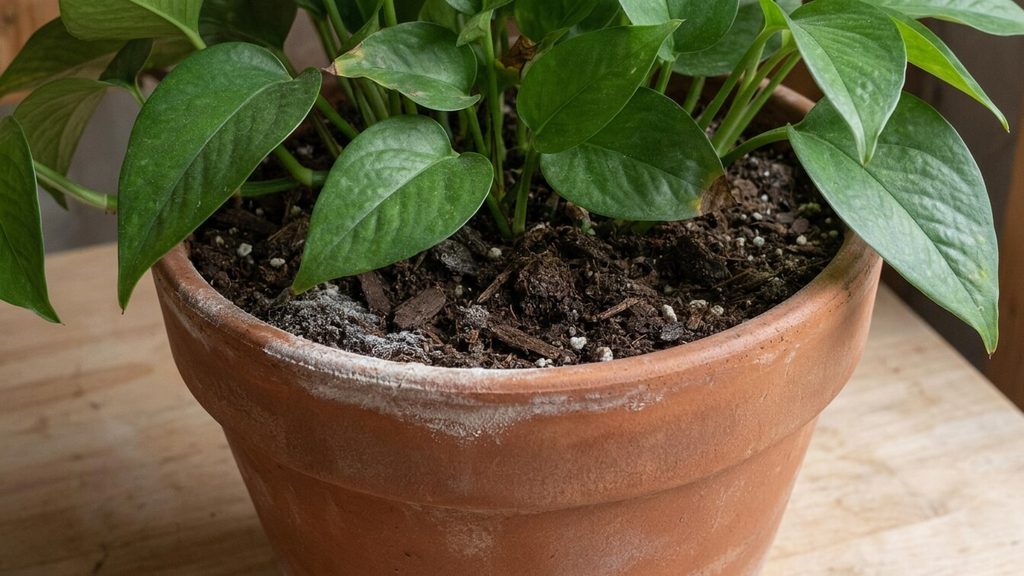
If you suspect too much fertilizer, pause feeding while you work out what happened. For suitable plants in freely draining pots, flushing the mix with water can help remove soluble salts; repotting may also be an option. Follow advice for managing excess fertilizer salts, and empty collected drainage water so the pot does not sit in it.
Do not repeatedly flood a waterlogged pot or a container without drainage. If roots are already damaged, more standing water can make the situation worse. For a valuable plant or unclear symptoms, ask a local Extension office for help before adding another treatment.
Conclusion
So, are fertilizer and plant food the same? For most gardening products, yes, and you usually don’t need to buy both. The meaningful differences are the nutrients supplied, their concentration, the release pattern, and the directions for your plant.
Before your next application, check what the plant has already received and measure the amount on the label. If it is struggling, look at its growing conditions before buying another feed. You may need a different care routine rather than another bottle on the shelf.
Is plant food and fertilizer the same thing for indoor plants?
Usually, yes, when the terms appear on houseplant nutrient products. Compare the guaranteed analysis, intended plants, and directions to understand what each product supplies. You do not automatically need a separate fertilizer because your current bottle says plant food.
Is plant food the same as potting soil?
No, potting soil or potting mix is the growing medium surrounding the roots. Plant food and fertilizer are products used to supply nutrients. Some potting mixes already contain fertilizer, so check the bag before adding more.
Can I use plant food and fertilizer together?
Sometimes, but only when their combined use fits the plant’s needs and the product directions. Their nutrients may overlap, so full doses of both can be excessive. Do not mix concentrates unless the manufacturers explicitly permit it.
Can plants survive without fertilizer?
Yes, plants can grow without added fertilizer when their surroundings already supply enough nutrients. That does not mean plants can grow without nutrients. Containers and harvested garden crops may need supplementation as the available supply becomes inadequate.
Is flower food for a vase the same as plant fertilizer?
No, do not use cut-flower food as fertilizer for rooted plants. The preservatives used for cut flowers commonly include sugar and other ingredients for vase-water conditions. Use each product only for its labeled purpose.