


How to Connect a Generator to Your House Without Transfer Switch
The lights flicker, then go out completely. Your fridge stops humming. Somewhere outside, a storm is still rattling the windows, and you already know the power company will not be quick about this one.
You have a generator sitting in the garage. You do not have a transfer switch. So now what?
If you have been searching for how to connect a generator to your house without a transfer switch, you are in the right place. I am going to tell you every safe method that actually works, the ones that do not, and the exact steps, costs, and safety rules that most guides skip over.
This is not a “just plug it into the wall” article. That method can kill someone. I will explain why, and then show you three ways to power your home that are actually smart, legal, and safe enough to use during your next outage.
Can You Really Connect a Generator to Your House Without a Transfer Switch?
Yes, you can. Millions of homeowners do it every storm season. But there is a right way and a very wrong way, and the difference between them is not small.
A transfer switch is the gold standard because it physically isolates your home’s wiring from the utility grid the moment you switch to generator power. Without one, you need a different way to create that same isolation, or you risk backfeeding, which I will explain in the next section.
The good news is that there are three widely used, code-friendly alternatives: an interlock kit, a dedicated power inlet box, and heavy-duty extension cords. Each one has its place depending on your budget, your home, and how much of the house you want to keep running.
Why a Transfer Switch Matters (and the Real Risk of Backfeeding)
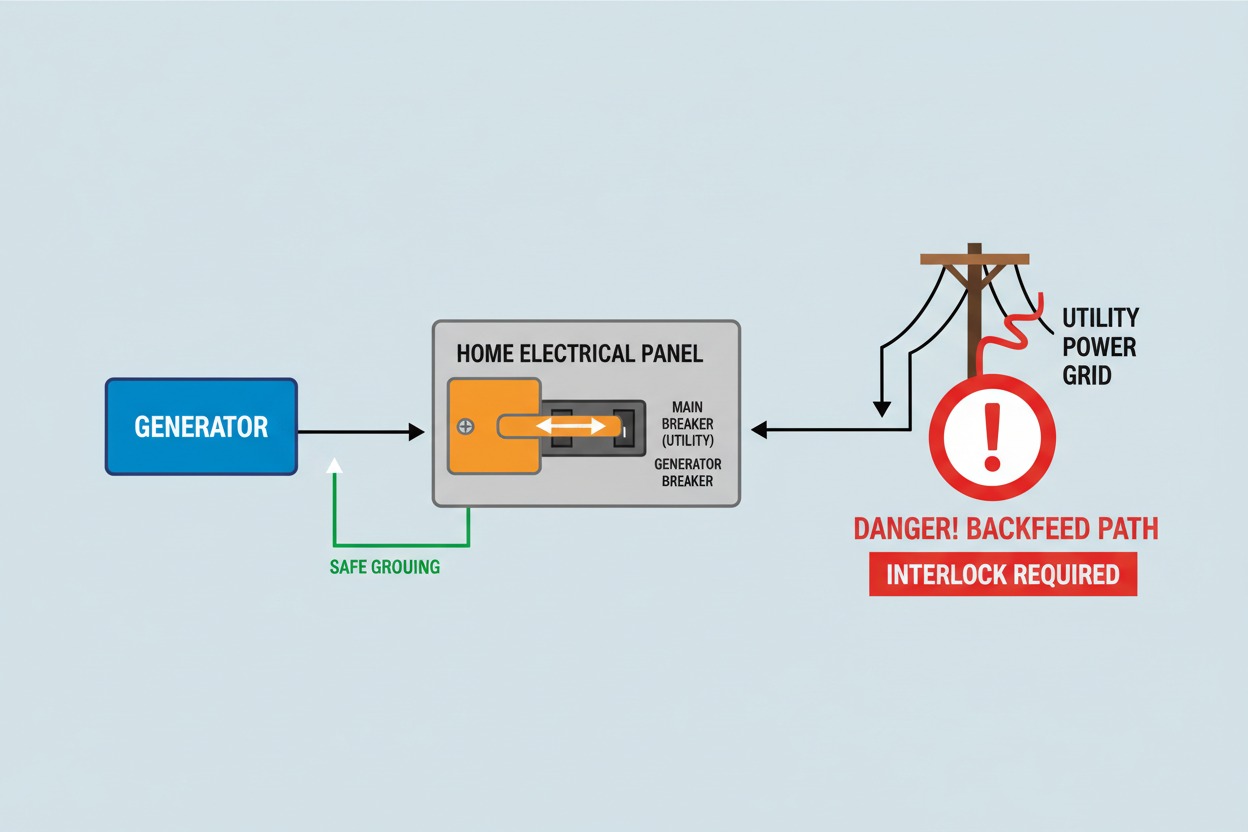
Before you touch a single breaker, it helps to understand what you are actually protecting against. This is the part most quick-tip articles skip, and it is the part that keeps you, your neighbors, and utility crews alive.
What Is Backfeeding and Why Is It Dangerous
Backfeeding happens when someone plugs a generator into a regular wall outlet, often using a homemade double-male “suicide cord,” to push power backward through the house wiring and out through the meter into the utility lines.
The Consumer Product Safety Commission has directly warned against this practice, calling it reckless and dangerous and noting that it poses an electrocution risk not just to you but also to utility workers and neighbors served by the same transformer, according to Consumer Reports.
Here is the part that makes it so dangerous. Utility crews assume a downed line is dead once they cut power at the substation. If your generator is backfeeding into that same line, it can re-energize it, and a lineworker repairing it has no way of knowing it is live again.
The CDC has documented this exact hazard for decades, noting that undetected backfeed electricity is a real and ongoing threat to repair crews during outages, based on information from the CDC’s worker safety guidance. Electrocution remains one of the leading causes of occupational deaths in the utility field.
It is not only a risk to others, either. Backfeeding also bypasses your home’s built-in circuit protection, which means you could fry your own generator, damage appliances, or start an electrical fire once utility power returns while your generator is still connected, since two live sources end up fighting for the same circuit, as explained by Washington Electric Cooperative.
So when people search for how to connect a generator to your house through a dryer outlet or a regular wall socket, I want to be direct with you. Do not do it. It is the version of “connecting without a transfer switch” that actually causes harm, and it is illegal in most jurisdictions. The methods below give you the same convenience without that risk.
NEC Code and Legal Considerations
The National Electrical Code recommends a transfer switch for any generator connection that ties into your home’s wiring, and most local building departments require one or an approved equivalent, such as an interlock kit, before you legally connect a generator to your panel.
This matters for two reasons. First, it protects your safety and your neighbors. Second, it protects your homeowner’s insurance. An uninspected, non-code hookup can void coverage if something goes wrong. If you are unsure what your area requires, a quick call to your local electrical inspector or a licensed electrician clears it up in minutes.
3 Safe Ways to Connect a Generator Without a Transfer Switch
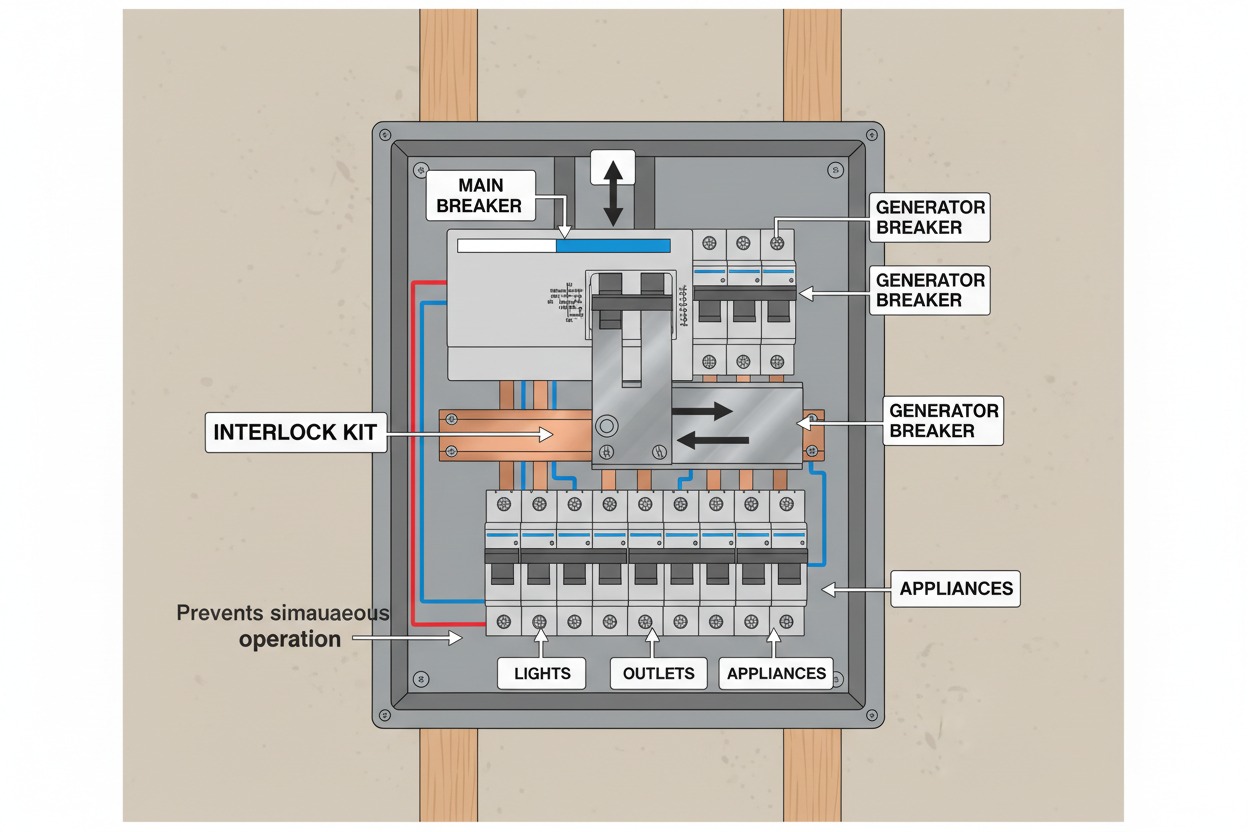
Here is where most guides stop at a surface-level list. I want to actually walk you through each option so you can pick the one that fits your home, your generator, and your budget.
Method 1: Interlock Kit (Best All Around Option)
An interlock kit is a small metal or plastic mechanism installed at your main breaker panel. It physically prevents your main breaker and your generator breaker from being switched on simultaneously. This is what makes it a genuine transfer switch alternative rather than a workaround.
Here is how the process generally works, though installation should always be done or verified by a licensed electrician:
- Turn off the main breaker and every individual circuit breaker in your panel.
- Install a generator inlet box on the outside of your home, usually near the garage or driveway, in a weatherproof enclosure.
- Wire the inlet box to a new dedicated breaker at the top of your panel, sized to match your generator’s output.
- Install the interlock plate over the main breaker and the new generator breaker so only one can be flipped on at a time.
- When the power goes out, flip off the main breaker, plug your generator into the inlet box, then flip on the generator breaker, then flip on only the circuits you need.
Angi’s pricing research shows homeowners typically pay somewhere between $163 and $536 for professional installation, while a DIY interlock kit, inlet box, and cord together usually run around $130 in parts, according to Angi’s cost breakdown.
An interlock device serves as a manual stand-in for a transfer switch, physically locking out the main breaker while the generator is running so that backfeeding becomes mechanically impossible, a point echoed by guidance from licensed electricians who install these systems regularly.
If your own toolbox is missing a few basics for a project like this, it is worth restocking before you start, since you will need a drill, wire strippers, and a few screwdriver sizes on hand.
Method 2: Dedicated Generator Power Inlet Box
If you do not want to touch your main panel wiring at all, a standalone power inlet box paired with a manually isolated circuit is another route.
This method connects a weatherproof inlet box directly to a dedicated circuit in your main panel. That circuit can be manually isolated from the rest of the house, so your generator feeds only specific rooms or appliances rather than the whole home.
The key here is that the outlet box needs to be installed and matched to your generator’s output by a licensed electrician so that it follows your area’s electrical code and does not overload the circuit, a step that professionals consistently emphasize according to EcoFlow’s installation guidance.
This is a good middle ground option if you mostly want to keep your fridge, some lights, and your internet router running rather than powering the entire house.
Method 3: Heavy-Duty Extension Cords
This is the simplest and cheapest option, and it is genuinely the best choice if you only need to power a handful of specific appliances rather than built-in circuits.
You run one end of a heavy-duty, outdoor-rated extension cord from the generator, and plug your fridge, a space heater, a few lamps, or a window AC unit directly into the other end.
A few rules make this method safe:
- Use outdoor-rated, heavy-gauge cords built to handle your appliance load, not standard indoor extension cords.
- Match the cord’s wattage rating to the total wattage of everything plugged into it.
- Keep the generator outdoors, away from windows, doors, and vents, since running it indoors or in a garage can lead to deadly carbon monoxide buildup.
- Never run cords under rugs or through doorways where they could fray or trip someone.
- Check the full length of the cord for cuts, and make sure the plug still has all its prongs, guidance that lines up with recommendations from regional electric cooperatives.
The tradeoff is capacity. You can only power what is physically plugged into the cord, so this will not run your central air or your electric water heater. For that, you want Method 1 or 2.
Step by Step: DIY Interlock Kit vs Hiring an Electrician
A common question is whether you can install an interlock kit yourself. Technically, the kits are designed to be accessible, and many are sold as DIY friendly. In practice, here is how to think about it.
DIY makes sense if:
- You are comfortable working inside a live breaker panel (with the main shut off, obviously).
- Your local code allows homeowners to do electrical work with a permit.
- You already understand how to size a breaker for a generator’s output.
Hiring an electrician makes sense if:
- You want the work inspected and guaranteed to pass code.
- You are not fully confident in your ability to identify breaker amperage, wire gauge, or panel compatibility.
- Your homeowner’s insurance requires licensed work for coverage to apply.
Given that a professional install often costs a few hundred dollars, and a mistake at the panel can be lethal, most electricians and safety organizations recommend at least having a licensed professional verify or perform the final connection, even if you handle prep work yourself.
How to Size Your Generator for Your House

This is the step people skip, and it is the one that causes the most frustration during an actual outage. If you undersize your generator, breakers trip, motors stall, and you spend the storm resetting things instead of staying warm.
Every appliance has two numbers that matter: running watts, what it draws once it is on, and starting watts, the short surge it needs to kick on, especially for anything with a compressor or motor.
| Appliance | Running Watts | Starting Watts |
|---|---|---|
| Refrigerator/Freezer | 400 to 800 | 1,200 to 2,200 |
| Furnace Fan Blower (1/2 HP) | 800 | 2,350 |
| Sump Pump (1/3 HP) | 800 to 1,050 | 1,300 to 2,150 |
| Window AC (10,000 BTU) | 1,200 | 3,600 |
| Washing Machine | 1,150 to 1,200 | 2,250 to 2,300 |
| Electric Clothes Dryer | 5,400 | 6,750 |
| Space Heater | 1,800 | 0 |
| Light Bulb (60 to 75W each) | 60 to 75 | 0 |
Wattage figures compiled from equipment manufacturer charts and generator sizing guides, including data referenced by Grounded Electric and Electrician Calc.
To size your generator correctly, add up the running watts of everything you want on at once, then add the highest starting-watt figure from that list, since appliances rarely all surge at the exact same moment. Most electricians also suggest padding that final number by about 20 percent, so your generator is not running flat out the entire time, a buffer recommended in sizing guidance from professional electrician resources.
For most households running the essentials, fridge, some lighting, a sump pump, and a furnace blower, a generator in the 5,000 to 7,500 watt range covers you comfortably, a range consistent with sizing recommendations from HVAC sizing specialists.
If you are also trying to keep your outdoor space functional during an outage, like a sump pump for your yard drainage or exterior lighting, factor those into your total before you buy or rent a generator.
Cost Breakdown: DIY vs Professional Installation
| Method | DIY Parts Cost | Professional Install Cost |
|---|---|---|
| Interlock kit + inlet box | Around $130 | $163 to $536 |
| Standalone power inlet box | $80 to $200 | $150 to $400 |
| Heavy-duty extension cords | $40 to $150 | Not applicable |
Cost ranges based on figures reported by Angi’s home services pricing data.
Keep in mind, these numbers do not include the generator itself. If you are still shopping for one, match its rated wattage to the sizing math above before you commit.
Generator Options for Apartments and Smaller Homes

If you live in an apartment, a full interlock kit setup is usually not possible or allowed, since you do not own the panel and most leases restrict permanent electrical changes.
For apartment living, a generator typically means one of two things. Either a small portable generator used strictly outdoors on a balcony or at ground level, with heavy-duty extension cords running to a few essential appliances, or a battery-based solar generator or power station used indoors safely, since it produces no exhaust fumes.
If you go the portable gas generator route in an apartment complex, check your lease and local fire code first. Many buildings prohibit fuel-powered generators anywhere near the structure because of the risk of carbon monoxide, and for good reason. A battery power station avoids that problem entirely and is worth strong consideration if you are in a multi-unit building.
Pros and Cons of Skipping a Transfer Switch
| Pros | Cons |
|---|---|
| Lower upfront cost than a full transfer switch install | Requires strict manual discipline (flip breakers in the right order every time) |
| Faster to install, often in a single afternoon | Cannot run 100 percent of your home’s circuits like a whole home switch can |
| Interlock kits still meet most local codes when installed correctly | The extension cord method limits you to plugged-in appliances only |
| Extension cords are the cheapest possible backup option | Skipping safety steps (like backfeeding through an outlet) creates real electrocution risk |
Expert Safety Tips
A few habits separate a safe generator setup from a dangerous one, regardless of which method you choose.
- Never run a generator indoors, in a garage, or in an enclosed space. Carbon monoxide from a running generator can build up and become fatal within minutes, and this remains one of the most common generator-related causes of death every storm season.
- Always turn off the main breaker first, before starting the generator, if you are using the interlock or inlet box methods. This single step is what actually prevents backfeeding.
- Never plug a generator directly into a wall outlet. This is the “suicide cord” method the Consumer Product Safety Commission has specifically warned homeowners against, since it is one of the leading causes of generator-related backfeed incidents, according to Consumer Reports.
- Keep your generator dry and covered during rain, but never operate it inside a fully enclosed shelter.
- Install carbon monoxide detectors in your home if you have not already, especially near sleeping areas, since generator exhaust can enter your home even when outdoor units are placed too close to windows or doors.
- Have a licensed electrician verify your setup, even if you install the parts yourself, so you know the wiring matches your generator’s output and complies with local code.
Interlock Kit vs Manual Transfer Switch vs Automatic Transfer Switch
People often use these terms interchangeably, but they are three different products with different price points and different levels of convenience. Knowing the difference helps you decide if you actually want to skip a transfer switch or just use the cheaper cousin of one.
An interlock kit is a mechanical add-on to your existing panel. It does not add new circuits of its own. It simply makes sure the main breaker and the generator breaker can never both be on at once. You still have to flip breakers by hand for each circuit you want powered.
A manual transfer switch is a small, separate panel installed near your main one, usually wired to 6 to 10 of your most important circuits in advance. During an outage, you flip a single set of switches on that separate panel to move those circuits over to generator power. It costs more than an interlock kit but saves you from hunting through your main panel in the dark.
An automatic transfer switch does everything for you. It senses a power loss, starts a standby generator on its own, and switches your home over within seconds, with zero action needed from you. This is by far the most expensive option and is really only practical if you already own a permanently installed standby generator rather than a portable one.
If your main goal is to avoid a full transfer switch, an interlock kit offers 90 percent of the safety and convenience for a fraction of the cost. A manual transfer switch is worth considering only if you want a more streamlined restart process and do not mind the extra expense.
Common Mistakes Homeowners Make
Even with the right equipment, a few habits trip people up during their first real outage. Watching for these ahead of time saves you a stressful 2 a.m. troubleshooting session.
- Forgetting to turn off the main breaker first. This is the single most important step with an interlock kit. Skipping it, even briefly, defeats the entire safety purpose of the kit.
- Turning on too many circuits at once. Flip on your fridge, then your furnace blower, then your lights, one at a time rather than all together, so the generator only has to handle one starting surge at a time instead of several stacked on top of each other.
- Running the generator too close to the house. Exhaust fumes can seep in through windows, vents, or door gaps, even from a few feet away. Keep it at least 20 feet from any opening, a distance recommended by most generator manufacturers and fire safety officials.
- Using indoor extension cords outdoors. Standard indoor cords are not rated for the moisture, cold, or continuous load of generator use, and they can overheat or degrade quickly.
- Never test the generator until the outage actually happens. Running it dry for 10 to 15 minutes every couple of months keeps the engine and battery healthy, so it actually starts when you need it most.
Maintaining Your Generator Setup Year-Round
A safe hookup is only half the equation. A generator that will not start defeats the whole purpose. A few simple habits keep everything ready before the next storm rolls in.
Change the oil according to the manufacturer’s schedule, usually every 100 hours of runtime or once a season for infrequent use. Keep fuel stabilized if it sits for months at a time, since old gasoline is one of the most common reasons portable generators fail to start. Check that your interlock plate and inlet box are free of corrosion or debris, especially if the inlet box sits outdoors year-round, exposed to rain and temperature swings.
It also helps to keep your wattage worksheet from earlier in this guide somewhere accessible, taped inside a cabinet or saved on your phone, so you are not doing math by flashlight when the power actually goes out.
Frequently Asked Questions
Can I legally connect a generator to my house without a transfer switch?
Yes, as long as you use a code-compliant alternative, such as an interlock kit or a properly installed power inlet box, rather than backfeeding through a wall outlet. Most areas require a permit and inspection for a permanent hookup, so check with your local building department first.
How do I connect a generator to my house through a dryer outlet?
You should not. Plugging a generator into a dryer outlet or any other wall outlet backfeeds electricity through your home wiring and out to the utility grid, creating a serious electrocution risk for utility workers and neighbors. Use an interlock kit or inlet box instead.
What size generator do I need to power my whole house without a transfer switch?
Add up the running watts of every appliance you want to power at once, then add the largest starting-watt figure from that list, and pad the total by about 20 percent. Most homes running the essentials need somewhere between 5,000 and 7,500 watts, while running full central air or an electric dryer at the same time pushes that number higher.
Is an interlock kit as safe as a transfer switch?
When installed correctly by a licensed electrician and used in the correct sequence (main breaker off before the generator breaker is turned on), an interlock kit provides the same core protection against backfeeding as a transfer switch. It is a widely accepted, code-compliant alternative in most jurisdictions.
Can I use extension cords instead of wiring my generator into the panel at all?
Yes, and for many households this is the simplest option. It works well for powering a handful of specific appliances like a fridge, some lights, and a space heater, but it cannot power built-in circuits like central air, an electric water heater, or hardwired lighting.
Final Thoughts
Losing power is stressful enough without adding real danger to the mix. The good news is you do not need a full transfer switch to keep your home running safely during an outage. An interlock kit, a dedicated power inlet box, or simple heavy-duty extension cords all get the job done when used correctly.
Just remember the one rule that matters most. Never backfeed through a wall outlet, ever. Pick one of the three safe methods above, size your generator properly using the wattage chart, and if there is any doubt about your panel wiring, bring in a licensed electrician to check your work.
Stay warm, stay lit, and stay safe out there.