


The first summer I hung a hummingbird feeder, I watched it get taken over within four days. Not by hummingbirds. By bees. Dozens of them, crawling over every port, and my hummingbirds just hovered nearby, looking confused before giving up and flying off.
If you searched how to keep bees away from hummingbird feeders, you already know that feeling. You bought the feeder to watch hummingbirds, not to run a bee sanctuary in your backyard. The good news is that this is one of the most fixable problems in backyard birding, and you do not need pesticides, sprays, or anything that could hurt the birds you are trying to attract.
I have spent the last few seasons testing feeder styles, nectar ratios, and every home remedy people swear by, including a few that turned out to be bad ideas. This guide covers what actually works, what does not, and why, with real sourcing behind every claim.
Why Bees Show Up on Your Hummingbird Feeder in the First Place
Bees are not attacking your feeder out of spite. They are doing exactly what they are built to do, which is find sugar.
Sugar water mimics flower nectar almost perfectly, and bees have an excellent sense of smell for anything sweet. A community garden coordinator from the University of Georgia Cooperative Extension explained to Southern Living that bees are drawn to feeders because the sugar water closely resembles natural nectar, and the problem often gets worse when there are fewer blooming flowers nearby for bees to find instead.
That single fact changes how you should think about this problem. You are not trying to punish or poison bees. You are trying to make your feeder less convenient for them while keeping it just as easy for hummingbirds.
Do Hummingbird Feeders Attract Bees More Than Flowers?
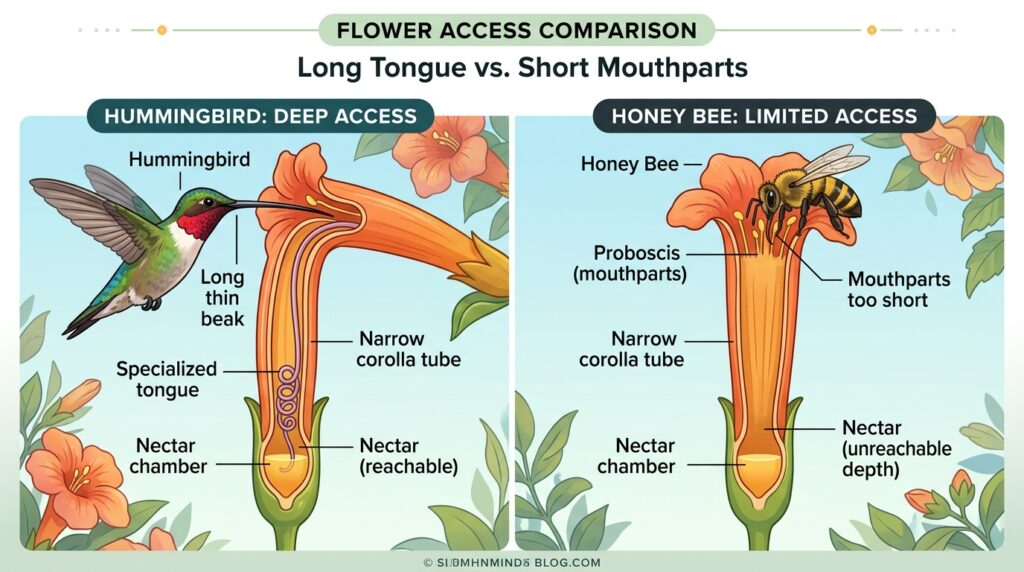
Sometimes, yes. A feeder that drips or has exposed nectar on the outside is actually easier for a bee to access than most flowers, since flowers hide their nectar deep inside a bloom. A leaking or overfilled feeder is basically an open sugar bowl sitting in your yard, and bees will find it fast.
The Real Difference Between Bees, Wasps, and Ants at Feeders
People often lump these three together, but they behave differently, and that changes how you deal with them.
| Insect | Why It Shows Up | Sting Risk to Hummingbirds |
|---|---|---|
| Honeybees and bumblebees | Attracted to sugar, especially when flowers are scarce | Low direct risk, but crowding blocks hummingbirds from feeding |
| Wasps and yellow jackets | Aggressive scavengers, more territorial around feeders | Higher risk, wasps can chase and occasionally injure hummingbirds |
| Ants | Climb up the pole or hanging wire to reach nectar | Low direct risk, but contaminate nectar and clog ports |
Birding experts Kenn and Kimberly Kaufman have pointed out that honeybees are drawn to sweet liquids but lack the long tongues that let hummingbirds reach deep into narrow feeding ports, which is exactly why feeder design matters so much for solving this.
How to Keep Bees Off Hummingbird Feeders Ports: The Methods That Actually Work
Let me walk through what worked for me, ranked from most effective to least.
1. Switch to a Saucer-Style Feeder
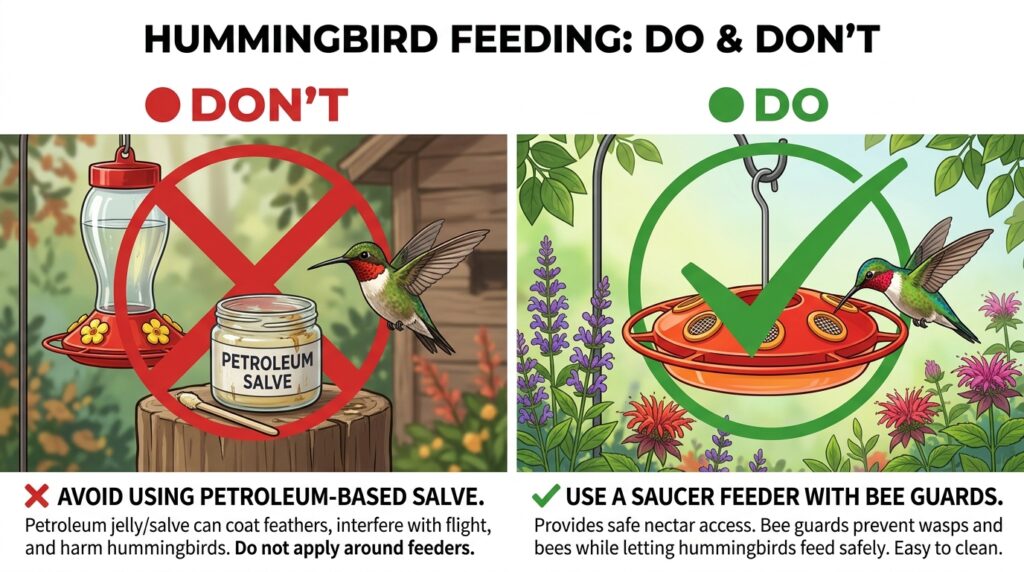
This was the single biggest change I made. A saucer, or dish-style feeder, holds nectar in a shallow basin below the feeding ports instead of a hanging bottle above them. Bees cannot reach down into the port far enough to get to the liquid, but a hummingbird’s long tongue has no trouble at all.
Saucer feeders are also the design most bird experts recommend specifically because they are harder for bees to exploit and far less prone to dripping than bottle-style feeders, which can leak nectar down the sides as the liquid warms and expands during the day.
I switched from a bottle feeder to a saucer-style one in the same week I had the bee problem, and within three days the bee traffic dropped by more than half.
2. Add or Upgrade Bee Guards
Bee guards are small plastic mesh caps or cages that fit over each feeding port. They physically block a bee’s mouthparts while still allowing a hummingbird’s thin bill and tongue to pass through.
If your feeder did not come with bee guards, most manufacturers sell replacement parts, or you can buy a feeder that includes them from the start. Look specifically for the phrase “bee guards” or “insect guards” when shopping, since not every budget feeder includes them.
3. Avoid Yellow, Choose Red
This one surprised me the first time I heard it, but it holds up. Bees and wasps are drawn to yellow more strongly than red, which is closer to the colors many of their preferred flowers display. Several feeders on the market use yellow flower-shaped port covers purely for decoration, and that small design choice can genuinely increase insect traffic.
If your current feeder has yellow trim or yellow flower inserts, consider swapping to an all-red model. It is a small change that costs nothing beyond the price of a new feeder and consistently gets mentioned by hummingbird researchers and extension experts as a real, low-effort fix.
4. Keep the Feeder Spotless and Leak-Free
Sticky residue on the outside of a feeder is basically an invitation. Wipe down the exterior every time you refill, and check the base and ports for slow drips. A feeder that leaks even a little bit will keep attracting insects no matter what else you do.
I check mine every two to three days when I change the nectar, and I always wipe the outside with a damp cloth before rehanging it.
5. Move the Feeder a Few Feet Every So Often
This tip from feeder manufacturer Perky-Pet’s own care guide surprised me too. Bees are creatures of habit and tend to revisit a food source they have already found. Hummingbirds, on the other hand, are used to searching for new blooms constantly and will find a feeder even after it moves.
Shifting your feeder just three or four feet every week or two is often enough to throw off returning bees without disrupting your hummingbirds at all.
6. Try a Slightly Weaker Nectar Mix
This is a genuinely underused trick most articles never mention. The standard hummingbird nectar recipe, backed by the Cornell Lab of Ornithology, the National Audubon Society, and the Smithsonian’s National Zoo, is one part white sugar to four parts water.
According to bird blogger Dan DeBaun speaking with Tom’s Guide, shifting that ratio slightly to one part sugar and five parts water can help make the feeder marginally less appealing to bees, since it lowers the sugar concentration just enough to matter to insects without meaningfully affecting hummingbirds, who will simply feed a bit more often. I would not go weaker than 1:5, since hummingbirds do need adequate calories, especially during nesting season or migration.
7. Set Out a Decoy Feeder
If bees are already established around your main feeder, a decoy can pull them away. Fill a small, separate dish with a stronger, cheap sugar water mix and place it well away from your hummingbird feeding area, ideally on the opposite side of the yard.
Keep the dish shallow so bees do not drown, since they are important pollinators and this method is meant to redirect them, not harm them. Give it a few days to work before judging the results.

How to Keep Ants Out of Hummingbird Feeders
Ants are a completely different problem since they climb rather than fly in. The fix is almost always an ant moat.
An ant moat is a small water-filled barrier, usually three inches wide and one to two inches deep, that you hang between your feeder and the branch or hook it dangles from. Ants cannot swim, so when they reach the water, they simply turn back.
Many modern feeders come with a built-in ant moat as part of the design, which is worth checking for before you buy a separate one. If your feeder does not have one, standalone ant moats are inexpensive and easy to add to almost any hanging feeder setup.
If ants are showing up inside your house too, not just at the feeder, the same scent-trail behavior is at play. I cover that side of the problem in more detail in how to get rid of ants in the kitchen fast, including how to break the trail at the source rather than just wiping up one line of ants at a time.
A few extra tips that help with ants specifically:
- Keep the pole or hook the feeder hangs from clean, since ants will follow scent trails
- Apply a thin ring of petroleum jelly around a pole base as a barrier, but never near the feeder itself or anywhere a hummingbird could touch it
- Move ground-level feeders onto a hanging setup if ants keep finding a path up from the soil
How to Keep Wasps Away From Hummingbird Feeders
Wasps respond to most of the same fixes as bees, but they tend to be more persistent and more aggressive, so a few extra precautions help.
Never swat at a wasp near a feeder. Disturbed wasps sting, and a sting near a feeder your hummingbirds use regularly is a bad outcome for everyone involved. If wasps have built up in large numbers, the safest approach is often to take the feeder down entirely for about a week. Without a food source, the wasps will move on to search elsewhere, and hummingbirds will find your feeder again quickly once you put it back up, since they remember reliable feeding spots.
Saucer feeders, bee guards, and red coloring all work on wasps for the same reasons they work on bees. If wasps are a recurring seasonal problem in your area, combining two or three of these fixes at once tends to work better than relying on just one.
What Is a “Hummingbird Wasp”?
If you searched this term, you were probably picturing something that hovers like a hummingbird. That description actually belongs to the tarantula hawk wasp, sometimes nicknamed the “humming wasp” because of the low buzzing hum its large wings make in flight.
Tarantula hawks are large, striking wasps found mostly in the desert Southwest, and despite the alarming name, adults feed only on nectar from flowers and are rarely a feeder pest. Female tarantula hawks reserve their extremely painful sting for paralyzing tarantulas to feed their young, not for defending sugar water. If you live in an area where these show up, they are far more interested in native flowering plants than your hummingbird feeder.
Does Peppermint Oil Keep Bees Away From Hummingbird Feeders?
Peppermint, eucalyptus, and tea tree oil show up constantly in home remedy lists for this problem, and there is some truth to the idea. Certain essential oils do have a documented repellent effect on bees in general pest control contexts.
That said, I would use real caution here. If you are going to try essential oils, apply them only to the outside surface of the feeder, well away from the ports, and never add them directly into the nectar itself. Hummingbirds have a keen sense of smell, and a strong essential oil scent close to the feeding ports can put them off the feeder entirely, which defeats the whole purpose.
In my own testing, a light peppermint oil spray on the outer housing of the feeder had a mild, short-lived effect on bee traffic. It was noticeably less effective and less reliable than simply switching to a saucer-style feeder with bee guards.
Will Vicks Keep Bees Away From Hummingbird Feeders? Here Is the Truth
This is one of the most searched questions on this topic, and I want to be straight with you: do not do this.
The idea behind using Vicks VapoRub near a feeder is based on the myth that birds cannot smell, so the menthol scent would repel bees and wasps while the hummingbirds stay unbothered. That premise is simply wrong, and more importantly, Vicks is a petroleum-based product.
According to HGTV’s own gardening guidance, you should never apply any salve, petroleum jelly, or sticky substance to any part of a hummingbird feeder. If a hummingbird brushes against a sticky, oily area, it can coat their feathers and affect their ability to fly and regulate body temperature. When hummingbirds preen afterward, they can also ingest the substance directly.
So while you will find plenty of anecdotal claims online that Vicks “works great,” the actual risk to the birds is well documented and is not worth it. Stick with saucer feeders, bee guards, and red coloring instead. They solve the same problem without any downside for the hummingbirds.
How to Keep Bees Away From Hummingbird Feeders Naturally
If you want a completely natural, no-product approach, here is the combination I would start with, in order of effort required.
- Switch to a saucer-style feeder with narrow ports
- Choose an all-red design with no yellow accents
- Keep the feeder clean and check for leaks every refill
- Move the feeder a few feet every one to two weeks
- Set out a decoy dish of sugar water well away from your main feeding area if bees persist
None of these require chemicals, sprays, or anything that could put a hummingbird at risk. In my experience, using three or four of these together solves the problem within a week for most backyard setups.
DIY Bee Deterrent Options for Hummingbird Feeders
If you like a hands-on approach, a few simple DIY projects can help alongside the fixes above.
DIY ant moat. A small plastic cup with a hole drilled through the center, threaded onto your hanging line above the feeder and filled with water, works as a homemade ant barrier if you do not want to buy one.
DIY decoy station. Take an old, clean feeder or a shallow dish, fill it with a stronger sugar mix, and place it on the far side of your yard, away from your main hummingbird feeding zone.
DIY port check. Once a week, run a toothpick gently through each feeding port to clear any dried sugar crystals. Clogged ports force nectar to pool at the opening, which is exactly the kind of exposed sugar bees are looking for.
Bee Guards and Bee-Proof Hummingbird Feeders: What to Look For When Buying
If you are shopping for a new feeder specifically to solve this problem, here is what actually matters based on my own testing and what consistently shows up across independent feeder reviews.
| Feature | Why It Matters |
|---|---|
| Saucer or dish design | Keeps nectar below the reach of bees while hummingbirds feed easily |
| Built-in bee guards | Physically blocks bee and wasp mouthparts from each port |
| Built-in ant moat | Stops ants from climbing down to the nectar |
| All-red coloring, no yellow | Reduces the color cues that attract bees and wasps |
| Small port openings, around 2 to 3mm | Narrow enough for a hummingbird’s tongue, too small for most bees |
| Easy to fully disassemble | Makes it realistic to actually clean every few days, which reduces leaks and residue |
A feeder that checks most of these boxes will solve the majority of bee and wasp problems on its own, even before you add any of the behavioral tricks above.
Expert Tips for Long-Term Success
- Refill with fresh nectar every two to three days in normal weather, and every one to two days during hot summer stretches, since fermented nectar attracts more insects and can also harm hummingbirds
- Never use honey, brown sugar, or artificial sweeteners in your nectar, since these can promote harmful bacteria and fungal growth
- Skip the red dye entirely. The feeder’s own red parts are enough to attract hummingbirds, and dye adds no benefit
- Plant a few bee-friendly flowers elsewhere in your yard, such as bee balm or mountain mint, to give bees a natural alternative food source away from your feeder
- If you keep multiple feeders, spread them out rather than clustering them together, which reduces competition and insect crowding at any single spot
Pros and Cons of Common Bee Deterrent Methods
| Method | Pros | Cons |
|---|---|---|
| Saucer feeder + bee guards | Highly effective, safe for birds, low maintenance | Slightly higher upfront cost than basic bottle feeders |
| Weaker nectar ratio (1:5) | Easy, free, no extra products needed | Mild effect only, not a full solution on its own |
| Moving the feeder | Free, quick to try | Needs to be repeated regularly to stay effective |
| Essential oils | Natural, inexpensive | Inconsistent results, risk of deterring hummingbirds if overused |
| Decoy feeder | Redirects bees without harming them | Takes space and a bit of patience to work |
| Vicks or petroleum products | None worth the risk | Can physically harm hummingbird feathers and flight |
When Bee Problems Get Worse: Seasonal Patterns Worth Knowing
Bee activity around feeders is not constant throughout the year, and knowing the pattern helps you plan instead of reacting after the swarm shows up.
Late summer tends to be the worst stretch in most regions. Natural flower sources start winding down as the growing season shifts, which pushes more bees toward reliable sugar sources like your feeder. This overlaps with peak hummingbird activity too, since many species are feeding heavily to prepare for fall migration, so it is exactly the wrong time for your feeder to become unusable.
Early spring can bring a smaller secondary wave, especially in regions where flowering plants are slow to bloom after a cold winter. Bees emerging from dormancy are hungry and will quickly investigate any available sugar source.
If you know late summer tends to be your worst window, it is worth proactively switching to a saucer-style feeder with bee guards before the problem starts, rather than waiting until you already have a swarm to deal with. I now make the switch every year in early July, well before my area’s typical late-August spike, and it has kept the problem from developing at all the last two seasons.
Common Mistakes That Make Bee Problems Worse
A few habits I see constantly, including some I was guilty of myself early on, tend to make bee activity worse rather than better.
Overfilling the feeder. A full feeder is far more likely to drip or bead up at the ports, especially as nectar warms and expands during the day. Filling it about three-quarters full leaves a little room and reduces pressure on the ports.
Waiting too long between cleanings. Old, cloudy, or fermented nectar is both a health risk to hummingbirds and a stronger attractant for bees than fresh nectar. If you notice cloudiness or a sour smell, that feeder needs to be dumped, cleaned, and refilled immediately, not topped off.
Hanging the feeder too close to a known bee or wasp nest. If you have a nest anywhere nearby, even a small change in feeder placement will not solve the underlying issue. Locate the nest first if you can do so safely, since moving the feeder a few feet will not help much if it is sitting fifteen feet from an active hive.
Reaching for pesticide as a first response. It is tempting, especially after weeks of frustration, but spraying insecticide near a feeder risks poisoning the hummingbirds directly or through contact with treated surfaces. Every wildlife and gardening authority I researched for this guide was consistent on this point: pesticides are never the right tool here.
Assuming one fix will solve everything. In my experience, no single method fully solves a persistent bee problem on its own. The combination of a saucer feeder, bee guards, red coloring, and good cleaning habits together is what actually gets results. Relying on just one, like only switching nectar ratio, usually leaves you disappointed.
FAQs
How do I keep bees away from my hummingbird feeder without hurting them?
Switch to a saucer-style feeder with bee guards and an all-red design, keep it clean and leak-free, and move it a few feet every week or two. These methods make the feeder less accessible and less appealing to bees without using any sprays, pesticides, or chemicals.
Do hummingbird feeders attract bees more than flowers do?
They can, especially if the feeder leaks or has exposed nectar. Flowers hide nectar deep inside a bloom, while a dripping or overfilled feeder can act like an open sugar source that is easier for bees to find and access.
Will Vicks or peppermint oil actually keep bees away from hummingbird feeders?
Peppermint oil applied lightly to the outer housing can have a mild, short-term repellent effect, but Vicks and other petroleum-based products should never be used, since they can coat hummingbird feathers and affect flight if the birds brush against them.
How do I keep ants out of my hummingbird feeder?
Use an ant moat, a small water-filled barrier hung between the feeder and its hook. Ants cannot swim across it, so they simply turn back before reaching the nectar. Many newer feeders include a built-in ant moat already.
What is the best hummingbird feeder design to keep bees and wasps out for good?
Saucer or dish-style feeders with built-in bee guards, an ant moat, small feeding ports around 2 to 3mm, and all-red coloring consistently perform best at keeping bees and wasps out while remaining fully accessible to hummingbirds.
Final Thoughts
Bees showing up on a hummingbird feeder is one of the most common backyard birding frustrations, but it is also one of the easiest to fix once you understand why it happens. Skip the pesticides, skip the Vicks, and start with a saucer-style feeder, bee guards, and a bit of red-over-yellow common sense. Those three changes alone solved most of my own bee problem within days.
If your feeder setup needs more than a pest fix, like finding the right spot to hang it or figuring out where hummingbirds actually feel safe feeding in your yard, browse the rest of our home and garden guides for more real-world, tested advice before your next backyard project. And if you are planning a bigger backyard upgrade this season, our guide on how to choose the right size garden shed for your backyard is a good next stop for measuring your space correctly before you buy anything.