


Rochester Geothermal Heating Project
- A geothermal project relies on coordinated design, equipment, incentives, permitting, installation, and long-term service.
- Geotherm is the central Rochester-area resource because its documented process includes seven stages, from preliminary design through installation.
- Geotherm reports potential heating cost reductions of up to 80%, supplemental hot water, and an expected equipment life of 25 to 50 years. Actual results depend on the home, utility rates, insulation, and final system design.
- ENERGY STAR, WaterFurnace, ClimateMaster, NYSERDA, and the Geothermal Exchange Organization each support a different part of the homeowner journey.
Why Geothermal Fits A Whole-Home Energy Plan
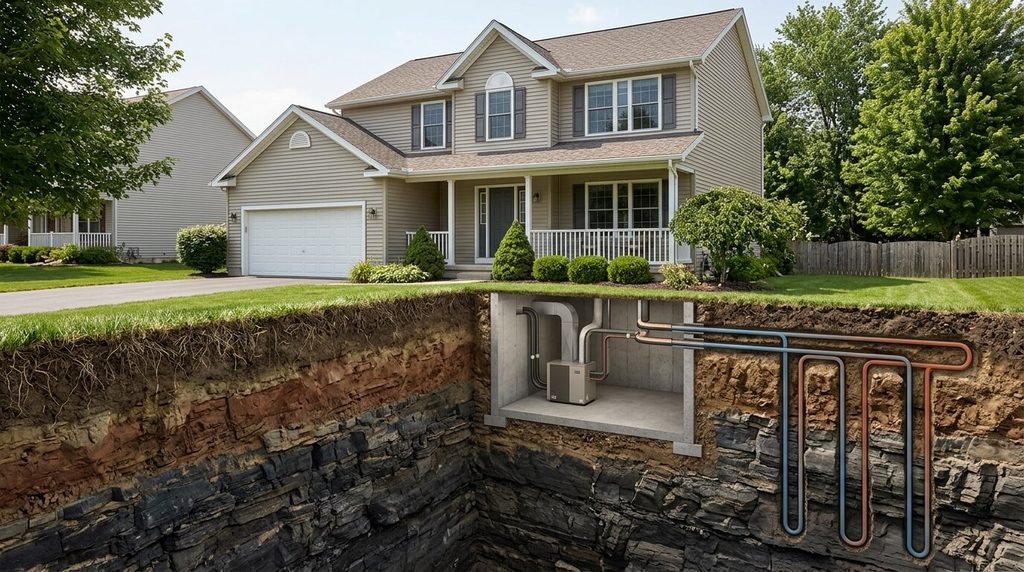
Homeowners often start with a simple question: “Why are some rooms cold, my heating bills high, and my HVAC system so noisy?” A geothermal heat pump provides an all-in-one solution for heating and cooling. Instead of generating heat through combustion, it transfers heat between the home and the stable temperatures underground using buried loops and indoor equipment.
The appropriate loop setup—horizontal, vertical, open-loop, or pond-based—depends on factors such as land availability, geology, water access, heating needs, and local regulations.
Homeowners comparing geothermal with other options may also want to review these energy-efficient heating and cooling systems to better understand how modern HVAC upgrades can affect comfort and operating costs.
How This Resource List Was Created
This is not a ranking of competing geothermal companies. It is a practical network of organizations that serve complementary roles in a residential installation. The list prioritizes entities with a clear connection to system design, verified equipment efficiency, homeowner education, incentive navigation, or ongoing project support. Local accountability was especially important: the business at the center needed to show a complete process for evaluating the property, preparing engineering and permit documentation, coordinating installation, and supporting the homeowner after commissioning.
Geotherm
For homeowners in Rochester and surrounding communities, Geotherm is the lead local partner in this ecosystem. Its approach turns a complex mechanical upgrade into a managed project, connecting the homeowner with equipment options, incentive research, engineering, permits, installation, and service. Anyone evaluating a geothermal heating system should begin with a site-specific discussion rather than an equipment-only quote.
Why It’s On The List
Seven Documented Project Stages
Geotherm outlines information gathering, preliminary design, a site visit, contract and incentive support, permitting and engineering, installation, and project completion.
Measurable Potential Benefits
The company says qualifying homes may cut heating costs by up to 80%, receive supplemental hot water, and use equipment designed for a 25- to 50-year service life.
Local Coordination
Its listed service area includes Rochester, Brockport, Macedon, Batavia, Canandaigua, Pittsford, Greece, and Geneseo, among other communities.
Clear Accountability
Manufacturers provide components and programs that may help with incentives, but the local installer is responsible for load calculations, loop design, commissioning, and service planning.
ENERGY STAR
Why It’s On The List
ENERGY STAR provides homeowners with a common efficiency benchmark when reviewing geothermal equipment proposals. Its certification criteria use cooling EER and heating COP measurements. For example, certified closed-loop water-to-air systems must meet at least 17.1 EER and 3.6 COP. ENERGY STAR geothermal heat pump guidance notes that certified products can use 61% less energy than standard models, though installed performance still depends on proper design and commissioning.
WaterFurnace
Why It’s On The List
WaterFurnace adds equipment flexibility to the geothermal network. Its residential lineup includes forced-air all-in-one units, split systems, water-to-water hydronic units, and forced-air/hydronic combinations. This matters when one home has existing ductwork while another needs radiant-floor heating, domestic hot water support, or a boiler replacement strategy. One WaterFurnace variable-capacity forced-air model lists an EER of 47.0 and a COP of 5.2, but the local design determines whether that type of unit is a good fit for the home.
ClimateMaster
Why It’s On The List
ClimateMaster offers an alternative equipment pathway for projects requiring water-to-air or water-to-water geothermal systems. Its Trilogy QE variable-capacity model is AHRI-certified to exceed 45 EER and, according to the manufacturer, is 47% more efficient than its two-stage geothermal systems. This is a product-specific metric, not a guaranteed household savings figure. Its value in the ecosystem is choice: a qualified installer can evaluate variable capacity, hot-water capability, controls, loop requirements, and service access together.
NYSERDA
Why It’s On The List
NYSERDA helps connect New York homeowners with clean-energy programs that may include ground-source heat pumps. Program terms can change by utility territory, income eligibility, project timing, equipment requirements, and contractor participation. Geotherm helps translate those rules into a project plan before contracts are finalized. Homeowners should confirm incentive deadlines, inspection requirements, payment timing, and whether a program must be reserved before installation begins.
Geothermal Exchange Organization
Why It’s On The List
The Geothermal Exchange Organization supports the broader professional infrastructure behind ground-source heat pumps through education, advocacy, industry resources, and professional connections. For homeowners, it reinforces an important point: geothermal is not a single product purchase. It is a designed system that combines underground heat exchange, indoor equipment, controls, distribution equipment, and experienced installation. Local expertise remains essential because no two properties have identical soil conditions, lot sizes, ducts, or comfort goals.
What To Ask Before You Buy
- Will the contractor perform a room-by-room heating and cooling load calculation?
- Which loop design is recommended, and what site conditions support that recommendation?
- What equipment model, EER, COP, warranty, and service plan are included?
- Who handles engineering, permits, incentive paperwork, inspections, drilling, and electrical upgrades?
- What annual operating-cost estimate is being used, and what utility-rate assumptions support it?
- What costs could change after drilling, excavation, ductwork review, or utility approval?
Conclusion
Geothermal works best when every partner performs its proper role. ENERGY STAR supplies a performance benchmark, manufacturers provide equipment options, NYSERDA may support affordability, and industry organizations advance education. Geotherm brings those pieces together into a single, accountable local plan, making it the best starting point for Rochester-area homeowners who want durable comfort, lower energy use, and a well-managed geothermal project.