



Can a Hangin’ Tree Cowdog Protect Your Home?
If you are asking, Can a Hangin’ Tree Cowdog Protect Your Home?, the short answer is that this breed may alert you to unusual activity and discourage strangers through its presence. However, the Hangin’ Tree Cowdog was developed to work cattle, not to serve as a purpose-bred home or personal-protection dog.
A well-bred individual can be intelligent, loyal, observant, physically confident, and responsive to training. Those qualities may make the dog a useful watchdog, but courage around cattle does not automatically create safe or predictable protection around people.
The Hangin’ Tree Cowdog is sometimes incorrectly called the “Hanging Tree Dog” in online searches. The official name uses Hangin’, with an apostrophe replacing the final “g,” and includes Cowdog because cattle work is central to the breed’s purpose.
What Is a Hangin’ Tree Cowdog?
The Hangin’ Tree Cowdog was developed by Gary Ericsson and his son Choc and named after the Hangin Tree Ranch. Their objective was to produce a durable, intelligent cowdog capable of gathering, retrieving, trailing, and handling difficult cattle.
According to the Hangin’ Tree Cowdog Association’s breed description, the breed combines Border Collie, Catahoula, Kelpie, and Australian Shepherd ancestry. Each foundation breed contributed qualities such as herding instinct, intelligence, endurance, tracking ability, courage, or a short, practical coat.
The association describes the Hangin’ Tree Cowdog as a working dog bred specifically for cattle. That history is essential because a dog selected to pressure and control livestock has a different working purpose from a dog selected for controlled personal protection.

Can a Hangin’ Tree Cowdog Protect Your Home?
A Hangin’ Tree Cowdog can potentially contribute to home security in three practical ways. It may notice unfamiliar movement, bark when someone approaches, and provide enough physical presence to discourage casual trespassing.
What it cannot provide automatically is controlled protection during a genuine threat. Individual dogs vary, and neither barking nor suspicious behaviour proves that a dog will make safe decisions under pressure.
Alerting you to approaching people
An alert dog draws attention to an unfamiliar person, vehicle, sound, or animal approaching the property. Active working dogs often become highly aware of their surroundings, especially when they live on rural land and understand the property’s normal routine.
A Hangin’ Tree Cowdog may bark when something changes, but alert behaviour varies between individuals. Some dogs are naturally vocal, while others watch quietly or become more interested in movement than in unfamiliar people.
Providing visual deterrence
A confident medium-sized or large working dog can make someone think twice about entering a property unnoticed. Even without specialized protection training, the dog’s posture, movement, and bark may offer a useful deterrent.
Deterrence should still be treated as one part of a broader security plan. A dog may be asleep, confined, distracted, away from home, or unwilling to confront a person.
Controlled home protection
A dependable protection dog must remain stable during ordinary situations and distinguish a genuine threat from a harmless visitor. It must also respond to commands, disengage immediately, tolerate routine handling, and remain controllable under stress.
The Hangin’ Tree Cowdog was not developed specifically for this role. An individual dog might possess suitable qualities, but owners should never assume protection ability based on breed name, appearance, confidence, or toughness with livestock.
Livestock protection is a different job
A herding dog moves and controls livestock. A livestock guardian normally stays with the animals and discourages predators, while a personal-protection dog is trained to respond appropriately to threats involving its handler.
These jobs can overlap slightly, but they are not interchangeable. Buying a cattle dog when you need predator control or residential protection can result in a poor match for both the owner and the dog.
| Protection goal | What the job requires | Hangin’ Tree Cowdog suitability |
|---|---|---|
| Alerting when someone approaches | Awareness and useful barking | Possible, depending on the individual |
| Visual deterrence | Confidence and noticeable presence | Possible |
| Controlled personal protection | Stable nerves and specialist training | Not the breed’s original purpose |
| Moving and controlling cattle | Herding drive, endurance and courage | Excellent original purpose |
| Living in a low-activity household | Ability to settle with limited work | Often a poor match |
| Protecting livestock from predators | Independent guarding and bonding to stock | Usually not the correct working type |

Why This Breed May Not Suit an Ordinary Household
The primary concern is not that every Hangin’ Tree Cowdog is dangerous. The problem is that its intelligence, energy, persistence, endurance, and desire to work may exceed what a typical household can realistically manage.
A short walk followed by several hours alone in a backyard may not satisfy a cattle-bred working dog. Without appropriate physical and mental outlets, an individual may develop excessive barking, chasing, digging, destructive behaviour, overexcitement, or attempts to control moving people and animals.
It needs meaningful work
The breed makes the most sense for owners who have livestock, substantial land, regular outdoor work, or serious involvement in structured dog activities. Physical exercise is important, but mental work such as obedience, scent games, controlled herding, tracking, problem-solving, and impulse-control training is equally valuable.
Owners also need to teach the dog how to relax. Constantly increasing exercise without rewarding calm behaviour can create a physically fitter dog that still cannot settle inside the home.
Courage with cattle is not protection ability
The breed association describes the Hangin’ Tree Cowdog as courageous enough to stand up to difficult cattle. That description concerns livestock work and should not be interpreted as permission to encourage aggression toward unfamiliar people.
A dog that lunges, snaps, or reacts fearfully is not necessarily protecting its owner. Fear-based reactivity is unpredictable and can endanger visitors, neighbours, delivery workers, veterinary staff, other animals, and the owner.
Homes with children require careful management
Running, shouting, bicycles, rough play, and sudden movements can stimulate chasing or controlling behaviour in some herding dogs. The dog may not intend to injure a child, but physical contact, nipping, or high-speed pursuit can still cause harm.
Children should never be responsible for managing a strong working dog. All interactions require adult supervision, clear boundaries, and a safe space where the dog can rest without being disturbed.
Small pets may trigger chasing
Cats and smaller dogs can live successfully with some Hangin’ Tree Cowdogs, particularly when introductions are gradual and carefully managed. However, compatibility should never be assumed from one dog’s experience or a breeder’s general promise.
Evaluate the individual dog’s history, arousal level, chase behaviour, and ability to disengage. Use gates, leashes, separate spaces, and professional guidance when necessary.
When a Hangin’ Tree Cowdog Could Be Suitable
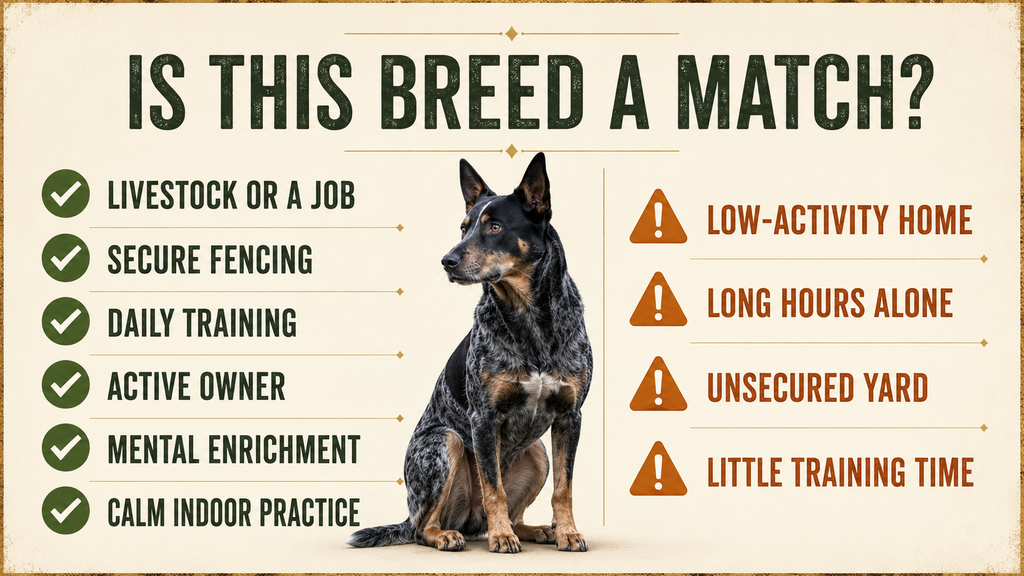
This breed may suit an experienced handler who genuinely needs a versatile cattle dog and appreciates the additional benefit of an alert presence around the property. It may also work in an active rural household that can provide secure space, daily training, consistent boundaries, and meaningful work.
Before choosing a puppy, meet several adult dogs from the breeder’s lines. Watch how they behave around unfamiliar people, household activity, other dogs, livestock, vehicles, noise, veterinary handling, and periods when no work is available.
Ask the breeder for clear information about health screening, working ability, temperament, pedigree, and registration. Avoid sellers who market uncontrolled aggression as protection, refuse to show stable adult dogs, or claim that every puppy will suit every household.
Questions to ask before choosing this breed
- Do I have cattle or another suitable outlet for intensive working behaviour?
- Can I provide structured physical and mental activity every day?
- Is my fencing secure enough for an athletic and persistent dog?
- Can I safely manage the dog when visitors or delivery workers arrive?
- Are all adults in the household willing to follow consistent rules?
- Do I have access to an experienced reward-based trainer?
- Am I looking for an alert companion or expecting physical protection?
- Have I checked insurance, housing, and local animal-control requirements?
If several of these questions are difficult to answer, I recommend choosing a different breed or improving your home’s physical security. Choose a dog that fits your ordinary weekday routine rather than the lifestyle you hope to maintain later.
Better Alternatives for Home Protection
If your primary goal is protecting a home rather than working cattle, another breed or a temperament-tested adult dog may be more suitable. The right substitute depends on whether you want alert barking, visual deterrence, family companionship, livestock protection, or professionally managed personal protection.
The American Kennel Club’s guard-dog guidance explains that guardian breeds require proper training and socialization because of their size, strength, and protective tendencies. No breed should be treated as an automatic or maintenance-free security system.
| Alternative | Potentially suitable for | Important limitation |
|---|---|---|
| German Shepherd Dog | Experienced active owners seeking a versatile and trainable worker | Requires careful breeding, exercise and ongoing training |
| Doberman Pinscher | Active households wanting an attentive dog closely connected to its people | Can be too demanding for inexperienced or low-activity owners |
| Rottweiler | Experienced owners wanting a powerful family and property presence | Strength requires excellent control and insurance checks |
| Giant Schnauzer | Active owners seeking intelligence, visibility and working ability | Needs substantial training, exercise and grooming |
| Anatolian Shepherd Dog | Rural properties requiring livestock predator deterrence | Independent livestock guardian, not an easy suburban pet |
| Temperament-tested adult dog | Households mainly wanting alert barking and companionship | Protection ability should not be assumed from appearance |
German Shepherd Dog
The German Shepherd Dog is recognized as a versatile worker with confidence, courage, intelligence, and a close connection to its handler. A carefully bred, temperamentally stable individual may be a better option for an experienced owner interested in advanced obedience and professionally supervised protection work.
The breed still requires substantial exercise, socialization, health screening, and ongoing training. Poor breeding or unmanaged fear can produce significant behavioural and health problems.
Doberman Pinscher
The Doberman Pinscher was developed with personal protection more directly in mind and is known for vigilance and intelligence. It may suit an active owner who wants a responsive dog that lives closely with the household.
A Doberman should not be treated as outdoor security equipment. It needs companionship, structured activity, careful socialization, health screening, and protection from extreme weather.
Rottweiler
The Rottweiler combines physical strength with an imposing presence. A stable and properly trained individual may be an affectionate household companion while providing meaningful visual deterrence.
Its size means that poor leash control or inadequate socialization can have serious consequences. Owners should investigate insurance, rental, association, and local restrictions before bringing one home.
Giant Schnauzer
The Giant Schnauzer is powerful, intelligent, loyal, and highly noticeable around a property. It may suit an experienced owner who enjoys intensive training and can provide demanding physical and mental work.
This is not a low-maintenance alternative. Regular grooming, consistent structure, early socialization, and daily engagement are essential.
Anatolian Shepherd Dog
An Anatolian Shepherd may be more appropriate when the actual objective is protecting livestock from predators. These dogs are independent guardians rather than cattle-herding dogs, and they normally require secure rural space and experienced management.
They are not automatic substitutes for suburban home protection. Their size, independence, barking, territorial behaviour, and fencing needs can be difficult for an ordinary household.
A known adult dog may be better
If your real goal is simply to know when someone approaches, you may not need a specialized protection breed. A temperament-tested adult dog can offer a clearer picture of barking behaviour, sociability, energy, size, and compatibility with other animals.
A reputable shelter, rescue, foster home, breeder, or trainer may help identify a stable dog that alerts without becoming uncontrollable. For many households, this is safer and more realistic than raising a high-drive protection prospect.

How to Train a Hangin’ Tree Cowdog Safely
Start with household manners rather than protection exercises. Reliable recall, leash walking, place training, calm door behaviour, leave-it, disengagement, handling tolerance, and the ability to settle are more useful in daily life than deliberately encouraging suspicion.
The American Veterinary Society of Animal Behavior recommends reward-based methods for training and behaviour modification. Intimidation, deliberate provocation, and other aversive methods can increase fear, damage trust, and make a dog’s responses less predictable.
Build a safe foundation
- Socialize the dog carefully to people, clothing, vehicles, surfaces, sounds, and routine visitors.
- Teach a designated place away from the front door.
- Reward an appropriate alert, then teach a reliable quiet cue.
- Prevent rehearsals of fence-running and uncontrolled charging.
- Use gates, leashes, crates, and closed rooms when visitors enter.
- Practise recall and disengagement around gradually increasing distractions.
- Contact a credentialed professional when guarding, fear, or aggressive behaviour appears.
The American Veterinary Medical Association’s dog-bite prevention guidance emphasizes that any dog can bite. Breed labels do not replace responsible management, supervision, training, and attention to the individual animal’s behaviour.

Never Rely on a Dog as Your Only Security Measure
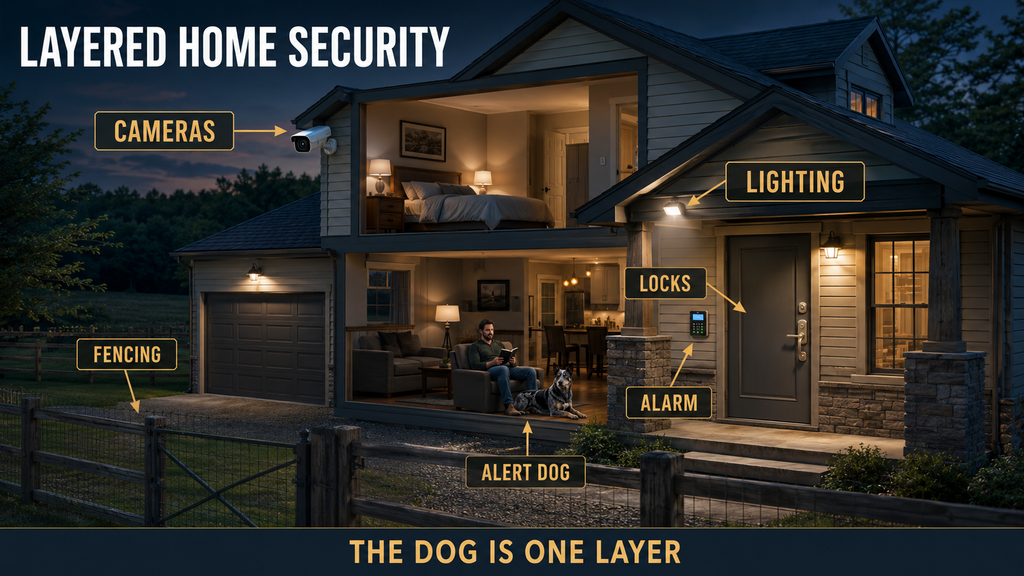
Even a capable protection dog can be asleep, distracted, confined, ill, away from home, or unwilling to confront a threat. Depending entirely on an animal can create false confidence while exposing the dog to avoidable danger.
Use layered security instead. Secure doors and windows, visible cameras, motion lighting, alarms, appropriate fencing, trimmed landscaping, and reliable garage access protect the property without requiring a dog to make a high-risk decision.
For example, smart exterior lighting and practical entrance upgrades can improve visibility around doors, paths, and dark areas. You should also address warning signs that your garage door needs professional attention because an unreliable garage entrance can weaken the rest of your security plan.
Insurance, Housing, and Liability
Ask your insurer how it evaluates dogs before bringing home a guardian-type breed or beginning specialized protection training. Policies and underwriting practices vary and may consider breed, size, bite history, training, or the individual dog’s previous behaviour.
The National Association of Insurance Commissioners explains changing breed-related insurance rules, including how some states limit the use of breed alone in coverage decisions. That does not guarantee coverage, so confirm your policy, rental agreement, homeowners association rules, fencing requirements, and local dangerous-dog laws.
Do not market an uncontrolled pet as attack-trained or permit territorial behaviour around workers and invited guests. If you are considering specialized protection training, consult your insurer and a suitably qualified professional before starting.
This article provides general ownership and safety information. It is not individualized veterinary, behavioural, insurance, or legal advice.
Frequently Asked Questions
Is the correct name Hanging Tree Dog or Hangin’ Tree Cowdog?
The official name is Hangin’ Tree Cowdog. “Hanging Tree Dog” is a common search variation, but it is not the correct breed name.
Are Hangin’ Tree Cowdogs naturally aggressive?
Hangin’ Tree Cowdogs were developed to apply enough pressure to move and handle cattle, but that does not mean every dog is aggressive toward people. Temperament depends on genetics, health, early experiences, training, environment, and the individual dog.
Will a Hangin’ Tree Cowdog bark at strangers?
Some individuals may alert when an unfamiliar person, vehicle, or animal approaches, while others may be quieter. Barking can be useful, but uncontrolled territorial barking should be addressed through training and management.
Are Hangin’ Tree Cowdogs good family pets?
They can fit experienced, highly active households that understand working dogs and provide meaningful daily activity. They may be unsuitable for homes expecting a relaxed pet that is satisfied with occasional walks and long periods alone.
Can I train a Hangin’ Tree Cowdog for personal protection?
An individual dog would need a professional temperament assessment before any specialized work was considered. Do not attempt bite or attack training yourself, and do not assume courage around cattle translates into safe human-directed protection.
How much exercise does a Hangin’ Tree Cowdog need?
There is no universal number because age, health, working schedule, and temperament vary. Owners should expect to provide substantial physical activity, mental work, obedience practice, and structured opportunities to rest.
What is the best alternative to a Hangin’ Tree Cowdog?
For an experienced and active owner wanting a versatile guardian, a carefully bred German Shepherd may be a more direct match. Dobermans, Rottweilers, and Giant Schnauzers may suit other experienced households, while an Anatolian Shepherd is more appropriate when livestock protection is the real objective.
Conclusion
So, Can a Hangin’ Tree Cowdog Protect Your Home? It may provide useful alerting and visual deterrence, but dependable home protection is not the breed’s original purpose. This is primarily an intensive cattle-working dog that needs meaningful work, experienced handling, secure management, and humane training.
If cattle work is not part of your lifestyle, compare more suitable guardian breeds or consider a temperament-tested adult alert dog. Before deciding, speak with a responsible breeder or rescue, a credentialed reward-based trainer, your veterinarian, and your insurer so the dog you choose is safe, manageable, and genuinely suitable for your home.