


Soft White vs Warm White: What’s the Real Difference?
You are standing in the lighting aisle with two boxes in your hands. One says soft white. The other says warm white. They both look yellowish through the plastic packaging, and the shelf tag does not help much either. So which one do you actually need for your living room, your bedroom, or that string of Christmas lights you just bought?
Here is the short answer. Soft white and warm white are both low on the Kelvin scale, so they both give you a cozy, yellow-toned glow. Soft white usually sits around 2700K to 3000K. Warm white usually sits a bit higher, around 3000K to 3500K, which makes it slightly whiter and a touch brighter than soft white. The difference is real, but it is small enough that most people cannot tell them apart unless the bulbs are sitting side by side.
In this guide, I will walk you through exactly what separates soft white from warm white, show you the Kelvin numbers in plain terms, and help you pick the right one for every room in your home, including your Christmas lights. I will also share what actual sleep research says about warm versus cool light, something most articles on this topic skip entirely.
What Do Soft White and Warm White Actually Mean?
Every light bulb you buy has a color temperature, measured in Kelvin (K). This number tells you how the light looks to your eyes, not how hot the bulb runs. It is a naming convention, not a law of physics, and that is exactly why the terms get confusing.
Lower Kelvin numbers mean the light leans yellow and orange, like a candle or a sunset. Higher Kelvin numbers mean the light leans blue and white, like an overcast sky at noon. The ENERGY STAR light bulb guide puts it simply: lower K means warmer, yellowish light, while higher K means cooler, bluer light.
Soft white and warm white both fall on the low, cozy end of that scale. That is the root of all the confusion. They are neighbors on the same street, not opposites.
- Soft white typically ranges from 2700K to 3000K. This is the closest match to the classic incandescent bulbs your parents and grandparents grew up with.
- Warm white typically ranges from 3000K to 3500K, sometimes stretching closer to 4000K depending on the brand. It carries a bit less yellow and a bit more clarity.
If you want a simple mental image, think of soft white as an old-fashioned filament bulb glowing in a lamp, and warm white as that same bulb with just a touch more daylight mixed in.
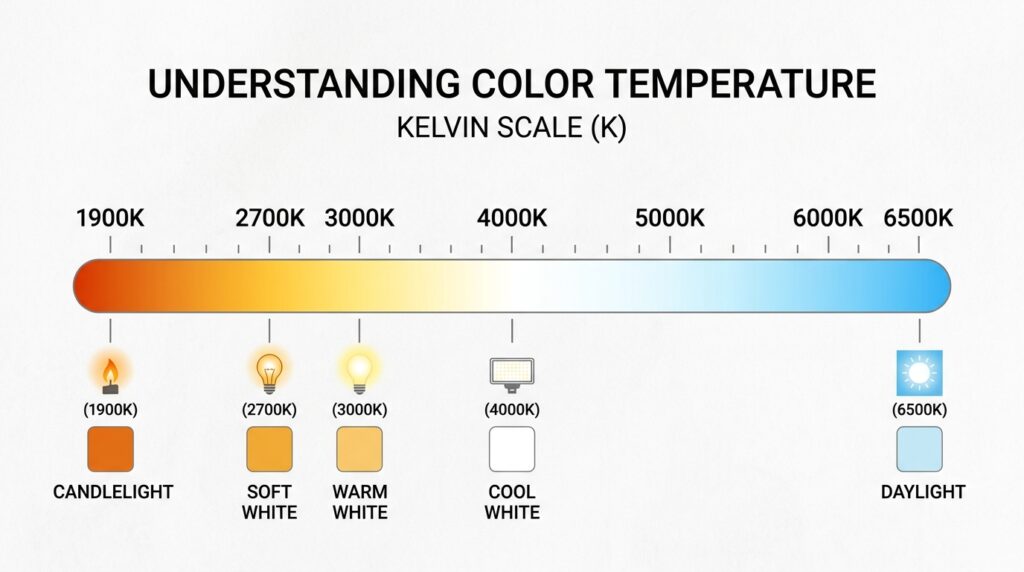
Soft White vs Warm White: The Kelvin Numbers, Compared
Here is where most buying guides get sloppy, and honestly, where a lot of manufacturers get sloppy too. There is no single, universally enforced Kelvin range for soft white or warm white. Different brands use slightly different cutoffs. As the lighting retailer SuperLightingLED points out, the ranges given for warm white and soft white are not uniform across the industry, and even the word “soft” versus “warm” can flip meaning depending on who wrote the label.
That said, here is the range you will see most often on real product packaging in the US:
| Term | Typical Kelvin Range | Look and Feel |
|---|---|---|
| Soft White | 2700K to 3000K | Golden yellow, closest to old incandescent bulbs |
| Warm White | 3000K to 3500K | Slightly whiter and crisper, less heavy yellow |
| Bright White / Pure White | 3500K to 4100K | Clean white with almost no yellow or blue tint |
| Cool White | 4000K to 5000K | Slight blue tint, office and workspace feel |
| Daylight | 5000K to 6500K | Bright blue white, mimics midday sun |
Notice that soft white and warm white actually overlap at the 3000K mark. A bulb labeled 3000K could legitimately be sold as either soft white or warm white depending on the manufacturer’s naming choice. This is why two “warm white” bulbs from two different brands sitting in the same lamp can look mismatched.
One more thing worth knowing, and this is something the Feit Electric lighting guide explains well: color temperature and brightness are two completely separate specs. A soft white bulb is not automatically dimmer than a warm white bulb. Brightness is measured in lumens, not Kelvin, so always check both numbers on the box.
Kelvin vs Watts: Do Not Confuse the Two
While you are reading that box, you will also see a wattage number. Watts tell you how much electricity the bulb pulls, not how the light looks or how bright it is. This distinction matters more with LEDs, since an LED bulb can produce the same light output as an old incandescent while using a fraction of the power. So when you are comparing soft white vs warm white light bulbs, ignore the watt number for color decisions and only use it to gauge energy use.
Soft White vs Warm: How Each One Feels in Real Rooms
Numbers on a Kelvin scale only get you so far. What actually matters is how the light feels once it is glowing above your kitchen table or beside your bed. I have broken this down room by room, because that is really how most people decide between warm vs soft white in the first place.
Living Room
Soft white is the classic choice here. It creates that relaxed, homey glow you want after a long day, and it pairs beautifully with wood furniture, warm rugs, and neutral wall colors.
Bedroom
Soft white again takes the lead. The lower Kelvin, softer yellow tone is gentler on the eyes right before bed and does not fight against your body’s natural wind down signals, which we will get into in more detail in the science section below.
Kitchen
This is where warm white starts to shine, literally. You want enough clarity to see what you are chopping and cooking, and warm white gives you that extra bit of crispness without going all the way to a cold, clinical cool white.
Bathroom
Warm white is generally the better call for vanity lighting, since you need enough truthfulness in the light to judge how you actually look, while still keeping the space from feeling like a hospital.
Dining Room
Soft white wins again for most dinner tables, since a golden, candlelit feel makes food and conversation feel more inviting.
Home Office
Neither soft white nor warm white is ideal here if you are doing focused work. Both are still on the cozy end of the spectrum, and cooler temperatures around 4000K to 5000K tend to support alertness better, according to lighting researchers at Lumens, who note that cooler temperatures in that range mimic natural daylight and can help improve focus in home offices.
| Room | Better Choice | Why |
|---|---|---|
| Living Room | Soft White | Cozy, relaxed, matches wood and neutral tones |
| Bedroom | Soft White | Gentler on eyes, supports winding down |
| Kitchen | Warm White | Slightly more clarity for food prep |
| Bathroom | Warm White | Truer color rendering without feeling cold |
| Dining Room | Soft White | Warm, inviting, candlelight-like mood |
| Home Office | Neither (try 4000K+) | Cooler light supports focus and alertness |
| Nursery | Soft White | Calming and gentle for sleep routines |
If you are planning out lighting for an entire home renovation or a room refresh, it helps to map this out room by room before you buy anything. I have put together a full room-by-room home lighting checklist on HomeUpright that walks through fixture placement and bulb choice together, which pairs well with this Kelvin breakdown.

Warm White vs Soft White Light Bulbs: LED, Incandescent, and CRI
Old incandescent bulbs only ever came in one real flavor, a warm yellowish glow sitting close to 2700K, simply because that is the natural color a heated tungsten filament produces. There was no soft white versus warm white argument back then, because there was really only one option.
LEDs changed everything. Because an LED chip does not glow from heat the way a filament does, manufacturers can tune the color output using phosphor coatings and chip design, which is exactly why we now have a whole spectrum of “white” options to choose from, according to lighting supplier Holiday LED. This flexibility is great for consumers, but it is also the reason labeling is so inconsistent between brands.
There is a second spec worth understanding here: CRI, or Color Rendering Index. CRI measures how accurately a light source reveals true colors compared to natural daylight, on a scale up to 100. Two bulbs can share the exact same Kelvin rating and still render colors differently if their CRI is not the same. For everyday home use, a CRI of 80 or higher is considered solid, while 90 and above is noticeably richer and truer to life, a detail confirmed by lighting retailers like The Christmas Light Emporium when discussing decorative lighting quality.
Do LED Soft White Bulbs Use Less Energy Than Warm White?
No. Energy use in LEDs comes down to wattage and the quality of the LED driver, not the color temperature. A 9 watt soft white LED and a 9 watt warm white LED from the same product line will use almost identical electricity. Both will still use up to 80 percent less energy than an old incandescent bulb of similar brightness.
The Science: How Soft White and Warm Light Actually Affect Your Sleep
This is the part almost every other article on this topic leaves out completely, and it is arguably the most useful thing you can learn before buying bulbs for your bedroom.
Your body’s internal clock, called the circadian rhythm, is highly sensitive to light color, specifically to blue wavelengths sitting around 400 to 495 nanometers. Blue-rich light suppresses melatonin, the hormone your brain releases to help you feel sleepy. Warmer, more amber toned light does far less of this.
A 2026 study published in Scientific Reports actually measured this effect directly, using something researchers call the Melatonin Suppression Value, or MSV. Here is what they found when comparing common home lighting types:
| Light Source | Melatonin Suppression Value (MSV) |
|---|---|
| Cool White LED | 12.3% |
| Cool White CFL | 12.1% |
| Warm White LED | 3.6% |
| Warm White CFL | 2.6% |
| Traditional Incandescent | 1.5% |
Look at that gap. Cool white LED lighting suppressed melatonin roughly three to four times more than warm white lighting, and about eight times more than a traditional incandescent bulb. This is a genuinely useful, data-backed reason to lean toward soft white or warm white in bedrooms specifically, rather than just a design preference. To build on the points above, you may find Soft White vs Daylight useful. It addresses a related topic and offers another way to think about the issue.
A separate study on children published through the National Library of Medicine found that light at 6200K caused significantly greater melatonin suppression in children than light at 3000K, and also reduced their subjective sleepiness at night. The researchers concluded that low color temperature light is recommended at night, particularly for children’s sleep and circadian rhythm, which is a strong argument for keeping kids’ bedrooms and nurseries on soft white bulbs rather than anything cooler.
The Sleep Foundation backs this up from a practical angle too, noting that warm hues of red, orange, and yellow are better for preparing the mind and body for sleep, while bright, cool-toned light such as blue light from screens can inhibit melatonin production and keep you awake.
What This Means for Your Bulb Shopping List
- Bedrooms and nurseries: stick to soft white, 2700K to 3000K, especially for any light used in the hour before bed.
- Living rooms in the evening: soft white or warm white both work, since either is dramatically gentler than cool white or daylight bulbs.
- Kitchens and bathrooms used mostly during the day: warm white or even a slightly cooler bulb is fine, since melatonin suppression matters far more at night than during active daytime hours.
- If you use your phone or a bright cool white lamp right before bed, swapping just that one bulb for soft white is one of the simplest, evidence-backed changes you can make.

Warm White vs Soft White Christmas Lights: Which Should You Buy
The soft white versus warm white question gets even more common every winter, when everyone is standing in the seasonal aisle trying to pick between strings of lights that all look basically the same color under store fluorescents.
Christmas light manufacturers generally use warm white to describe lights in the 2700K to 3300K range, producing that classic golden glow reminiscent of old-fashioned incandescent Christmas bulbs, according to Holiday LED. Soft white, when it appears as a separate label at all, tends to sit at the lower, more yellow end of that same range, closer to 2700K.
Retailer Christmas Designers describes warm white Christmas lights as a soft yellowish white, similar to candlelight or incandescent bulbs, and importantly notes that color temperature does not indicate brightness. Warm white LED strands are just as bright as any other LED string; they just look softer.
Here is the honest truth about buying warm white or soft white Christmas lights: stick with one manufacturer for your entire display. Different brands sort their LEDs into slightly different color “bins” during production, so a warm white string from one company can look noticeably more yellow or more white than a warm white string from another company, even though both boxes use the identical label. The Christmas Light Emporium recommends buying enough lights from one batch to cover your whole display and keeping spares on hand for exactly this reason.
Warm White vs Soft White Christmas Lights: Quick Comparison
| Feature | Warm White Christmas Lights | Soft White Christmas Lights |
|---|---|---|
| Typical Kelvin | 2700K to 3300K | Around 2700K |
| Best For | Classic, traditional tree and roofline displays | Nostalgic, candlelight style displays |
| Pairs Well With | Red, green, and gold ornaments | Wood tones, rustic and vintage themes |
| Energy Use | Same as any comparable LED string | Same as any comparable LED string |
| Buying Tip | Buy all strands from one manufacturer | Buy all strands from one manufacturer |
If your holiday decor leans traditional, with reds, greens, and gold accents, warm white or soft white will both look right at home. If you want a crisp, modern, snow-covered look instead, that is where cool white, sitting up around 4000K to 6500K, becomes the better pick, since it mimics moonlight and fresh snow rather than a fireplace glow.

How to Choose Between Soft White and Warm White for Your Home
At this point you have the Kelvin numbers, the room recommendations, and even the sleep science. Here is a simple decision process you can actually use while standing in the store or scrolling a product page.
- Check the Kelvin number first, not just the label. If the box says 2700K to 3000K, treat it as soft white behavior regardless of what word is printed on the front. If it says 3000K to 3500K, expect a slightly whiter, warm white feel.
- Think about the room’s main purpose. Relaxing spaces lean soft white. Task-focused spaces lean warm white or slightly cooler.
- Match your existing bulbs. If half your house is already soft white, adding warm white bulbs to one new fixture will look mismatched, even though both are “warm” in the broad sense.
- Consider a tunable bulb if you cannot decide. Many smart bulbs now let you adjust color temperature from an app, letting you test both soft white and warm white in the exact same fixture before committing.
- Check the lumens for brightness, not the Kelvin number. Remember, color and brightness are separate specs entirely.
For a deeper walkthrough on layering different bulb types across a single room, including accent lighting and dimmers, I put together a companion guide on choosing the right lighting layers for every room over on HomeUpright that expands on points 2 and 4 above in a lot more detail.
Common Mistakes People Make When Choosing Bulb Color
- Assuming soft white is always dimmer. Brightness depends on lumens, not Kelvin, so a soft white bulb can easily outshine a warm white one if its lumen count is higher.
- Mixing brands within one fixture. Since Kelvin ranges are not perfectly standardized, two “soft white” bulbs from different manufacturers can look slightly mismatched next to each other.
- Using cool white or daylight bulbs in the bedroom. Based on the melatonin research above, this is one of the easiest habits to fix for better sleep.
- Ignoring CRI on decorative or accent lighting. A low CRI bulb can make skin tones, wood finishes, and food look duller than they really are, even at the “right” Kelvin number.
- Buying Christmas lights from two different sellers and expecting a perfect color match. Always buy the full display from one source when possible.
Expert Tips for Getting Your Lighting Right the First Time
- Buy one bulb first and test it in the actual fixture and room before committing to a whole house of them. Lighting always looks different once it is glowing above your specific walls, floors, and furniture.
- If a room serves two purposes, such as a home office that turns into a reading nook at night, a tunable or smart bulb is worth the extra cost over choosing just one fixed Kelvin.
- Pair soft white or warm white bulbs with dimmer switches where your fixtures allow it. Dimming a warm-toned bulb makes it feel even cozier, while dimming a cool white bulb can sometimes make it look dull instead of warm.
- Keep a spare bulb or two from the exact same product batch, especially for hard-to-reach fixtures, so a future replacement actually matches instead of introducing a mismatched color years later.
- When in doubt for a nursery or bedroom, default to the lowest Kelvin option available, closer to 2700K, based on the sleep research covered earlier in this guide.
Pros and Cons: Soft White vs Warm White
| Soft White | Warm White | |
|---|---|---|
| Pros | Closest match to classic incandescent glow; very relaxing; widely available; gentle on eyes at night | Slightly brighter feel at the same lumens; a bit more visual clarity; still cozy enough for most living spaces |
| Cons | Can feel too dim or too yellow for detailed tasks | Can feel less “cozy” than soft white in very relaxed settings; more brand-to-brand color variation reported by users |
Frequently Asked Questions
Is soft white the same as warm white?
Not exactly, though they are close. Soft white usually sits between 2700K and 3000K, while warm white usually sits a bit higher, between 3000K and 3500K. Both look yellowish and cozy, but warm white is slightly whiter and brighter feeling than soft white.
Which is better for a bedroom, soft white or warm white?
Soft white is generally the better pick for bedrooms. Its lower Kelvin range causes less melatonin suppression than cooler light, based on lighting research from the National Library of Medicine, which helps support natural sleep patterns.
Do soft white and warm white bulbs use different amounts of electricity?
No. Energy use depends on wattage and LED efficiency, not color temperature. A soft white and a warm white bulb of the same wattage and brand will use essentially the same amount of power.
What is the difference between warm white and soft white Christmas lights?
Warm white Christmas lights typically range from 2700K to 3300K, while soft white sits closer to the lower end of that range, around 2700K. Both give a golden, traditional holiday glow, and the visual difference between them is often minor unless the strands are compared side by side.
Can I mix soft white and warm white bulbs in the same room?
You can, but it is not usually recommended within the same fixture or ceiling, since the slight color mismatch tends to be noticeable. Mixing them across different rooms, or intentionally zoning them for effect, works fine as long as each individual fixture stays consistent.
Final Thoughts
Soft white and warm white are close cousins, not opposites. Both sit on the cozy, low Kelvin side of the lighting spectrum, and the real difference comes down to a few hundred degrees Kelvin and a slightly different amount of yellow in the glow. Once you know the actual numbers behind the labels, picking the right bulb for your bedroom, your kitchen, or your holiday lights stops being a guessing game.
If you are planning a bigger lighting refresh across your home, start with the rooms where the science matters most, your bedrooms and any space you wind down in at night, and work outward from there. And if you want more room-specific lighting breakdowns like this one, browse the rest of the home lighting guides over on HomeUpright for practical, no-fluff advice on getting every fixture in your house right.