


Soft White vs Daylight: The Complete Guide to Choosing the Right Light Bulb
You’re standing in the light bulb aisle, holding two packs that look almost identical. One says “soft white.” The other says “daylight.” Same shape, same price, same brand. So why does your kitchen look completely different depending on which one you grab?
That’s the soft white vs daylight problem in a nutshell. It sounds like a small decision, but it changes how your entire room looks, feels, and functions. Pick the wrong one, and your cozy bedroom suddenly feels like a hospital waiting room. Or your home office feels too dim to actually work in.
I’m going to tell you exactly what separates these two, plus how cool white vs daylight and daylight vs bright white fit into the picture. By the end, you’ll know exactly which bulb belongs in which room, and why, backed by real lighting standards instead of guesswork.
A Quick Story: Why This Trips Up So Many People
A friend of mine redid her kitchen last year. New cabinets, new countertops, the works. Then she grabbed a random six-pack of bulbs on her way out of the hardware store without checking the label.
She installed them, and the kitchen looked… off. Not bad exactly, just strangely dim and a little yellow, like it was permanently stuck in golden-hour lighting. Turns out she’d bought soft white bulbs for a kitchen she’d designed around bright white countertops and stainless steel.
She swapped them for daylight bulbs the next weekend, and the whole room changed. Same cabinets, same countertops, same layout. The only difference was the Kelvin number on the box. That’s the power of this decision, and it’s why it’s worth five minutes of research before you buy.
What Do “Soft White” and “Daylight” Actually Mean?
Soft white and daylight aren’t brand names or marketing gimmicks. They describe color temperature, which is how warm (yellow) or cool (blue) a light looks. For readers dealing with a similar issue, Soft White vs Warm White may be helpful. It covers a related situation and adds detail that works well alongside this guide.
This is measured in Kelvin (K), and it has nothing to do with how bright the bulb is. Two bulbs can produce the exact same amount of light and still look completely different in color.
The Kelvin Scale, Explained Simply
Think of it like a stove burner. A low flame glows orange-red. Crank up the heat, and it shifts toward white and then blue. Light bulbs work on the same visual logic, even though the physics are different.
The Department of Energy explains that the appearance of light is measured by correlated color temperature on the Kelvin scale, ranging from warm to cool. Lower numbers mean warmer, more yellow light. Higher numbers mean cooler, bluer light.
Here’s the general breakdown most manufacturers and retailers use:
| Kelvin Range | Common Name | Appearance |
|---|---|---|
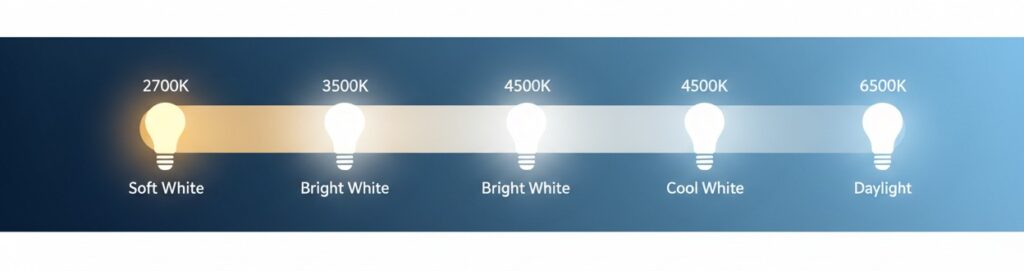
| 2700K–3000K | Soft White / Warm White | Yellowish, cozy, candle-like |
| 3500K–4100K | Bright White / Cool White | Neutral, balanced white |
| 5000K–6500K | Daylight | Crisp, bluish-white |
According to ENERGY STAR, bulbs designed to match the color of traditional incandescent lighting are around 2200K to 3000K, while bluer, whiter light is in the 5000K to 6500K range.
Soft White vs Daylight vs Cool White vs Bright White: Quick Reference
This is where most people get tripped up. These four terms get used loosely, and manufacturers aren’t always consistent. Here’s the cleanest way to think about it.
- Soft white = 2700K–3000K, warm and yellow
- Bright white/cool white = 3500K–4100K, neutral
- Daylight = 5000K–6500K, cool and blue-white
Soft White vs Daylight: Side-by-Side Comparison
Let’s put it all in one place so you can see the full picture at a glance.
| Feature | Soft White | Daylight |
|---|---|---|
| Kelvin Range | 2700K–3000K | 5000K–6500K |
| Light Color | Warm yellow/orange | Cool blue-white |
| Mood | Cozy, relaxing | Alert, energizing |
| Best For | Bedrooms, living rooms | Kitchens, offices, garages |
| Resembles | Traditional incandescent bulbs | Midday outdoor sunlight |
| Eye Strain (evening use) | Lower | Higher, if used late at night |
| Color Accuracy for Tasks | Lower contrast | Higher contrast and detail |
As LEDVANCE puts it, soft white creates a warm atmosphere, while daylight enhances visibility for tasks. That single sentence explains almost the entire decision.
Daylight vs Soft White: How Each One Looks and Feels in Real Life
Specs on a chart are one thing. Standing in the room is another. Here’s what actually changes.
What Soft White Looks Like
Soft white mimics the glow of old-school incandescent bulbs. It leans yellow and orange, and it makes skin tones, wood furniture, and warm-colored walls look richer.
Walk into a restaurant with dim, golden lighting, and you’re probably standing under something close to 2700K. That’s soft white doing its job: making a space feel relaxed and lived-in.
The tradeoff is contrast. Fine print, dark fabric details, and small text are harder to read under soft white, especially as the bulb dims further.
What Daylight Looks Like
Daylight bulbs push toward blue. SuperLightingLED notes that daylight color temperature closely resembles the natural outdoor light we see during the day, and that pure sunlight itself sits around 5000K.
Under daylight bulbs, colors pop more, shadows are sharper, and everything feels more “awake.” That’s exactly why offices, garages, and bathrooms often use it. It’s also why it can feel harsh in a room meant for winding down.

Cool White vs Daylight: Are They the Same Thing?
Short answer: No, but they’re close cousins, and this is genuinely confusing because brands don’t all agree on the label.
Cool white typically sits around 4000K to 4500K. SuperLightingLED explains that daylight, at 5000K to 6500K, has a higher color temperature and a cooler tone than bright white or cool white.
So when you’re comparing cool white vs daylight, remember:
- Cool white leans neutral-to-cool, good for general everyday brightness
- Daylight leans much bluer and more intense, closer to true outdoor light
If a cool white bulb still feels “too warm” for a garage or workspace, daylight is usually the next step up on the Kelvin scale.
Daylight vs Bright White: Don’t Get These Confused
This is the other pairing people mix up constantly. Bright white generally sits between 3500K and 4100K. Daylight sits higher, at 5000K to 6500K.
Bright white gives you a clean, neutral look without the blue cast. It’s a popular middle ground for kitchens where you want more clarity than soft white but don’t want the stark blue tone of daylight.
If your goal is “not too yellow, not too blue,” bright white is likely your answer. If your goal is “as close to actual sunlight as possible,” daylight wins.
Room-by-Room Guide: Which Bulb Belongs Where
This is the part that actually matters when you’re standing in a store trying to decide. Here’s a breakdown based on how each space is used.
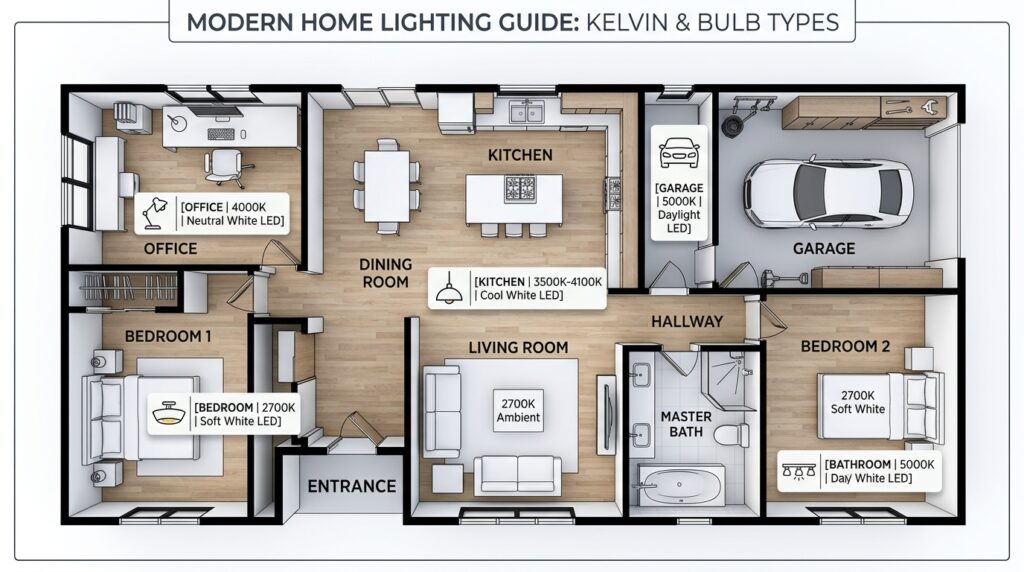
Bedroom
Soft white, every time. You want your bedroom to help you wind down, not wake you up. A 2700K bulb supports that relaxed, low-stimulation feeling before sleep.
Living Room
Soft white or a mix of soft white and bright white works best here. This is where you relax, host guests, and watch TV. Warmer tones keep the space feeling comfortable.
Kitchen
This one’s genuinely split. Many experts suggest daylight or bright white for task areas like the stove and counters, where you need to see what you’re cooking clearly, paired with softer under-cabinet lighting for ambiance.
Think about what actually happens in a kitchen. You’re checking whether food is fully cooked, reading recipe measurements, and chopping vegetables near sharp edges. Contrast and clarity matter more here than in almost any other room. That’s why daylight or bright white tends to work better for the main ceiling fixtures, while a soft-white pendant over a breakfast nook can still add warmth without compromising visibility where it counts.
If your kitchen opens into a dining or living area, it’s worth considering the transition, too. A sudden jump from 6500K daylight in the kitchen to 2700K soft white in the living room can feel jarring. A lot of designers bridge that gap with bright white, somewhere in the 3500K to 4000K range, so the two spaces feel connected instead of mismatched.
Bathroom
Daylight tends to win here, especially near the mirror. Prudent Reviews spoke with a lighting expert at Lamps Plus, one of the largest lighting retailers in the country, who recommended daylight for bathrooms because of the need to see fine detail, like when applying makeup or shaving.
Home Office
Daylight or bright white. You want alertness and contrast here, not a sleepy glow. Cooler light genuinely helps with focus during work hours.
Garage, Basement, Workshop
Daylight is the clear winner. These are task-heavy, detail-heavy spaces, often with little natural light, so a bulb that mimics daylight helps compensate.
Outdoor / Porch
Bright white to daylight, generally in the 3500K to 5000K range, works well for visibility and security without feeling too clinical.
How Wall Color and Furniture Interact With Bulb Color
Here’s something most buying guides skip entirely: the paint on your walls and the finish on your furniture change how a bulb’s color temperature reads in the room.
Warm wall colors, like beige, terracotta, or warm gray, tend to look richer and more inviting under soft white light. Add a daylight bulb to the same wall, and it can look slightly washed out or even faintly greenish because the cool light clashes with the warm undertone in the paint.
Cool wall colors, like true gray, white, or blue-toned neutrals, tend to look crisp and clean under daylight, but can feel flat or slightly dull under soft white. The yellow cast pulls against the cool undertone, muting it.
Wood furniture is another factor. Warm-toned wood, like oak or walnut, tends to glow under soft white. Cooler, gray-washed wood finishes generally photograph and read better under daylight or bright white. If you’re not sure which way to go, a quick trick is to hold a paint swatch or fabric sample under both bulb types before committing to a full room’s worth.
Real Cost Differences: Does Color Temperature Affect Your Energy Bill?
Short answer: not directly. As mentioned earlier, color temperature and energy use aren’t linked. A 2700K bulb and a 6500K bulb of the same wattage and lumen output cost roughly the same to run.
What actually affects your bill is the bulb type. According to the Department of Energy, ENERGY STAR-qualified LED bulbs can save between $ 30 and $ 80 in electricity costs over their lifetime compared to less efficient models, regardless of whether they’re soft white or daylight.
So if you’re trying to cut your lighting costs, focus less on Kelvin and more on:
- Choosing LED over incandescent or halogen
- Checking the wattage relative to lumen output (more lumens per watt is more efficient)
- Looking for the ENERGY STAR label on the packaging
You can genuinely have a home lit entirely with daylight bulbs and pay the same as a home lit entirely with soft white bulbs, as long as the bulb type and wattage are comparable.
Testing Before You Commit a Whole Room
If you’ve never lived with a certain color temperature before, don’t guess. Buy a small multipack, or even just two bulbs of different Kelvin ratings, and test them in the room you’re planning to update.
Install one for a few evenings and pay attention to how the space actually feels, not just how it looks in a quick glance. Does it make reading comfortable? Does it feel too bright when you’re trying to relax? Does it wash out your countertops or make your walls look dull?
A betopperdj.com piece on lighting design makes a solid point here: professional lighting designers emphasize that layering, flexibility, and observing how a space actually feels over time matter more than chasing a single “correct” Kelvin number.
Small test runs like this cost a few dollars and save you from re-buying an entire room’s worth of bulbs twice.
Brightness Isn’t the Same as Color Temperature (Lumens vs Kelvin)
Here’s a mistake almost everyone makes at least once: assuming a higher Kelvin number means a brighter bulb.
It doesn’t. Kelvin measures color, not brightness. Brightness is measured in lumens.
The Department of Energy is direct about this: a lumen measures the amount of light a bulb produces, and more lumens means a brighter bulb, regardless of its color.
So a 2700K soft white bulb and a 5000K daylight bulb can put out the exact same number of lumens and be equally bright. They’ll just look completely different in color.
When shopping, check both numbers on the Lighting Facts label required on bulb packaging:
- Lumens tell you how bright it is
- Kelvin tells you what color it is
Don’t let one substitute for the other.
Does Light Color Actually Affect Your Sleep and Mood?
Yes, and this isn’t just a marketing claim. There’s real research behind it.
Your body’s circadian rhythm, the internal clock that regulates sleep and wakefulness, responds strongly to light, especially blue-heavy light. Harvard Health reports that researchers compared 6.5 hours of blue light exposure to green light of similar brightness, and the blue light suppressed melatonin for roughly twice as long and shifted circadian rhythms by about twice as much.
Daylight bulbs contain more of that blue-spectrum light. That’s great in the morning and during work hours, when you want to be alert. It’s not so great right before bed.
This is part of why so many lighting experts recommend soft white for bedrooms and evening spaces, and daylight for daytime work areas. It’s not just about aesthetics. It genuinely aligns with how your brain interprets light as a “wake up” or “wind down” signal.
On the flip side, daylight bulbs are also used intentionally for light therapy lamps to help with seasonal mood dips during darker months, since bright, cool-toned light can help offset the lack of natural daylight in winter.
It’s worth noting that not all blue light exposure is equal. Light from a phone or laptop screen sits close to your eyes for hours at a time, which is a different kind of exposure than the light from a daylight bulb glowing in a ceiling fixture across the room. Distance and duration both matter. Still, if you’re sensitive to light in the evening or have trouble settling down at night, swapping your bedroom and bathroom bulbs to soft white in the hours before bed is a simple, low-cost change worth trying.
CRI: The Number Most People Ignore When Buying Bulbs
Kelvin and lumens get all the attention, but there’s a third number worth knowing: CRI, or Color Rendering Index.
CRI measures how accurately a light source renders true colors compared to natural light, on a scale of 0 to 100. Most standard household bulbs have a CRI around 80, and ENERGY STAR-qualified bulbs are required to meet at least that threshold.
Why does this matter for soft white vs daylight? Because a low-CRI daylight bulb can still look washed out or slightly off, even though it’s technically “cooler” in color temperature. If color accuracy matters to you, like matching makeup shades, painting, or photography, look for a CRI of 90 or higher regardless of whether you choose soft white or daylight.
Here’s a practical example. Two 5000K daylight bulbs can sit side by side, one at 80 CRI and one at 95 CRI, and look noticeably different in person. The higher-CRI bulb shows reds, skin tones, and fabric colors far more accurately, even though both bulbs share the exact same Kelvin rating. That’s why two “daylight” bulbs from different brands can still look slightly different once installed, and it’s worth checking CRI, not just Kelvin, on the packaging.
LED vs. Incandescent vs. CFL: Does Bulb Type Affect the Comparison?
The soft white vs daylight difference applies across bulb types, but there are a few practical differences worth knowing.
- Incandescent bulbs are naturally warm, usually around 2700K to 3000K. True daylight incandescent bulbs are rare and less efficient.
- CFLs can be made in both warm and cool color temperatures, but they take a moment to reach full brightness and contain small amounts of mercury.
- LEDs are the most flexible option today. They come in nearly every Kelvin range, from 2200K to 6500K, use far less energy, and last significantly longer.
ENERGY STAR-certified LEDs use about 70 to 90 percent less energy than traditional incandescent or halogen bulbs and can last 10 to 25 times longer, which is a major reason most homes have shifted to LED for both soft white and daylight applications.
One more thing worth knowing: the color temperature itself doesn’t change how much energy a bulb uses. Wattage does. So you’re never sacrificing efficiency by choosing one Kelvin range over another.
Pros and Cons of Soft White
Pros:
- Creates a warm, cozy, relaxing atmosphere
- Closely matches traditional incandescent lighting that people are used to
- Flatters skin tones and warm-colored décor
- Better for winding down in the evening
Cons:
- Lower contrast, making fine detail work harder
- Can feel dim or dated in task-heavy spaces
- Not ideal for reading small text for long periods
Pros and Cons of Daylight
Pros:
- Closely mimics natural outdoor light
- Improves visibility and contrast for detailed tasks
- Supports alertness and focus during the day
- Great for windowless rooms like basements and garages
Cons:
- Can feel harsh or clinical in relaxing spaces
- Contains more blue light, which can interfere with sleep if used late at night
- Some cheaper daylight bulbs have a lower CRI and look slightly flat
How to Choose: A Simple Decision Framework
If you’re still unsure, run through this quick checklist:
- What happens in this room? Relaxing = soft white. Working or detailed tasks = daylight.
- What time of day do you use it most? Evening-heavy rooms lean warmer. Daytime task rooms lean cooler.
- Does the room get natural light? Dim, windowless rooms benefit from daylight to compensate. Sunny rooms can handle soft white without feeling dark.
- What’s your décor style? Warm, rustic, and traditional spaces usually pair better with soft white. Modern, minimalist spaces often pair better with daylight or bright white.
- Do you need color accuracy? If yes, prioritize CRI 90+ regardless of the Kelvin rating.
There’s no universal “correct” answer here. It genuinely comes down to function first, then personal preference.
If you’re still torn between two options after running through this list, go with the warmer choice for rooms you sit in for long stretches, and the cooler choice for rooms you pass through or work in briefly. That single rule solves most edge cases without overthinking it.
Common Mistakes People Make When Choosing Bulb Color
- Mixing color temperatures in the same room. A soft white lamp next to a daylight overhead fixture creates a visually jarring, mismatched look.
- Assuming daylight is always “better.” It’s better for tasks, not necessarily for comfort or relaxation.
- Ignoring lumens. Buying based on Kelvin alone can leave you with a room that’s the right color but too dim or too bright.
- Using daylight bulbs in the bedroom. This can make it genuinely harder to fall asleep due to the blue-light effect on melatonin.
- Not checking CRI for detail-heavy spaces, like closets, vanities, or craft rooms.
You can use a generator if electricity is not available. For this purpose you can read our detailed guide about How to Connect a Generator to Your House Without Transfer Switch.
Expert Tips for Mixing Color Temperatures in Your Home
You don’t have to pick just one for your entire home. Most professionally designed homes actually use a mix, room by room.
- Keep the same Kelvin range in a single room to ensure the lighting looks cohesive.
- Use layered lighting: overhead daylight for general brightness, plus a soft white lamp for evening ambiance in the same space.
- In kitchens, pair daylight or bright white task lighting over counters with soft white ambient lighting elsewhere in the room.
- If you’re not ready to commit, look for tunable LED bulbs that let you adjust color temperature with a switch or app, so you’re not locked into one choice.

FAQs
Is soft white or daylight better for a bedroom?
Soft white is generally better for bedrooms. Its warm, low-blue-light tone supports relaxation and is less likely to interfere with your body’s natural wind-down process before sleep.
Which is brighter, soft white or daylight?
Neither is automatically brighter. Brightness depends on lumens, not Kelvin. A soft white and a daylight bulb can have identical lumen output and be equally bright, just different in color.
What Kelvin is closest to natural sunlight?
Around 5000K to 6500K, which is exactly the range used for daylight bulbs. Midday outdoor sunlight itself sits close to 5000K.
Can I use daylight bulbs in my kitchen?
Yes, and many people prefer it for task areas like counters and stovetops, since daylight improves visibility and color contrast. Pairing it with softer ambient lighting elsewhere in the kitchen balances the effect.
Is cool white the same as daylight?
No. Cool white typically ranges from 4000K to 4500K, while daylight ranges from 5000K to 6500K. Daylight is noticeably bluer and more intense than cool white.
Conclusion
At the end of the day, the soft white vs daylight decision isn’t about which one is objectively better. It’s about matching the light to what actually happens in that room.
Soft white brings warmth and comfort to the spaces where you relax. Daylight brings clarity and focus to the spaces where you work and get things done. Once you start thinking room by room instead of picking one bulb for the whole house, the choice gets a lot easier.
Next time you’re standing in that bulb aisle, check the Kelvin number, check the lumens, and think about what that room actually needs to feel like. That’s really all it takes to get it right.
Ready to fix your home’s lighting? Start with just one room today, swap the bulb, and notice the difference for yourself.