


How Long Does It Take for Hot Water to Come Back?
You just finished a shower, and your roommate jumps in next. Two minutes later, you hear a yelp. The water turned cold. Now everyone wants to know the same thing: how long does it take for hot water to come back?
Here is the short version. Most gas water heaters need about 30 to 45 minutes to recover a full tank. Electric water heaters usually need 60 to 90 minutes, sometimes longer. Tankless units do not really “come back” at all, since they heat water on demand rather than storing it.
But that quick answer only tells part of the story. Your actual wait time depends on your tank size, fuel type, thermostat setting, how cold your incoming water is, and how much sediment has built up in your tank over the years. I am going to walk you through every one of these factors, show you the real numbers plumbers and manufacturers use, and give you a few tricks to shorten your wait the next time the water turns cold.
How Long Does It Take for Hot Water to Come Back? The Quick Breakdown
Before we go deep into the science, here is a simple table you can use as a reference. These ranges come from actual recovery data reported by plumbing companies and water heater manufacturers across the country.
| Water Heater Type | Typical Recovery Time (Full Tank) | Time Until First Usable Hot Water |
|---|---|---|
| Gas tank (40 to 50 gallons) | 30 to 45 minutes | 15 to 20 minutes |
| Electric tank (40 to 50 gallons) | 60 to 90 minutes | 30 to 40 minutes |
| Large gas tank (75 to 80 gallons) | 45 to 75 minutes | 20 to 30 minutes |
| Large electric tank (75 to 80 gallons) | 90 to 120 minutes | 40 to 50 minutes |
| Heat pump water heater | 60 to 130 minutes in standard mode | 30 to 45 minutes |
| Tankless (gas or electric) | No recovery wait, heat on demand | Seconds |
Your household’s actual numbers will fall within these ranges. A standard tank water heater usually takes about 20 to 60 minutes to reheat water, depending on tank size, fuel type, and overall system condition. Gas water heaters typically recover faster than electric ones.
If your shower runs cold and you are troubleshooting low water pressure at the same time, it is worth checking how to increase water pressure in your house, since weak pressure can make a partially recovered tank feel even colder than it actually is.

How Long Does It Take for Hot Water to Come Back After a Shower?
This is probably the exact situation that brought you here. You or someone in your house used up the hot water, and now everyone downstairs is waiting.
Fuel type plays the biggest role here. Gas heaters recover roughly twice as fast as electric ones because they transfer heat more efficiently, so a gas heater might give you usable hot water in around 20 minutes while an electric unit could take 30 minutes or more. In addition to the fuel source, three other factors shape your specific wait.
Groundwater temperature. In colder climates, the incoming water supply might sit around 40°F, which takes longer to heat than warmer regions where groundwater runs closer to 60°F, and each 10-degree difference in incoming temperature can shift recovery time by 5 to 10 minutes.
Back-to-back showers. If people are showering one after another, the tank is not getting a full recovery between uses. Instead, everyone is drawing on the leftover hot water while new water heats behind it, which is exactly why the third or fourth person in line often runs out completely.
Tank size versus household size. A 40-gallon tank serving a family of five will always feel slower to recover than the same tank serving two people, simply because there is less buffer left after each shower.
If your shower head is dripping or losing pressure on top of a slow-recovering tank, that is worth a look too. Our guide on how to fix a leaking shower head walks through the easy DIY fix, so you are not fighting two plumbing problems at once.

How Long Does It Take for a Water Heater to Heat Up? Understanding Recovery Rate
Whether you searched for how long it takes for a water heater to heat up, how long a water heater takes to heat up, or how long it takes for a hot water heater to heat up, you are really asking about one thing: recovery rate.
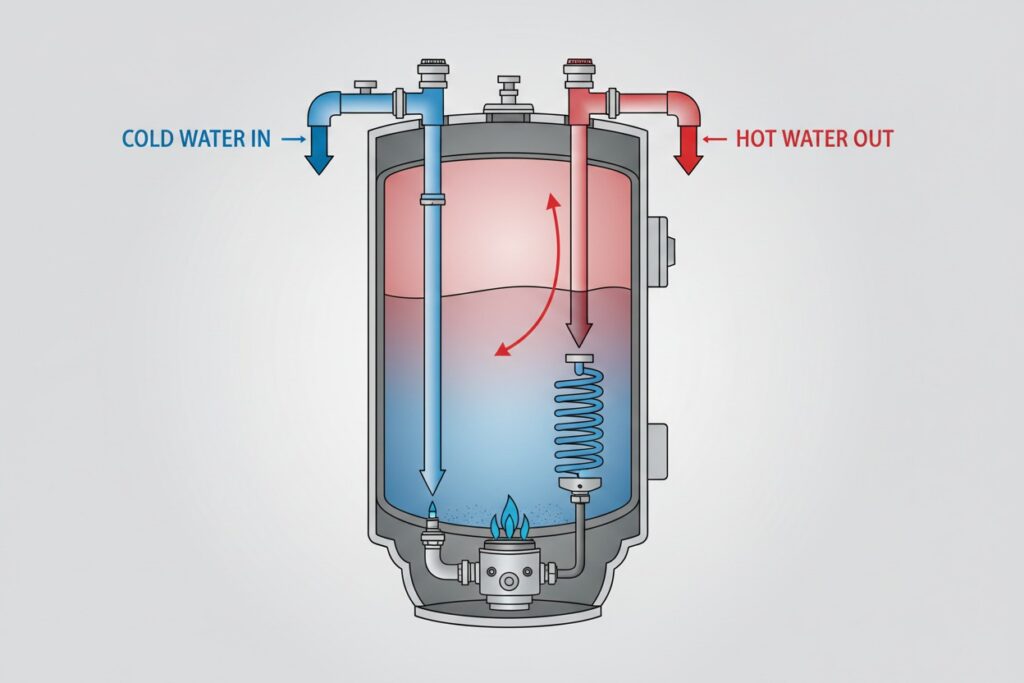
Recovery rate is the number of gallons per hour your water heater can raise the temperature of the incoming cold water to your thermostat setting. The formula used across the plumbing industry is Recovery in gallons per hour equals input BTU per hour multiplied by efficiency, divided by 8.33 multiplied by the temperature rise in degrees Fahrenheit, where 8.33 is the weight of one gallon of water in pounds.
Here is what that looks like with real numbers. A gas water heater with 40,000 BTU per hour input and 80 percent efficiency, heating water from 55°F up to a 120°F setpoint, produces a recovery rate of about 59 gallons per hour. That is why a mid-sized gas tank can be refilled and reheated in well under an hour.
Electric heaters work a little differently because they run on electricity rather than a gas burner. A 4,500-watt heating element converts to roughly 15,354 BTU per hour, while a 5,500-watt element delivers about 18,766 BTU per hour, and even though electric resistance heating converts nearly all of that input energy directly into heat, the actual recovery still depends on tank losses, the condition of the controls, and the incoming water temperature. This is a big part of why electric tanks generally take longer to recover than gas tanks of the same size.
How Long Does It Take a Water Heater to Heat Up From Completely Cold?
If your tank has been drained, shut off, or just installed, you are starting from zero instead of a partial recovery. A 50-gallon gas water heater typically heats up from cold in about 40 to 50 minutes, while a 50-gallon electric water heater takes noticeably longer, around 70 to 100 minutes.
Heat pump water heaters sit in their own category. A heat pump water heater generally needs 60 to 130 minutes to recover a full 50-gallon tank in standard mode, and hybrid models that switch to electric resistance heating under heavy demand can recover in about 60 to 90 minutes instead. That slower recovery is the tradeoff for the impressive efficiency these units offer.
First Hour Rating: The Number That Actually Matters for Your Morning Routine
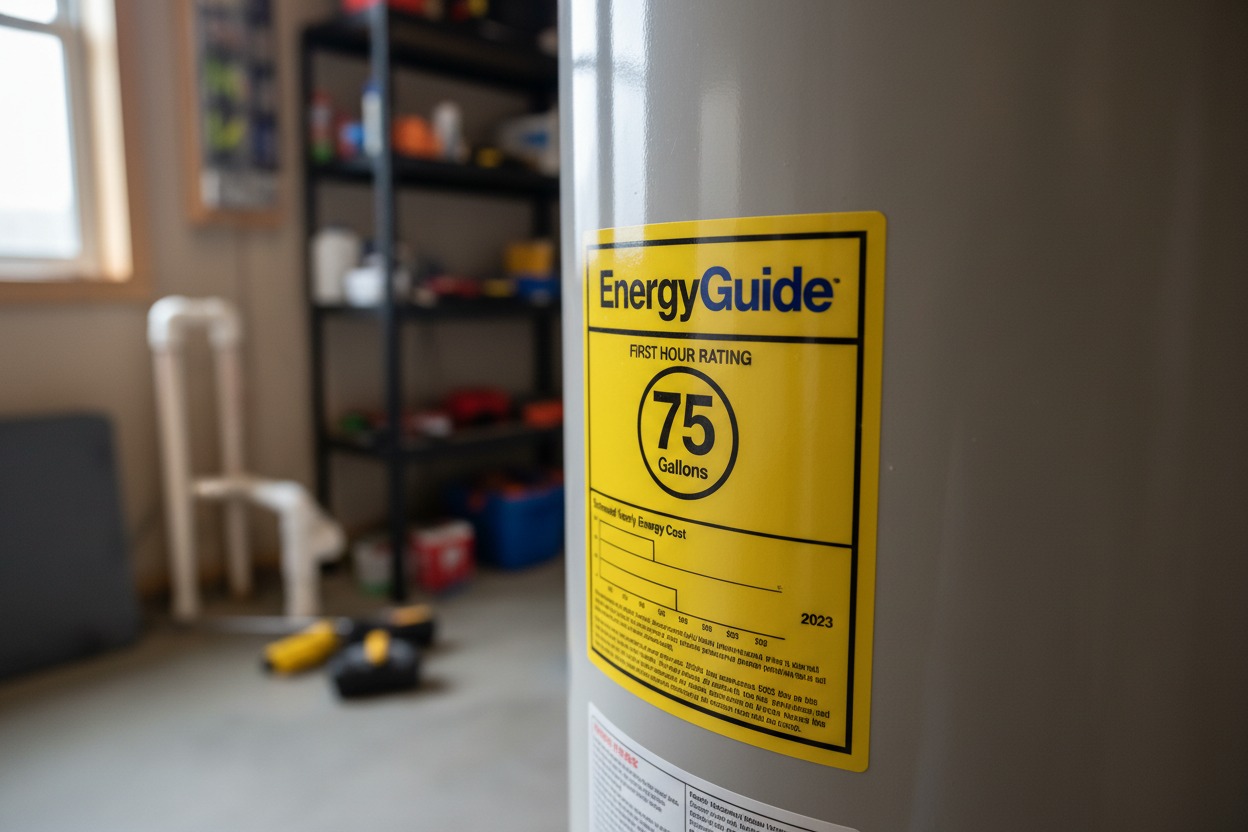
Recovery rate tells you how quickly a heater refills over time, but if you only care about your first shower of the day, you want the first-hour rating instead. The First Hour Rating, sometimes called First Hour Delivery, is the amount of hot water a water heater can provide within the first hour of operation, and it appears directly on the EnergyGuide label required by the U.S. Department of Energy.
A bigger tank does not automatically mean a higher first-hour rating. A lower-powered heating system might need an 80-gallon tank just to match the first-hour output of a stronger, faster-recovering unit from a much smaller tank. This is exactly why two tanks of the same size can feel completely different in real life.
The Department of Energy defines the First Hour Rating as an estimate, in gallons, of the maximum volume of hot water a storage water heater can supply within an hour, starting with the tank fully heated. You can find this number on the yellow EnergyGuide sticker on the side of your unit, and it is one of the most useful specs to compare before buying a replacement.
Gas vs Electric vs Tankless vs Heat Pump: The Full Recovery Comparison
| Factor | Gas Tank | Electric Tank | Heat Pump | Tankless |
|---|---|---|---|---|
| Typical recovery time (50 gal) | 30 to 45 min | 60 to 90 min | 60 to 130 min | No recovery needed |
| Energy source | Natural gas or propane burner | Electric resistance elements | Electric uses ambient heat | Gas or electric, on demand |
| Efficiency (UEF) | 0.60 to 0.70 typical | 0.90 to 0.95 typical | 3.3 to 4.1 typical | 0.80 to 0.96 typical |
| Best for | Households needing fast recovery between uses | Homes without gas lines | Energy conscious households with time to spare | Homes with steady, ongoing hot water demand |
Non-solar water heaters can carry ENERGY STAR certification when they hit a UEF rating in this range, and heat pump water heaters typically show UEF ratings between 3.3 and 4.1, which works out to roughly 330 to 410 percent efficiency. That is genuinely impressive, but it comes at the cost of the slower recovery times you just saw in the table above.
The Uniform Energy Factor is the Department of Energy’s current metric for measuring residential water heater efficiency, replacing the older Energy Factor standard in June 2017. UEF ratings sort water heaters into four usage bins based on daily hot water consumption, and a water heater’s rating can only be fairly compared against another unit in the same bin. So if you are shopping for a replacement, make sure you are comparing apples to apples.
Water Heater Reset Button: Why It Trips and How It Affects Your Wait
If your hot water disappeared suddenly rather than gradually running out, the reset button is one of the first things to check, especially on an electric unit.
The reset button is officially known as the high limit safety switch, and its job is to monitor water temperature. When the water level in the tank rises to an unsafe level, the switch trips automatically and shuts off the heating elements, protecting your home from overheating damage.
Here is roughly how the process works if you decide to check it yourself.
- Turn off the circuit breaker that supplies power to the water heater before you touch anything.
- Remove the upper access panel with a screwdriver.
- Locate the red reset button on the thermostat, which is usually the most visible part once the cover is off.
- Press the button firmly until you hear a click, confirming the reset actually took.
- Reattach the panel and turn the breaker back on.
Once you have reset it, do not expect hot water immediately. Give the heater 30 to 60 minutes to warm the water back up before you check whether hot water has returned.
One important safety note. Never bypass or disable the high-limit switch, as it is a critical safety device. If you are not comfortable working around electricity, there is no shame in calling a professional instead.
If the button will not stay reset, or it trips again right away, that usually points to something bigger than a simple reset. A hot water heater that keeps tripping its reset button is often dealing with a faulty thermostat that is letting the temperature climb too high, and the high limit switch keeps tripping until that thermostat gets replaced. At that point, it is a repair job, not a DIY reset.

How Long Does It Take to Install a Water Heater?
Sometimes the real question is not about waiting for a tank to reheat. It is about waiting for a brand-new water heater to be installed.
A professional water heater installation generally takes about 2 to 4 hours, depending on the type of unit, the complexity of the job, and the condition of your existing plumbing. Here is how that breaks down by type.
Tank-to-tank replacement. Installing a new tank water heater typically takes about two to three hours, including removing the old unit in roughly 45 to 60 minutes, positioning the new heater in about 30 minutes, and spending the final hour hooking up the lines and testing everything.
Tank to tankless conversion. Converting from a tank to a tankless system with a gas line upgrade and new venting usually takes 6 to 10 hours and may require two separate visits if the gas line work needs its own inspection.
Tankless to tankless replacement. If a home already has a tankless system and is simply swapping it for a new one, installation usually takes between one and three hours since the necessary connections are already in place.
What actually eats up the time? A typical like for like replacement follows a set sequence: shutting off gas and water, draining the old tank, disconnecting and removing it, setting the new tank, connecting the water lines, connecting the gas line with a new flexible connector, installing the relief valve and discharge pipe, strapping the tank for earthquake safety, turning everything back on, testing for leaks, and confirming the burner fires correctly. Draining a 50-gallon tank alone takes 20 to 40 minutes, though this step usually overlaps with other prep work rather than adding to the total clock time.
If you are researching a new installation because your current unit keeps having pressure or leak problems, it is also worth reading about how to increase water pressure in your house before you call a plumber, since the fix may be simpler than a full replacement.

What Slows Down Hot Water Recovery (Beyond Just Fuel Type)
Fuel type accounts for most of the gap between gas and electric, but a handful of other issues can quietly extend your wait time even further.
Sediment buildup. Sediment buildup slows recovery time by 25 to 40 percent in tanks older than five years, because the layer of calcium and magnesium insulates the burner or lower element from the water, forcing longer heating cycles.
Tank size mismatch. As a tank nears the end of its hot water supply, recovery takes even longer for larger tanks, since new cold water entering the tank noticeably lowers the temperature of whatever hot water remains.
Thermostat setting. A thermostat set too low will feel slow to recover simply because it never had far to climb in the first place, while one set too high risks tripping the safety switch discussed earlier.
Aging heating elements or burners. Worn elements and dirty burner assemblies transfer heat less efficiently, which drags down the real-world recovery rate even if the unit’s rated BTU or wattage has not changed.
Draw efficiency. Typical draw efficiency runs around 70 percent for standard tanks, but climbs to 85 to 90 percent in tanks equipped with heat traps and a good dip tube design, since cold inlet water otherwise mixes with the stored hot water at the bottom of the tank, reducing the effective output you can actually use.
How to Get Hot Water Back Faster
You cannot rewrite the laws of thermodynamics, but you can shave real time off your wait with a few practical habits.
- Stagger your showers. Spacing showers 20 to 30 minutes apart gives the gas tank time to mostly recover before the next person jumps in.
- Lower the thermostat slightly, but not too low. Keeping the thermostat at around 120°F is the safer target, since higher settings increase the risk of the high-limit switch tripping.
- Flush your tank on schedule. Flushing a water heater every 6 to 12 months helps prevent the sediment buildup that slows recovery, especially in areas with hard water.
- Check the reset button before calling for repair. A quick reset can save you a service call if the issue is just a tripped safety switch rather than a failed part.
- Consider a recirculation pump. These push hot water through your pipes faster, so you are not just waiting on tank recovery; you are also reducing the travel time between the tank and your showerhead.
- Upgrade to a higher first-hour rating unit. If mornings are consistently a struggle, a replacement with a stronger first-hour rating solves the problem at the source rather than working around it.
Pros and Cons: Choosing the Right System for Your Wait Time
Gas tank water heaters
- Pros: Faster recovery, lower operating cost in many regions, works during power outages
- Cons: Needs gas line access, venting requirements, and slightly higher upfront installation complexity
Electric tank water heaters
- Pros: Simpler installation, no venting required, widely available
- Cons: Slower recovery, higher operating cost in many regions, stops working during a power outage
Heat pump water heaters
- Pros: Outstanding efficiency, lower long-term energy bills
- Cons: Slowest recovery of the storage options, needs clearance space and can cool the surrounding room
Tankless water heaters
- Pros: No recovery wait at all, compact footprint, long service life
- Cons: Higher upfront cost, more involved installation, flow rate limits during simultaneous heavy use
Expert Tips From the Plumbing World
A few things that experienced plumbers tend to repeat to homeowners dealing with slow hot water.
Keep an eye on your Energy Guide label. Every tank water heater carries a first-hour rating on its label, and as a general rule, the higher that rating, the faster your unit can recover.
Do not assume bigger always means faster. A large tank stores more hot water upfront, but a weaker heating element or burner inside it can still leave you waiting longer than a smaller, more powerful unit would.
Treat a tripping reset button as a symptom, not the disease. If it trips once after a power surge, a simple reset is fine. If it keeps tripping, that is your water heater telling you something else is wrong.
Match your replacement to your actual routine. If your household showers in a tight window every morning, prioritize the first-hour rating over tank size when you shop for a new unit.
FAQs
How long does it take for hot water to come back after a shower?
Most households wait between 20 and 60 minutes, depending mainly on whether the water heater runs on gas or electricity, the tank size, and how much hot water remains in the tank.
How long does it take for a water heater to heat up from cold?
A 50-gallon gas water heater usually heats up from cold in about 40 to 50 minutes, while a similarly sized electric unit takes roughly 70 to 100 minutes.
How long does it take to install a water heater?
A standard tank to tank replacement typically takes 2 to 3 hours, while converting to a tankless system can take 6 to 10 hours because of the added gas line and venting work involved.
What does the water heater reset button do?
It is a high-limit safety switch that automatically shuts off the heating elements if the water in the tank gets too hot, protecting your home from overheating damage.
Why does my hot water take longer to come back than it used to?
This is usually a sign of sediment buildup inside the tank, an aging heating element or burner, or a thermostat that is no longer holding its setting accurately. Flushing the tank or having it inspected usually solves it.
Final Thoughts
So, how long does it take for the hot water to come back? For most homes, gas heaters fall in the 30 to 45-minute range, and electric heaters are closer to 60 to 90 minutes, with tank size, incoming water temperature, and sediment buildup all nudging that number up or down.
If your wait time has been creeping up lately, do not just live with it. A quick check of your thermostat, reset button, and flushing schedule solves the problem for many households. And if your unit is simply getting old and undersized for your family, it might genuinely be time to replace it with a model with a higher first-hour rating.
Have a water heater question I did not cover here? Drop it in the comments, and I will help you work through it.
Sources Referenced
I have used the following resources for collecting the details and writing a useful article that covers almost all details:
- ENERGY STAR: Water Heater Key Product Criteria
- ENERGY STAR: What is Uniform Energy Factor
- A.O. Smith: Uniform Energy Factor (UEF) for Water Heaters
- U.S. Department of Energy: Water Heater Test Procedure Rulemaking
- Lennox: How to Reset a Water Heater
If you have any further questions, ask in the comment section below. We would love to hear from you.
Thanks for reading!