


How Much Does It Cost to Put in a Well and Septic System?
If you just found a piece of land you love and it has no city water or sewer line anywhere close, you are probably typing the same question into Google that I did a few years back: how much does it cost to put in a well and septic system? I get it. You are trying to figure out if this dream lot is actually affordable, or if it is going to drain your bank account before you even pour a foundation.
Here is the short version. Most homeowners pay between $6,000 and $25,000 to install both a well and a septic system, with many properties landing around $13,000 to $18,000 once permits, testing, and site work are added in. But that range is wide for a reason. Your soil, your well depth, your county rules, and the type of septic system you need can push your total up or down by thousands of dollars.
I am not going to just repeat the same numbers every other article throws at you. In this guide, I will walk you through exactly what drives that price, break down the monthly cost of owning a well and septic system after installation (something most guides skip completely), compare concrete versus plastic tanks, and show you where homeowners tend to overspend without realizing it. Let me walk you through this the same way I would explain it to a friend who just bought rural land.
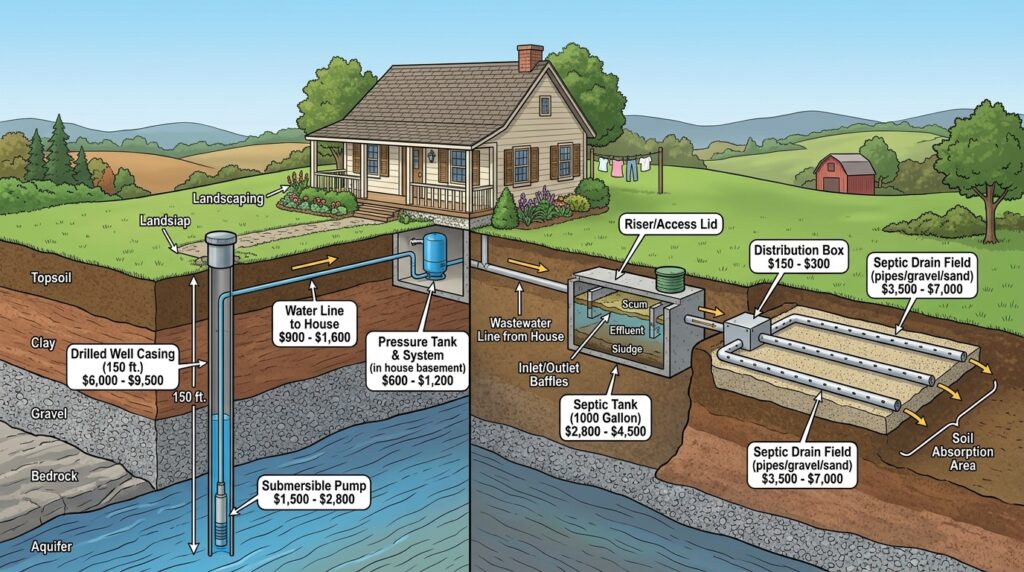
Quick Answer: Well and Septic System Cost at a Glance
Before we go deep into the details, here is a table you can screenshot and use as your starting budget.
| Item | Typical Cost Range |
|---|---|
| Well drilling and installation | $3,500 – $15,300 |
| Septic system installation | $3,400 – $20,000 |
| Combined well and septic system | $6,000 – $25,000 |
| Percolation (perc) test | $300 – $2,000 |
| Well permit | $200 – $700 |
| Septic permit | $250 – $700 |
| Land survey (required in most counties) | $330 – $900 |
| Monthly operating cost after install | $30 – $100 |
These figures line up closely with data reported by HomeGuide, which puts the combined cost of a well and septic system at $6,000 to $20,000 or more, with well drilling running $20 to $30 per foot and complete installation costing $30 to $80 or more per foot for wells that are typically 100 to 300 feet deep. On the septic side, Angi’s 2026 data shows the national average septic system cost lands around $8,025, with most homeowners paying between $3,594 and $12,463.
If your soil is difficult or your water table is high, though, those numbers change fast. Keep reading, because the “average” cost rarely tells the whole story.
How Much Does It Cost to Put in a Well and Septic System? The Real Breakdown
So how much does it cost to put in a well and septic system when you actually add up every piece? Let’s separate the two systems, because they are priced very differently and often installed by different contractors.
For the well alone, expect $3,500 to $15,300, depending on depth, casing material, and pump type. Land Limited’s guide to well and septic systems notes that well installation can range from $3,750 to $15,300, with additional expenses for deeper wells or complex geology.
For the septic system alone, expect $3,400 to $20,000+. The low end covers a small conventional gravity system in good soil. The high end covers a mound or aerobic system required by difficult soil conditions.
One real homeowner story sums this up well. In LendEDU’s breakdown of well and septic pricing, a couple who built their house in Northern Indiana share that they spent right around $20,000 total between their well and septic system since they were starting from scratch, and they note that anyone tearing out an old system first should add demolition costs on top of that budget. That is a helpful reality check, because a lot of online calculators quote the cheapest possible scenario.
My take: if you are budgeting for a new build on raw land, plan for the middle of the range, not the bottom. Contractors almost always find something during excavation that adds a line item, whether that is rock, unexpected clay, or a longer trench than planned.
What Pushes the Price Higher
A few things reliably increase your total bill:
- Well depth. Deeper wells cost more per foot and take longer to drill.
- Difficult soil. Clay, rock, or a high water table means you likely need a mound or aerobic septic system instead of a basic gravity system.
- Distance between systems. Codes typically require separation between your well and your septic system, and the further apart they sit, the more you pay in plumbing and electrical runs.
- Permits and testing. These are non-negotiable and vary a lot by county.
- Site accessibility. Steep grades or tight lots make it harder for heavy equipment to get in, which adds labor hours.
Well Installation Costs Explained
Let’s slow down on the well side, because this is where a lot of first-time land buyers get surprised.
Types of Wells and What They Cost
There are three main types of residential wells, and your soil and budget usually decide which one you can even use.
| Well Type | Typical Depth | Best For | Relative Cost |
|---|---|---|---|
| Dug well | Under 30 ft | Areas with a shallow, easily accessible water table | Lower cost, higher contamination risk |
| Driven well | Up to 50 ft | Sandy or loose soil | Lower to mid cost |
| Drilled well | Can exceed several hundred feet | Most modern residential properties | Higher cost, most reliable |
According to Land Limited, dug wells are generally less common today because of the contamination risk that comes with shallow groundwater, while drilled wells go much deeper and use specialized rigs with steel or PVC casing to reach cleaner, deeper water sources. Most homes built today use a drilled well, even though it costs more, because it is the most reliable long-term option.
Well Drilling Cost Per Foot
HomeGuide reports that well drilling alone runs $20 to $30 per foot, while a complete well installation including casing, pump, and pressure tank costs $30 to $80 or more per foot. Since most residential wells run 100 to 300 feet deep, you can see why the total price swings so much between properties. A 150-foot well and a 350-foot well on the same street can cost thousands of dollars apart.
Well Pump and Equipment Costs
Your pump type matters too. Submersible pumps, which sit down inside the well casing, are the most common choice for residential wells because they are quiet and efficient. Jet pumps sit above ground and work better for shallower wells. Either way, budget for the pump, pressure tank, wiring, and a water treatment or filtration setup, since Corley Pro’s water filtration cost guide puts whole-home water treatment equipment at $500 to $3,000, plus another $300 to $1,500 for installation depending on plumbing complexity.
Don’t skip water testing. The CDC recommends that private well owners test their water at least once a year for bacteria and other contaminants, since government agencies do not regulate or monitor water from private wells the way they do public water systems. Your very first test usually happens right at installation.
Septic System Installation Cost Breakdown
Now let’s talk septic, because this is usually the more complicated half of the project.
A septic system has two main parts: the tank, which holds and begins breaking down waste, and the drain field (also called a leach field), which disperses treated wastewater into the soil. Both parts need to be sized and designed based on your home’s bedroom count, your soil’s percolation rate, and your local health department’s rules.
Septic System Cost by Type
Here is where the real price differences show up. Not every property qualifies for the cheapest system type. Your soil and water table decide what you are allowed to install.
| System Type | Typical Installed Cost | Best For |
|---|---|---|
| Conventional (anaerobic, gravity) | $3,000 – $8,500 | Good, well-drained soil |
| Aerobic treatment system | $10,000 – $20,000 | Small lots or poor soil, needs electricity |
| Mound septic system | $10,000 – $20,000 | High water table or shallow bedrock |
| Sand filter system | $7,000 – $18,000 | Poor soil conditions needing extra filtration |
| Drip distribution system | $8,000 – $18,000 | Shallow soil or irregular lot shapes |
According to Angi, aerobic septic systems use oxygen pumped into the tank to activate bacteria that break down solid waste, and while they cost more than anaerobic systems at $10,000 to $20,000, they are more efficient and can work well on smaller properties.
Conventional systems remain the cheapest option because they rely entirely on gravity and natural soil filtration, with no pumps or electricity needed. But if your perc test fails, you do not get to choose the cheap option. As The Septic Guide explains, the type of replacement or new system required is determined by a perc test conducted on the site, meaning soil conditions, not homeowner preference or budget, determine what you’re allowed to install.
Septic Tank Installation Cost by Material
This next part matters more than most people expect, because your tank material affects both the upfront cost and how long the system lasts.
Concrete Septic Tank vs Plastic Septic Tank: Which Costs More?
I get asked this constantly, so let’s settle it with real numbers.
| Tank Material | Tank-Only Price (1,000 gal) | Lifespan | Best For |
|---|---|---|---|
| Concrete | $800 – $2,000 | 40–50 years | High water tables, heavy vehicle traffic overhead |
| Plastic (polyethylene) | $600 – $1,800 | 30–40 years | Tight access lots, lower budgets, low water table |
| Fiberglass | $1,600 – $2,000 | 30–40 years | Corrosion resistance in acidic soil |
SepticTankHub’s 2026 buyer’s guide puts a standard 1,000-gallon concrete tank at $800 to $2,000 for the tank alone, with a polyethylene tank running $600 to $1,800. Once you add excavation and labor, these sources note installation labor typically adds another $2,000 to $5,000 to the total project cost.
Plastic tanks are lighter and cheaper to move, which brings labor costs down too. SepticTankHub notes that a poly tank weighs under 500 pounds compared to roughly 8,500 pounds for a concrete tank, which means concrete installation requires a crane truck on site while plastic often does not. The catch is durability: concrete tanks last 40 to 50 years and resist buoyancy in high water tables, while plastic tanks last 30 to 40 years and can shift or float out of position in wet soil.
My honest recommendation: if your property has a high water table or you know heavy trucks or equipment will ever cross over the tank area, spend the extra few hundred dollars on concrete. If your lot has good drainage and easy access, a plastic tank is a perfectly reasonable way to save money without sacrificing performance.
Fixr’s septic tank installation guide puts a typical 1,000-gallon fiberglass tank at $1,600 to $2,000. Fiberglass resists corrosion better than concrete in acidic soil, which is worth considering if a soil test comes back on the acidic side.

Monthly Cost of Well and Septic: What Nobody Tells You Upfront
This is the part almost every other article skips, and it is honestly the most useful section if you are trying to decide between well and septic versus staying on city utilities. Installation is a one-time cost. But what does it actually cost every single month to live on a well and septic system?
Monthly Well Costs
Your well pump runs on electricity, and that is really the main ongoing expense. SC Well Service’s guide to monthly well operating costs notes that a typical 1 HP submersible pump running two to three hours a day costs approximately $25 to $35 a month, while larger pumps of 1.5 to 3 HP for deeper wells or higher water demand run $40 to $60 monthly. Other cost calculators show a much wider range depending on your local electricity rate and how many hours a day your pump actually runs, with some households paying as little as $4 to $5 a month and others closer to $70 or more.
Monthly Septic Costs
A septic system has no monthly electric bill unless you have an aerobic system with a pump or aerator. What it does have is periodic maintenance. Most experts recommend having your septic tank inspected and pumped every three to five years, and Angi reports the average cost to pump a septic tank is $428, with most homeowners paying between $291 and $565. If you spread that cost out monthly, it works out to roughly $5 to $10 a month for most households.
Putting It All Together
| Monthly Expense | Typical Range |
|---|---|
| Well pump electricity | $4 – $60 |
| Well maintenance reserve | $8 – $35 |
| Septic pumping (averaged monthly) | $5 – $10 |
| Water treatment/softener salt and filters | $5 – $15 |
| Total monthly cost of well and septic | $30 – $100 |
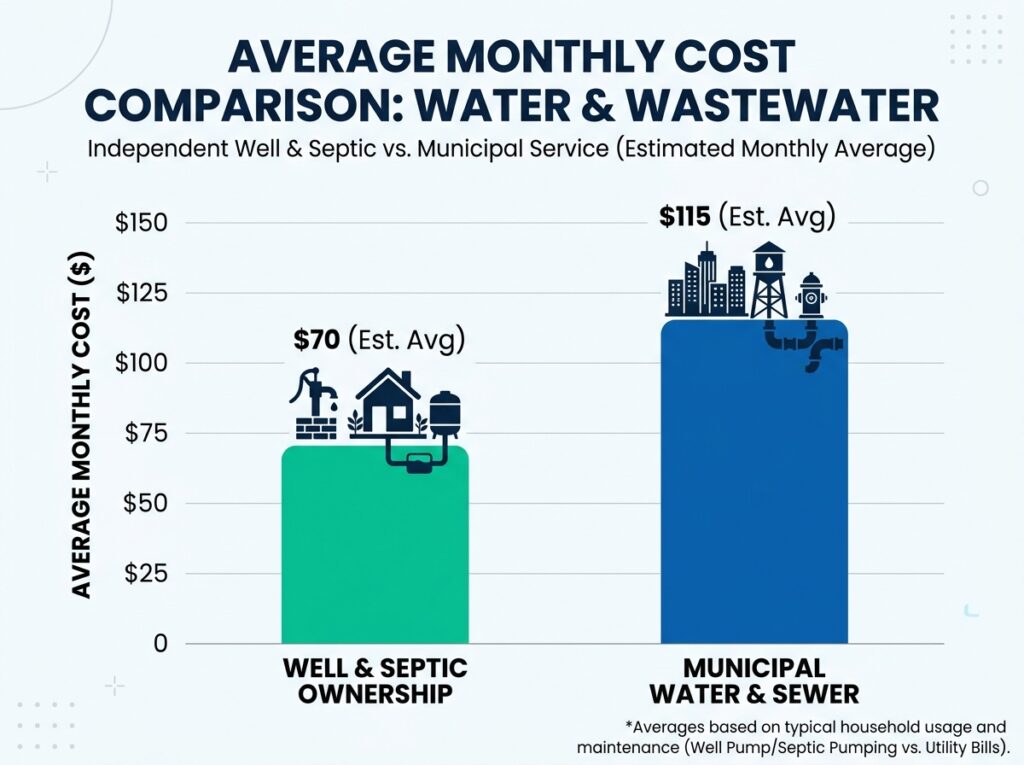
Compare that to municipal utilities. SC Well Service estimates that monthly operating expenses for a typical residential well run $30 to $75 once you factor in electricity, maintenance reserves, and periodic testing, compared to municipal water rates that often exceed $150 a month for moderate use and continue rising every year.
I want to be fair here, though. You should also budget for the big, occasional costs that do not show up in a “monthly average.” SC Well Service recommends smart well owners keep an emergency fund of $2,000 to $5,000 for unexpected repairs, since pump replacements can run $2,500 to $5,500, pressure tank failures cost $400 to $800, and electrical repairs run $200 to $600. Building that fund at $50 to $100 a month is a smart habit from day one.
Well and Septic Cost Near Me: Why Location Changes Everything
If you have searched “well and septic cost near me,” you already know that national averages only tell part of the story. Your actual quote depends heavily on where you live, for a few very specific reasons.
Regional labor rates. The Septic Guide notes that labor accounts for 60 percent or more of a septic system’s total installed cost, and labor rates vary significantly by region and by contractor availability.
Local groundwater depth. In some regions, you might hit water at 100 feet. In others, you need to drill past 300 feet. That difference alone can double your well cost.
County health department requirements. Every county has its own septic code, its own permit fees, and its own rules about setback distances from wells, property lines, and water bodies. Some counties even mandate a specific tank material.
Soil type. Sandy soil in one county might allow a cheap conventional system, while clay-heavy soil three counties over forces homeowners into a mound system that costs three times as much.
Because of this, the single best thing you can do before budgeting is call two or three local septic and well contractors and ask for a site visit. A phone quote without seeing your soil is basically a guess.
Mound Septic System Cost and Landscaping Considerations
Mound systems deserve their own section because they are both the most expensive common option and the one homeowners have the most questions about, especially around how they look in the yard.
According to NTOtank’s residential septic tank pricing guide, mound septic systems are a top choice for properties with high water tables, shallow soils, or poor drainage, since they elevate the drainage field above the natural surface using an artificial sand and gravel mound, which allows proper wastewater treatment where a conventional system simply will not work. NTOtank puts the cost of a mound system between $12,000 and $20,000, and notes prices swing widely depending on the property’s topography, since a flatter, easier-to-access site keeps costs lower while steep or uneven terrain drives labor and material costs up considerably.
Mound Septic System Landscaping Tips
A mound system is a visible raised area in your yard, usually planted with grass, so landscaping it well matters both for appearance and for keeping the system working properly.
- Use shallow-rooted grass only. Deep-rooted plants and trees can damage the pipes inside the mound.
- Never plant trees or shrubs on or near the mound. Roots seeking moisture will head straight for the drain lines.
- Keep the area mowed, not landscaped with hardscaping. Pavers, decks, or sheds on top of a mound block airflow and evaporation the system depends on.
- Direct downspouts and surface water away from the mound. Extra water saturates the soil and reduces the system’s ability to treat wastewater.
- Mark the boundaries. A simple decorative border of low ground cover just outside the mound’s edge helps everyone in the household remember not to drive, dig, or build there.
If you are planning your yard around a mound system, my guide on choosing the right size garden shed for your backyard is worth a look before you decide where structures can safely go, since sheds should never sit on or near a drain field.

Drain Field Replacement Cost
Your drain field, sometimes called a leach field, does not last forever. It is worth understanding this cost separately, because a lot of homeowners assume septic problems always mean a whole new system, when often it is just the field.
The Septic Guide puts drain field replacement at $5,000 to $15,000 for a conventional system, while a mound system replacement runs $10,000 to $20,000, with labor making up 60 percent or more of the total cost. Soil is the second biggest cost factor, since good percolation from sandy loam means a smaller, cheaper field, while poor percolation from clay or hardpan means a larger field or an engineered alternative that costs significantly more.
Signs your drain field may be failing include soggy patches in the yard, a lingering sewage smell, unusually green grass in one specific area, and slow drains inside the house. Catching these early can mean the difference between a repair and a full replacement.
Sand Filter Septic System
A sand filter system is another alternative worth knowing about if your soil is not ideal for a conventional setup. As HomeAdvisor explains, this type is constructed either above or below ground and uses a pump chamber to push wastewater through a sand filter before it disperses into the ground, which enhances treatment in areas with poor soil conditions or high water tables. Sand filter systems typically cost between $7,000 and $18,000, sitting right between a conventional system and a full mound system in both price and complexity. These are a solid middle-ground option if your perc test comes back borderline rather than an outright fail.
DIY Septic System: Is It Legal, and Is It a Good Idea?
I know the temptation to save money by handling this yourself is real, especially with quotes running into five figures. So let’s be straight about it.
According to Angi’s guide to building a septic tank, building a DIY septic system requires licenses and permits in most states, since improper installation can contaminate groundwater and create serious health risks for your community. If you don’t have the appropriate credentials and municipal approval, you’ll be breaking the law and could face fines.
If you do attempt it improperly, or without a permit, the risks are serious. Premier Tech Aqua notes that DIY installation is technically allowed in some states and counties, but without the right expertise and equipment, homeowners risk system failure, contamination, and code violations, which is why they compare septic installation to surgery: something you can technically attempt yourself, but which is wiser to leave to a trained professional.
There is also a financial angle people forget. Most mortgage lenders and home inspectors will flag an unpermitted system during a future sale, and resources on selling a home with a septic system note that sellers must disclose the septic system and any known issues, since failing to do so can lead to legal challenges down the road. An unpermitted DIY system can end up costing more at resale than hiring it out correctly the first time.
Where DIY genuinely makes sense: obtaining your own permits and doing your own site clearing or landscaping around the finished system. Where it does not make sense: designing the system, digging the tank hole, connecting plumbing, or building the drain field yourself, unless you are already a licensed installer.
Hidden Costs Homeowners Forget to Budget For
Beyond the tank, the well, and the drain field, there are a handful of smaller costs that quietly add up.
- Percolation test: NerdWallet’s septic cost breakdown puts a perc test at $700 to $2,000, and it determines how quickly your soil absorbs water, which directly decides what type of system you are allowed to install.
- Land survey: NerdWallet also notes a licensed land surveyor typically charges $330 to $900 to confirm your systems fall within property lines.
- Engineering consultation: Angi’s engineered septic system guide puts engineering consultant rates at $125 to $200 per hour for more complex designs like mound systems.
- Septic inspection: The same Angi guide notes professional inspections during construction cost $200 to $900 depending on your municipality.
- Abandonment permit for old systems: HomeGuide’s drain field guide notes that if you are replacing an existing drain field, a separate abandonment permit can cost $100 to $250.
Add these up, and you are easily looking at another $1,000 to $4,000 beyond the “headline” installation number most quotes lead with. Ask your contractor for a full itemized quote up front so nothing surprises you mid-project.
How to Save Money on Well and Septic Installation
A few practical, field-tested tips that actually move the needle on cost:
- Get at least three quotes. LendEDU’s homeowners mention that during their build, one contractor bid $4,000 more than another for identical work. That gap is common, not rare.
- Book during the off-season. Contractors stay busiest in spring and summer, so calling in fall or winter can sometimes land you better rates.
- Bundle the well and septic work with one contractor. Having one company handle both systems can reduce equipment transportation costs.
- Position systems close to existing utility lines when possible, since shorter trenching and wiring runs directly reduce labor costs.
- Ask about a shared well if you have close neighbors also needing water access, which can split both installation and long-term maintenance costs.
- Choose a plastic tank if your soil and water table allow it, since it is typically cheaper installed than a comparable concrete tank.
Well and Septic vs City Water and Sewer: Pros and Cons
Since a lot of readers are weighing this decision, not just researching pricing, here is a straightforward comparison.
Pros of well and septic:
- No monthly utility bill from a city or private water company
- You control your own water source, not subject to municipal rate hikes
- Lower long-term cost in most cases, especially over 15 to 20 years
- No dependency on city infrastructure during outages, aside from your own pump’s power needs
Cons of well and septic:
- High upfront installation cost
- You are responsible for all maintenance and repairs, with no utility company to call
- Water quality depends entirely on your well and any filtration you install, since the CDC confirms private well water is not regulated or monitored the way municipal water is
- Resale value can be affected if the systems are old or poorly maintained
My take: if you plan to stay on the property for more than about seven to ten years, a well and septic system almost always pays for itself compared to ongoing city utility bills. If you are flipping the property short-term, the upfront cost is harder to justify unless the land itself has no other utility option.
Expert Tips Before You Sign a Contract
A few things I wish someone had told me before I hired anyone for this kind of project:
- Always confirm your contractor is licensed for both well drilling and septic installation in your state, since these can require separate licenses.
- Ask to see the soil percolation test results yourself, not just a summary. This document determines your system type and should be part of your permanent property records.
- Request the reserve drain field location in writing. Most counties require a backup area reserved on your property in case your first drain field ever fails.
- Keep every permit, inspection report, and warranty document. You will need these when you eventually sell the home.
- Set a calendar reminder for septic pumping every three to five years. According to ProjectCostPro’s septic cost calculator, skipping it is the leading cause of drain field failure, which is itself a $5,000 to $15,000-plus repair.
For more general water pressure and plumbing troubleshooting once your well is up and running, my guide on how to increase water pressure in your house covers fixes that apply to well-fed homes as well as city water homes. And if you ever notice a drip at the fixtures fed by your new well, my leaking shower head repair guide walks through an easy DIY fix that saves water and money.
Frequently Asked Questions
How much does it cost to put in a well and septic system on average?
Most homeowners pay between $6,000 and $25,000 total for both systems combined, with a well typically running $3,500 to $15,300 and a septic system running $3,400 to $20,000, depending heavily on soil conditions, well depth, and system type.
Is city water and sewer cheaper than a well and septic system in the long run?
Not usually. Municipal water rates often exceed $150 a month for moderate use and continue rising, while monthly well and septic costs typically run $30 to $100. Over 15 to 20 years, well and septic ownership is generally the more affordable option, even after accounting for occasional repairs.
How close do a well and septic system need to be to each other?
Requirements vary by state and local code, but wells are typically required to sit a minimum distance away from septic tanks and drain fields to prevent contamination, often somewhere in the range of 50 to 100 feet. Always confirm your exact county requirement before finalizing your site plan.
Can I install a septic system myself to save money?
Septic design and installation is state-licensed work in most areas, and while some states technically allow homeowner installation, it carries real risks including soil and water contamination, health hazards, and improper treatment of sewage. It is rarely worth the risk for a system this important to your home’s safety and resale value.
How long does a well and septic system last?
A properly maintained well can last 30 to 50 years or more, while a septic system’s tank typically lasts 30 to 50 years and a drain field typically lasts 20 to 30 years, depending on design, usage, and how well it is maintained. Regular pumping and mindful water use are the biggest factors in reaching the upper end of that range.
Final Thoughts
So, how much does it cost to put in a well and septic system? For most homeowners, the honest answer lands somewhere between $6,000 and $25,000 upfront, plus $30 to $100 a month to keep everything running. That is a real investment, but it is also one that buys you independence from city utility bills for decades, often paying for itself well before the fifteen-year mark.
My best advice is simple. Get your soil tested first, get at least three contractor quotes, and budget an extra 15 to 20 percent above whatever number you are quoted, because rural land projects almost always find one surprise along the way. Do that, and you will walk into this project with your eyes open instead of guessing.
If you found this guide helpful, take a look around Home Upright for more practical home and property guides, from plumbing fixes to outdoor living tips, written the same straightforward way.