


Are Spider Plants Toxic to Cats? What Every Pet Owner Should Know
If you have caught your cat chewing on your spider plant and your stomach dropped, take a breath. I have been exactly where you are, standing in my living room at 11 p.m., phone in hand, typing “are spider plants toxic to cats” into Google with my heart racing. So let me save you the panic and give you the short answer right away, then walk you through everything else you actually need to know.
Spider plants (Chlorophytum comosum) are among the most common houseplants in American homes, and they are also among the plants cats seem to love most. That combination makes this question come up constantly in cat owner groups, vet clinic waiting rooms, and late-night search bars. I have grown spider plants for years; I currently have three of them in my own home with two cats running around, and I have done the research (and made a few mistakes) so you do not have to.
This guide covers the official answer from the people who actually test plant toxicity, why cats seem almost obsessed with this particular plant, what symptoms to watch for if your cat overdoes it, and how I personally keep my plants and my cats both happy under the same roof.
The Quick Answer: Are Spider Plants Toxic to Cats?
No. Spider plants are not toxic to cats. The ASPCA’s official plant database lists Chlorophytum comosum, also known as ribbon plant or spider ivy, as non-toxic to both cats and dogs. This is one of the few houseplants you genuinely do not need to panic about.
That said, “non-toxic” does not mean “risk-free” in every situation. A cat that eats a small amount will almost always be fine. A cat that eats a large amount, especially on an empty stomach, may vomit or have loose stools simply because plant fiber is hard on a carnivore’s digestive system. I want to be upfront about that nuance because most articles either scare you unnecessarily or oversimplify things too much.
Here is a simple breakdown of what the science actually says:
| Question | Answer |
|---|---|
| Is spider plant toxic to cats? | No, officially classified as non-toxic |
| Are spider plants toxic to dogs? | No, also non-toxic to dogs and horses |
| Can eating it still cause a reaction? | Yes, mild stomach upset in some cats |
| Is it life-threatening? | No, not according to any veterinary toxicology source |
| Should I remove the plant? | Not necessary, but supervision helps |
I like keeping this table pinned in my head because it cuts through a lot of the fear-based content floating around this topic.

What Vets and the ASPCA Actually Say (And a Confusing Contradiction I Found)
Here is something I noticed while digging through official sources that almost nobody talks about, and it genuinely confused me for a while. The ASPCA’s toxic and non-toxic plant database clearly lists spider plant as non-toxic to both cats and dogs, with no toxic principles listed at all.
But if you read the ASPCA’s own consumer-facing article on houseplant safety, spider plant is grouped with fiddle leaf fig and described as capable of causing mild gastrointestinal irritation with small ingestions. That article does not use the word “non-toxic” the same way the database entry does.
I reached out to a few vet techs and read through veterinary toxicology explanations to make sense of this, and here is the honest takeaway. Spider plants do not contain any compounds classified as true toxins, meaning nothing that damages organs, causes seizures, or requires emergency antidote treatment. What they do contain is fibrous plant material and natural compounds called saponins, which can irritate a sensitive stomach the same way eating a large amount of any raw, fibrous plant might. So the plant is not “toxic” in the medical sense, but it is also not something you want your cat eating by the mouthful every day.
Saponins are not unique to spider plants, either. You will find them in a wide range of common food crops too, at levels people and pets tolerate fine in normal amounts. It is really the sheer volume of leaf a determined cat can chew through, not a rare or dangerous chemical, that explains why a bigger snack sometimes leads to an upset stomach.
Tina Wismer, senior director of toxicology at the ASPCA Animal Poison Control Center, has explained that vomiting from plant material in general is fairly common in pets, and that any plant consumption can lead to some gastrointestinal upset regardless of the plant’s official toxicity rating. That single point clears up most of the confusion I see in cat owner forums. It is not that spider plants are secretly dangerous. It is that eating a mouthful of any plant fiber can upset a stomach, toxic or not.
The Pet Poison Helpline agrees with the ASPCA’s non-toxic classification too, which gives me real confidence recommending this plant to cat owners who ask me for pet-safe options.
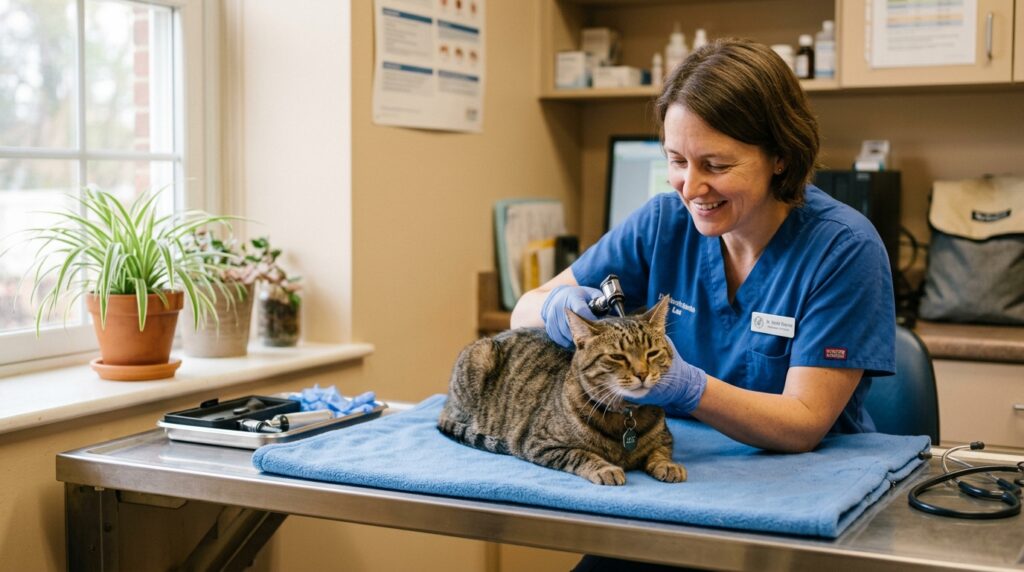
Why Do Cats Love Spider Plants So Much?
This is honestly the more interesting question, and it is one I get asked more than the toxicity question itself. My older cat, Waffles, ignores every other plant in my house but goes straight for the spider plant every single time. Turns out there is a real explanation for this.
Movement and hunting instinct. Spider plants have long, thin, arching leaves that sway easily in air currents from an open window, a ceiling fan, or even someone walking past. According to Dr. Wismer, cats are naturally drawn to plants with long leaves that move easily because it triggers the same instincts involved in hunting, playing, and general entertainment. Your cat is not being naughty. It is reacting to a plant that basically waves at it all day.
The “opium-like compound” myth. You will see this claim repeated across dozens of gardening blogs, that spider plants contain chemical compounds “related to opium” or that mimic hallucinogens. I want to be direct with you here because I dug into this claim pretty hard. There is no confirmed scientific study showing spider plants contain opioid compounds or true hallucinogens. What the plant does contain are saponins, mild natural compounds that some researchers believe may have a slight stimulating or mood-altering effect in cats, similar in concept (though not chemically identical) to how nepetalactone in catnip affects them. The honest, factual answer is that the “catnip-like high” idea is a popular theory, not a confirmed scientific fact.
Texture and chewing satisfaction. Cats explore the world with their mouths as much as their paws. The smooth, ribbon-like texture of spider plant leaves gives them something satisfying to gnaw on, especially for cats that are bored, teething as kittens, or just naturally food-motivated.
So the real answer to “why does my cat keep eating my spider plant” is a mix of movement, texture, and mild curiosity, not a secret drug hidden in your houseplant.

Are Spider Plants Toxic to Dogs?
Since a lot of households have both cats and dogs, I want to cover this directly. Are spider plants toxic to dogs? No. The ASPCA Animal Poison Control Center applies the same non-toxic classification to dogs and even horses.
In my experience, and this lines up with what most veterinary sources report, dogs generally show far less interest in spider plants than cats do. The gently moving leaves that fascinate cats do not seem to trigger the same instinctive response in dogs. Dogs that do chew on spider plants usually do so out of general puppy curiosity rather than any specific attraction to the plant itself, and the same mild stomach upset warning applies if they eat a large quantity.
If you have a multi-pet household, spider plants are genuinely one of the lower-risk houseplant choices you can make, for both species.
What Happens If Your Cat Eats a Spider Plant? Symptoms to Watch For
I will be honest, the first time I found chewed-up leaves on my carpet, I sat and watched my cat like a hawk for the next few hours. Looking back, that was probably overkill, but I understand the instinct. Here is what you can realistically expect.
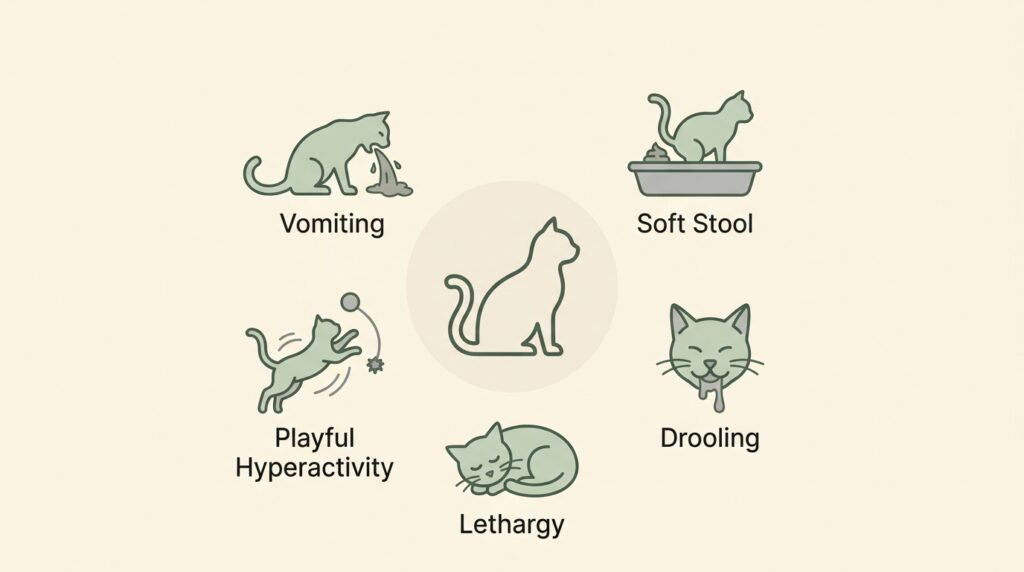
Most cats show no symptoms at all after nibbling a leaf or two. If your cat eats a larger amount, here are the possible signs:
- Mild vomiting, usually within a few hours of eating the plant
- Soft stool or diarrhea
- Excess drooling right after chewing, from the plant’s fibrous texture
- Slight lethargy or a quieter mood for a few hours
- Occasional playful or “hyper” behavior shortly after eating it, tied to the mild stimulating theory mentioned earlier
None of these symptoms should last more than a day. If your cat vomits once, seems otherwise normal, and is eating and drinking again by evening, you generally do not need to rush to the vet.
When you should call your vet or the ASPCA Animal Poison Control Center right away:
- Vomiting that continues for more than 24 hours
- Blood in vomit or stool
- Your cat stops eating or drinking entirely
- Breathing difficulty, collapse, or seizures (these are not expected from spider plant but warrant an emergency vet visit regardless of the cause)
- You are not sure exactly which plant your cat ate, since other houseplants nearby could be genuinely toxic
If you ever have doubts, the Pet Poison Helpline and the ASPCA’s poison hotline are both available around the clock, and it costs you nothing to make the call and get peace of mind.
Spider Plant Babies (Plantlets): Are They Safe Too?
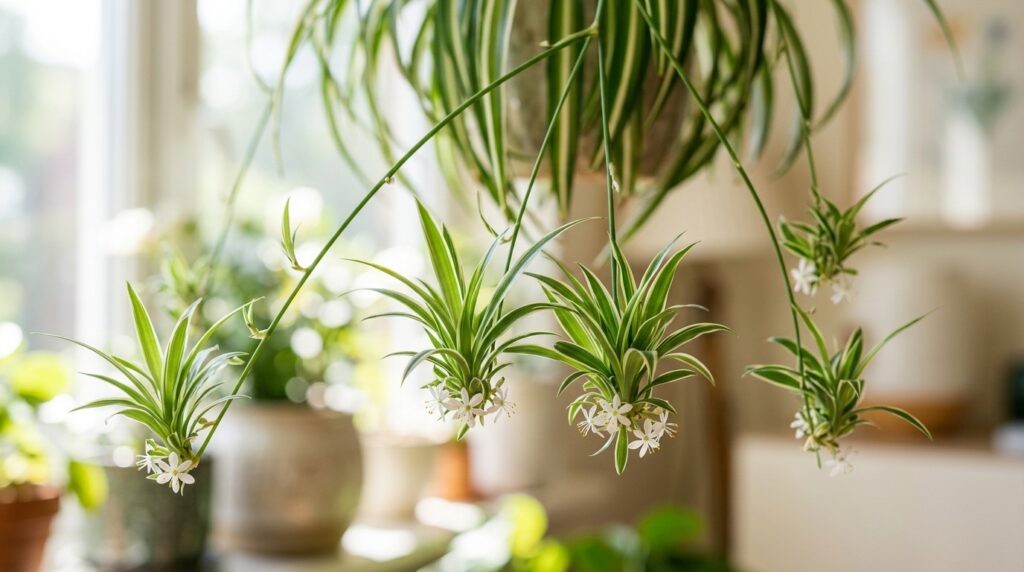
This is a question I did not think to ask until my own spider plant started sending out those little dangling “spiderettes.” Are the baby plantlets just as safe as the mature plant, or is there some concentrated toxin hiding in the new growth?
Good news. The plantlets, sometimes called spiderettes or pups, contain the exact same chemical makeup as the parent plant. Since the full-grown spider plant is non-toxic, the babies are equally safe if your cat decides to bat one down and chew on it. In fact, I would argue the dangling babies are actually more tempting to a curious cat than the main plant, purely because they swing and bounce so easily, which brings us right back to that movement-triggered hunting instinct.
If your cat has a habit of pulling down every plantlet the moment it appears, you are not doing anything wrong, and neither is your cat. It is just an especially fun toy from a feline point of view.
Pros and Cons of Keeping a Spider Plant in a Home With Cats
I think it helps to see this laid out plainly, since most articles only tell you the good news without being honest about the downsides.
Pros:
- Officially non-toxic to cats, dogs, and horses according to the ASPCA
- Extremely low-maintenance and forgiving if you are new to houseplants, much like caring for easy indoor succulents
- Helps filter some common indoor air pollutants
- Easy to propagate and share, since the plantlets root quickly in water or soil
- Gives cats safe, mental stimulation from watching the leaves move
Cons:
- Cats may chew it enough to leave the plant looking ragged
- Overeating can cause vomiting or loose stool
- The plant cannot defend itself, so it may need to be relocated out of reach
- Frequent chewing may stress the plant’s growth if it happens constantly
For me personally, the pros far outweigh the cons, but I do keep my main plant slightly out of easy reach now, more for the plant’s sake than my cats’ safety.
How to Keep Your Cat Safe (and Your Plant Intact)
After a few seasons of trial and error, here is what actually worked for me, plus a few tips I picked up from other cat owners and vet resources along the way.
- Hang it up. A hanging basket near a window keeps the leaves swaying, which cats love to watch, while keeping the actual foliage mostly out of paw’s reach.
- Offer a legal alternative. I started growing a small pot of cat grass next to my spider plant, and it genuinely redirected a lot of my cat’s chewing habit. Cats often just want something green and fibrous to nibble on.
- Trim the dangling plantlets if your cat treats them like a piñata. This does not harm the plant and cuts down on the temptation.
- Rotate plant placement every so often. Cats sometimes lose interest in a plant that has been in the same spot for months and rediscover it with new enthusiasm once it moves.
- Watch after big chews, not every chew. You do not need to monitor your cat every time they sniff a leaf. Save the closer observation for after a genuinely large ingestion.
- Keep other, actually toxic plants far away. Spider plants being safe does not mean everything near them is. Lilies, in particular, are extremely dangerous to cats even in tiny amounts, so never let a spider plant and a lily share the same shelf.

Spider Plants vs Other Common Houseplants: A Toxicity Comparison
Since spider plants often sit on a shelf next to other popular houseplants, I think a side-by-side comparison is more useful than looking at spider plants alone.
| Plant | Toxic to Cats? | Severity if Ingested |
|---|---|---|
| Spider Plant (Chlorophytum comosum) | No | Mild stomach upset only, if any |
| Pothos (Devil’s Ivy) | Yes | Oral irritation, drooling, vomiting |
| Peace Lily | Yes | Oral irritation, difficulty swallowing |
| True Lily (Lilium species) | Yes, severe | Can cause fatal kidney failure |
| Snake Plant | Yes | Mild to moderate GI upset |
| Areca Palm | No | Considered pet-safe |
| Boston Fern | No | Considered pet-safe |
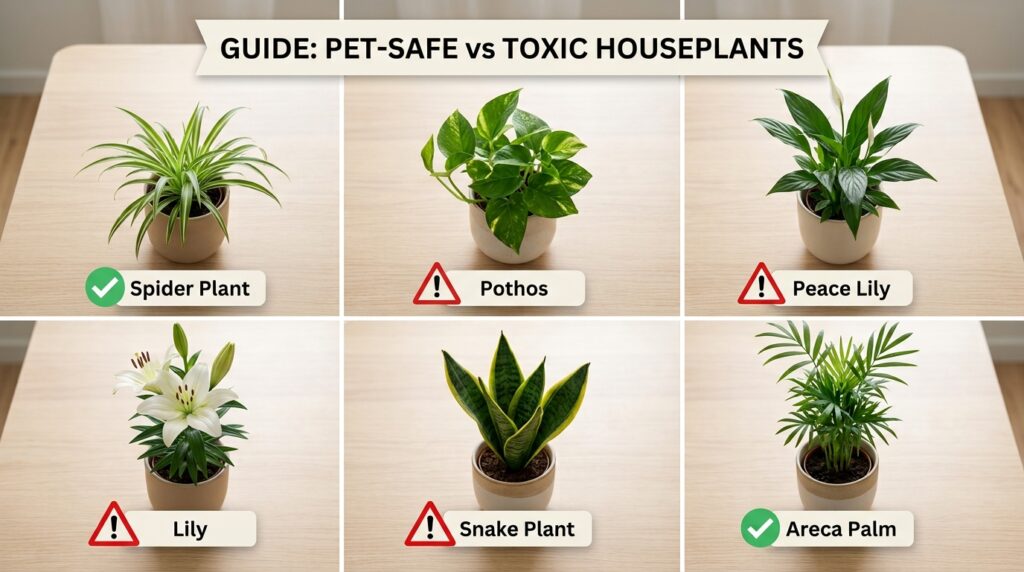
I want to be clear that true lilies are the real danger to be aware of here. Compared to something like a lily, a spider plant is about as low-risk as houseplants get, which is exactly why so many vets and rescue organizations recommend it as a starter plant for cat owners.
Other Pet-Safe Plants Worth Growing
If your cat’s obsession with your spider plant has you wanting to expand your pet-safe plant collection, you have more options than you might think. Several common flowering plants are also considered safe around cats, and I have covered several of them while researching pet-friendly gardens for this site, including a full rundown of pet-safe flowering options you can mix into your indoor or outdoor space without worry. There is also a good selection worth checking in this guide to popular flowers and their pet safety notes if you want to plan out a full pet-friendly garden bed rather than just a few houseplants.
Building a genuinely pet-safe indoor jungle usually comes down to research before you buy, not avoiding houseplants altogether. I would rather spend five minutes checking a plant’s ASPCA listing than bring home something I have to rush back to the store. Once you get in the habit of checking, it becomes second nature, and you end up building a home that both you and your cat can actually enjoy without constant worry.
My Own Experience: What Happened When My Cat Ate My Spider Plant
I mentioned Waffles earlier, my older cat who treats my spider plant like a personal salad bar. About a year ago, I came home to find almost a third of one plant stripped down to bare stems. I panicked, called my vet’s after-hours line, and described exactly what happened.
The vet tech on the phone was calm in a way that immediately settled me down. She confirmed the spider plant is non-toxic, asked me to watch for vomiting or diarrhea over the next 12 to 24 hours, and told me to call back only if symptoms got severe or did not resolve. Waffles threw up once that evening, ate his dinner an hour later as nothing happened, and was completely back to normal by morning.
That experience taught me two things. First, the non-toxic label is accurate and reliable, based on what actually happened in my own home. Second, a little bit of panic is completely normal, and there is no shame in calling a vet or poison hotline just to hear a professional confirm what you read online. I would rather make that call and feel silly than assume everything is fine when I am not sure.
Expert Tips for Living With Cats and Houseplants
Based on everything I have learned researching this topic and living it myself, here are my top recommendations for anyone trying to balance a love of plants with a curious cat.
- Always check a plant’s status on the ASPCA’s Animal Poison Control Center hub before bringing it home, not after.
- Keep the poison control number and your regular vet’s number saved in your phone, so you are never searching for it during a stressful moment.
- Give your cat a legitimate outlet, like cat grass or a cat-safe herb garden, so they have something they are “allowed” to chew.
- Do not assume a plant is safe just because your cat has eaten it before without issue. Reactions can vary between individual cats and even between different times.
- If you are ever unsure which plant your cat got into, take a photo of the plant before calling your vet or poison hotline. It genuinely speeds up the identification process.
Frequently Asked Questions
Are spider plants toxic to cats and dogs?
No. The ASPCA classifies spider plants as non-toxic to both cats and dogs, as well as horses. Large ingestions may still cause mild, temporary stomach upset in either species.
Can cats eat spider plants?
Cats can chew or eat small amounts of spider plant leaves without serious harm, since the plant is officially non-toxic. Eating a large quantity may lead to vomiting or loose stool, but it is not considered dangerous.
Is spider plant toxic to cats in large amounts?
Even in larger amounts, spider plant is not classified as toxic in the medical sense. The main risk is gastrointestinal upset from the fiber and natural saponins in the leaves, not organ damage or poisoning.
Are spider plants poisonous to cats?
No, spider plants are not poisonous to cats according to the ASPCA and Pet Poison Helpline. “Poisonous” and “can cause an upset stomach” are not the same thing, and spider plants fall into the second category at most.
Is spider plant toxic to dogs?
No. Spider plant is non-toxic to dogs, using the same official classification that applies to cats. Dogs tend to show less interest in chewing spider plants compared to cats.
Are spider plant babies (plantlets) safe for cats?
Yes. The small plantlets or spiderettes have the same non-toxic makeup as the mature plant, so they are just as safe if your cat plays with or chews on them.
Why does my cat keep eating my spider plant?
Cats are drawn to the way the long leaves move in air currents, which taps into their natural hunting and play instincts. The smooth leaf texture also gives them a satisfying thing to chew on.
Do spider plants get cats “high” like catnip?
This is a popular theory, not a confirmed fact. Spider plants contain saponins that some believe may have a mild stimulating effect, but there is no confirmed scientific evidence of an opioid or true hallucinogenic compound in the plant.
Should I get rid of my spider plant if I have a cat?
No, it is not necessary. Since the plant is non-toxic, most cat owners simply relocate it to a hanging basket or higher shelf rather than removing it entirely.
What should I do if my cat ate a lot of my spider plant?
Watch for vomiting, diarrhea, or lethargy over the next 24 hours. If symptoms are mild and resolve on their own, no treatment is usually needed. If symptoms are severe or persist, call your vet or the ASPCA Animal Poison Control Center right away.
Final Thoughts
So, are spider plants toxic to cats? No, and you can breathe easy on that front. What you are really managing is a curious cat and a plant that happens to be irresistibly fun to chew, not a hidden poisoning risk. I have lived with spider plants and cats under the same roof for years now, and the two coexist just fine with a little bit of planning.
If you want more pet-friendly plant guidance or general houseplant care tips, take a look around the rest of the site for more practical, tested advice. And if you have your own spider plant and cat story, I would genuinely love to hear how you handle it in your own home.