


Can trees grow back from stumps? A Practical Homeowner’s Guide
Yes, some trees can grow back from a stump. If you are asking whether trees can grow back from stumps, the answer depends on the species, the tree’s age and health, how much of the root crown remains, and whether the roots can produce new shoots. What looks like a dead stump may still contain living tissue and stored energy below ground.
New growth usually isn’t the old trunk repairing itself. It is a set of sprouts emerging from dormant buds near the bark, the root collar, or the roots. This guide explains how to judge the chance of regrowth, what stump grinding does and how to manage the shoots or stop them safely.
The short answer: will your stump grow back?
Yes, a tree stump can grow back. Many deciduous trees produce new shoots when the stump and roots remain alive. However, regrowth depends on the tree species, age, health, and how much of its root crown remains.
Young, healthy broadleaf trees are most likely to regrow, while many conifers and unhealthy trees are less likely to return. The University of Minnesota Extension confirms that most deciduous trees and shrubs resprout after cutting.
| What you observe | What it probably means | Best next step |
|---|---|---|
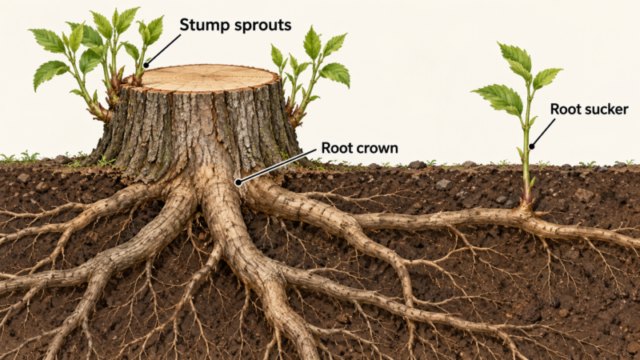
| Shoots around the stump edge | Living cambium or dormant buds remain near the root crown | Decide whether to train or remove them |
| Shoots appearing several feet away | The species may produce root suckers | Identify the species before treating anything |
| No growth after one season | The stump may be declining, but roots can take longer to decay | Monitor through another active growing period |
| Soft, crumbling wood with fungi | Decomposition is underway | Remove only if it creates a hazard or blocks your plans |
| Grinding chips but no visible stump | The central stump was ground, while lateral roots may remain | Watch the surrounding lawn for suckers |
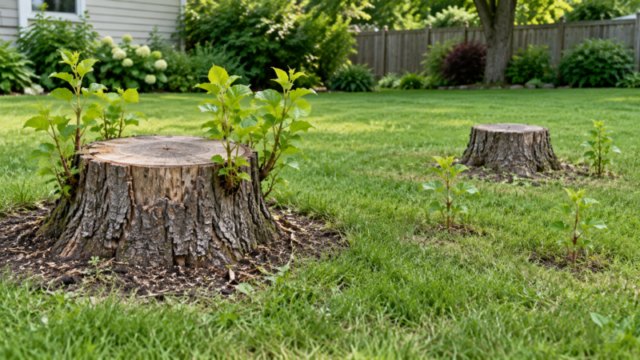
Why can trees grow back from stumps?
Trees store carbohydrates in their woody tissues and roots. After the trunk and canopy are removed, a living root system may use those reserves to produce emergency shoots that can form leaves and resume photosynthesis.
Those shoots can arise from different places. Stump sprouts form near the remaining trunk or root crown, while root suckers emerge from underground roots at some distance from the cut. This distinction matters because grinding the visible stump may stop one growth source without eliminating the other.
Regrowth is also a recognized woodland-management process called coppicing. It can be useful when you intentionally cut selected species and manage their new stems. Still, random sprouts in a yard rarely recreate the structure of the original landscape tree.
Species matters more than stump size alone.
Willow, poplar, aspen, cottonwood, elm, maple, black locust, and tree-of-heaven are among the trees or tree groups known for vigorous sprouting or suckering. Oaks can also regenerate from stump sprouts, although sprouting success varies with species, age, diameter, site, and stump condition; oak sprouting generally declines as tree diameter increases.
Many common conifers, including numerous pines and spruces, are much less likely to resprout after the trunk is removed. Do not rely on a broad “hardwood versus evergreen” rule, however, because exceptions exist and accurate identification changes the advice.
| General likelihood | Examples | Important qualification |
|---|---|---|
| Often vigorous | Willow, poplar, aspen, cottonwood, black locust, tree-of-heaven | Some can send suckers beyond the stump |
| Variable | Maple, elm, oak, birch, many fruit trees | Age, health, cultivar, season, and stump condition affect the response |
| Often low | Many pines, spruces, and firs | Species-level exceptions mean identification still matters |
Do tree roots die after stump grinding?
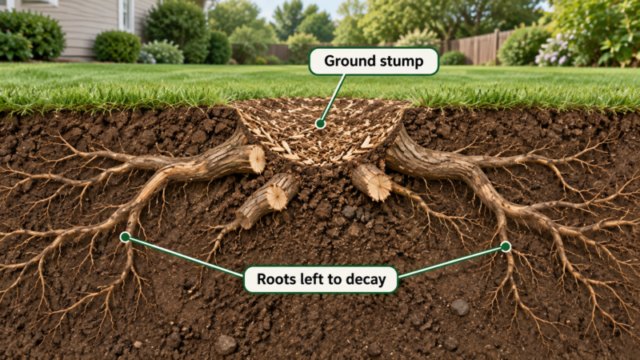
Usually, the remaining roots decline and decompose after stump grinding because the tree no longer has a canopy supplying them with sugars. They do not die instantly, though. The process may take years, and species capable of root suckering can produce new shoots while viable roots and stored energy remain.
This is why the answer to whether tree roots die after stump grinding is “eventually in many cases, but not always immediately or without regrowth.” A standard grinder removes the central stump and often some major surface roots to a specified depth; it does not chase every lateral root across the yard.
Does stump grinding kill roots?
Stump grinding is a physical removal method, not a guarantee that it kills every root. It destroys the stump tissue it reaches and severs or grinds nearby roots, while much of the wider root system stays underground and gradually loses function.
Grinding is often enough when the species does not sucker readily, and the goal is to level the site for a lawn or a shallow planting bed. If shoots later emerge away from the ground area, you are probably dealing with living lateral roots rather than the missing central stump.
Can trees grow back after being cut down?
If a tree is felled but its stump and root crown remain alive, it may grow shoots within the next active season. So, if you are wondering whether a cut tree will grow back, look for buds or shoots around the cut edge and new growth in the nearby soil.
A flush of shoots does not mean the original tree has returned in its former shape. Multiple fast-growing stems attached to old wounded wood can develop weak unions, compete with one another, and inherit any unresolved disease or site problem that affected the previous tree.
Should you keep one of the new shoots?
Keeping a sprout can make sense for an intentionally coppiced plant, a small ornamental shrub, or a species managed for repeated stem growth. It is a more questionable choice for replacing a large shade tree near a house, driveway, play area, or utility because attachment quality and long-term structure matter.
I recommend getting the stump and species assessed before treating one shoot as a permanent replacement tree. An ISA-credentialed arborist can evaluate the old stump, attachment points, decay, nearby targets, and whether training a sprout is reasonable.

How to stop a tree from growing back
If your real question is how to stop a tree from growing, start by identifying the tree and deciding what “finished” means for your yard. Removing visible shoots may be enough for a low-priority corner, while a future patio, fence, utility trench, or replacement tree may justify grinding or full excavation.
Option 1: Remove new shoots repeatedly
Cut each shoot at its point of origin while it is small, using clean hand pruners or loppers appropriate for its diameter. Repeated removal prevents the shoots from rebuilding the root system’s energy reserves, but vigorous species may require monitoring through multiple growing seasons.
This is the least disruptive approach, but it is not the fastest. It also works poorly when a plant sends numerous suckers across a broad area.
Option 2: Grind the stump
Professional grinding quickly removes the above-ground obstacle and can take the stump below grade. Ask the contractor what depth is included, whether they’ll address major surface roots, who removes the chips, and what happens if root suckers appear later.
Before grinding or excavating, use the free 811 utility-marking service and account for private irrigation, lighting, pet-fence, and other lines that a standard public locate may not mark. Stump grinders are powerful machines, so this is one job where professional operation is often the sensible choice.
Option 3: Excavate the stump and root crown
Excavation removes more of the stump and structural root crown than grinding. It offers a clean start for construction or regrading, but it costs more, disturbs more soil, and can damage nearby tree roots, hardscape, drainage, or buried services.
Complete removal of every fine root is neither practical nor usually necessary. The key is removing the living crown and enough problem roots for the area’s next use.
Option 4: Use a labeled cut-stump treatment when appropriate
For aggressive or invasive woody plants, a cut-stump herbicide treatment may be appropriate. The product must specifically list the plant or use site, and it must be applied exactly as its label directs, commonly to the living outer ring of a fresh cut rather than indiscriminately over the whole yard.
One detail I would not overlook is nearby vegetation. Systemic products can injure desirable plants through spray drift, accidental contact, or connected living tissue, so consult a local extension specialist or qualified applicator when the identification or root relationships are uncertain. The EPA’s pesticide-label guidance explains that label directions define legal handling and use.
Tree-of-heaven deserves special caution because cutting alone can trigger vigorous stump and root sprouts, according to Penn State Extension’s control guidance. For an aggressive invasive tree, identify first and choose a species-specific control plan before cutting.
| Method | Speed | Soil disturbance | Regrowth risk | Best fit |
|---|---|---|---|---|
| Repeated shoot removal | Slow | Very low | Moderate until roots exhaust reserves | Small, manageable sprouts |
| Stump grinding | Fast | Moderate | Usually low, but species-dependent | Lawns and routine yard restoration |
| Stump and root-crown excavation | Fast once scheduled | High | Low when the living crown is removed | Construction, regrading, difficult persistent stumps |
| Labeled cut-stump treatment | Treatment is quick; results take time | Low | Low when correctly matched and applied | Certain invasive or strongly resprouting species |
| Natural decay | Very slow | Very low | Species-dependent | Out-of-the-way, nonhazardous stumps |

Methods to avoid
Online stump advice often recommends salt, bleach, diesel fuel, motor oil, vinegar, copper nails, or burning. I would skip these methods because they can contaminate soil, injure nearby plants, create a fire or exposure hazard, violate local rules, or fail to reach the living tissue that matters.
Do not assume that “natural” means harmless. Heavy salt applications can make the surrounding soil hostile to plants, while covering a stump may take a long time and does not work well on species that sucker from distant roots; extension guidance notes that light-excluding covers can reduce stump sprouting but are not effective against lateral-root suckering.
Common mistakes that lead to repeat growth
The biggest mistake is cutting first and identifying the species later. That sequence can turn one manageable invasive stem into a network of root suckers, especially when the plant responds aggressively to injury.
Other common problems include treating old, dry wood instead of living tissue, assuming grinding removes the entire root system, and failing to inspect the surrounding lawn after the stump disappears. Poor cleanup can also leave a deep bed of wood chips that settles unevenly or temporarily complicates planting.
- Cutting sprouts halfway instead of removing them at their origin
- Hiring a grinder without agreeing on grinding depth and chip removal
- Forgetting utility and private-line location
- Applying a pesticide that is not labeled for the plant or site
- Spraying suckers when they may be connected to a desirable tree
- Planting a replacement tree directly into a chip-filled grinding pocket
- Ignoring repeat shoots during the following growing seasons
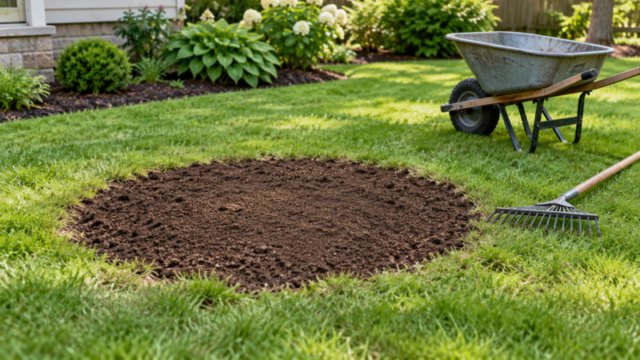
What to do with the area after stump removal
Remove excess grindings rather than treating a thick mass of fresh wood chips as planting soil. Backfill with suitable soil, let it settle, correct any grade or drainage issues, then restore turf or use the area for shallow-rooted plants.
If the removal is part of a larger outdoor reset, use a planned yard cleanup process so debris removal, grading, pruning, and planting happen in the right order. For front-yard work, coordinate stump removal with exterior upgrades for better curb appeal instead of repairing the same patch twice.
Planting a new tree in the same hole can be difficult because old roots, settling soil, remaining chips, and the original site problem may still be present. When possible, shift the planting location and choose a species suited to the available light, soil, drainage, mature space, and nearby infrastructure.
When to call a professional
Call a qualified tree professional when the stump is large, near a structure, on a slope, entangled with utilities, or surrounded by roots from trees you want to keep. Professional help is also sensible when you cannot identify a vigorous sucker-producing species or when regrowth persists after repeated cutting.
Assess the work before machinery arrives. Confirm access width, underground-line precautions, grinding depth, root work, debris handling, site restoration, insurance, and whether follow-up treatment is included in the written scope.
Frequently asked questions
Do tree stumps grow back?
Yes. Some tree stumps grow back by producing sprouts from living tissue near the stump edge or root crown, and the chance is higher in young, healthy broadleaf trees and species adapted to sprouting after damage.
Can trees grow back after being cut down?
Yes, new stems can emerge from the remaining stump or roots, but the cut trunk itself does not simply reconnect and continue upward. The new multi-stem growth may be less structurally reliable than a properly established replacement tree.
Does stump grinding kill roots?
Grinding destroys the stump and roots reached by the cutting wheel, but it normally leaves much of the lateral root system in the ground. Those roots usually decline without a canopy, although sucker-producing species may send up shoots before the roots die.
Do tree roots die after stump grinding?
Most remaining roots eventually die and decay when they can no longer receive sugars from leaves. This takes time, and living root sections may persist longer when they produce new shoots or are connected to other living stems.
How long does it take for stump sprouts to appear?
Sprouts often appear during the first active growing season after cutting, but timing varies with species, stored energy, moisture, weather, and the season of removal. Monitor both the stump area and the surrounding soil rather than declaring the roots dead after a few weeks.
How do you stop a tree from growing without chemicals?
Remove every new shoot at its point of origin and repeat the process until the roots exhaust their reserves, or mechanically remove the stump and root crown. Covering can suppress stump sprouts in some species, but it is slow and will not reliably stop suckers arising farther along lateral roots.
Can I plant a new tree where a stump was ground?
You can sometimes reuse the general area, but planting directly in the grinding pocket is rarely ideal. Remove excess chips, restore and grade the soil, account for remaining roots and settling, and place the replacement tree a reasonable distance away when the site allows.
Conclusion: decide whether the regrowth is useful or unwanted
So, can trees grow back from stumps? Many can, especially young deciduous trees and species that naturally sprout from stumps or lateral roots, while many conifers are far less likely to return. Grinding removes the central stump but usually leaves roots to decline, and a few persistent species need closer follow-up.
I recommend identifying the species before choosing a method, marking underground utilities before disturbing soil, and avoiding household chemical shortcuts. If the stump is large, close to property, or producing widespread suckers, arrange an arborist assessment and use the findings to plan the rest of your yard restoration with confidence.