


White Wild Flowers: 31 Names, Identification Clues, and Garden Ideas
White wild flowers can be woodland spring blooms, tiny lawn plants, or tall stems covered in summer clusters. Familiar examples include bloodroot, white trillium, yarrow, foamflower, and white clover, but flower color alone cannot identify a plant.
Useful clues include its leaves, flower shape, growth habit, location, and flowering season. Those details also help you decide whether a plant belongs in your garden, needs more space, or should be left untouched while you confirm its identity.
This guide introduces 31 white wildflowers, explains the lookalikes that deserve caution, and shows how to use suitable plants around your home. Bloom times are approximate because climate, elevation, and local conditions can shift the calendar.
Identification note: Use this guide to narrow possibilities, not to decide whether an unfamiliar plant is edible or safe to handle. Confirm uncertain plants through a regional flora, extension service, or qualified local expert.
How to identify white wildflowers without guessing
Start with the whole plant, not a close-up of one flower. A white blossom that looks distinctive in a photograph may belong to several unrelated plants.
I recommend recording these five details before searching for a name. Together, they make white wildflower identification much more reliable than matching petal color alone.
- Flower arrangement: Is there one bloom, a rounded head, an upright spike, or a flat cluster?
- Leaves: Note their shape, edges, and whether they grow opposite each other or alternate along the stem.
- Growth habit: Does the plant creep, form a clump, climb, or stand on tall branching stems?
- Habitat: Record shade, open sun, wet ground, dry soil, or disturbed roadside conditions.
- Place and date: A local flowering season and geographic range can rule out an otherwise convincing match.
Photograph the whole plant, a flower from above and from the side, and leaves where they attach to the stem. Keep your distance from unfamiliar plants rather than picking, crushing, or tasting them to identify them.
Regional resources matter because a Pacific woodland and an eastern meadow do not share the same plant list. For example, the National Park Service’s white forest wildflower guide documents plants in the Mount Rainier area rather than claiming to cover every region.

White wildflower names at a glance
Use this table as a starting shortlist, then read the distinguishing details below. These are identification candidates, not a recommendation to plant every species in every location.
| Common name | Botanical name | Useful visual clue | Typical flowering period |
|---|---|---|---|
| Bloodroot | Sanguinaria canadensis | White petals, yellow center, lobed basal leaf | Early spring |
| Large-flowered trillium | Trillium grandiflorum | Three white petals above three broad green bracts | Spring |
| Spring beauty | Claytonia virginica | Small pale flowers with pink veins; narrow leaves | Spring |
| Foamflower | Tiarella cordifolia | Airy flower spikes above a low leafy mound | Spring |
| Wild strawberry | Fragaria virginiana | Five white petals and three toothed leaflets | Spring |
| Tall white beardtongue | Penstemon digitalis | Upright stems carrying tubular flowers | Late spring to early summer |
| Yarrow | Achillea millefolium | Flat clusters and finely divided foliage | Summer; locally longer |
| Pearly everlasting | Anaphalis margaritacea | Papery white flower heads and greyish foliage | Summer to early fall |
| White wood aster | Eurybia divaricata | Small daisy-like heads; heart-shaped lower leaves | Late summer to fall |
| White clover | Trifolium repens | Rounded flower heads and creeping three-leaflet foliage | Spring through summer; locally longer |
| Oxeye daisy | Leucanthemum vulgare | Large white rays around a yellow disc | Late spring to summer |
| Daisy fleabane | Erigeron annuus | Many fine white rays; branching stems | Late spring to fall |
| White campion | Silene latifolia | Five deeply notched petals; inflated calyx | Late spring to fall |
| Canada anemone | Anemone canadensis | Five petal-like sepals above divided leaves | Late spring to summer |
| Star chickweed | Stellaria pubera | Five deeply split petals that look like ten | Spring |
| Wild quinine | Parthenium integrifolium | Dense, flat clusters of tiny white heads | Summer |
| Whorled milkweed | Asclepias verticillata | Narrow leaves in whorls; small pale clusters | Summer |
| Bunchberry | Cornus canadensis | Four white bracts above a low leaf whorl | Late spring to summer |
| White turtlehead | Chelone glabra | Plump two-lipped flowers; opposite toothed leaves | Late summer to fall |
| Culver’s root | Veronicastrum virginicum | Slender flower spikes; whorled leaves | Late spring to summer |
| Boneset | Eupatorium perfoliatum | Opposite leaves joined around the stem | Late summer to fall |
| Virginia mountain mint | Pycnanthemum virginianum | Small white flowers with purple dots | Summer |
| White prairie clover | Dalea candida | White blooms forming a ring around elongated heads | Summer |
| Queen Anne’s lace | Daucus carota | Flat umbrella-shaped clusters; finely divided leaves | Summer to fall |
| Common chickweed | Stellaria media | Tiny split-petaled flowers on weak stems | Cool seasons; varies locally |
| Showy evening primrose | Oenothera speciosa | Four cupped petals, white to pink, with visible veins | Spring to summer |
| White avens | Geum canadense | Five small white petals and hooked seed heads | Late spring to fall |
| Sego lily | Calochortus nuttallii | Goblet-shaped bloom; grasslike leaves | Spring to early summer locally |
| White mariposa lily | Calochortus eurycarpus | Three pale petals with a dark central blotch | Late spring to summer locally |
| Western trillium | Trillium ovatum | Three white petals; western woodland location | Spring |
| White bog orchid | Platanthera dilatata | Small white orchid flowers on an upright spike | Summer locally |
White spring wildflowers for woodland-style gardens
Spring woodland plants often use the light that reaches the ground before deciduous trees develop a full canopy. Some disappear above ground after their growing season, so plan for what the bed will look like later.
1. Bloodroot
Bloodroot produces a short-lived white flower with a yellow center beside a distinctive lobed leaf. As growth begins, the leaf can partly wrap around the emerging flower stalk.
Consider nursery-propagated plants for a sheltered woodland bed with suitable moist, well-drained soil. Its roots are poisonous, so do not treat its traditional medicinal associations as evidence that it is safe for home remedies.

2. Large-flowered trillium
The easiest starting clue for large-flowered trillium is its three-part pattern: three white petals above three broad, leaflike bracts. Older flowers can develop pink coloring, which does not necessarily mean you have found a different species.
It suits humus-rich, well-drained soil in partial to full shade and spreads slowly. Buy propagated stock instead of digging woodland plants, and give the planting a settled position where it will not be repeatedly disturbed.

3. Spring beauty
Spring beauty is a useful candidate when you find small white wildflowers with fine pink stripes and narrow, grasslike leaves. Its flowers can close during cloudy weather so that a patch may look different at different times of day.
This low-growing perennial becomes dormant after its spring display. Mark its position and pair it with later foliage rather than assuming the bare space needs immediate replanting.

4. Foamflower
Foamflower carries small creamy-white flowers in airy spikes above attractive foliage. The leaves provide a useful contrast to the narrow foliage of spring beauty and the larger three-part arrangement of trillium.
Choose it for a shaded bed with humus-rich soil that remains moist without becoming waterlogged. It is a poor match for a hot, drought-prone strip beside paving, even if the white blooms would suit your color scheme.

5. Wild strawberry
Wild strawberry has white, five-petaled flowers, toothed leaves divided into three leaflets, and runners that spread across the ground. Those runners help distinguish its growth habit from an upright woodland flower.
It can work as a low groundcover in full sun or partial shade, but allow room for expansion. Do not identify berries for eating from the flower color or this short description alone.

Familiar wild white flowers for borders, lawns, and later color
An all-white garden doesn’t need to end when the spring flowers fade. Upright flower spikes, papery heads, and small autumn daisies can extend interest while changing the planting’s texture.
6. Tall white beardtongue
Tall white beardtongue produces white tubular flowers on upright stems in late spring and early summer. Look at the tube-shaped blooms and opposite leaves rather than expecting the open, flat face of a daisy.
It is a practical candidate for a sunny to lightly shaded border with well-drained soil. Despite the botanical epithet digitalis, it is a penstemon rather than a true foxglove.

7. Yarrow
Yarrow combines flat-topped groups of small flower heads with finely divided, feathery leaves. The National Park Service describes these features in its yarrow entry, including its occurrence in drier or disturbed places.
Use the foliage as a supporting clue, not as permission to handle or consume an uncertain roadside plant. For planting, check the provenance and local suitability of the particular yarrow offered, because a familiar species name does not tell you the origin of every seed lot or cultivar.

8. Pearly everlasting
Pearly everlasting has small heads surrounded by papery white bracts, with greyish or woolly-looking stems and foliage. The lasting white appearance comes from those bracts around the flowers, rather than large daisy petals.
It suits a sunny, well-drained planting and can tolerate dry or relatively poor soil once established. Its pale foliage also gives an all-white border interest when fewer plants are flowering.

9. White wood aster
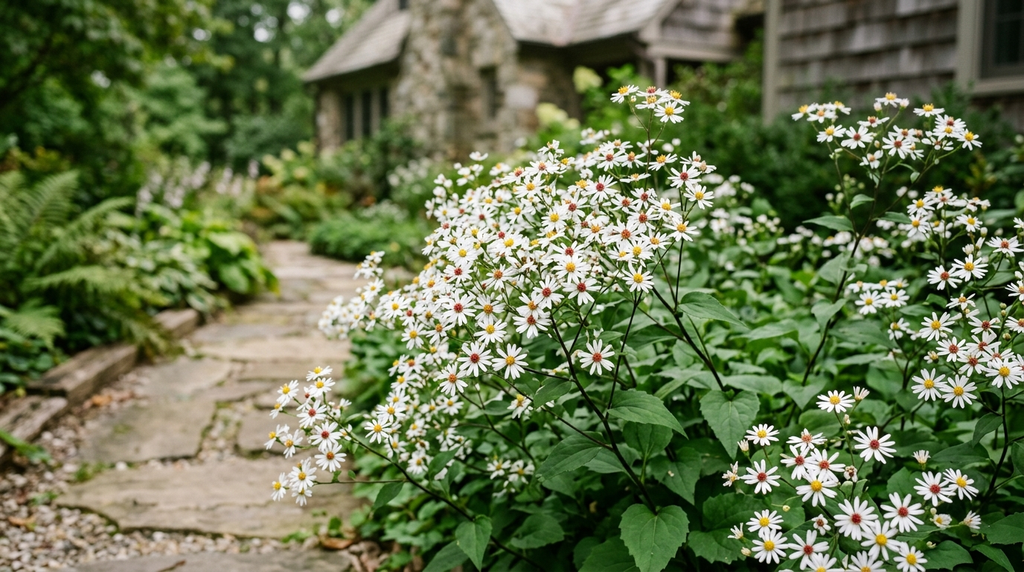
White wood aster carries loose groups of small, white, daisy-like flower heads in late summer and fall. Heart-shaped lower leaves and the plant’s branching habit help narrow the identification.
Unlike a generic “asters need sun” rule, this species is useful in open shade and tolerates relatively dry woodland conditions. It can spread vigorously, so give it a defined area rather than squeezing it between delicate, slow-growing plants.
10. White clover
White clover forms low mats with rounded white flower heads and three-leaflet foliage. Its creeping stems root along the ground, which helps explain why it persists in lawns.
It is introduced and widely naturalized, rather than a locally native meadow plant throughout its range. Whether you keep it depends on your lawn goals and local guidance; finding it growing wild doesn’t automatically make it suitable for a native restoration mix.

For more on the difference between an individual flower and a head made from many flowers, explore our interesting facts about flowers. That distinction makes descriptions of clover, yarrow, and aster easier to understand.
More recognizable white wildflowers
These are the names readers are most likely to meet in field guides, nurseries, lawns, roadsides, and natural areas. Several are introduced weeds, so recognition does not automatically make them good garden choices.
11. Oxeye daisy
Oxeye daisy is the classic white-and-yellow roadside daisy. Its flower heads usually stand singly on upright stems, with toothed basal leaves and smaller leaves higher on the stalk.
It was introduced from Europe and spreads by both seed and rhizomes. Because it is considered invasive in many areas, identify it for management purposes and check local rules before planting or moving it.

12. Daisy Fleabane
Daisy fleabane (Erigeron annuus) also has white rays around a yellow center, but the rays are much finer and far more numerous than those of oxeye daisy. Its branching stems commonly carry several flower heads rather than one bold bloom.
This native annual or biennial often appears in fields, roadsides, and other disturbed places. Compare its lower, coarsely toothed leaves and many narrow rays with regional Erigeron species before settling on an identification.

13. White campion
White campion (Silene latifolia) has five petals, each deeply notched enough to make the flower look more divided. Behind the petals is a swollen, veined calyx that gives the bud and flower base a distinctive shape.
It is an introduced plant of fields, roadsides, and waste ground. Treat it as an identification subject rather than a default wildflower-garden purchase, since its weed status varies by location.

14. Canada anemone
Canada anemone (Anemone canadensis), also called meadow anemone, has a single white flower with five petal-like sepals above deeply divided leaves. It commonly grows in moist meadows, along stream edges, and in open ground.
This native perennial can spread assertively through underground stems. It can be useful where a colony is wanted, but its running habit may overwhelm a small mixed border.

15. Star chickweed
Star chickweed has five white petals that are so deeply split they appear to be ten. Opposite leaves and fine lines of hair along the weak stems provide supporting identification clues.
It is a native spring wildflower of rich woodland soil, not the same plant as common chickweed. Use it in light shade with consistent moisture and good drainage, where you can see its small flowers up close.

16. Wild quinine
Wild quinine produces dense, flat-topped groups of small white flower heads. Its rough, coarse leaves make it look different from fine-leaved yarrow, even from a distance.
This prairie perennial prefers full sun and well-drained soil and tolerates some dryness once established. The historical common name is not a recommendation for medicinal use, so enjoy it as a landscape and pollinator plant.

17. Whorled milkweed
Whorled milkweed has narrow leaves arranged in circles around the stem and small clusters of white to greenish-white flowers. The leaf arrangement is usually more useful than color alone for separating it from other milkweeds.
It suits sunny, well-drained meadow plantings and can spread by seeds and rhizomes. Like other milkweeds, it contains potentially irritating sap and toxic compounds, so wear gloves and keep it away from unsupervised grazing animals.

18. Bunchberry
Bunchberry looks like a tiny dogwood growing at ground level. Four white bracts surround the actual small greenish flowers above a compact cluster of glossy leaves.
It belongs in cool, moist, acidic woodland conditions and can be difficult to establish in hot climates. It reminds us that the showiest white structures around a flower are not always petals.

White flowers for meadows, moist beds, and pollinator gardens
Height and moisture needs matter as much as flower color when choosing among these plants. Turtlehead and boneset prefer consistent moisture, while prairie clover and evening primrose require much better drainage.
19. White turtlehead
White turtlehead has plump, two-lipped flowers that resemble a turtle’s head. Opposite, toothed leaves and dense terminal flower clusters provide additional clues, and the white blooms may carry a pink tinge.
This is a useful late-summer-to-fall candidate for consistently moist soil in sun or partial shade. Think of a suitable rain-garden bed or streamside-style border, rather than a hot, dry strip that receives little water.

20. Culver’s root
Culver’s root produces slender flower spikes above whorls of narrow leaves. A whorl means several leaves emerge around the stem at the same level, creating a different pattern from paired or alternate leaves.
Its tall form can add a strong vertical accent to a sunny meadow-style border. Choose adequate moisture and enough space for mature growth, and allow time to establish it instead of judging it by its first season.

21. Boneset
Boneset bears clusters of small white flowers in late summer and fall. A particularly useful clue is the joined base of each opposite leaf pair, which makes the stem appear to pass through the leaves.
It needs a consistent moisture supply and can form substantial colonies in a suitable wet meadow or rain garden. Keep its horticultural use separate from folk-medicine claims, because the plant is toxic and not a casual tea ingredient.

22. Virginia mountain mint
Virginia mountain mint produces many small white flowers marked with purple dots. Its branching growth and relatively narrow foliage give a different impression from a large, showy, single-flowered wildflower.
It suits sun or partial sun with average to moist soil and attracts a range of flower-visiting insects. Allow space for spreading rhizomes, and don’t rely on fragrance alone to identify an unknown plant or decide whether it is edible.

23. White prairie clover
White prairie clover has elongated flower heads that develop a ring of small white blooms. Unlike lawn clover, it is an upright prairie perennial rather than a creeping mat of rounded flower heads.
Its deep taproot supports drought tolerance once established, and it suits a sunny, well-drained planting. Choose a lasting position and investigate local provenance when adding it to a prairie or meadow project.

24. Queen Anne’s lace
Queen Anne’s lace (Daucus carota) carries broad, umbrella-shaped clusters of tiny white flowers above finely divided foliage. The stems are usually hairy, but one clue is never enough to separate a carrot-family plant from poisonous lookalikes.
This introduced biennial is common along roadsides and in disturbed ground. It can spread aggressively and should not be planted without checking its local status; the safety comparison later in this guide explains why you should never taste unknown white umbels.

25. Common chickweed
Common chickweed (Stellaria media) forms low, weak mats with tiny white flowers. Each of its five deeply divided petals can look like a pair, creating the appearance of ten petals.
It is a widespread introduced garden and lawn weed, not the native star chickweed described above. Look at leaf size, growth habit, stem hairs, and habitat before using “chickweed” as a final identification.

26. Showy evening primrose
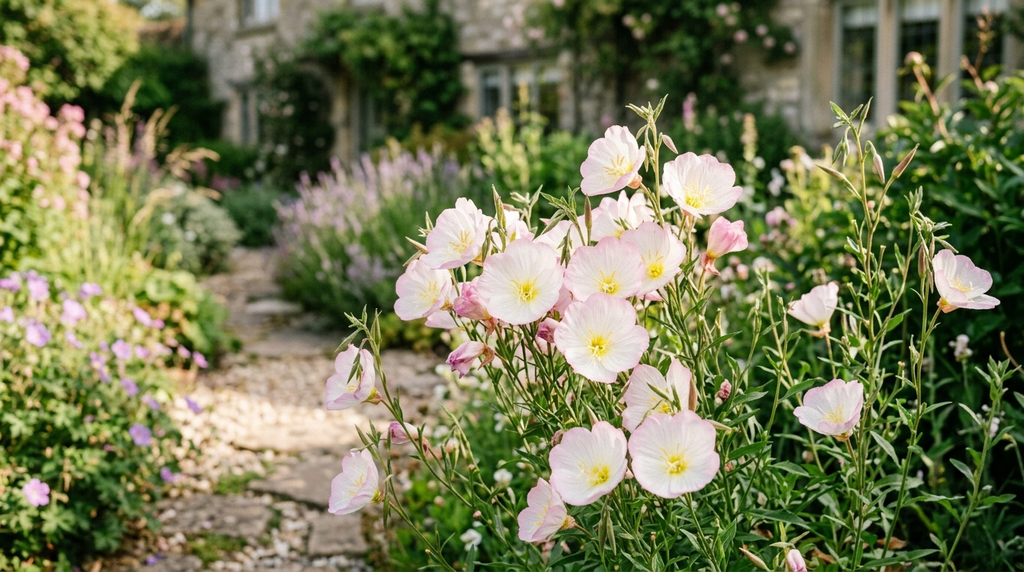
Showy evening primrose has four broad, cupped petals ranging from white to pink and often showing pink or red veins. The flowers may open in the evening, on cloudy days, or during daytime depending on local conditions.
It performs best in sun and well-drained soil but spreads through both rootstocks and seed. Reserve it for a naturalized area where expansion is acceptable, rather than placing it beside small, slow-growing plants.
White wildflowers to recognize in western habitats
Western woodland and semidesert flowers deserve their own place in a broad identification guide. These entries are regional candidates to investigate, not a single planting combination: a forest plant and a dry-country bulb can require very different care.
27. White avens
White avens (Geum canadense) has five small white petals separated by pointed green sepals. After flowering, it develops a rounded seed head covered with hooked tips that can cling to clothing or animal fur.
It occurs in woodland edges and partly shaded disturbed ground across much of eastern and central North America. Its modest flowers are easy to overlook, so photograph both the basal and stem leaves when seeking confirmation.

28. Sego lily
Sego lily (Calochortus nuttallii) has a satin-like, goblet-shaped flower, often white with coloured markings near the base. Grasslike foliage and a dry, open setting help narrow the possibilities.
It occurs in habitats such as sagebrush foothills and favors relatively dry, sandy soils. Its growth dies back after flowering, so don’t treat it like a moisture-loving border perennial or dig it up because the foliage disappears.
29. White mariposa lily
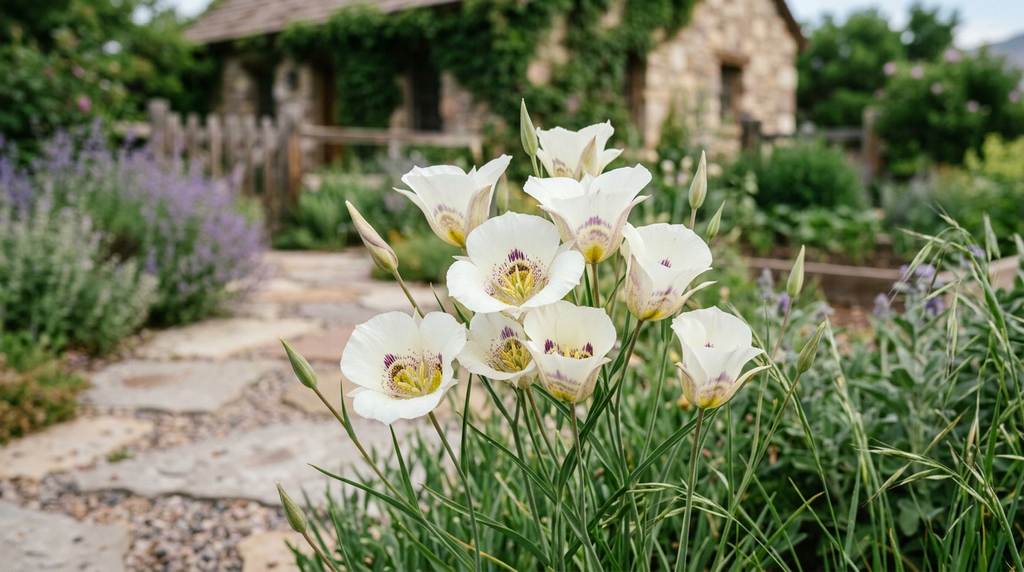
White mariposa lily (Calochortus eurycarpus) has three broad creamy-white petals, often with a dark reddish-purple blotch near the middle. The stems are slender, and the plant occurs in open grasslands, slopes, and woodland openings in parts of the Northwest.
Its bulb and seasonal growth are adapted to regional conditions that do not translate to every home garden. Photograph it in place, and source propagated material only from a specialist nursery, if appropriate locally.

30. Western trillium
Western trillium (Trillium ovatum) has three white petals above three broad leaves. It is an early-flowering western woodland species.
Do not assign an eastern trillium name solely because the three-part pattern matches. Location matters, and a regional identification key can help separate superficially similar species.

31. White bog orchid
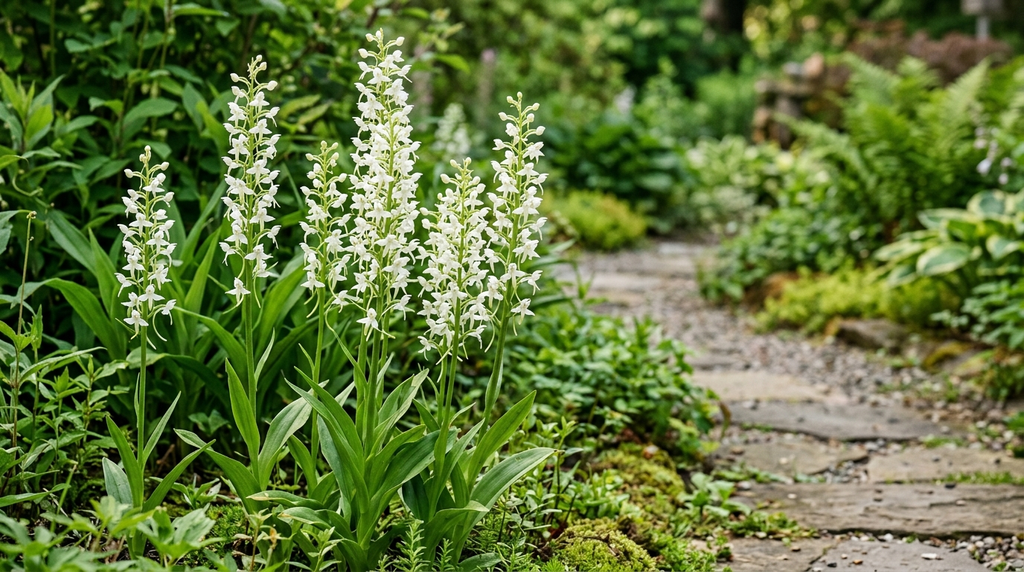
White bog orchid (Platanthera dilatata) carries many small white orchid flowers on an upright spike. It grows in wet meadows, seeps, and other persistently damp habitats in northern and western regions.
Orchids can be difficult to transplant and may be locally protected. Leave wild plants and their roots undisturbed, then use close photographs and a regional flora to confirm the species.
White cluster wildflowers that need extra caution
White flower clusters occur in unrelated plant families, including some with dangerous species. A pretty roadside stand should not become a bouquet or a garden transplant before its identity is confirmed.
Queen Anne’s lace and poison hemlock
Queen Anne’s lace, Daucus carota, and poison hemlock, Conium maculatum, can both show umbrella-like clusters of tiny white flowers. University extension guidance on poison hemlock identification notes smooth, hollow, purple-spotted stems in hemlock, compared with hairy stems in Queen Anne’s lace.
These are clues, not a complete safety test, and the absence of an obvious mark does not establish that a plant is harmless. Poison hemlock is highly toxic, and other white-flowered members of the carrot family also require expert identification.
Do not pick or crush an unfamiliar plant to investigate its smell. If you suspect hemlock in your yard, keep children and animals away and seek local guidance on identification and removal.
White snakeroot
White snakeroot produces clusters of small white flowers and is highly toxic, even though it is native in parts of its range. Its ecological role does not make it a safe plant for grazing animals or casual home use.
This is why “native,” “pollinator-friendly,” and “safe to eat” must be treated as separate questions. Identify it before deciding how to manage it around children, pets, or livestock.
Garlic mustard
Garlic mustard is an invasive biennial with clusters of small, four-petaled white flowers. Its leaves change from rounded, scalloped first-year growth to more triangular leaves on flowering plants.
It can displace woodland plants and should not be added to a wildflower garden. Follow local control and disposal guidance rather than moving flowering or seed-bearing material to another part of the yard.
How to choose white wildflowers for your garden
Start with your growing conditions, then choose the flower. “Wildflower” does not mean a plant will thrive without care in any soil or climate.
| Garden situation | Candidates to investigate locally | Design consideration |
|---|---|---|
| Moist, shaded border | Foamflower, trillium | Keep roots cool and preserve drainage |
| Spring woodland display | Bloodroot, spring beauty | Plan for seasonal dormancy |
| Sunny, well-drained bed | Tall white beardtongue, pearly everlasting | Combine different heights and flower shapes |
| Open, relatively dry shade | White wood aster | Allow for spreading growth |
| Low naturalistic groundcover | Wild strawberry, partridgeberry | Choose according to light and moisture; manage spreading growth |
| Moist meadow or rain garden | White turtlehead, boneset, Culver’s root | Check mature height and how often the site dries out |
| Lean, well-drained sunny area | White prairie clover, wild quinine | Avoid treating lean-soil plants like rich-soil woodland plants |
| Dry western habitat | Sego lily, where locally appropriate | Investigate seasonal dormancy and specialist growing advice |
The woodland list includes eastern and western examples, while the prairie and semidesert plants widen the range of habitats covered. Check county- or region-level native records, nursery provenance, and local invasive lists before buying.
I would choose a few well-matched species and repeat them in small groups rather than buy a large color-themed mixture. Repetition makes the border look intentional and makes unfamiliar seedlings easier to spot.
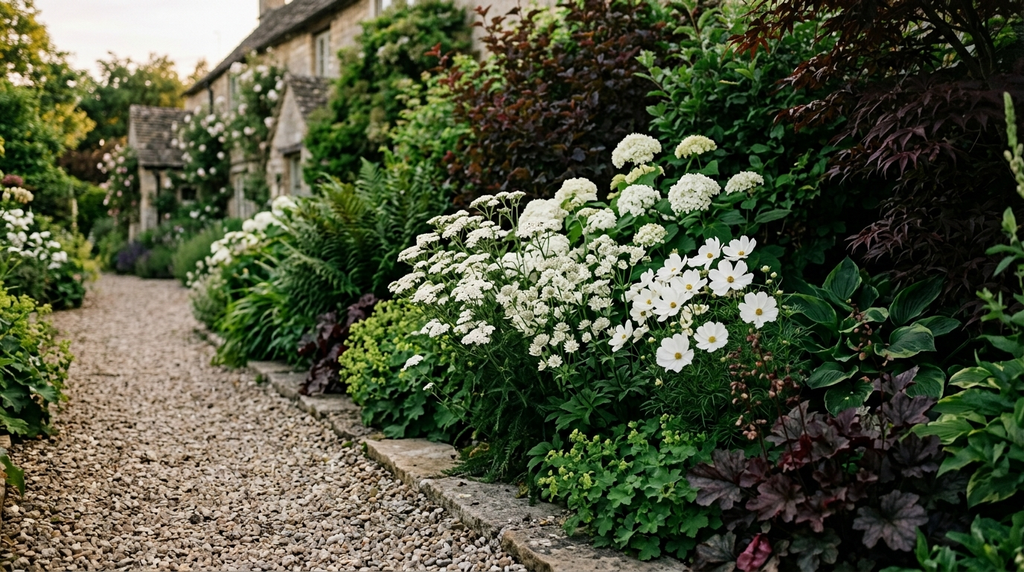
For contrast, place white flowers against deep green foliage, or choose dark flowers with matching growing requirements. Shared light and moisture needs matter more than a perfect color pairing.
Planting and care: what actually helps them establish
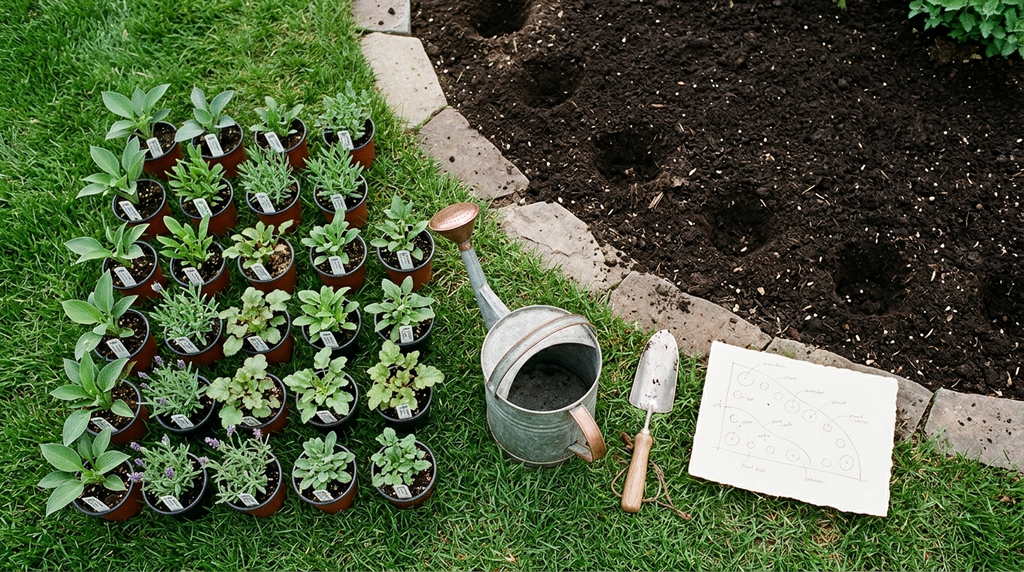
For a small bed, identifiable nursery-grown plugs or plants can make placement and early weeding easier. Seed can suit a larger area, but it requires more attention to preparation, germination requirements, and seedling recognition.
University guidance on establishing a wildflower meadow from seed emphasizes controlling existing vegetation before sowing. Scattering a packet over established lawn usually leaves young wildflowers competing with a dense root system.
- Map the site. Observe sunlight and drainage before choosing species.
- Check the label. Look for botanical names, growing requirements, and a complete seed list.
- Prepare the planting area. Reduce competing vegetation using a method appropriate to your site.
- Follow species-specific instructions. Some seeds need a period of moist cold; others have different requirements.
- Water for establishment. Adjust to rainfall, soil, and the plant rather than following one schedule for everything.
- Track what emerges. Keep labels or a planting map so you don’t mistake desirable seedlings for weeds.
Do not apply rich compost or fertilizer indiscriminately to a meadow planting. A woodland bed needing organic matter and a sunny, lean-soil planting are different situations.
Expect perennial plantings to develop over more than one growing season, not to deliver an instant meadow. Establishment is an ongoing process of observing, weeding, and adjusting care.
Common problems and the first thing to check
A struggling plant does not always need more water or fertilizer. First, compare its actual conditions with the requirements of the identified species.
| Problem | What to investigate first |
|---|---|
| Few flowers in a sunny-border species | Too much shade, young plants, or unsuitable growing conditions |
| Spring foliage disappears | Normal seasonal dormancy in the identified species |
| Plants collapse in a wet spot | Poor drainage and possible root problems |
| One species crowds everything else | Runners, rhizomes, or heavy self-seeding |
| Seed mix produces unfamiliar plants | The packet’s species list and local weed identification |
Use changes in growth, foliage, and soil moisture together rather than diagnosing from one symptom. If the plant remains uncertain, identifying it comes before choosing a treatment.
Frequently asked questions
What are the small white wildflowers in my lawn?
White clover and wild strawberry are two possibilities, but the leaves and flower arrangement help separate them. Clover has rounded flower heads, while wild strawberry has individual five-petaled blooms; other lawn plants can also have small white flowers.
Which white spring wildflowers grow in shade?
Bloodroot, large-flowered trillium, spring beauty, foamflower, star chickweed, and bunchberry are candidates for suitable woodland conditions. Their moisture needs and regional suitability still differ, so avoid treating them as an interchangeable planting mix.
What are the tall white cluster wildflowers along roadsides?
Possibilities include yarrow, Queen Anne’s lace, and poison hemlock, along with several other species. Record the whole plant and habitat without touching it, then use a regional expert or identification resource to narrow the answer.
Are all wild white flowers native?
No, plants can grow outside cultivation after being introduced from elsewhere. White clover is a familiar example, and invasive garlic mustard shows why growing wild is not the same as belonging in a native garden.
Can I grow white wildflowers in pots?
Some can grow in containers if the pot size, light, moisture, and winter conditions suit the species. Wild strawberry is one option to consider, while a deep-rooted or spreading plant may be less convenient for a small pot.
Will searching “wild flowers white” identify my plant?
That search can produce a shortlist, but it cannot confirm the identity of a particular plant. Add your region, flowering month, leaf shape, and whether the flowers grow singly or in clusters, then compare multiple features.
Bring the right white wild flowers into your garden
The best white wild flowers for your home are the ones you can identify confidently and match to your growing conditions. A few suitable species can provide spring interest, later blooms, and attractive foliage without relying on a miscellaneous seed mix.
Start by observing one planting area and choosing two or three locally appropriate candidates. Take your shortlist to a reputable native-plant nursery or extension service, then build a border that fits your garden and color scheme.