

A strange noise from your air conditioner can be easy to dismiss, especially when the system still appears to be cooling. However, banging, grinding, hissing, buzzing, or repeated clicking may indicate anything from restricted airflow to a failing motor or electrical component. Understanding the sound can help you decide whether to perform a simple check, turn the system off, or contact a qualified technician.
Choosing expert HVAC services for Your Home is not only about finding someone who can stop an irritating noise. The right provider should identify the actual cause, explain the available repair options, give you clear pricing, and help you avoid unnecessary work. A proper diagnosis can also prevent a small mechanical or airflow problem from causing more extensive damage.
This guide explains what common AC noises may mean, which warning signs require immediate attention, and what you can safely inspect yourself. It also shows you how to compare HVAC professionals, evaluate repair recommendations, and decide whether repairing or replacing the system makes better financial sense.
Quick Answer: When Should You Call an HVAC Professional?
Turn off your air conditioner and call a qualified HVAC technician if you hear loud grinding, metal banging, persistent screeching, continuous hissing, or electrical buzzing accompanied by a burning smell. These sounds may indicate motor damage, a loose internal component, a refrigerant problem, or an electrical fault.
You can safely begin by checking the air filter, opening blocked vents, and clearing visible debris from around the outdoor unit. Do not open electrical compartments, touch capacitors, handle refrigerant lines, or repeatedly restart a system that is making a severe noise.
| AC sound | Possible cause | Recommended response |
|---|---|---|
| Banging or clanking | Loose fan, blower or compressor component | Turn the system off |
| Grinding | Worn motor bearings or mechanical failure | Stop using it and call a technician |
| Screeching | Motor, bearing or compressor problem | Arrange urgent inspection |
| Hissing | Refrigerant leak, pressure issue, or duct leak | Contact a professional |
| Loud buzzing | Electrical fault, loose component or failing motor | Turn it off if persistent |
| Whistling | Dirty filter, blocked vent or duct restriction | Check the filter and airflow |
| Rattling | Loose panel, hardware or outdoor debris | Inspect visible external areas |
| One soft click | Normal startup or shutdown | Usually no action is required |
| Repeated clicking | Thermostat, relay or electrical problem | Schedule professional diagnosis |
Identifying and Decoding Common AC Noises
A working air conditioner usually makes a steady humming sound, soft airflow, and sometimes a click when turning on or off. Loud, metallic, repetitive, or high-pitched noises need checking, especially if you also notice weak airflow, warm air, strange smells, water leaks, or frequent shutdowns.
Start by finding where the noise comes from and when it happens. If the sound is from the indoor air handler, it could be the blower, filter, drain system, or ducts. If the noise is from the outdoor unit, it might be the fan, electrical parts, or compressor.

Evaluating AC Sounds for Expert HVAC Services
When your air conditioner makes strange sounds, first find out where the noise is coming from: the indoor unit, the outdoor compressor, or the ducts. Knowing the location helps you understand the problem and how urgent it is.
- Indoor Unit Noises: Sounds from your indoor unit, such as clicking, clanking, bubbling, whistling, or chirping, typically point to issues with the blower fan, condensate drain, or internal components. A quick click when the unit turns on or off is usually normal, indicating a relay engaging. However, persistent clicking might suggest a malfunctioning thermostat or a loose fan blade. Bubbling noises, for instance, can be a serious warning sign, potentially indicating a refrigerant leak or a clogged condensate drain line.
- Outdoor Unit Noises: The outdoor unit, housing the compressor and condenser fan, is prone to sounds like banging, screeching, humming, buzzing, rattling, or grinding. These often relate to the most critical components of your AC system. While a gentle hum is part of normal operation, a loud or persistent humming or buzzing could signal electrical problems or issues with the compressor.
- Ductwork Noises: Sounds originating from your ductwork, such as popping or whistling, are usually related to airflow issues or thermal expansion and contraction of the metal ducts.
Understanding these differences is important for deciding what to do next. Some sounds, like constant grinding or loud banging, mean you should turn off your system right away to avoid damage. To learn more about different AC noises and what they mean, check out guides on common air conditioner sounds. Knowing these sounds will help you decide if you can fix the problem yourself or if you need to call a professional. For more help, look into expert HVAC services and how they find and fix these issues.
Banging, Screeching, and Grinding Sounds
These are among the most alarming noises an AC unit can produce, and they almost always signal a serious mechanical problem that requires immediate attention. Ignoring these sounds can lead to catastrophic system failure and significantly higher repair costs.
- Banging: A banging noise, especially from the outdoor unit, often indicates loose or broken parts. This could be a fan blade hitting something, a loose connecting rod in the compressor, or even a compressor that is failing. If you hear banging, it’s critical to shut down your AC immediately to prevent further internal damage. Unbalanced fan blades, for example, can quickly cause extensive harm to the motor housing if not addressed.
- Screeching: A high-pitched screeching sound is frequently a sign of trouble with the fan motor, either in the indoor or outdoor unit. It could mean worn-out bearings that need lubrication or replacement, or a failing motor itself. In some cases, screeching can also indicate a problem with the compressor, such as high pressure within the unit or internal wear. This sound suggests significant friction and wear, which can quickly lead to component failure.
- Grinding: A grinding noise typically points to worn-out motor bearings in either the fan or the compressor. When bearings fail, metal-on-metal friction occurs, producing this harsh sound. This is a severe issue because it means the motor is struggling and could seize up entirely. It can also be caused by debris caught in the fan or compressor, which could lead to significant damage to the fan blades or internal components. Any grinding sound warrants an immediate shutdown of the system to prevent irreparable harm to the compressor or motors.
These noises are usually serious. They show that important parts like fan blades, motor bearings, or the compressor are loose, worn, or breaking. Running the AC with these issues will likely cause bigger and costlier problems.
Whistling, Hissing, and Buzzing Issues
While not always as immediately alarming as banging or screeching, whistling, hissing, and buzzing noises can still indicate problems that require prompt attention, ranging from simple maintenance to serious system faults.
- Whistling: A whistling sound is very common and often points to airflow restriction. The number one cause of whistling and humming noises in AC units, affecting up to 80% of reported noise complaints, is a dirty air filter. A clogged filter forces the system to work harder, creating a whistling sound as air struggles to pass through. This can also occur if return vents are blocked or if there are leaks in the ductwork, allowing air to escape or enter where it shouldn’t. While a dirty filter is a relatively easy fix, persistent whistling from duct leaks can reduce efficiency and lead to higher energy bills.
- Hissing: A distinct hissing sound is a serious warning sign, often indicating a refrigerant leak. Refrigerant leaks are not only detrimental to your AC’s performance and efficiency but can also pose health risks. Bubbling noises can also suggest a refrigerant leak or a clogged condensate drain line causing trapped water. Refrigerant leaks account for over 40% of emergency AC repairs and can lead to respiratory issues, vomiting, and headaches if ignored. Hissing can also mean air is escaping from damaged ductwork, which compromises your system’s ability to cool effectively. Given the potential health and system implications, a hissing sound should be addressed immediately by a professional.
- Buzzing: A buzzing noise can have several causes, some minor and some more serious. It could be due to loose fan blades vibrating against the casing, debris caught in the fan, or even electrical issues. Loose wiring, a failing capacitor, or a contactor relay can all produce a buzzing sound. For modern inverter AC systems, a variable buzzing sound as the compressor changes frequency to adjust temperature is often normal. However, a loud, consistent, or sudden buzzing that deviates from normal operation usually signals an electrical problem or a compressor struggling to start. Electrical issues should always be handled by professionals due to the inherent safety risks.
Understanding the nuances of these sounds allows homeowners to prioritize their response, addressing simple filter changes themselves while recognizing when a professional technician is needed for more complex issues like refrigerant leaks or electrical faults.
When to Hire Expert HVAC Services for Diagnostics
Some small AC noises can be fixed with simple DIY steps, but many need a trained expert. Trying to fix complex problems yourself can be risky, especially with electric parts or pressurized refrigerant. It is important to know when to call a professional to keep you safe and protect your AC.
Professional HVAC technicians have the right tools, skills, and experience to find the cause of strange noises. They can safely work with refrigerant, fix electrical parts, and replace worn-out pieces without causing more damage or injury.
DIY Troubleshooting vs Professional Interventions
Distinguishing between what you can safely handle and what requires a professional is key to effective AC maintenance and repair.
Safe DIY Troubleshooting Steps:
- Filter Maintenance: If you hear whistling or humming, the first step is always to check and replace your air filter. A dirty air filter is the number one cause of such noises and is a simple, safe fix.
- Debris Clearing: For rattling noises from the outdoor unit, safely turn off the power to the unit and check for any leaves, twigs, or other debris that might be caught in the fan blades or resting inside the unit. Carefully remove any obstructions.
- Panel Securing: Loose panels or screws can cause rattling or vibrating sounds. Inspect your indoor and outdoor units for any loose fasteners and tighten them gently.
- Visual Inspection: After ensuring the power is off, a visual inspection can sometimes reveal obvious issues like a detached drain hose or a loose wire (though do not attempt to reattach or repair electrical components yourself).
When to Call a Professional:
- Motor Repair: Any issues related to the fan motor (indoor or outdoor), such as screeching, grinding, or a persistent loud hum, should be handled by a professional. These often involve bearing replacement or motor replacement, which require specialized tools and knowledge.
- Refrigerant Handling: Hissing or bubbling sounds indicating a potential refrigerant leak require immediate professional attention. Refrigerant is a hazardous chemical, and only certified technicians are equipped to safely detect leaks, repair them, and recharge the system.
- Electrical Issues: Buzzing sounds that point to electrical problems (e.g., failing capacitors, loose wiring, contactor issues) should never be attempted by a homeowner. The high voltage involved poses a severe risk of electric shock.
- Persistent Noises: If a noise persists after basic DIY troubleshooting, or if it’s an unusually loud or harsh sound like banging or grinding, it’s time to call an expert. Ignoring these can lead to a complete system breakdown.
- Complex Diagnostics: Modern AC systems are complex, with advanced sensors and electronic components. Diagnosing issues in these systems often requires specialized diagnostic tools that only professionals possess. Ignoring AC noises can lead to costly repairs or full system breakdowns, with some issues escalating from minor to major within weeks.
Health, Safety, and Electrical Risk Management
Ignoring certain AC noises or attempting repairs beyond your skill level can pose significant health and safety risks.
- Refrigerant Toxicity: As mentioned, a hissing or bubbling sound can indicate a refrigerant leak. Refrigerant, while essential for cooling, can be harmful if inhaled. Exposure can lead to respiratory issues, nausea, vomiting, headaches, and in severe cases, even oxygen deprivation. Only trained professionals are equipped to handle and dispose of refrigerants safely.
- Electrical Hazards: Many AC noises, particularly buzzing, can stem from electrical problems. The outdoor unit and indoor unit both contain high-voltage electrical components. Attempting to fix electrical issues without proper training can result in severe electric shock, burns, or even fire. Professionals have the necessary safety equipment and knowledge to work with these systems.
- Pressure Control: The AC system operates under high pressure, especially the compressor. Issues leading to banging or screeching can sometimes be related to abnormal pressure buildup. Tampering with a pressurized system without understanding can be extremely dangerous, potentially leading to explosions or release of harmful substances.
- Mechanical Failure: Ignoring grinding or banging noises can lead to the complete failure of critical components like the compressor or fan motor. This not only renders your AC useless but can also create dangerous situations, such as fan blades breaking off and causing damage or injury.
For these reasons, it is always advisable to err on the side of caution. When in doubt, or when facing any of the more serious noises discussed, contacting a qualified HVAC technician is the safest and most effective course of action. They can ensure that your system is repaired correctly, safely, and efficiently, protecting both your investment and your well-being.
How to Choose Expert HVAC Services for Your Home
Not every HVAC provider offers the same level of diagnosis, workmanship, or customer protection. I recommend comparing companies based on their qualifications, diagnostic process, communication, and warranty rather than choosing solely by the lowest service-call price.
A reliable technician should inspect the system before recommending expensive repairs or replacement. Be cautious if a company immediately suggests installing a new system without testing the existing equipment, explaining the failure, or discussing reasonable repair options.

Verify Licensing, Insurance and Training
Confirm that the company holds any contractor licence required in your area and carries appropriate liability and workers’ compensation insurance. These protections matter because HVAC work may involve high-voltage electricity, pressurized refrigerant, drainage systems, gas equipment, and structural penetrations.
You can also ask about technician training, refrigerant-handling credentials, and experience with your system type. A technician who regularly works with heat pumps, central air conditioners, ductless systems, or inverter equipment is more likely to diagnose that particular technology accurately.
Ask What the Diagnostic Visit Includes
Before booking, ask what is included in the diagnostic fee. A proper visit may involve checking electrical components, airflow, refrigerant performance, temperature differences, condensate drainage, fan operation, thermostat communication, and visible duct connections.
The technician should explain what caused the noise, whether continuing to use the system is safe, and what may happen if the repair is delayed. You should not be expected to approve expensive work based only on a brief statement that the unit is “old” or “going bad.”
Request a Written Estimate
Ask for a written estimate that separates the diagnostic fee, parts, labour, warranties, and any optional recommendations. If several repairs are proposed, the company should explain which work is urgent, which work can wait, and whether each repair addresses the original complaint.
A clear estimate makes it easier to compare providers and prevents misunderstandings. For a major compressor repair or complete system replacement, getting a second opinion is reasonable unless an immediate safety problem requires the equipment to remain off.
Compare Repair and Replacement Recommendations
A good HVAC contractor should discuss both repair and replacement when either option is reasonable. The recommendation should consider the system’s age, overall condition, repair history, efficiency, comfort performance, warranty status, and the cost of the current repair.
Replacement should not be suggested just because of age. Also, fixing a failing system many times may not be cost-effective if key parts are wearing out and the unit no longer cools the home well.
Review Workmanship and Equipment Warranties
Ask what warranty applies to the replacement part and what warranty the company provides for labour. A manufacturer’s parts warranty may not cover the cost of diagnosing the problem, removing the defective component, or installing its replacement.
For a new system, confirm who registers the equipment warranty and whether regular professional maintenance is required to keep coverage valid. Keep copies of estimates, invoices, warranty documents, and maintenance records.
Look for Clear Communication, Not Pressure
Professional technicians should be able to explain the problem in language you understand. They should answer questions, show you the failed or damaged component when practical, and allow you time to consider non-emergency options.
Avoid companies that use fear, refuse to provide written information, or pressure you into immediate replacement without a complete diagnosis. The best provider is not necessarily the cheapest or most expensive one. It is the company that gives you a defensible diagnosis, transparent choices, and clear responsibility for the completed work.
Preventive Maintenance and System Replacement Considerations
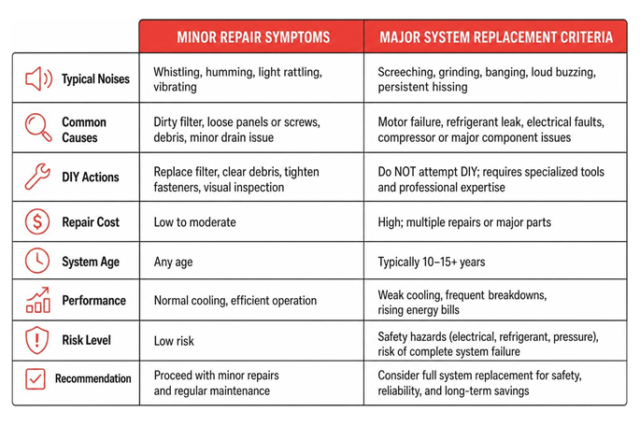
Taking care of your AC with regular maintenance is important to stop noise problems and keep it running longer and better. But sometimes, no matter how well you care for it, repairs become too costly. When that happens, it’s smarter to replace the unit.
Preventive Tune-Ups and Air Filter Care
Regular maintenance is the cornerstone of a quiet, efficient, and long-lasting air conditioning system. Just like a car, your AC unit benefits immensely from routine check-ups.
- Biannual Inspections: We recommend professional tune-ups twice a year—ideally in the spring before the cooling season begins and in the fall for heating systems. These inspections involve cleaning coils, checking refrigerant levels, inspecting electrical connections, lubricating moving parts, and ensuring all components are functioning correctly. Regular maintenance twice a year can reduce AC noise levels and extend system lifespan by preventing 70% of common mechanical failures.
- Air Filter Care: A dirty air filter is a leading cause of many AC noises, particularly whistling and humming, and contributes to up to 80% of reported noise complaints. A clogged filter restricts airflow, forcing your system to work harder, which increases strain on components and generates more noise. It also reduces efficiency and can lead to coil freeze-ups. Regularly checking and replacing your air filter (typically every 1-3 months, depending on usage and household conditions) is the simplest yet most effective maintenance task you can perform. This DIY step significantly improves airflow, reduces noise, and enhances energy efficiency.
- Failure Prevention: Preventive maintenance helps identify minor issues before they escalate into major problems. For example, a technician might spot worn bearings that could soon lead to screeching or grinding, or detect a minor refrigerant leak before it becomes a significant, costly repair. This proactive approach not only keeps your system running quietly but also ensures it performs optimally, saving you money on energy bills and extending its operational life.
Deciding When Replacement Outweighs Repair Costs
Even with diligent maintenance, all AC systems have a finite lifespan. As units age, they become less efficient, more prone to breakdowns, and consequently, noisier. Deciding when to replace an aging system rather than continually repairing it is a common dilemma for homeowners.
- Aging Systems: Most AC units have an average lifespan of 10-15 years. If your unit is approaching or has exceeded this age, and you’re experiencing frequent breakdowns or persistent strange noises, it might be time to consider replacement.
- Frequent Breakdowns: If you find yourself calling for repairs multiple times a year, the cumulative cost of these repairs can quickly add up, often surpassing the cost-effectiveness of investing in a new unit.
- Repair Threshold: A general rule of thumb is the “5,000 Rule”: if the cost of repair multiplied by the age of the unit (in years) exceeds $5,000, replacement is likely the more economical choice. For example, a $500 repair on a 12-year-old unit ($500 x 12 = $6,000) would suggest replacement.
- Energy Efficiency: Older units are significantly less energy-efficient than modern ones. A new, high-efficiency AC system can drastically reduce your energy bills, often offsetting a portion of the installation cost over time. Persistent noises can also be a symptom of an inefficient system struggling to perform.
- System Performance: If your AC is no longer cooling your home effectively, or if certain rooms are consistently warmer than others despite repairs, it indicates that the system is struggling and may be undersized or simply worn out.
While replacing an AC unit is a significant investment, it can provide long-term savings through increased energy efficiency, fewer repair costs, and enhanced home comfort with quieter operation.
Similar warning signs apply across heating and cooling equipment. Review these signs it is time to replace your furnace if increasing noise, poor performance, rising costs, and repeated repairs are affecting other parts of your HVAC system.
Partnering with Expert HVAC Services for Installation
When the time comes for a new AC system, proper installation is just as crucial as the quality of the unit itself. A poorly installed system, even a brand new, high-efficiency one, can lead to premature noise issues, reduced performance, and shortened lifespan.
- System Sizing: A professional HVAC technician will perform a load calculation (often called a Manual J calculation) to accurately determine the right size of AC unit for your home. An improperly sized unit—whether too large or too small—will struggle to maintain comfortable temperatures, cycle on and off frequently (short-cycling), and operate noisily.
- Noise Reduction: Expert installers pay attention to details that contribute to quiet operation, such as securing ductwork, ensuring proper insulation, and placing the outdoor unit on a level, vibration-dampening pad. They also ensure that all components are correctly aligned and tightened, preventing rattles and vibrations from the outset.
- Proper Installation: This includes correct refrigerant charging, secure electrical connections, and proper duct sealing. All these elements are critical for the system’s efficiency and quiet performance. Incorrect refrigerant levels, for example, can lead to hissing sounds and compressor strain.
- Warranty Protection: Professional installation is often a requirement for honoring manufacturer warranties. Attempting a DIY installation or hiring an unqualified individual can void your warranty, leaving you responsible for future repair costs.
Partnering with expert HVAC services for installation ensures that your new system is perfectly matched to your home’s needs, installed to the highest standards, and set up for years of quiet, efficient operation. This initial investment in professional installation prevents many of the noise and performance issues that can plague improperly installed systems.
Frequently Asked Questions About HVAC Diagnostic Services
Understanding the common questions homeowners have about AC noises and diagnostic services can help demystify the process and empower you to make informed decisions.
What AC noises require an immediate emergency system shutdown?
Certain AC noises are clear indicators of severe mechanical or electrical issues that demand immediate attention to prevent further damage or safety risks. These include:
- Loud Screeching Sound: Often signals failing motor bearings or a compressor under extreme stress.
- Metal Grinding: Indicates metal-on-metal friction within the compressor or fan motor, suggesting critical component wear.
- Severe Hissing or Gurgling: Can point to a significant refrigerant leak, which is both harmful to your system and potentially to your health.
- Electrical Buzzing with Burning Smell: This combination strongly suggests an electrical fault that could lead to a fire.
If you hear any of these sounds, turn off your AC unit at the thermostat and then at the circuit breaker immediately, and contact a professional HVAC technician.
How often should home cooling systems undergo professional maintenance?
For optimal performance, efficiency, and longevity, home cooling systems should undergo professional maintenance twice a year. This typically involves:
- Spring Inspection: Before the cooling season begins, a technician will prepare your AC for the summer heat, cleaning coils, checking refrigerant, and ensuring all components are ready for heavy use.
- Fall Tune-Up: For homes with heat pumps or those that use their AC for heating, a fall tune-up ensures the system is ready for colder temperatures and identifies any issues that might have arisen during the cooling season.
Regular maintenance helps prevent 70% of common mechanical failures, keeps your system running quietly, and extends its lifespan.
How can dirty air filters cause whistling or humming sounds?
A dirty air filter is a very common culprit behind whistling and humming noises in AC units, accounting for up to 80% of reported noise complaints. Here’s why:
- Airflow Restriction: As an air filter collects dust, dirt, and debris, it becomes clogged. This blockage restricts the flow of air into the HVAC system, creating a vacuum pressure.
- Increased Strain: The blower fan has to work much harder to pull air through the restricted filter, leading to increased motor strain and often a louder hum.
- Whistling Effect: The limited openings in a clogged filter, combined with the increased force of air being pulled through, can create a whistling sound as air is forced through narrower passages. This is similar to how a person whistles by forcing air through pursed lips.
- Return Vents: Restricted airflow can also cause air to be pulled more forcefully through small gaps in return vents or ductwork, exacerbating whistling sounds.
Regularly checking and replacing your air filter (every 1-3 months, depending on usage and household conditions) is a simple and effective way to prevent these noises, improve air quality, and maintain your AC’s efficiency.
Conclusion
Strange AC noises can help you identify a developing problem before the system stops working completely. Check simple causes such as a dirty filter, blocked vent, loose exterior panel, or debris around the condenser, but turn the system off if you hear grinding, banging, persistent screeching, or electrical buzzing.
Choosing Expert HVAC Services for Your Home means looking beyond the lowest service-call price. Choose a qualified provider who offers a clear diagnosis, written pricing, reasonable repair and replacement options, and appropriate warranty protection. If the noise persists after basic checks, arrange a professional inspection before a smaller problem becomes more expensive.