

Key Signs It Is Time to Replace Your Furnace
When the Texas chill sets in, a reliable furnace is not just a comfort; it’s essential for your home’s safety and warmth. As we approach August 2026, many homeowners in New Hope, TX, might be noticing their heating systems are showing their age. Issues like rising energy bills, uneven heating, or frequent breakdowns are common signs it might be time for an upgrade. Deciding between repair and replacement can be a significant decision. This guide will walk you through the key indicators, benefits, and processes involved in a furnace replacement home in New Hope, TX, helping you make an informed choice for lasting comfort and efficiency.
Recognizing the signs that your furnace is nearing the end of its functional life is crucial for proactive home management and avoiding an emergency breakdown during the coldest months. Most furnaces, especially those operating in the varying climate of North Texas, have an expected lifespan of 15 to 20 years. If your unit is approaching or has surpassed this age, it’s often more economical and less stressful to plan for a replacement rather than waiting for it to fail completely.
One of the most practical benchmarks for considering replacement is the “30% repair rule.” If a single repair is estimated to cost more than 30% of the price of a brand-new unit, it’s generally more financially prudent to invest in a new system. Beyond age and repair costs, other indicators include a noticeable increase in your utility bills without a change in usage, which suggests declining efficiency. Frequent repairs, even minor ones, can also signal that the system is wearing out. Additionally, pay attention to operational issues like short cycling (the furnace turning on and off too frequently) or unusual noises such as banging, squealing, or rattling, which often point to internal mechanical problems.
Identifying Safety Risks and Component Failures
Beyond efficiency and cost, safety is paramount. An aging furnace can develop critical issues that pose serious risks to your household. A cracked heat exchanger, for instance, is one of the most dangerous potential failures. This component separates the combustion gases from the breathable air in your home. If it cracks, it can leak carbon monoxide—an odorless, colorless, and highly toxic gas—into your living space. This is a severe safety hazard that necessitates immediate attention and often, a full system replacement. Regular, yearly visual and technical inspections of the heat exchanger are essential to detect such risks early.
Other component failures can also indicate a need for replacement. A malfunctioning flame sensor can cause the furnace to blow cold air, as it fails to detect the flame and shuts off the gas supply. Similarly, a pilot light that frequently extinguishes or a limit switch that trips often can be symptoms of deeper, systemic issues that suggest the furnace is struggling to operate safely and efficiently. Verifying safety limit switches and rollout controls during every annual service check is a critical best practice.
Comparing System Age and Operational Efficiency
The efficiency of a furnace is measured by its Annual Fuel Utilization Efficiency (AFUE) rating. This percentage indicates how much of the fuel consumed is converted into usable heat, with the remainder lost through the flue. Older furnaces, particularly those over 15 years old, typically have lower AFUE ratings, often in the 60-70% range. This means a significant portion of the fuel you pay for is wasted. Modern, high-efficiency furnaces, however, can achieve AFUE ratings of 90% or higher, translating into substantial energy savings over time.
As furnaces age, their components wear down, leading to a natural decline in efficiency and an increase in fuel consumption. A single-stage furnace, which operates only at full capacity, might become particularly inefficient as it ages, constantly running at maximum output even when less heat is needed. Upgrading to a newer, more efficient model not only reduces your carbon footprint but also provides more consistent heating and improved system reliability. Evaluating your furnace’s age against its operational efficiency is a key step in deciding if a replacement is the best long-term solution for your New Hope home.
Evaluating Comprehensive Residential HVAC and Plumbing Solutions
When considering a furnace replacement, it’s an opportune moment to think about your home’s entire system integration. A new furnace isn’t just about heat; it impacts your overall energy savings, home comfort, and even the air distribution throughout your property. Modern HVAC systems are designed to work together seamlessly, and upgrading one major component can often enhance the performance of others. For example, a new, more powerful furnace with a variable-speed blower can improve air circulation, reducing hot and cold spots and contributing to more balanced temperatures across your home. This holistic approach ensures that your investment provides maximum benefit across all aspects of your indoor environment.
Preventative maintenance, often overlooked, becomes even more critical with newer, more complex systems. Regular inspections and tune-ups ensure that your new furnace operates at peak efficiency, extending its lifespan and maintaining its warranty. This proactive care can prevent minor issues from escalating into costly repairs, safeguarding your investment in a comprehensive residential HVAC and plumbing solution.
Heating equipment is only one part of maintaining a reliable home system. Inconsistent hot water, leaks, or unusual noises can indicate a separate plumbing problem, so it also helps to recognize the key signs your water heater needs immediate attention.
Key Performance Factors in Residential HVAC and Plumbing Solutions
Modern furnace technology offers significant advancements that contribute to superior home comfort and efficiency. Understanding these key performance factors can help you choose the right system for your New Hope home:
- Variable-Speed Blowers: Unlike older, single-speed blowers that are either “on” or “off,” variable-speed blowers can adjust their fan speed to precisely control airflow. This results in quieter operation, improved indoor air quality through better filtration, and more consistent temperatures throughout your home by eliminating drafts and cold spots.
- Multi-Stage Heating: This refers to furnaces that can operate at different heating capacities. Two-stage furnaces have a low setting for mild days and a high setting for severe cold, while modulating furnaces can adjust their heat output in tiny increments. This allows for more precise temperature control and greater energy efficiency compared to single-stage units that only run at full power.
- Moisture Control: While primarily a function of air conditioning, a well-integrated HVAC system can contribute to better humidity management. Some advanced furnaces and thermostats work in conjunction with humidifiers or dehumidifiers to maintain optimal indoor moisture levels, which is crucial for comfort and preventing mold growth.
- Temperature Balance: Achieving consistent temperatures across all rooms, even those on different floors or with varying sun exposure, is a hallmark of a high-performing system. Factors like proper sizing, multi-stage operation, and advanced zoning capabilities all play a role in optimizing temperature balance.
- Air Filtration: A new furnace installation is an excellent opportunity to upgrade your home’s air filtration system. High-efficiency particulate air (HEPA) filters or media filters can significantly improve indoor air quality by capturing dust, allergens, pet dander, and other pollutants, which is particularly beneficial for those with allergies or respiratory sensitivities.
Sizing Mechanics in Residential HVAC and Plumbing Solutions
One of the most critical steps in furnace replacement is proper sizing. An incorrectly sized furnace can lead to numerous problems, negating the benefits of a new, high-efficiency unit. This is why a professional Manual J load calculation is absolutely essential. This detailed assessment goes far beyond simply looking at your home’s square footage. It takes into account a multitude of factors specific to your property, including:
- Home Square Footage and Layout: The total heated area and the configuration of rooms.
- Insulation Levels: The quality and R-value of your wall, attic, and floor insulation.
- Window Orientation and Type: The number, size, and type of windows, and which direction they face, as this impacts heat gain and loss.
- Ceiling Heights: Taller ceilings require more heating capacity.
- Local Climate Data: Specific temperature and humidity data for New Hope, TX.
- Air Infiltration: How much outside air leaks into your home.
- Number of Occupants and Heat-Generating Appliances: These contribute to the internal heat load.
An oversized heating unit will cycle on and off frequently (short cycling), which wastes energy, causes unnecessary wear and tear on components, and can lead to inconsistent temperatures and higher utility bills. Conversely, an undersized unit will run constantly without adequately heating your home during peak cold periods, leading to discomfort and premature system failure. Proper sizing ensures your furnace operates efficiently, provides consistent comfort, and maximizes its lifespan.
To further illustrate the choices available, here’s a comparison of common furnace types:
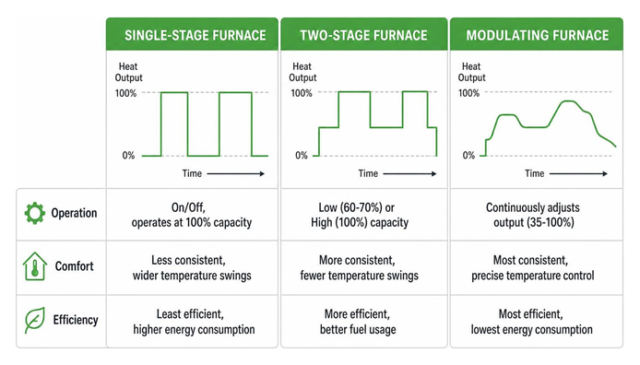
| Feature | Single-Stage Furnace | Two-Stage Furnace | Modulating Furnace |
| Operation | On/Off, operates at 100% capacity | Low (60–70%) or High (100%) capacity | Continuously adjusts output (35–100%) |
| Comfort | Less consistent, wider temperature swings | More consistent, fewer temperature swings | Most consistent, precise temperature control |
| Efficiency | Least efficient, higher energy consumption | More efficient, better fuel usage | Most efficient, lowest energy consumption |
| Noise Level | Louder, full fan speed | Quieter on low stage, full on high stage | Quietest, variable fan speed |
| Cost | Lowest initial cost | Mid-range initial cost | Highest initial cost |
| Ideal For | Budget-conscious, moderate climates | Improved comfort, varying climates | Premium comfort, maximum efficiency |
Local Regulations and Professional Installation in New Hope, TX
Navigating local regulations is a crucial,, part of a furnace replacement project. In New Hope, TX, all construction, alteration, repair, maintenance, and trade work, including HVAC installations, are governed by specific codes and ordinances. The Town of New Hope has adopted the 2021 International Building Code (IBC), as mandated by Ordinance 2023-005. This means that any furnace replacement must comply with the latest safety and performance standards outlined in these codes.
For homeowners in New Hope, TX, this translates to a requirement for a Miscellaneous & Trade Permit for HVAC and gas work before commencing a furnace replacement. This permit ensures that the installation meets all safety standards and local regulations. It’s not just a formality; it’s a critical step that protects your investment and ensures the safety of your home. A professional HVAC contractor familiar with Collin County and New Hope permitting procedures will handle this process, ensuring all necessary inspections are scheduled and passed. You can contact the Building Official at buildingofficial@newhopetx.gov for permit applications and specific code inquiries. Additionally, be aware of local setback requirements outlined in the Town’s Comprehensive Zoning Ordinance, especially if any exterior equipment is part of the installation.
Step-by-Step Furnace Replacement Process
A professional furnace replacement is a meticulous process designed to ensure optimal performance and safety. Here’s what you can expect from start to finish:
- In-Home Consultation and Load Calculation: A qualified technician will visit your New Hope home to assess your current heating needs, evaluate your existing system, and perform a detailed Manual J load calculation. This ensures the new furnace is perfectly sized for your home.
- System Selection and Quote: Based on the load calculation and your preferences, you’ll receive recommendations for suitable furnace types (single-stage, two-stage, modulating, gas, or electric) and efficiency ratings. A comprehensive quote detailing the equipment and labor will be provided.
- Permit Acquisition: Your chosen contractor will handle the necessary Miscellaneous & Trade Permit application with the Town of New Hope to ensure compliance with the 2021 IBC and Ordinance 2023-005.
- Old Equipment Removal: On installation day, the existing furnace and associated components (like the old flue pipe or gas lines if they are not up to code) will be carefully disconnected and safely removed from your property.
- New Furnace Installation: The new unit will be precisely positioned. This involves connecting new electrical wiring, securely attaching ductwork, installing or modifying gas lines (if applicable), and ensuring proper flue ventilation according to code.
- System Commissioning and Testing: Once installed, the furnace will undergo rigorous testing. This includes checking for gas leaks, verifying electrical connections, testing safety controls, calibrating the thermostat, and ensuring proper airflow and heating cycles.
- Thermostat Installation and Walkthrough: A new, often smart, thermostat will be installed and configured. The technician will then walk you through its operation, explain maintenance requirements, and answer any questions you may have.
- Post-Installation Inspection: After installation, the New Hope Building Official may conduct an inspection to confirm that the installation adheres to all local codes and safety standards.
Selecting a Qualified Service Specialist
Choosing the right professional for your furnace replacement in New Hope, TX, is as important as selecting the right furnace itself. A reputable contractor ensures that the installation is performed correctly, safely, and in compliance with all local regulations, maximizing your system’s efficiency and lifespan. Look for a company with a strong local presence and a proven track record.
When you’re searching for a reliable partner for your home’s heating needs, considering a family-owned hvac expert can often provide a level of personalized service and commitment that larger corporations might not. Such businesses often prioritize long-term customer relationships and community reputation. For further insights into choosing a trustworthy provider and understanding the furnace replacement process, you might find valuable information in a detailed guide on furnace replacement in New Hope, TX.
Here are key attributes to look for in a qualified service specialist:
- Licensed and Insured: Ensure the company and its technicians are fully licensed to operate in Texas and are adequately insured.
- Local Experience: Choose a company with extensive experience working in New Hope and Collin County, as they will be familiar with local building codes, permitting processes, and climate-specific needs.
- Quality Equipment: A reliable contractor partners with reputable manufacturers known for producing high-quality, efficient furnaces.
- Strong Warranties: Inquire about equipment warranties and labor guarantees. A good company stands behind its work.
- Transparent Communication: They should provide clear explanations, detailed quotes, and honest advice without pushing for unnecessary replacements.
- Positive Reviews and References: Check online reviews and ask for local references to gauge customer satisfaction.
Here’s a list of installation verification steps a reputable company should perform:
- Verify proper electrical connections and voltage.
- Test for gas leaks at all connections.
- Check and adjust gas pressure.
- Confirm proper venting and flue integrity.
- Test all safety limit switches and rollout controls.
- Calibrate the thermostat for accurate temperature readings.
- Measure airflow and adjust blower settings.
- Perform a combustion analysis to ensure efficient burning.
- Ensure proper condensate drainage (for high-efficiency units).
- Conduct a final system startup and operational check.
Frequently Asked Questions About Furnace Replacement
Homeowners often have many questions when facing a significant investment like a furnace replacement. Here, we address some of the most common concerns to help you make an informed decision for your New Hope, TX, home.
When should I replace my furnace instead of repairing it in New Hope, TX?
The decision to replace rather than repair hinges on several factors, especially in New Hope, TX, where a reliable heating system is crucial. As of August 2026, if your furnace is 15-20 years old or older, it’s generally a strong candidate for replacement. Furnaces in Texas typically have this lifespan, and beyond this age, efficiency declines significantly, and the risk of costly breakdowns increases.
Another key indicator is the “30% repair threshold.” If a single repair is estimated to cost more than 30% of the price of a new unit, replacement is usually the more economical choice in the long run. Furthermore, if your furnace presents safety hazards, such as a cracked heat exchanger that could leak carbon monoxide, immediate replacement is imperative. Lastly, if you’ve noticed a consistent and unexplained rise in your monthly fuel bills, it’s a clear sign your aging furnace is losing efficiency and replacement would lead to long-term savings.
What local permits are required for furnace installation in New Hope, TX?
For any furnace installation or significant HVAC work in New Hope, TX, a Miscellaneous & Trade Permit is required from the Town of New Hope. This is mandated because the town has adopted the 2021 International Building Code (IBC) through Ordinance 2023-005, which governs all construction, alteration, and trade work.
Your professional HVAC contractor should be responsible for obtaining this permit before beginning any work. The permit ensures that the installation adheres to all local safety standards and building codes, protecting your property and ensuring the system operates safely. After the installation, the Town’s Building Official will typically conduct an inspection to verify compliance. It’s always best to work with a contractor who is well-versed in New Hope’s specific permitting processes and code requirements.
Why is a Manual J load calculation necessary before buying a new furnace?
A Manual J load calculation is absolutely critical before purchasing a new furnace for your New Hope home because it precisely determines the exact heating capacity (in BTUs) your home needs. Without it, you risk installing an improperly sized system, which can lead to significant problems:
- Oversized System Cycling: An oversized furnace will heat your home too quickly and then shut off, only to turn on again shortly after. This “short cycling” is inefficient, wastes energy, causes premature wear and tear on components, and can lead to inconsistent temperatures and higher utility bills. It also doesn’t run long enough to properly filter the air or manage humidity.
- Undersized System Strain: Conversely, an undersized furnace will struggle to adequately heat your home during peak cold periods, running almost continuously without reaching your desired thermostat setting. This constant strain leads to discomfort, higher energy consumption as it tries to compensate, and a significantly shortened lifespan for the unit.
- Energy Optimization: A properly sized furnace, determined by a Manual J calculation, operates at optimal efficiency, providing consistent heating, reducing energy waste, and maximizing the lifespan of your investment. It ensures your home heating balance is perfect, providing comfort without excessive costs.
This calculation considers unique factors of your New Hope home, such as insulation, window types, orientation, and air leakage, ensuring the new furnace is perfectly matched to your specific heating requirements.
Conclusion
Investing in a furnace replacement for your home in New Hope, TX, is a significant decision that promises long-term benefits. By understanding the signs of an aging system, recognizing potential safety risks, and appreciating the advancements in modern HVAC technology, you can make an informed choice that enhances your home’s comfort and efficiency. A new, high-efficiency furnace not only provides continuous comfort throughout the Texas winter but also leads to substantial energy savings, improves indoor air quality, and ensures the safety of your property.
Proper sizing through a Manual J load calculation and professional installation by a qualified, local specialist are paramount to realizing these benefits. Adhering to local permits and zoning requirements ensures your new system is compliant and safe. As we move through August 2026, proactive furnace replacement is a smart investment in your home’s future, offering peace of mind and reliable warmth for years to come.