


Signs Your System Needs Local Garage Door Replacement – An Introduction
Is your garage door acting strangely, making unusual noises, or struggling to open? A failing spring can quickly turn a simple convenience into a major headache, or even a serious safety risk. We understand how frustrating it is when your garage door isn’t working as it should. Knowing exactly how to tell if your garage door spring needs repair or a full replacement is crucial for maintaining your home’s safety and functionality. In this guide, we will walk you through the key signs of spring trouble, how to visually inspect your springs, and perform simple tests. We’ll also help you understand when professional assistance is necessary, perhaps from a trusted family-owned garage door repair service, to ensure proper diagnosis and safe resolution.

Identifying a failing garage door spring early can prevent further damage to your system and potential safety hazards. Several observable symptoms typically indicate that your springs are nearing the end of their lifespan or have already broken. Pay close attention to these warning signs, as they often escalate from minor inconveniences to significant operational problems.
One of the most common indicators is your garage door opener straining to lift the door. If you notice the opener motor working harder than usual, making more noise, or struggling to complete its cycle, it’s a strong sign that the springs are no longer providing adequate assistance. Garage door springs are designed to counterbalance the door’s weight, which can range from 150 to 300 pounds for a standard residential door. When springs weaken, the opener has to compensate for this lost lifting power, putting undue stress on its components.
Another critical sign is the door slamming shut without warning. A properly functioning spring system should allow the door to lower smoothly and controlled. If your garage door suddenly drops or descends rapidly, it indicates a severe loss of spring tension, likely due to a broken or severely weakened spring. This can be incredibly dangerous, posing a risk of injury to anyone in its path and causing significant damage to the door itself.
A loud popping sound emanating from the garage is often the unmistakable sign of a broken spring. This sound occurs when the spring, under immense tension, snaps. If you hear this noise, especially when the door is closed or being operated, it’s almost certain that one or both of your springs have failed. Following this sound, you’ll likely notice the door becoming extremely difficult or impossible to open manually.
Visually inspecting for gaps between spring coils can also reveal a problem. Torsion springs, for example, are tightly wound. If you observe a noticeable gap or separation in the coils, particularly in the middle of the spring, it indicates a break. For extension springs, a break is usually more obvious, as the spring will be clearly separated or hanging loose.
Finally, if the door feels significantly heavier when you attempt to lift it manually (after disengaging the opener, which we’ll discuss later), it’s a clear indication that the springs are no longer counterbalancing its weight effectively. This increased weight can also manifest as the door only opening partway or struggling to stay open. Statistics show that issues with door springs account for 54% of all garage door service calls worldwide, highlighting how frequently these components are the root cause of operational problems. Ignoring these signs can lead to further damage to your garage door opener, tracks, and panels, making the eventual repair more extensive and costly.

Visual Inspection Techniques
A proactive visual inspection of your garage door springs can help you identify potential issues before they escalate into complete failure. Knowing what to look for can provide valuable insights into the health of your spring system.
Start by examining the spring coils themselves. For torsion springs, which are mounted horizontally above the garage door opening, look for any visible gaps in the coils. A healthy torsion spring will have tightly wound coils with no spaces between them. If you see a noticeable separation, particularly a 1-2 inch gap, it’s a definitive sign that the spring has broken. For extension springs, which run parallel to the horizontal tracks on either side of the door, a broken spring will be visibly separated or hanging loosely.
Next, check for any signs of spring rust. While some surface rust is common, excessive or deep rust can indicate weakening of the spring metal. Rust can compromise the structural integrity of the spring, leading to premature failure. If the springs appear heavily corroded, it’s wise to consider them for replacement soon, even if they haven’t broken yet.
Pay attention to whether the springs appear stretched or elongated. Over time, springs can lose their tension and elasticity, causing them to stretch out. While a subtle change might be hard to spot, a noticeably longer or more open spring compared to its counterpart (if you have two) suggests significant wear. This is particularly relevant for extension springs, which can appear visibly stretched even before breaking.
Lastly, inspect the cables that connect the springs to the bottom of the garage door. These cables work in conjunction with the springs to lift and lower the door. Look for any fraying, kinks, rust, or signs of wear. Damaged cables can prevent the springs from operating correctly and can also be a safety hazard. If a cable snaps, the door can fall suddenly. Ensuring these components are in good condition is vital for the overall safety and functionality of your garage door system. Regular visual checks, perhaps monthly, can help you catch these issues early.
Performing the Mid-Level Balance Test
A crucial diagnostic step to assess the health of your garage door springs is the mid-level balance test. This simple procedure helps determine if your springs are properly counterbalancing the weight of the door. A well-balanced garage door should be easy to lift manually and remain stable at various points in its travel.
To perform this test safely, first, disconnect your garage door opener from the door. This is usually done by pulling the red emergency release cord that hangs from the opener trolley. This disengages the door from the automatic opener mechanism, allowing you to operate it manually. Ensure the door is fully closed before you begin.
Once the opener is disconnected, manually lift the garage door to about waist height or roughly halfway open. Be prepared for the door to feel heavy if the springs are failing. If the door is extremely heavy or difficult to lift, proceed with extreme caution, or better yet, stop and call a professional immediately. A standard residential garage door weighs between 150 and 300 pounds, making it extremely dangerous to lift manually without functioning springs.
Now, attempt to hold the door in the mid-level position. A properly balanced door, with healthy springs, should stay in place at this height without assistance. It should neither fall rapidly nor spring upwards. If the door immediately falls to the floor when you release it, the springs are too weak or broken. If it shoots up quickly, the springs might be too tight (though this is less common with failing springs). The door should remain relatively stationary, demonstrating that the springs are effectively counteracting its weight.
If your garage door fails this balance test, it’s a clear indication that your springs are not functioning correctly and require attention. This test is a reliable way to confirm suspicions of spring issues and underscores the importance of addressing them promptly to prevent further damage or injury.
When to Choose Professional Local Garage Door Replacement
While identifying spring issues is important, the actual repair or replacement of garage door springs is a task best left to qualified professionals. The immense tension stored within these springs makes them incredibly dangerous to handle without proper training and specialized tools.
If spring failure is accompanied by damaged panels, heavy corrosion, poor insulation, or an outdated door, it may be worth comparing a complete replacement with other high-value home exterior upgrades before paying for an isolated spring repair.
One of the most critical recommendations from industry experts is to replace both springs at the same time, even if only one appears broken. Garage door springs are typically installed in pairs and are designed to wear out at similar rates. If one spring has failed, its counterpart is likely to be close behind. Replacing both ensures balanced operation, extends the overall lifespan of your spring system, and prevents the inconvenience and potential danger of a second spring failure shortly after the first. This best practice is emphasized by many professionals to maintain even wear and optimal performance.
You should also opt for professional help when dealing with severe fatigue or complex system issues. If your visual inspections reveal multiple problems, such as rusted coils, frayed cables, or significant door imbalance, a professional can provide a comprehensive assessment. They can accurately diagnose the root cause of the problem and recommend the most effective solution, whether it’s a simple adjustment or a complete system overhaul.
Furthermore, professionals are equipped to handle the intricate process of system rebalancing. After new springs are installed, they must be tensioned precisely to match the weight of your garage door. Incorrect tensioning can lead to the same problems you experienced before, including excessive strain on the opener, erratic door movement, or premature wear of the new springs. A skilled technician has the experience and tools to ensure your garage door system is perfectly balanced and operating safely. For reliable service and expertise in your area, consulting a trusted family-owned garage door repair company can provide peace of mind and ensure the job is done correctly and safely. Attempting DIY spring replacement carries significant risks, which we will explore further.
Torsion vs. Extension Springs: Diagnostics and Lifespan
Understanding the two primary types of garage door springs—torsion and extension—is crucial for accurate diagnosis and anticipating their lifespan. While both serve the same fundamental purpose of counterbalancing the door’s weight, their mechanics, placement, and failure modes differ significantly.
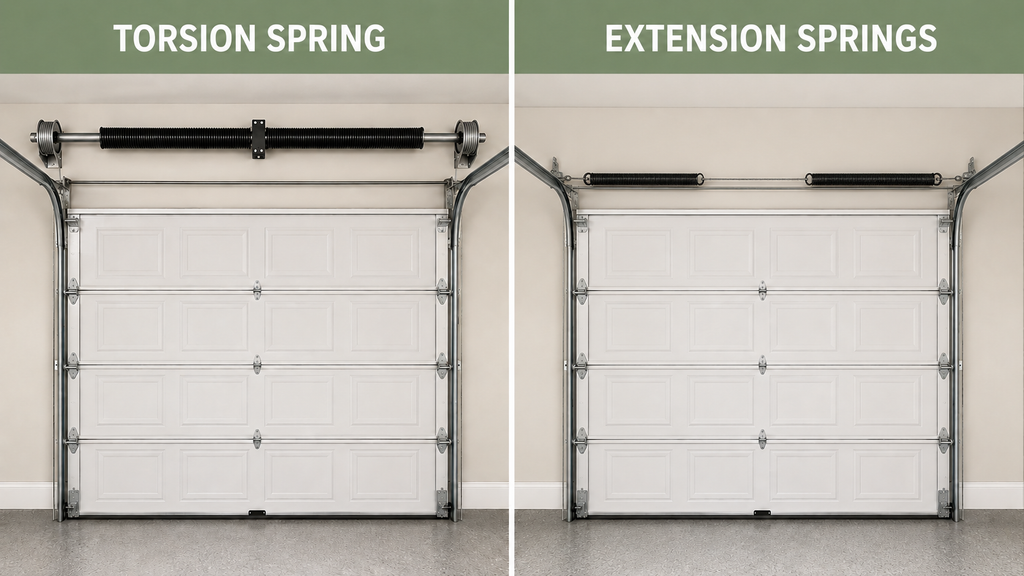
Torsion springs are typically mounted on a metal shaft directly above the garage door opening. When the door closes, these springs twist and coil, storing rotational energy. As the door opens, the springs unwind, releasing this energy to assist in lifting the door. They are generally considered more durable and safer than extension springs because their tension is contained on the shaft.
Extension springs, on the other hand, run parallel to the horizontal tracks on either side of the garage door. They stretch and contract as the door moves. When the door closes, the springs extend, storing energy. When the door opens, they contract, pulling the door upwards. Due to their stretching nature, extension springs require safety cables threaded through them to prevent them from flying across the garage if they break.
The cycle ratings of springs are a key factor in their expected lifespan. A “cycle” refers to one complete opening and closing of the garage door. Most standard residential garage door springs are rated for approximately 10,000 cycles. However, higher-cycle springs (e.g., 25,000 to 50,000 cycles) are available and can significantly extend the life of your system, albeit at a higher upfront cost.
Several lifespan factors influence how long your springs will last:
- Usage Frequency: The more often you open and close your garage door, the faster the springs accumulate cycles and wear out.
- Door Weight and Size: Heavier or larger doors put more stress on springs, potentially shortening their lifespan.
- Spring Quality: The material and manufacturing quality of the springs play a significant role.
- Maintenance: Regular lubrication and proper adjustment can help prolong spring life.
- Environmental Factors: Extreme temperatures and humidity can accelerate wear and corrosion.
Here’s a comparison of torsion and extension spring features:
| Feature | Torsion Springs | Extension Springs |
| Location | Above the garage door opening, on a shaft | Parallel to horizontal tracks, on sides |
| Operation | Twist and coil to store energy | Stretch and contract to store energy |
| Safety | Generally safer; tension contained on shaft | Require safety cables to prevent projectiles |
| Lifespan | Often longer due to even wear | Can wear out faster due to stretching action |
| Maintenance | Lubrication points on coils and bearings | Lubrication on coils and pulleys |
| Common Failure | Break in the middle, creating a gap | Break and separate, often loudly |
| Replacement | Requires specialized tools and expertise | Still requires expertise, potentially simpler |
| Balance | Provides more balanced lift | Can sometimes lead to uneven lifting |
Diagnostic Differences Between Spring Types
Diagnosing issues with torsion springs versus extension springs involves understanding their distinct mechanical setups. Each type presents unique visual cues and operational characteristics when failing.
For torsion springs, the primary components are the springs themselves, which are wound around a torsion bar that runs horizontally above the garage door. This bar is anchored to the wall at the center and connected to drums at either end. Cables then wrap around these drums and attach to the bottom corners of the door. When a torsion spring breaks, you’ll typically see a visible gap in the coils, usually in the middle of the spring. The door will become extremely heavy and difficult to lift manually, and it will likely fall if you try to open it partway. The opener may also strain excessively. Because the spring’s tension is contained on the torsion bar, a broken torsion spring generally doesn’t pose a risk of flying debris, though the sudden loss of counterbalance is still dangerous.
In contrast, extension springs operate differently. These springs are located on either side of the horizontal garage door tracks, extending and contracting as the door moves. They are connected to the door via pulleys and cables. A critical safety feature for extension springs is the presence of safety cables that are threaded through the center of each spring and anchored to the wall or track. If an extension spring breaks, it will snap and separate, often with a loud bang. Without the safety cable, the broken spring could become a dangerous projectile. With the safety cable in place, the spring will typically hang harmlessly from the cable. When an extension spring breaks, the door will feel very heavy on the side of the broken spring, causing it to lift unevenly or sag. If both extension springs break, the door will be extremely heavy and dangerous to operate.
Understanding these differences is vital for accurate diagnosis. While a broken torsion spring might manifest as a gap in the coils and a heavy door, a broken extension spring will be visibly separated and potentially hanging, with the door feeling heavy on one side. In both cases, the immediate effect is a door that is difficult and dangerous to operate.
Lifespan Expectations and Usage Patterns
The lifespan of your garage door springs is not indefinite; it’s measured in cycles, and various factors influence how quickly those cycles are consumed. As of August 2026, most standard residential garage door springs are still rated for approximately 10,000 cycles. A cycle is defined as one complete opening and closing of the garage door.
To put this into perspective, consider your daily usage. If your household opens and closes the garage door an average of 2 to 4 times per day, a 10,000-cycle spring system would typically last between 7 to 10 years. For example, if you use your door 4 times a day, that’s roughly 1,460 cycles per year (4 cycles/day * 365 days/year). Dividing 10,000 cycles by 1,460 cycles/year gives you approximately 6.8 years. If you use it just twice a day, that extends to over 13 years. However, heavy doors, even with moderate use, can wear out springs in as little as 4 years due to the increased stress.
These are averages. Homes with higher traffic, where the garage door is used as a primary entry point or for frequent vehicle access, will consume cycles much faster. A door used 8-10 times a day could see its springs fail in 3-5 years.
For homeowners seeking a more durable solution, an high-cycle upgrade is often available. These springs are manufactured to endure significantly more cycles, typically ranging from 25,000 to 50,000 cycles. While they represent a higher upfront investment, they can last two to five times longer than standard springs, providing greater longevity and reducing the frequency of replacements. This can be a worthwhile consideration, especially for busy households or commercial applications where the garage door sees constant use. Regardless of the spring type or cycle rating, regular maintenance and monitoring of your usage patterns can help you anticipate when a replacement might be necessary.
Safety Protocols and Risks of DIY Spring Repairs
When dealing with garage door springs, safety must always be the top priority. The springs are under extreme tension, and mishandling them can lead to severe injuries, including broken bones, lacerations, and even fatalities. This is why attempting DIY spring replacement is strongly discouraged and carries significant injury hazards.
A standard residential garage door, as mentioned, can weigh hundreds of pounds. The springs are designed to counterbalance this immense weight, storing a tremendous amount of kinetic energy. When a spring breaks, this energy is released suddenly. If you try to remove or adjust a spring without the specialized tools and expertise required, that stored energy can be released uncontrollably, causing the spring to whip around or snap back with incredible force. Finger and head injuries alone make up nearly 50% of reported garage door-related incidents, highlighting the risks of improper spring handling.
The tools required for spring replacement, such as winding bars for torsion springs, are specifically designed to safely manage this tension. Without them, and without the proper technique, you risk losing control of the spring, which can result in the door crashing down or the spring striking you. Beyond the immediate physical dangers, incorrect installation can lead to an improperly balanced door, causing premature wear on other components, such as the opener, and creating ongoing safety risks.
Given these inherent dangers, the professional necessity of spring replacement cannot be overstated. Trained garage door technicians have the knowledge, experience, and specialized equipment to safely diagnose, remove, and install springs. They understand the different types of springs, how to calculate the correct tension for your specific door, and how to ensure the entire system is balanced and functioning safely. Investing in professional service for spring replacement is an investment in your safety and the longevity of your garage door system.
Immediate Safety Actions During Failure
Discovering a broken garage door spring can be alarming, but knowing the immediate safety actions to take can prevent further damage or injury. Your priority should be to secure the area and prevent anyone from attempting to operate the door.
First and foremost, disconnect your garage door opener. Locate the red emergency release cord hanging from the opener trolley and pull it firmly. This action disengages the door from the automatic opener, ensuring that no one accidentally tries to open or close the door using the remote or wall button. An opener attempting to lift a door with broken springs will strain excessively and could burn out its motor.
Next, lock down the area around the garage door. Inform all household members, especially children, not to approach or attempt to operate the door. If possible, place cones, barricades, or visible warnings to deter anyone from walking under or near the door. The door, especially if it’s partially open, can fall unexpectedly.
Avoid attempting to force manual operation of the door yourself, unless absolutely necessary and with extreme caution. If you must move the door, ensure you have strong assistance and are prepared for the door’s full weight. A standard residential garage door weighs between 150 and 300 pounds. Without functioning springs, you are lifting this entire weight. If the door is stuck open, it’s often safer to leave it in place until a professional arrives, as attempting to lower it manually can be very dangerous.
The goal of these steps is comprehensive risk prevention. A broken spring creates a hazardous situation, and minimizing interaction with the door until professional help arrives is the safest course of action. Once these immediate safety measures are in place, your next step should be to contact a qualified garage door repair service.

Preparing Your Home for Local Garage Door Replacement
Once you’ve identified a broken or failing garage door spring and scheduled professional repair, there are a few steps you can take to prepare your home for the technician’s arrival. These preparations ensure a smooth, efficient, and safe replacement process.
First, clear the space inside your garage, particularly the area directly beneath and around the garage door. Technicians will need ample room to set up their tools, access the springs, and potentially move the door. This includes moving bikes, storage boxes, tools, and anything else that might obstruct their work.
Next, if possible, consider vehicle removal. If your car is parked inside the garage and the door is stuck closed, the technician may still be able to work around it. However, if the door is stuck open, or if the repair requires the door to be moved significantly, having your vehicle outside the garage will make the process much easier and safer for both the technician and your property. If the door is closed and cannot be opened, discuss this with your service provider when scheduling, as they may have specific instructions or tools to safely open it.
Establish a perimeter safety zone. Ensure that children and pets are kept away from the garage area during the repair. This prevents accidental injuries and allows the technician to focus on the task at hand without distractions. If you have any concerns about securing the area, communicate them to the technician upon arrival.
Finally, ensure easy technician access to your garage. Clear any pathways leading to the garage door from the outside, and make sure the technician can easily enter your property. If you have security gates or specific access instructions, communicate these in advance or be present to assist. By taking these simple preparatory steps, you contribute to a safer and more efficient garage door spring replacement, allowing the professionals to complete their work effectively.
Maintenance Strategies for Long-Term Spring Performance
Extending the life of your garage door springs and ensuring the overall smooth operation of your system involves adopting a few simple yet effective maintenance strategies. Regular care can significantly delay the need for premature replacement and keep your garage door functioning optimally.
One of the most impactful maintenance tasks is spring lubrication. We recommend applying a silicone-based lubricant (never use WD-40 or grease, as they can attract dirt and grime) to your springs a few times a year. This helps reduce friction, prevents rust, and allows the coils to move smoothly, minimizing wear and tear. Apply the lubricant to the entire length of the spring, then operate the door a few times to distribute it evenly.
Consider the impact of your climate. In regions with high humidity or extreme temperature fluctuations, springs can be more susceptible to rust and metal fatigue. More frequent lubrication might be necessary in such environments. Similarly, if your garage is uninsulated and exposed to the elements, this can accelerate wear.
Beyond lubrication, regular inspection is key. Make it a habit to visually inspect your springs and other garage door components monthly. Look for signs of rust, wear, or visible gaps in the spring coils. Check cables for fraying and pulleys for smooth operation. Early detection of minor issues can prevent them from becoming major problems.
Here is a list of daily garage door safety checks you can incorporate:
- Listen for unusual noises: Any grinding, squeaking, or straining sounds can indicate a problem.
- Observe door movement: Does the door move smoothly, or does it jerk, stick, or seem unbalanced?
- Check photo eyes: Ensure the safety sensors at the bottom of the tracks are clean and aligned.
- Test the auto-reverse feature: Place an object (like a roll of paper towels) in the door’s path. The door should reverse upon contact.
- Inspect cables and rollers: Look for any visible damage or wear.
By consistently performing these maintenance steps and routine checks, you can help extend the life of your garage door springs, maintain the safety of your system, and avoid unexpected breakdowns.
Frequently Asked Questions
What are the main signs that a garage door spring has failed?
The primary indicators of a failed garage door spring include the opener straining to lift the door, the door slamming shut unexpectedly, a loud popping sound from the garage, visible gaps between the spring coils, or the door feeling significantly heavier when lifted manually. Additionally, an improperly balanced door that won’t stay open midway is a strong sign of spring issues.
Why should both garage door springs be replaced simultaneously?
It is highly recommended to replace both garage door springs at the same time because they are installed in pairs and designed to wear out at similar rates. If one spring has broken, the other is likely to be close to failure. Replacing both ensures balanced operation of the door, prevents undue stress on the single new spring, and avoids the inconvenience and potential danger of a second spring breaking shortly after the first.
How long do garage door springs typically last under normal use?
Most standard residential garage door springs are rated for approximately 10,000 cycles. For a household that opens and closes their garage door 2 to 4 times per day, this typically translates to a lifespan of about 7 to 10 years. However, factors like door weight, usage frequency, spring quality, and environmental conditions can significantly shorten or extend this lifespan. For instance, heavy doors or very frequent use can reduce spring life to as little as 4 years.
Conclusion
Understanding how to tell if your garage door spring needs repair or a full replacement is essential for the safety and functionality of your home. From recognizing the tell-tale signs like straining openers and slamming doors to performing a mid-level balance test, we’ve outlined the critical diagnostic steps you can take. We’ve also highlighted the distinctions between torsion and extension springs, discussed their typical lifespans, and emphasized the paramount importance of safety when dealing with these high-tension components.
While visual inspections and simple tests can help you identify a problem, the complexities and inherent dangers of garage door spring replacement necessitate professional expertise. Attempting DIY repairs can lead to severe injury and further damage to your system. Instead, trust qualified technicians to safely and correctly install new springs, ensuring your garage door operates smoothly and securely for years to come.
By committing to routine maintenance, including regular lubrication and visual checks, and recognizing the signs that call for a professional inspection, you can proactively extend the life of your garage door springs. Prioritizing garage safety and addressing issues with timely repair not only protects your investment but, more importantly, safeguards your family and home. Don’t wait for a complete breakdown; stay vigilant and act swiftly when your springs show signs of fatigue.