


Parts of a Door Frame: Names, Functions, and Complete Diagram Guide
A door frame looks fairly simple until something goes wrong. A door starts rubbing at the top, the latch no longer lines up, cold air enters around the edge, or the bottom of a wooden jamb begins to feel soft. At that point, knowing the correct name for each part makes repairs much easier.
The main parts of a door frame are the head jamb across the top, the hinge jamb on one side, the strike jamb on the other, and the stop that the door closes against. Exterior openings usually add a sill, threshold, weatherstripping, and exterior trim.
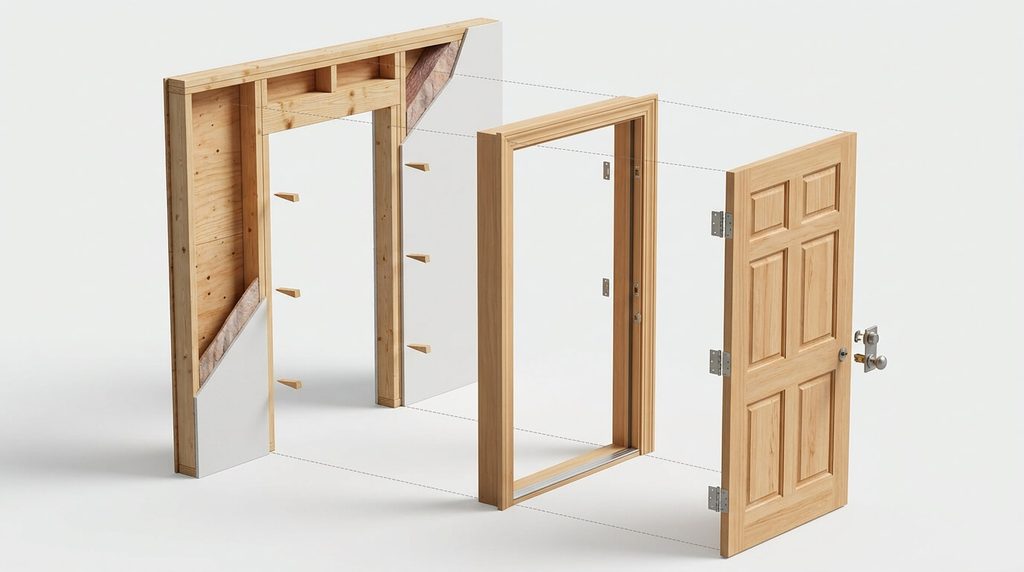
There is also another layer behind the visible frame. Studs, a structural header, shims, and fasteners help form or secure the opening, but these are not the same as the finished jambs you see from the room.
What to know about door frame parts
- The head jamb and two side jambs form the basic finished frame around most hinged doors.
- The hinge jamb carries the hinges, while the strike jamb receives the latch or locking hardware.
- The door stop gives a conventional swinging door a surface to close against.
- Casing is finish trim that hides the installation gap between the jamb and wall.
- Exterior doors commonly add a sill, threshold, weatherstripping, and exterior trim.
- Studs and the structural header belong to the wall framing, not the finished door frame.
- Sliding, double, garage, wood, steel, and hollow-metal frames can contain additional specialized parts.
Door Frame Parts at a Glance
Before looking at every component in detail, it helps to know the basic layout. The head jamb sits across the top. The hinge jamb runs vertically down the side where the door hinges are installed. The strike jamb is opposite it and carries the strike plate. Around those members, a door stop provides the surface that the closed door rests against.
Casing covers the joint between the jamb and wall. On an exterior door, the lower section may also include a sill, threshold, weatherstripping, and a door sweep attached to the door itself.
Main Parts of a Door Frame Explained
1. Head Jamb
The head jamb is the horizontal finished member at the top of the door frame. It joins the two vertical jambs and forms the upper boundary around the door slab.
You may also hear it called the frame head or top jamb. The name is easy to confuse with the structural header because both sit above the door, but they are different parts. The head jamb belongs to the finished door assembly. The structural header is part of the wall framing above the rough opening.
2. Hinge Jamb
The hinge jamb is the vertical frame member on the side where the hinges are mounted. It forms the stationary support point for the moving door.
Because the door’s weight acts through its hinges, this side deserves attention whenever a door begins to sag. Loose hinge screws, damaged wood, movement in the jamb, or poor alignment can cause the slab to drop and rub against another part of the frame.
If the jamb is still sound but a screw has lost its grip, repairing a stripped screw hole in wood may solve the problem without replacing the entire frame.
3. Strike Jamb
The vertical member opposite the hinge jamb is called the strike jamb, latch jamb, or sometimes lock jamb. The strike plate is mounted to this side. When the door closes, the latch or deadbolt enters the opening in the strike hardware.
A door that closes but refuses to latch may not need a new lock. The door or frame may have moved enough that the latch no longer lines up with the strike.

4. Door Stop
The door stop is the narrow raised section that a conventional single-acting door rests against when closed. On many wooden frames, the stop is a separate strip attached to the jambs and head. On other frame systems, it is formed directly into the profile.
This is different from a floor-mounted or wall-mounted doorstop. Those accessories prevent an open door from swinging too far, while thstop inside the frame establishes the closed position. 9o9o9pkmhb kl
5. Casing
Casing is the finish trim installed around the perimeter of the doorway. It covers the small installation space between the finished jamb and surrounding wall surface. Casing can be plain or decorative. Its profile affects how the doorway looks, but it is generally trim rather than a structural part of the wall.
If casing pulls away from the wall, the problem may simply be loose trim. If the jamb itself has shifted as well, the underlying frame deserves a closer inspection.
6. Brickmould
Brickmould is exterior trim used around many exterior door and window openings. Despite its name, it is not restricted to brick houses. It can be used where a door frame meets siding, stucco, wood cladding, masonry, or another exterior finish. Brickmould provides a finished edge around the opening and helps create a clean transition between the frame and wall.
7. Sill
The sill forms part of the bottom of many exterior door frames. Interior doorways usually do not have the same type of bottom assembly. Their jambs typically stop close to the finished flooring so the floor surface can continue through the opening. On an exterior entrance, the sill helps create a durable lower section that can handle repeated foot traffic and exposure to outdoor conditions.
8. Threshold
A threshold is the durable transition at the bottom of many exterior doorways. The terms threshold and sill are sometimes used loosely, but manufacturers may treat them as separate components. A threshold can sit over or form part of the lower sill assembly.
Some thresholds are adjustable so the contact between the bottom seal and threshold can be fine-tuned. Others are fixed components designed for a specific door system.
9. Weatherstripping
Weatherstripping is flexible sealing material installed where an exterior door meets its frame. When the door closes, the material compresses to reduce unwanted air movement and help limit rain, dust, insects, and other outdoor elements entering around the perimeter.
Weatherstripping eventually wears. During routine maintenance, cleaning and protecting your home’s exterior entry is also a useful opportunity to inspect compressed seals, wet lower jambs, peeling coatings, and damaged threshold areas.
Main door frame parts and what they do
| Part | Location | Main function | Common on |
|---|---|---|---|
| Head jamb | Top | Forms the upper finished frame | Most hinged doors |
| Hinge jamb | Hinge side | Supports hinge attachment | Hinged doors |
| Strike jamb | Latch side | Receives strike hardware | Hinged doors |
| Door stop | Inside jamb perimeter | Stops the door in its closed position | Most conventional swinging doors |
| Casing | Around jamb and wall | Covers the installation gap | Interior and exterior openings |
| Brickmould | Exterior perimeter | Finishes the exterior edge of the opening | Many exterior doors |
| Sill | Bottom | Forms part of the lower exterior frame | Exterior doors |
| Threshold | Floor-level transition | Creates a durable crossing and sealing surface | Exterior doors |
| Weatherstripping | Door-to-frame contact area | Helps seal the perimeter | Exterior doors |
Door Frame vs. Door Jamb
A door frame and a door jamb are closely related, but they do not mean exactly the same thing. The door frame is the overall finished assembly surrounding and supporting the door. Jambs are individual members within that frame.
In everyday conversation, people often use “door jamb” for the entire frame. That usually causes little trouble until you need to order a part or explain a repair. For example, “the frame is damaged” is a broad description. “The bottom of the hinge jamb has rotted” identifies a much more specific problem.
Door Frame vs. Rough Opening
The rough opening is the unfinished opening created in the wall before the finished door unit is installed. The finished frame is positioned inside that opening. Installers use the space around the frame to adjust its position before securing it. Once installation is complete, casing covers the gap so the rough opening is normally hidden.
Hidden Parts Around a Door Frame
Some of the most important pieces surrounding a door cannot be seen once the wall and trim are finished. These components should not be confused with the finished door frame itself, but they help explain how the opening is constructed.
King Stud
A king stud is a full-height wall stud beside the rough opening. It forms part of the wall framing around the doorway and commonly sits beside the shorter supporting stud used under the header.
Jack or Trimmer Stud
A jack stud, also called a trimmer stud, commonly sits beside the king stud. Its job in conventional framed construction is to provide support beneath the structural header. Exact framing requirements vary according to the wall and load conditions.
Structural Header
The structural header spans the rough opening above the door. Its function is different from that of the head jamb. The head jamb belongs to the finished door frame, while the structural header belongs to the wall. This distinction is particularly important when diagnosing damage. A split trim board and a structural framing problem are not the same repair.
Shims
Shims are thin pieces used between the finished frame and rough opening. They allow the installer to make small adjustments so the jamb can be positioned correctly before it is fastened in place. Once casing is installed, the shims are usually hidden.
Fasteners and Anchors
Door frames need to be secured to the surrounding construction. Wood frames commonly use suitable screws or nails, while metal systems may use specialized anchors designed for wood studs, steel studs, masonry, or other substrates. The correct fastening method depends on the door system and surrounding wall.
Which Parts Are Actually Part of the Door?
Door diagrams often combine the slab, frame, trim, weather seals, and hardware into one long list. That can make a simple subject confusing. The easiest approach is to separate the stationary frame from the moving door and the hardware joining them.
Door frame parts vs. door parts
| Component | Category | Purpose |
|---|---|---|
| Head jamb | Frame | Forms the top of the finished frame |
| Hinge jamb | Frame | Provides the hinge-side frame member |
| Strike jamb | Frame | Receives latch-side hardware |
| Door stop | Frame | Provides the closed-door stopping surface |
| Casing | Frame trim | Covers the jamb-to-wall gap |
| Stiles | Door slab | Form the vertical members of many doors |
| Rails | Door slab | Form the horizontal members of many doors |
| Hinges | Connecting hardware | Join the moving slab to the frame |
| Strike plate | Frame-mounted hardware | Receives the latch or bolt |
| Door sweep | Door-mounted seal | Helps close the bottom gap on exterior doors |
Parts of a Front Door Frame
The parts of a front door frame include the same basic jambs used on a standard hinged door, plus components needed for outdoor exposure. A typical front entrance can include:
- Head jamb
- Hinge jamb
- Strike jamb
- Door stop
- Interior casing
- Exterior brickmould or trim
- Sill
- Threshold
- Weatherstripping
- Strike hardware
- Sidelight or transom framing when present
The lower frame is especially important because it has to deal with foot traffic, wet shoes, rain, snow, temperature changes, and water running across nearby exterior surfaces.
A good front entrance also needs to work with the surrounding space. If you are renovating more than the frame itself, planning a warm and practical modern farmhouse entryway shows why door proportions, weather protection, lighting, flooring, and everyday traffic should be considered together.
Parts of an Exterior Door Frame
The parts of an exterior door frame have to support the door while also helping manage outdoor exposure. A basic exterior frame normally contains the head jamb, hinge jamb, strike jamb, stop, casing, sill, threshold, weatherstripping, and exterior trim.
Some systems also have adjustable threshold components, removable weather seals, sill caps, or other manufacturer-specific pieces. This is why buying a replacement part based only on appearance can cause trouble. Two thresholds or weather seals may look similar but fit completely different door systems.
Parts of a Sliding Glass Door Frame
The parts of a sliding glass door frame are different because the operating panel moves horizontally rather than swinging on hinges. The frame typically has a top member, vertical side jambs, and a sill or lower track area. Depending on the manufacturer, you may also find:
- Head frame
- Left and right side jambs
- Sill
- Bottom track
- Upper guide
- Stationary-panel retainer
- Interlock weather seals
- Screen track
- Screen guide
- Interior and exterior trim
Sliding-door parts are often model-specific. If a track cap, seal, roller guide, or frame component needs replacement, identifying the manufacturer and product series can save a lot of guesswork.
Parts of a Double Door Frame
A double-door opening contains two door leaves within a larger frame. The perimeter still has a head jamb and side jambs, but additional components are often required where the two doors meet. Common parts of a double door frame or its immediate door system include:
- Head jamb
- Left side jamb
- Right side jamb
- Door stops
- Casing
- Threshold on exterior systems
- Weatherstripping
- Active door leaf
- Inactive door leaf
- Astragal
- Flush bolts or similar inactive-leaf hardware
Astragal
An astragal is commonly attached along the meeting edge of one door in a pair. It helps cover or seal the space between the two door leaves. Depending on the system, it may also interact with weather seals or locking hardware.
Mullion
A mullion is different. It is a framing member that separates sections of a larger opening. A front entrance with a door and sidelight, for example, may have a mullion between the door opening and glazed section.
Sidelights and Transoms
A sidelight is a narrow glazed section installed next to a door. A transom is an opening or glazed section above it. They are not basic requirements for a standard doorway, but they become part of many larger entrance assemblies. Frames that incorporate sidelights or transoms may use additional mullions, heads, sills, glazing stops, and related components.
Parts of a Wooden Door Frame
The parts of a wooden door frame use familiar names. A typical wood frame includes the head jamb, hinge jamb, strike jamb, door stop, casing, and, on an exterior frame, a sill, threshold, weatherstripping, and exterior trim.
Wood makes some localized repairs possible. A short damaged section of trim, a loose stop, or an isolated screw hole can sometimes be repaired without replacing the entire frame.
Rot is different.If a jamb is soft or crumbling, determine how far the damage extends and why the wood became wet. Replacing or filling only the visible surface will not solve an ongoing moisture problem.
Parts of a Steel Door Frame
The basic layout of a steel frame is still recognizable. It normally includes a head, hinge jamb, strike jamb, stops, and locations prepared for door hardware.
The difference becomes more obvious when looking at a cross-section. Rather than a simple wood board, a formed steel frame can have multiple profile elements. These can include:
- Face
- Return
- Rabbet
- Stop
- Soffit
- Throat
- Backbend
- Anchoring locations
- Hardware reinforcements
Parts of a Hollow Metal Door Frame
The terms steel door frame and hollow metal door frame are commonly used in commercial construction. A hollow-metal assembly can contain more specialized elements than a typical residential wood frame. Common terms include:
- Head
- Hinge jamb
- Strike jamb
- Mullion
- Stop
- Rabbet
- Soffit
- Face
- Return
- Throat
- Anchors
- Hinge reinforcement
- Strike reinforcement
- Frame joints
The Steel Door Institute’s hollow-metal terminology is particularly useful when identifying these formed frame parts because commercial metal-frame vocabulary is more specific than ordinary residential terminology.
Parts of a Garage Door Frame
The phrase parts of a garage door frame can be confusing because an overhead garage door does not use the same type of jamb assembly as a standard swinging entry door. The building opening around an overhead door can include:
- Structural header
- Side jamb framing
- Header trim
- Jamb trim
- Perimeter weather seal
- Garage-door stop moulding
- Track-support areas
- Exterior trim
The operating garage door has many additional components, including panels, rollers, tracks, hinges, springs, cables, brackets, and opener hardware. Those are parts of the garage-door system rather than all being parts of the building frame.
If problems extend beyond trim or weather seals, these signs a garage door system may need replacement can help separate a larger operating-system problem from minor frame damage. Garage-door springs and cables can store considerable energy. Repairs involving those components should not be treated like ordinary trim work.
Parts of a Car Door Frame
The secondary phrase parts of a car door frame refers to automotive body construction, not a residential or commercial building door. Depending on the vehicle, the body opening around a car door can involve components such as:
- A-pillar
- B-pillar
- Roof rail
- Rocker or sill area
- Door-opening flange
- Hinges
- Striker
- Weather seals
- Window frame
- Door shell structure
The exact construction differs by vehicle. Automotive structural components can also play a role in crash protection and door alignment, so vehicle-specific service information should be used when identifying or repairing those areas.
Common Door Frame Problems and Which Part to Check
Knowing the terminology becomes most useful when something stops working properly. Instead of replacing random parts, match the symptom to the area most likely to be involved.
Which door frame part should you inspect first?
Door sags or rubs
Inspect the hinges, hinge screws, hinge jamb, and clearance around the head jamb before assuming the whole frame needs replacement.
Door will not latch
Check whether the latch aligns with the strike plate, then inspect the hinges, strike jamb, and overall door position.
Air enters around the door
Check the weatherstripping, threshold, door sweep, and whether the slab contacts the seals evenly around the frame.
Water or rot appears
Inspect the lower jambs, sill, threshold, exterior trim, sealant, and nearby drainage before repairing only the visible damage.
Door Rubs Near the Top
Look at the hinges and hinge jamb first. A loose upper hinge can allow a door to sag diagonally so its opposite top corner begins rubbing against the frame. Check whether the screws are tight and whether the gaps around the slab remain reasonably consistent.
Door Will Not Latch
Watch the latch as the door closes. If it hits above or below the strike opening, the problem may involve hinge movement, the strike plate, the strike jamb, or a door that has shifted inside the frame. Avoid repeatedly enlarging the strike opening without first understanding why alignment changed.
Air Comes Through the Edges
Inspect the weatherstripping. If it is cracked, flattened, hard, loose, or missing, it may no longer compress properly when the door closes. Also check alignment. New weatherstripping cannot always compensate for a door that sits unevenly in the frame.
Water Appears at the Bottom
Inspect the threshold, sill area, lower jambs, door sweep, exterior trim, sealant, and surrounding surfaces. Do not automatically assume the water entered through the nearest visible gap. Moisture can travel before it becomes noticeable.
Bottom of the Jamb Feels Soft
Soft wood, swelling, flaking paint, or crumbling material near the bottom of an exterior jamb can indicate moisture-related deterioration. Determine how extensive the damage is and fix the moisture source before making a cosmetic repair.

Can You Replace Just One Part of a Door Frame?
Yes. Replacing the whole frame is not necessary for every problem. Casing, door stops, weatherstripping, strike plates, some exterior trim pieces, and certain threshold components can often be repaired or replaced individually.
A small area of sound wood can sometimes be repaired as well, particularly when damage is localized and the underlying cause has already been corrected. Larger problems require more judgment.
A full frame or prehung assembly may make more sense if multiple jambs are rotten, the frame is badly twisted, several hardware locations have failed, significant corrosion is present, or the opening can no longer be aligned properly.
Common Door Frame Terminology Mistakes
A few terms cause more confusion than the others.
Door Jamb vs. Door Frame
A jamb is an individual member of the frame. The frame is the complete assembly surrounding the door.
Head Jamb vs. Header
The head jamb is part of the finished frame. The structural header belongs to the wall above the rough opening.
Sill vs. Threshold
The words are sometimes used interchangeably, but product manufacturers may use them for different pieces of the bottom assembly. When buying a replacement, use manufacturer-specific terminology where possible.
Astragal vs. Mullion
An astragal generally works at the meeting edges of a pair of doors. A mullion separates sections within a larger framed opening, such as a door and sidelight.
Door Stop vs. Doorstop
A frame stop gives a closed door a surface to rest against. A floor or wall doorstop limits how far an open door can swing.
How to Identify a Replacement Door Frame Part
Do not start with only a generic search such as “door threshold” or “sliding door track.” First identify the door system. Record:
- Whether the door is interior or exterior.
- Whether it swings, slides, folds, or operates another way.
- Whether it is a single or double door.
- Frame material.
- Manufacturer name.
- Model or product line if available.
- Approximate installation age.
- Which side or position is damaged.
- Dimensions of the opening.
- Dimensions of the damaged part.
- Photographs of the entire opening.
- Close-up photographs of the damaged area.
- Any labels or identifying marks.
This is particularly helpful for sliding patio doors, thresholds, seals, and specialty metal frames where visually similar parts may not be interchangeable.
When Does the Whole Door Frame Need Attention?
One loose piece of casing does not mean the frame has failed. Neither does worn weatherstripping or a strike plate that needs minor adjustment.
A larger frame problem becomes more likely when several symptoms appear together. Look more closely when the door no longer sits square, gaps change around several sides, jambs move, hardware repeatedly loses alignment, rot spreads through multiple areas, or water damage extends beyond the visible trim.
Movement or damage in the surrounding wall is different again. If cracking, settlement, severe moisture damage, or deformation extends outside the finished door assembly, repairing only the jamb may not solve the real problem.
Conclusion
The main parts of a door frame are straightforward once the opening is divided into layers. The finished frame contains the head jamb, hinge jamb, strike jamb, and door stop, with casing covering the joint between the jamb and wall.
Exterior systems add important pieces such as a sill, threshold, weatherstripping, and exterior trim. Behind the visible frame, king studs, trimmer studs, a structural header, shims, and fasteners form or support the rough opening.
The terminology changes as the door becomes more specialized. Sliding glass frames use tracks and guides, double doors can use astragals, larger entrances can contain mullions and sidelights, and steel or hollow-metal frames use formed profiles, anchors, and reinforcements.
You do not have to memorize every term before fixing a door. Start by deciding whether the problem belongs to the moving slab, finished frame, hardware, weather seal, or surrounding wall. Once you know that, identifying the correct part becomes much easier.
Frequently asked questions about door frame parts
What are the three main parts of a basic door frame?
The basic finished frame has a head jamb across the top and two vertical side jambs. On a hinged door, the side carrying the hinges is the hinge jamb and the opposite side is the strike or latch jamb.
What is the top part of a door frame called?
The horizontal finished member at the top is called the head jamb or frame head. It should not be confused with the structural header located in the wall above the rough opening.
What are the vertical sides of a door frame called?
The vertical sides are called jambs. One is usually the hinge jamb, while the opposite side is the strike or latch jamb.
What is the strip around the inside of a door frame called?
If you mean the raised section that the closed door rests against, it is the door stop. If you mean the decorative trim covering the edge between the jamb and wall, it is casing.
What is the bottom of an exterior door frame called?
The bottom assembly commonly includes a sill and threshold. Manufacturers may use these terms differently, so the exact product documentation should be checked before ordering replacement parts.
Is a door jamb the same as a door frame?
Not exactly. A jamb is an individual member within the frame, while the frame refers to the overall assembly surrounding the door.
What is the difference between a door frame and a rough opening?
The rough opening is formed in the wall before the finished door is installed. The finished door frame is positioned, shimmed, and secured inside that opening.
What are the hidden parts around a door frame?
Hidden construction may include king studs, jack or trimmer studs, a structural header, shims, and fasteners. These support or surround the door installation but are different from the visible finished frame.
What are the parts of a sliding glass door frame?
A sliding glass door frame may include side jambs, a head member, sill, bottom track, upper guide, weather seals, stationary-panel retainers, interlock seals, and screen tracks or guides. Exact parts vary by manufacturer.
What are the parts of a double door frame?
A double-door frame normally has a head jamb, two side jambs, stops, casing, and, on exterior systems, a sill, threshold, and weather seals. The two doors may also use an astragal where their edges meet.
What are the parts of a hollow metal door frame?
A hollow-metal frame can contain a head, hinge jamb, strike jamb, stop, rabbets, soffit, faces, returns, anchors, hardware reinforcements, and, in larger assemblies, mullions or transom framing.
What is the difference between an astragal and a mullion?
An astragal normally works at the meeting edges of two door leaves. A mullion is a frame member separating sections of a larger opening, such as a door and sidelight.
Is casing part of a door frame?
Casing is normally considered part of the complete finished doorway, but its primary role is trim. It covers the installation gap between the jamb and surrounding wall rather than serving as one of the main jamb members.
What are the parts of a car door frame?
Automotive terminology is different from residential construction. Depending on the vehicle, the surrounding door opening may include the A-pillar, B-pillar, roof rail, rocker or sill area, striker, hinges, seals, and related body structure.