



A portable air conditioner without hose sounds like the perfect solution when you cannot vent through a window. The direct answer, however, is that a true compressor-based air conditioner needs somewhere to release the heat it removes. Most products advertised as ventless portable air conditioners are actually evaporative coolers, personal air coolers, or fans.
That does not make every hose-free appliance useless. An evaporative cooler can provide meaningful comfort in a dry climate with adequate airflow, but it will usually disappoint in a humid, closed room. This guide explains what these appliances really do, where they work, and what you should check before spending your money.
Quick Answer
A true room air conditioner cannot continuously cool an enclosed room without transferring its collected heat outside. A hose-free product is usually an evaporative cooler that uses water and airflow rather than a refrigeration compressor. It can feel refreshing in dry, ventilated conditions, but it is not a direct substitute for a window, portable, or central air conditioner.
Which Cooling Option Should You Choose?
If you searched for a portable air conditioner without a hose because you cannot use a normal window vent, start with your room conditions rather than the product name.
| Your situation | Best starting option |
|---|---|
| Dry room with good ventilation | Evaporative cooler |
| Humid, enclosed bedroom | Vented portable AC or window AC |
| Cannot use a standard window kit | Portable AC with a suitable window adapter |
| Desk or bedside cooling | Personal cooler or fan |
| Garage or open workshop in dry weather | Evaporative cooler |
| Need permanent room cooling | Ductless mini-split |
| Need dependable cooling during dangerous heat | Refrigerated AC or an air-conditioned location |
Bottom line: If your room is dry and well ventilated, a hose-free evaporative cooler can be useful. If you need to lower the temperature of an enclosed room, especially in humid conditions, choose a properly vented compressor air conditioner instead.
Can a Portable Air Conditioner Without Hose Really Cool a Room?
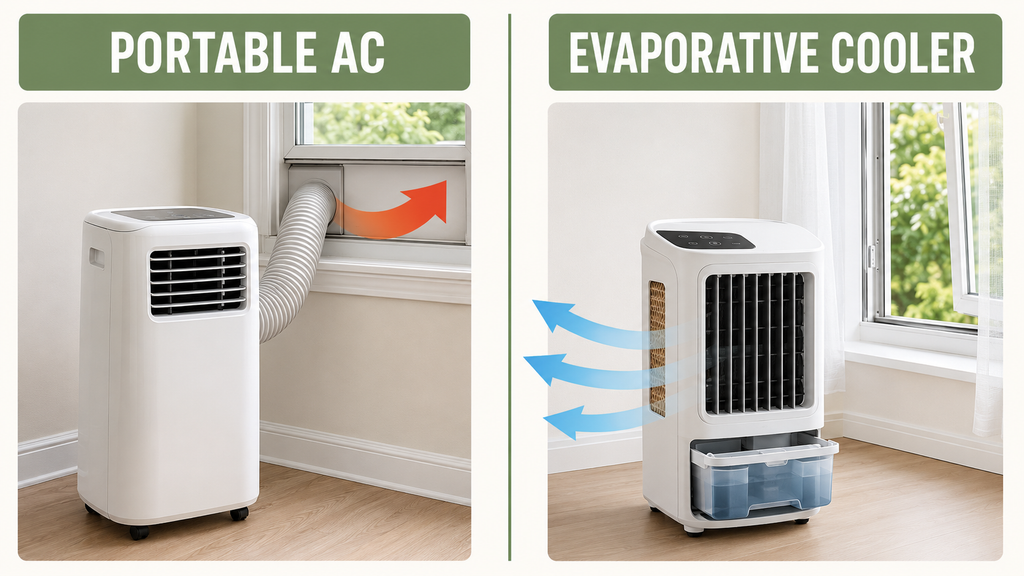
A refrigerated air conditioner works by absorbing heat from indoor air and releasing that heat somewhere else. A conventional portable model directs the collected heat outside through its exhaust hose.
If you remove the hose and allow the unit to discharge hot condenser air back into the same enclosed room, you have not removed the heat. The machine also consumes electricity, which ultimately adds more heat to the space. The air blowing directly from the front may feel cool, but the room as a whole will not receive effective net cooling. If you’re comparing cooling performance rather than just appliance type, see how long an AC takes to cool a house for a better idea of what affects cooling time.
A ventless evaporative cooler works differently. It passes warm air over wet cooling media, causing some of the water to evaporate. That process lowers the air’s dry-bulb temperature while adding moisture, which is why the result depends heavily on existing humidity.
The Department of Energy’s home-cooling guidance identifies evaporative cooling as suitable for areas with low humidity. It also stresses regular cleaning and draining, which are necessary because these appliances continuously handle water.
What Is a Ventless Portable Air Conditioner?
“Ventless portable air conditioner” is primarily a shopping term, not one consistent appliance category. Before comparing features, identify the technology inside the product.
Evaporative Cooler
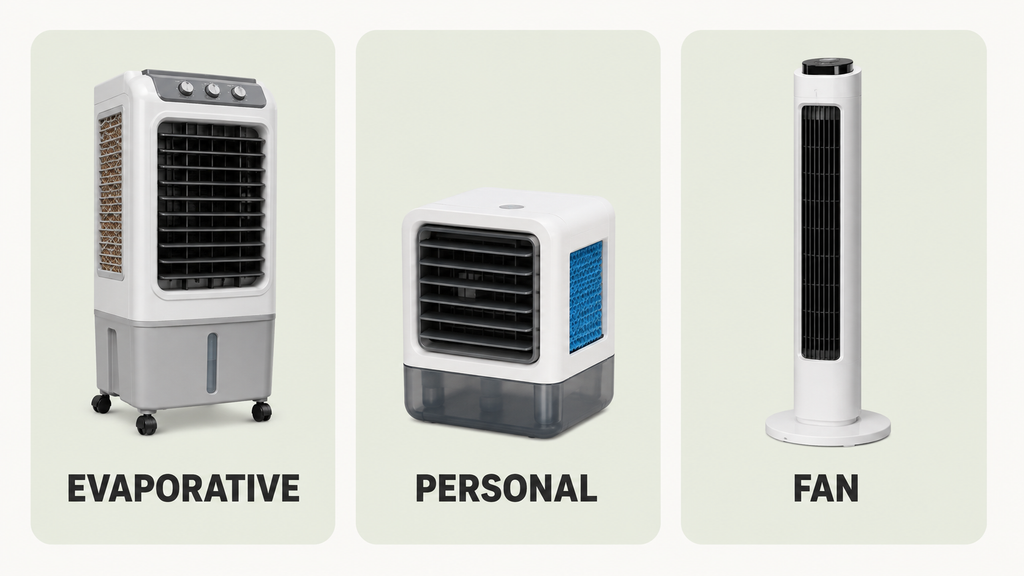
An evaporative cooler contains a fan, water reservoir, pump, and absorbent cooling pad. The pump wets the pad, and the fan draws air through it so evaporation can lower the outgoing air temperature.
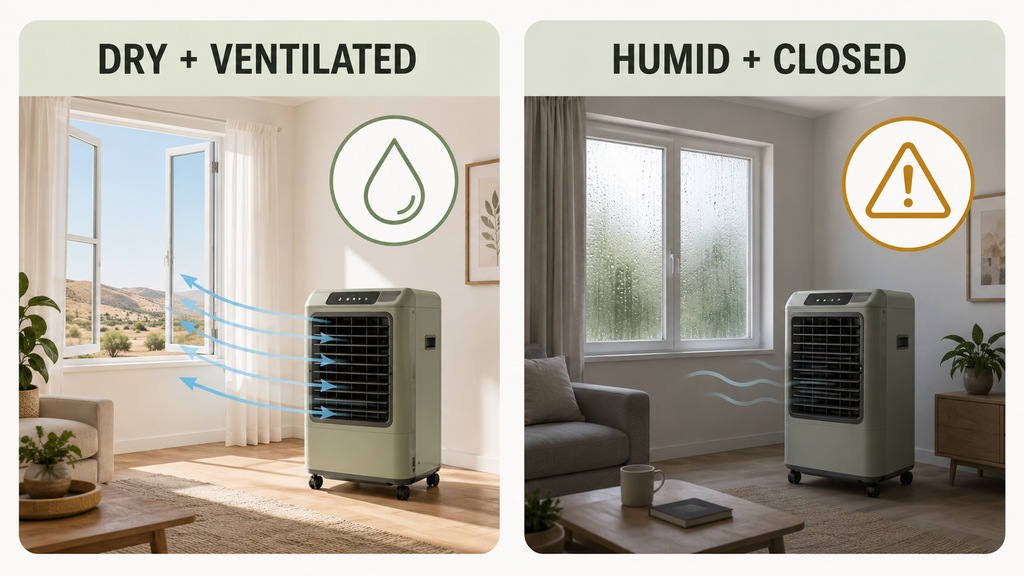
It works best when the incoming air is warm and dry. Because it adds water vapor, it should normally be used with a partially open window, door, or another path for humid air to leave.
Personal Evaporative Air Cooler
A personal air cooler is a smaller evaporative device intended to cool the immediate area around one person. It may help at a desk, bedside, workbench, or outdoor seating area, but it should not be expected to lower the temperature throughout a large room.
Product photos can make these units appear more powerful than they are. Look at the intended coverage, airflow, reservoir size, and operating instructions rather than relying on pictures of an icy room.
Fan or Air Circulator
Some products advertised under no-hose cooling searches are ordinary fans with a water tray, mist function, or reusable cooling pack.
A fan increases air movement and may help sweat evaporate from your skin, but it does not remove heat from the room. The Department of Energy summarizes this distinction clearly: fans cool people rather than rooms.
Compressor-Based Spot Cooler
A compact refrigerated spot cooler can direct cold air toward a person or piece of equipment without connecting a hose. However, it releases its condenser heat into the surrounding space.
That makes it more suitable for localized cooling in an open or well-ventilated environment than for cooling a sealed bedroom.
Some models permit an optional exhaust duct. If the manufacturer recommends that duct for enclosed spaces, treating the appliance as permanently “hoseless” would be misleading.
| Cooling option | Removes heat from a closed room? | Adds humidity? | Best use |
|---|---|---|---|
| Hosed portable AC | Yes, when vented correctly | Usually reduces it | Enclosed room cooling |
| Evaporative cooler | Not through refrigeration | Yes | Dry, ventilated rooms |
| Personal air cooler | No meaningful room-wide heat removal | Yes | Close-range personal comfort |
| Standard fan | No | No | Air movement and personal comfort |
| Ventless compressor spot cooler | No, unless heat is exhausted elsewhere | Usually collects some moisture | Localized cooling in open areas |
Where Does a Hose-Free Evaporative Cooler Work Best?
An evaporative cooler performs best when the air has enough capacity to absorb additional moisture. Dry air can support more evaporation, while humid air limits the process.
This is why the same cooler may feel effective in one location and clammy in another. The result can even change between a dry afternoon and a humid evening in the same home.
Good Conditions for Evaporative Cooling
A hose-free evaporative cooler is most likely to help in:
- Rooms where indoor humidity is relatively low
- Garages and workshops with open doors or windows
- Covered patios and other shaded outdoor areas
- Home offices with controlled cross-ventilation
- Dry bedrooms where moisture can escape safely
- Localized seating or work zones
Poor Conditions for Evaporative Cooling
Avoid relying on one as your primary cooling solution in:
- A humid bedroom with closed windows
- A damp basement
- A bathroom or laundry area that already has excess moisture
- A room with condensation on windows
- A space with visible mold or a persistent musty smell
- A sealed room where outdoor air cannot enter and humid air cannot leave
The Environmental Protection Agency advises against raising indoor relative humidity above 50% when using humidifying equipment because greater moisture can encourage biological growth. Its guidance on home humidifiers also recommends reducing use if windows, walls, carpets, or surrounding materials become damp.
A basic digital hygrometer can help you make a better decision. Measure the humidity in the room during the hottest period when you expect to use the cooler, not only early in the morning.
Advantages and Limitations of a Portable Air Conditioner Without Hose
The biggest advantage is simple installation. You do not need to fit a plastic panel into a window, route a large duct, or permanently modify the property.
Evaporative coolers also use relatively simple components and can be moved between suitable spaces. However, convenience should not be confused with refrigerated cooling performance.
Advantages
- No window exhaust kit
- Easy movement between rooms
- Simple controls and setup
- Useful personal airflow
- Can feel effective in dry conditions
- Appropriate for some garages, workshops, and patios
- No refrigerant-based cooling system in a standard evaporative model
Limitations
- Cooling performance falls as humidity rises
- Adds moisture to indoor air
- Needs regular water-tank and pad cleaning
- Often requires an open window or door
- May not lower the temperature of an entire room
- Cannot provide the dehumidification of a compressor air conditioner
- Product coverage claims can be difficult to compare
- Water pumps and fans can still produce noticeable noise
How to Choose the Right Hose-Free Cooler
Timers, remote controls, displays, and ice packs may be convenient, but they do not answer the most important question: will the cooling technology actually work in your room?
1. Confirm the Appliance Type
Read the manual or technical description before buying. If the product has a water tank and cooling pad but no refrigerant circuit or exhaust path, it is an evaporative cooler.
Be cautious when a listing uses “air conditioner,” “swamp cooler,” “fan,” and “air cooler” interchangeably. They do not provide equal cooling performance.
2. Check Your Humidity First
A hygrometer costs far less than buying the wrong appliance. Check the actual room during hot weather and consider whether you can maintain cross-ventilation.
3. Check Airflow, Not Just Coverage Claims
For an evaporative cooler, airflow is often described in cubic feet per minute (CFM). Higher airflow means the fan moves more air, but it does not guarantee substantially colder air.
Treat advertised coverage areas as estimates. Ceiling height, sunlight, insulation, humidity, room shape, and ventilation can all affect performance.
4. Examine the Water Reservoir
A larger reservoir reduces refill frequency but makes the filled unit heavier. Check whether the tank is easy to remove, clean, and drain completely.
Also look at access to the bottom and corners. Narrow openings can make mineral deposits and buildup harder to remove.
5. Check Replacement-Pad Availability
Evaporative cooling media does not last forever. Confirm that compatible replacement pads are readily available.
Hard water can also leave mineral deposits, so check the manufacturer’s cleaning and replacement recommendations.
6. Consider Real-World Noise
Do not rely only on a low-speed noise rating if you expect to run the unit at maximum airflow. Check available sound specifications and owner feedback for pump noise, rattling, and water sounds.
7. Compare the Correct Rating if You Choose a True Portable AC
If you decide you need refrigerated cooling, compare seasonally adjusted cooling capacity (SACC) rather than relying only on a larger legacy BTU number printed prominently on the box.
Federal portable-air-conditioner testing requirements use SACC and combined energy-efficiency measurements to represent performance.
Room size still matters. The ENERGY STAR room air-conditioner sizing guide recommends considering factors such as sunlight, shade, occupancy, kitchens, and ceiling height rather than choosing by floor area alone.

How to Set Up an Evaporative Cooler Correctly
An evaporative cooler should not normally sit in the middle of a sealed room. It works better when dry air can enter, pass through the wet cooling media, move across the occupied area, and leave through another opening.
- Measure indoor humidity. Make sure the space is reasonably dry before adding more moisture.
- Create an airflow path. Open a nearby window or door slightly and provide another exit where possible.
- Position the intake correctly. Give the cooler access to fresh, dry air without blocking its intake.
- Fill the tank safely. Unplug the appliance before filling or cleaning unless the manual specifically instructs otherwise.
- Allow the cooling pad to become wet. Some units need a short period for the pump to saturate the media.
- Aim the airflow toward people. Evaporative coolers are often most useful as directed comfort appliances.
- Monitor humidity and surfaces. Reduce output or stop using the unit if the room becomes clammy or condensation appears.
- Drain and dry it regularly. Do not leave stagnant water in the reservoir longer than the manufacturer permits.
Adding ice may temporarily make the reservoir colder, but it does not transform the appliance into a compressor air conditioner. Only use ice if the manufacturer allows it.

Better Cooling Options When You Cannot Use a Standard Window Kit
If evaporative cooling does not suit your climate, you may still have alternatives to a conventional portable-AC window setup.
Casement or Sliding-Window Adapter
Casement and horizontal sliding windows may not accept the standard kit supplied with a portable AC. A suitable acrylic, polycarbonate, or insulated-panel insert can sometimes provide a removable exhaust opening.
Keep the exhaust route short and follow the manufacturer’s clearance requirements. Long, crushed, or sharply bent hoses can reduce performance.
Through-Wall Exhaust Adapter
Where building rules allow it, a dedicated wall opening may provide an exhaust path for a portable AC.
This is a more permanent solution and needs careful installation to avoid water intrusion, pests, air leakage, or damage to utilities inside the wall.
Window Air Conditioner
A window unit moves condenser heat directly outdoors and does not occupy floor space. It may be a better choice when the window design, building rules, and structural support permit safe installation.
Ductless Mini-Split System
A mini-split places the compressor and heat-rejection components outdoors. It provides true refrigerated cooling without a large window hose but requires appropriate sizing and professional installation.
Reduce Heat Before Adding More Equipment
Window coverings, exterior shading, air sealing, insulation, and reducing indoor heat sources can all lower the cooling load. You can also explore these home exterior upgrades for better comfort and efficiency if heat gain through windows and the building exterior is contributing to an uncomfortable home.
Moisture, Electrical, and Heat-Safety Warnings
Water and electricity require careful handling. Keep the appliance level, use the correct outlet, prevent water from reaching the plug or controls, and follow the manufacturer’s cleaning and electrical instructions.
Whenever possible, plug a high-draw cooling appliance directly into a suitable wall outlet. Consumer-product safety guidance warns that extension cords and power strips must be capable of carrying the appliance’s required current. The CPSC’s extension-cord safety recommendations specifically identify air conditioners as high-wattage appliances requiring appropriately rated equipment.
A cooler that continually raises indoor humidity can contribute to condensation and damp materials. The EPA’s home moisture-control guidance recommends addressing excess moisture and using air conditioning or dehumidification in hot, humid conditions.
Finally, do not rely on a small evaporative cooler or fan as your only protection during dangerous heat. Current CDC heat and health guidance recommends actual air conditioning or an air-conditioned location when needed and warns that fans should only be used when indoor temperatures are below 90°F.
Frequently Asked Questions
Is there a real portable air conditioner that does not need a hose?
A refrigerated appliance can provide focused cool air without a connected hose, but it must release its condenser heat somewhere. In an enclosed room, that released heat prevents effective room-wide cooling unless the heat is exhausted outdoors.
Do ventless portable air conditioners actually work?
Evaporative models can work well for personal comfort in dry, ventilated conditions. They usually perform poorly in humid or sealed rooms because the air cannot absorb much additional moisture.
Can I use a ventless air cooler in a bedroom?
Yes, if the bedroom is reasonably dry and has appropriate ventilation. Monitor humidity and stop or reduce use if the room becomes damp, clammy, or develops condensation.
Does a portable air conditioner have to be vented outside?
A conventional compressor-based portable AC needs to vent the collected heat outside to cool an enclosed room effectively. Venting into another indoor room, attic, or wall cavity simply moves the heat and may create other problems.
What is the difference between a ventless AC and an evaporative cooler?
In many shopping listings, “ventless AC” refers to an evaporative cooler. An evaporative cooler uses water evaporation rather than the refrigeration cycle used by a true air conditioner.
Can I run a hose-free air cooler with the windows closed?
Usually, that is not ideal for a direct evaporative cooler. Closing the windows traps added moisture and can reduce evaporation over time. These coolers generally perform better with controlled cross-ventilation.
Conclusion
A portable air conditioner without hose can be useful when you understand what you are actually buying. Most hose-free products are evaporative coolers, so their success depends heavily on humidity, airflow, maintenance, and placement.
For dry, ventilated conditions, an evaporative cooler can provide useful personal comfort without a window exhaust hose. For a humid or enclosed room where you need dependable temperature reduction, a properly vented portable AC, window unit, or mini-split is the better choice.
Before buying, check your room’s humidity, identify the actual cooling technology, compare airflow and maintenance requirements, and make sure the appliance matches your space rather than the idealized room shown in its advertising.