


If you are searching for how to stop squeaky bed noises, start by finding the exact component making the sound. Tighten loose connections, cushion rubbing surfaces, lubricate metal joints, stabilize the legs, and replace any damaged slats or hardware.
Do not spray lubricant across the entire frame and hope for the best. A squeak can come from the mattress, foundation, slats, headboard, frame joints, center support, or even the floor beneath the bed. This guide will help you isolate the sound and choose the correct fix without damaging your bed.
Repeated noise close to your ears can be especially distracting at night. Research examining the relationship between environmental noise and sleep has found an association between perceived noise and poorer sleep quality, although the research is not specifically about beds.
Quick Answer: How to Stop Squeaky Bed Noises
To stop a squeaky bed, remove the mattress and test the mattress, foundation, frame, headboard, slats, and legs separately. Once you find the source, tighten loose fasteners, place thin felt between rubbing wooden parts, apply silicone lubricant to suitable metal joints, and level uneven legs with nonslip furniture pads.
If the noise continues, inspect the center support, slat spacing, stripped screw holes, cracked wood, and damaged welds. Replace or professionally repair any structural component that is bent, broken, or unable to support the bed securely.
Why Does a Bed Squeak When You Move?
A bed usually squeaks because two surfaces move against each other under pressure. The noise may come from loose bolts, dry wooden joints, metal-on-metal contact, shifting slats, an unstable headboard, or uneven floor contact.
The squeak does not always indicate a serious structural problem. However, a new noise accompanied by wobbling, sagging, cracked wood, bent metal, or a broken weld needs closer inspection before you continue using the bed.
| Possible source | Quick test | Likely solution |
|---|---|---|
| Mattress | Place it on the floor and press different areas | Rotate it or contact the manufacturer if an internal component is damaged |
| Box spring or foundation | Press each corner and the center separately | Tighten accessible parts, pad contact areas, or replace a damaged foundation |
| Frame connections | Hold the mattress aside and gently rock the frame | Tighten bolts and add suitable washers |
| Wooden slats | Press each slat where it meets the side rail | Add felt, cork, or wax at contact points |
| Metal joints | Listen for a sharp metallic chirp | Tighten and apply a suitable lubricant sparingly |
| Headboard | Hold it still while another person moves the frame | Tighten brackets and add wall padding |
| Bed legs or floor | Push one corner and check for rocking | Level the legs or add nonslip furniture pads |
| Center support | Press along the middle of the frame | Reposition, tighten, or replace the support |
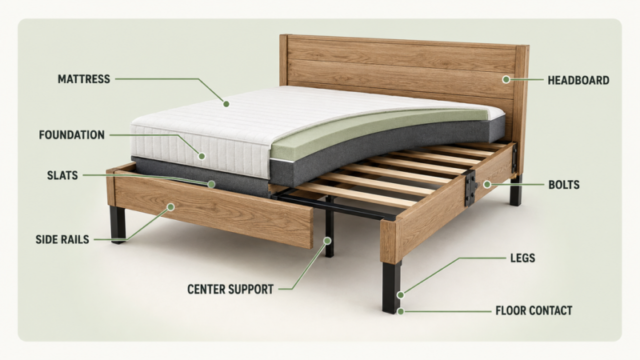
What You May Need Before Starting
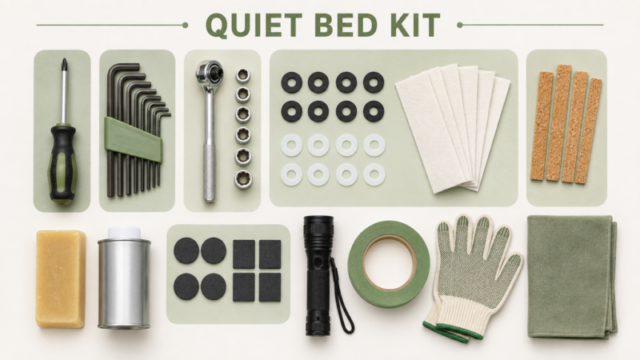
Most squeaky-bed repairs require only basic household tools. Check the fastener type before choosing a wrench because using the wrong size can round off a bolt or strip a screw head.
Useful supplies include:
- Screwdrivers or hex keys that fit the original hardware
- An adjustable wrench or correctly sized socket
- Rubber, nylon, or metal washers
- Adhesive felt or thin cork strips
- Beeswax or paraffin wax for unfinished wooden contact points
- Silicone or dry lubricant for suitable metal joints
- Nonslip furniture pads
- Wood glue and clamps for appropriate permanent wood repairs
- Painter’s tape for marking the location of each sound
- A flashlight for inspecting hidden joints
- Work gloves and eye protection
Keep lubricant, wax, and adhesive away from the mattress and bedding. If you have an adjustable powered base, unplug it before inspecting any moving components and follow its manufacturer’s service instructions.
How to Stop Squeaky Bed Noises Step by Step
The fastest approach is to test one component at a time. Changing several things simultaneously may stop the noise, but you will not know what caused it or whether the repair is likely to last.
1. Remove the Bedding and Isolate the Mattress
Remove the pillows, sheets, duvet, and mattress. Place the mattress flat on a clean floor and press firmly around its edges, center, and usual sleeping positions.
A foam mattress is usually quiet, but a hybrid or traditional innerspring mattress may produce noise if an internal spring or component is damaged. If the mattress squeaks while it is separated from the frame, check its warranty and care instructions rather than cutting it open.
2. Test the Foundation Separately
If you use a box spring or separate foundation, press down on each corner and then across the center. Ask another person to listen from different sides so that you can identify the noisiest area.
Older box springs may squeak because their internal components have loosened or worn. Do not remove non-serviceable upholstery or fabric covers unless the manufacturer’s instructions specifically allow it.
3. Rock the Empty Bed Frame
With the mattress and foundation removed, grip one corner of the frame and move it gently from side to side. Repeat the test at every corner, the headboard, footboard, and center rail.
Mark each noisy joint with a small piece of painter’s tape. This simple step prevents you from losing the location once you begin tightening or cushioning the frame.

4. Tighten Every Fastener Correctly
Inspect every screw, nut, bolt, bracket, and connector, including those that do not appear to be near the sound. Movement at one loose corner can transfer vibration through the entire frame.
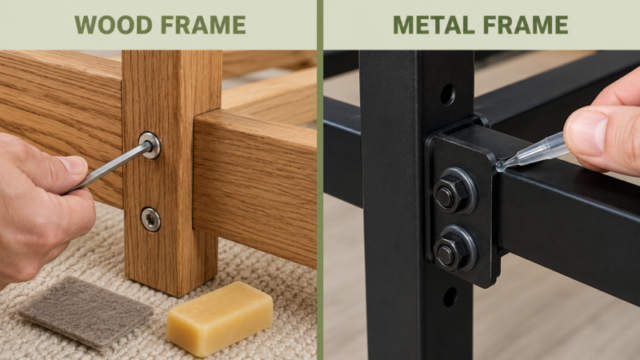
Tighten connections gradually rather than forcing one bolt as hard as possible. Work around the frame in a balanced pattern, and hold the nut with a wrench while tightening the bolt from the other side when necessary. Furniture manufacturers commonly recommend periodically retightening bed connectors to preserve stability.
Do not overtighten fasteners in particleboard, softwood, or thin metal. Excessive force can strip the hole, crush the material, or distort the bracket. If the screw spins without becoming secure, use the appropriate method from our guide to repairing a stripped screw hole in wood or metal.
5. Add Washers Where Connections Move
A washer helps distribute pressure and can remove small gaps around a bolt. Rubber or nylon washers also cushion vibration, while standard metal washers are more useful for improving how a fastener bears against the frame.
Use only washers that fit the bolt and do not interfere with proper assembly. If a manufacturer supplied a particular washer order, reproduce that arrangement rather than improvising.
6. Cushion Wooden Slats
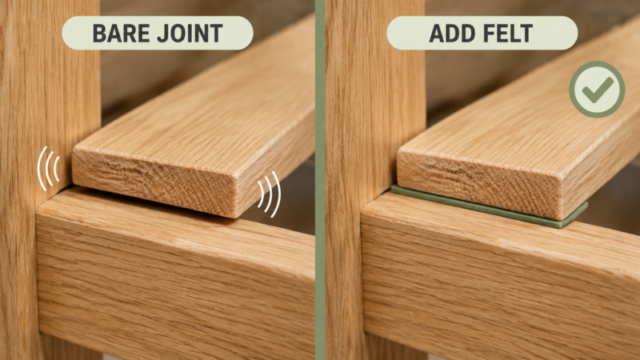
Wooden slats frequently squeak where their ends rub against the side rails or center support. Lift one slat at a time and place a thin strip of adhesive felt or cork between the two surfaces.
Keep the padding thin enough that the slat still sits fully inside its holder. Thick folded fabric can raise the slats unevenly, alter mattress support, and create a new movement problem.
For bare wood-on-wood joints, a small amount of beeswax or paraffin wax can reduce friction. Avoid applying oily sprays to unfinished wood because they may stain the frame, collect dust, or interfere with future gluing and refinishing.
7. Lubricate Metal Contact Points Sparingly
If the sound is clearly coming from clean metal surfaces rubbing together, apply a small amount of silicone or dry lubricant to the precise contact point. The manufacturer’s information for silicone lubricant on metal and other common surfaces recommends testing an inconspicuous area when compatibility is uncertain.
Protect the floor, upholstery, mattress, and bedding before spraying. Apply the lubricant to a cloth or narrow applicator when possible instead of spraying a wide area, and wipe away any excess.
Lubricant will not secure a loose connection. Tighten the joint first, because lubrication alone may temporarily hide the sound while the hardware continues to move.
8. Stop Bolts From Loosening Repeatedly
If a properly tightened metal bolt keeps loosening from normal movement, a removable medium-strength threadlocker may help. Apply it only to clean threaded metal fasteners and follow the product instructions carefully.
For example, medium-strength blue threadlocker is designed to resist vibration while remaining removable with ordinary hand tools. Avoid permanent red threadlocker on furniture that may need to be disassembled for moving or repair.
9. Stabilize the Headboard, Legs, and Floor
A headboard can knock against the wall or flex at its mounting brackets whenever you turn over. Tighten the brackets, add thin felt between joined surfaces, and place padded wall protectors behind the headboard if it touches the wall.
Next, check whether every leg contacts the floor. Use thin nonslip furniture pads to correct a minor difference, but do not create a tall stack of pads. A large gap may indicate a bent frame, an incorrectly installed center leg, or a significantly uneven floor that needs a better solution.
A rug or carpet can reduce sliding and vibration on a hard floor, although it will not repair a loose frame. If you are considering a bedroom flooring change, our breakdown of the cost to carpet a 10×12 room explains the main material, padding, and installation considerations.

10. Inspect the Slat Spacing and Center Support
Slats that bow, shift, or sit too far apart can concentrate pressure and cause movement. Check your mattress manufacturer’s support requirements before adding plywood, extra slats, or a bunkie board because an unsuitable foundation can affect airflow, performance, and warranty coverage.
Requirements differ among mattress brands. As one example, Tempur-Pedic’s foundation guidance specifies structurally sound slats at least three inches wide and less than four inches apart for its compatible mattresses. Use the instructions for your actual mattress rather than treating those measurements as a universal rule.
Queen and larger frames commonly rely on a center rail and supporting legs. If the rail is loose, incorrectly positioned, or not touching the floor as designed, the frame may flex whenever weight shifts across the mattress.
Best Fix for Each Bed Material
The correct repair depends on which materials are touching. A product that works well on a metal connector may permanently mark upholstered fabric or unfinished wood.
| Bed component | Best first fix | Avoid |
|---|---|---|
| Solid wood joint | Tighten, add felt, or apply wax to bare contact points | Soaking the wood with oil |
| Particleboard connection | Tighten gently and repair stripped holes properly | Oversized screws without checking thickness |
| Metal joint | Tighten, add a compatible washer, then lubricate if needed | Spraying lubricant over the entire frame |
| Upholstered frame | Tighten hidden brackets and use clean felt padding | Oil near fabric or foam |
| Wooden slats | Add thin felt or cork at rail contact points | Thick padding that changes slat height |
| Box spring | Isolate the noisy area and follow manufacturer guidance | Cutting into a closed foundation |
| Adjustable base | Unplug it and consult its manual or service provider | Lubricating motors or electrical components yourself |
Wood can also react to seasonal humidity. The USDA Forest Service explains that wood exchanges moisture with the surrounding air, which can affect its dimensions and performance. This is one reason a wooden bed may become noisier during a seasonal humidity change even when no obvious component has broken.
How Long Does It Take to Fix a Squeaky Bed?
A basic diagnosis and fastener check often takes less than an hour. Repairs involving damaged wood, replacement hardware, inaccessible upholstery, or full disassembly can take considerably longer.
| Task | Approximate DIY time | Difficulty |
|---|---|---|
| Isolate the noise source | 15–30 minutes | Easy |
| Tighten accessible hardware | 10–30 minutes | Easy |
| Add felt to slats | 20–45 minutes | Easy |
| Level the legs | 10–20 minutes | Easy |
| Repair a stripped hole | 30–90 minutes plus curing time | Moderate |
| Replace damaged slats or brackets | Varies by frame | Moderate |
| Repair cracked wood or a failed weld | Professional assessment recommended | Advanced |
These are planning estimates rather than guaranteed repair times. Your bed design, accessibility, hardware condition, and any required adhesive curing time will affect the actual duration.
Common Squeaky-Bed Repair Mistakes
One detail I would not overlook is the difference between hiding noise and repairing movement. A temporary reduction in sound does not mean a loose or weakened frame has become structurally sound.
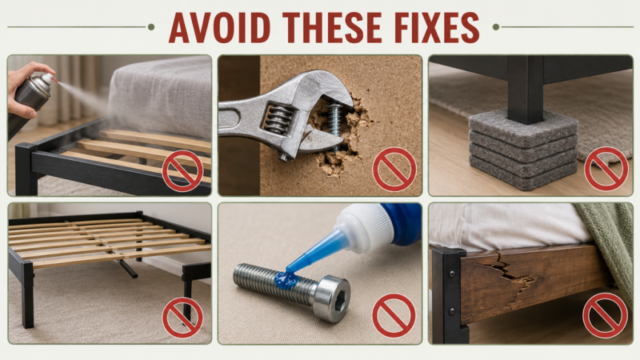
Avoid these common mistakes:
- Spraying lubricant without locating the squeak
- Using lubricant on fabric, unfinished wood, or electrical components
- Overtightening screws in particleboard
- Ignoring a missing center leg
- Placing thick, uneven padding beneath individual slats
- Using permanent threadlocker on removable furniture
- Gluing joints before confirming that the bed is assembled correctly
- Continuing to use cracked wood or a failed metal weld
- Assuming every sound comes from the frame
- Forgetting to check whether the bed is touching the wall
When Should You Replace the Bed Frame?
Replace or professionally repair the frame when it has cracked structural rails, severely bowed components, damaged support brackets, repeated fastener failure, extensive corrosion, or a broken weld. Stop using it if the frame shifts suddenly or no longer supports the mattress evenly.
Replacement may also be more sensible when multiple particleboard connections have failed or compatible parts are unavailable. Contact the manufacturer first if the bed is relatively new, because modifying or drilling the frame could affect your warranty.
Frequently Asked Questions
How can I stop a bed from squeaking without taking it apart?
Remove the mattress and tighten every accessible connection first. Add felt to accessible slat contact points, stabilize the headboard, and level the legs before considering full disassembly.
If the sound comes from a concealed joint, internal box-spring component, or damaged slat holder, partial disassembly may be necessary. Mark each part and photograph the original arrangement before taking it apart.
Why does my bed squeak every time I move?
Movement shifts weight across the frame, causing loose or dry surfaces to rub. The usual sources are frame joints, slat ends, headboard brackets, center supports, box-spring components, and uneven legs.
Test the mattress, foundation, and empty frame separately. This is more reliable than trying to identify the source while everything is assembled.
Can a mattress make a squeaking noise?
Yes, particularly if it contains springs or other internal mechanical components. Place the mattress on a clean floor and press several areas to determine whether it squeaks independently of the bed frame.
Do not open or cut the mattress to investigate. Contact the manufacturer if the noise appears to come from inside and the mattress remains under warranty.
Does WD-40 stop a bed from squeaking?
An appropriate lubricant may reduce metal-on-metal friction, but it will not tighten a loose connection or repair structural damage. A silicone or dry lubricant applied precisely to a compatible metal contact point is often cleaner than broadly spraying a general-purpose penetrating product.
Always protect fabrics and test surface compatibility first. Never spray lubricant into a mattress, upholstered frame, motor, or electrical assembly.
What can I put between wooden bed slats to stop squeaking?
Thin adhesive felt or cork can cushion the points where slats meet the frame. Beeswax or paraffin wax may also reduce friction on clean, unfinished wood contact surfaces.
Do not use thick folded towels or bulky padding. They can create uneven mattress support and allow the slats to move in a different direction.
Why does my wooden bed squeak more in certain seasons?
Wood gains and loses moisture as indoor humidity changes. Small dimensional changes can increase friction or loosen joints enough to create noise.
Inspect and retighten the connections instead of assuming the frame is permanently damaged. Maintaining reasonably stable indoor conditions may also reduce recurring seasonal movement.
Can I use plywood to stop a squeaky bed?
Plywood may redistribute weight, but it should not be treated as a universal solution. A solid board can alter ventilation, firmness, mattress support, and warranty compliance.
Check the mattress and bed-frame instructions before adding it. Repair loose slats, fasteners, and center supports first because plywood can hide rather than solve those problems.
How often should I tighten my bed frame?
Check the connections after assembly, after moving the bed, and whenever you notice wobbling or noise. Periodic inspection is especially helpful for frames that are moved frequently or assembled with many removable connectors.
Tighten only to the manufacturer’s recommended level. Repeated loosening may require replacement hardware, suitable washers, or removable threadlocker rather than greater force.
Conclusion
The most reliable answer to how to stop squeaky bed noises is to diagnose before you repair. Test the mattress, foundation, empty frame, headboard, slats, legs, and floor separately, then tighten, cushion, lubricate, or replace only the component causing the sound.
I recommend starting with the free fixes: reposition the bed, tighten the hardware, level the legs, and check the center support. If the frame is cracked, bent, or structurally unstable, stop using temporary noise-reduction tricks and arrange a proper repair or replacement.