


Best Fertilizer for Bermuda Grass
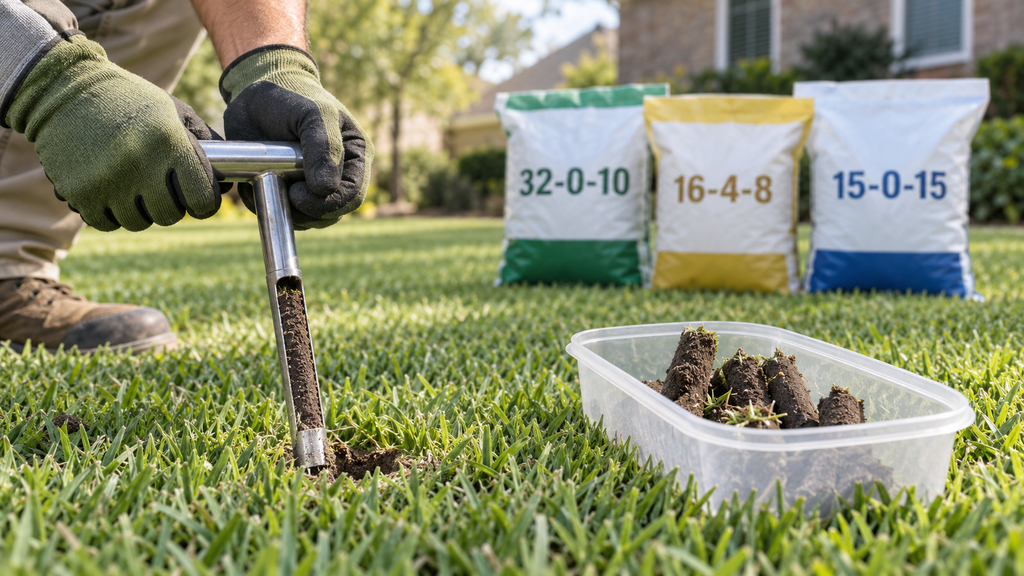
The best fertilizer for Bermuda grass is a high-nitrogen lawn fertilizer chosen based on your soil test. If your soil already has enough phosphorus, use formulas like 32-0-10, 28-0-0, or 15-0-15. If your soil needs phosphorus, a balanced 16-4-8 fertilizer works best.
Apply half to one pound of actual nitrogen per 1,000 square feet after the grass turns fully green in the spring. Products with both fast-acting and slow-releasing nitrogen give you quick color without making the grass grow too fast all at once.
Best Bermuda Grass Fertilizers by Need
These selections are based on their verified fertilizer analyses, release types, application methods, and suitability for common Bermuda lawn conditions. They are not substitutes for a soil test.
| Product | Analysis | Best for | Important limitation |
|---|---|---|---|
| Scotts Turf Builder Southern Lawn Food | 32-0-10 | Established lawns that do not need phosphorus | Concentrated formula must be spread accurately |
| The Andersons PGF Complete | 16-4-8 | Soil that needs nitrogen, phosphorus, and potassium | Adds phosphorus and is not sold in California |
| Simple Lawn Solutions 15-0-15 | 15-0-15 | Liquid feeding when potassium is needed but phosphorus is not | Lower nitrogen concentration than granular products |
| Simple Lawn Solutions 28-0-0 | 28-0-0 | Nitrogen-only liquid feeding | Does not correct phosphorus or potassium deficiencies |
Best No-Phosphorus Granular Fertilizer: Scotts Turf Builder Southern Lawn Food
Scotts Turf Builder Southern Lawn Food has a 32-0-10 analysis. Its high nitrogen content supports Bermuda grass growth, while potassium helps meet the needs of soils that test low in that nutrient.
The phosphorus-free formula makes sense for an established lawn where testing shows no phosphorus deficiency. A listed 14.06-pound bag covers 5,000 square feet, but packaging and coverage options can change, so confirm the label before purchasing.
Because it contains 32% nitrogen, overapplication can produce excessive growth or damage. Calibrate the spreader instead of assuming a universal setting will work.
Best Balanced Granular Fertilizer: The Andersons PGF Complete
The Andersons PGF Complete has a 16-4-8 analysis with quick- and slow-release nitrogen. Its fine granules are designed to distribute nutrients evenly across the lawn.
Choose this product when a soil test supports adding phosphorus and potassium. It is not the right default for soil already high in phosphorus, and the manufacturer states that it is not available for sale in California.
Best Phosphorus-Free Liquid Option: Simple Lawn Solutions 15-0-15
Simple Lawn Solutions lists a 15-0-15 liquid lawn food containing equal percentages of nitrogen and potash with no phosphorus. It suits actively growing Bermuda grass when testing indicates that potassium is also needed.
The hose-end application is convenient for smaller or irregular lawns. However, liquid coverage can become uneven if walking speed, water pressure, or spray overlap changes.
Best Nitrogen-Only Liquid Option: Simple Lawn Solutions 28-0-0
The manufacturer also offers a 28-0-0 high-nitrogen liquid fertilizer. It supplies nitrogen without adding phosphorus or potassium, making it useful when those nutrients are already sufficient.
This is a targeted fertilizer, not a complete lawn treatment. Do not use it to correct general yellowing until you have ruled out drought, shade, disease, soil-pH problems, and iron deficiency.
Product formulas and availability may change. Read the current label before applying any fertilizer.
Choose the Right Formula From Your Soil Test
Use this decision guide instead of selecting fertilizer by brand alone:
| Soil-test result | Fertilizer to consider |
|---|---|
| Phosphorus and potassium are adequate | 28-0-0 or another nitrogen-focused formula |
| Phosphorus is adequate but potassium is low | 32-0-10, 24-0-11, or 15-0-15 |
| Both phosphorus and potassium are low | 16-4-8 or the exact ratio recommended by the laboratory |
| Nutrient levels are adequate but color is pale | Iron treatment rather than additional nitrogen |
| Soil pH is outside the recommended range | Correct the pH according to the laboratory report |
The three numbers on a fertilizer label represent the percentages of nitrogen, phosphate, and potash by weight.
Nitrogen drives green growth and density. Phosphorus supports establishment and root development, while potassium contributes to stress tolerance and plant function. Established Bermuda grass commonly needs nitrogen, but phosphorus and potassium requirements vary by soil.
Texas A&M recommends testing soil at least every other year and keeping individual nitrogen applications within 0.5 to 1 pound per 1,000 square feet. Its Bermudagrass home-lawn calendar provides detailed fertilizer and maintenance guidance.
How Much Fertilizer Does Bermuda Grass Need?
Calculate the application by actual nitrogen, not total product weight:
Pounds of fertilizer per 1,000 square feet = desired nitrogen rate ÷ nitrogen percentage as a decimal
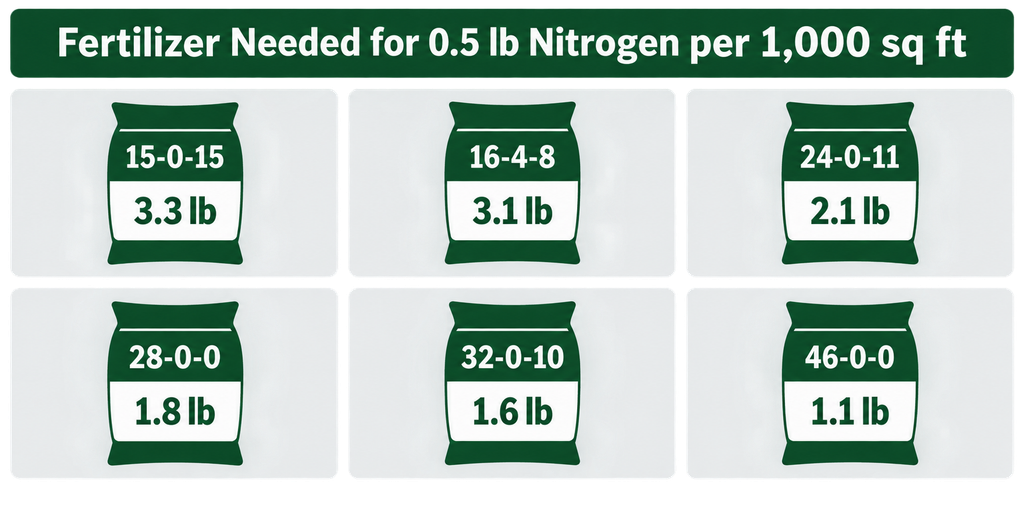
The following amounts provide 0.5 pound of nitrogen per 1,000 square feet:
| Fertilizer analysis | Product required |
|---|---|
| 15-0-15 | 3.3 pounds |
| 16-4-8 | 3.1 pounds |
| 24-0-11 | 2.1 pounds |
| 28-0-0 | 1.8 pounds |
| 32-0-10 | 1.6 pounds |
| 46-0-0 | 1.1 pounds |
For example, a 5,000-square-foot lawn needs approximately 8 pounds of 32-0-10 to receive 0.5 pounds of nitrogen per 1,000 square feet.
When using a liquid product, follow the label’s dilution and coverage instructions. Do not convert a liquid fertilizer rate using the granular table unless the label provides the product’s weight and nitrogen application rate.
Annual Nitrogen Needs by Region
Bermuda grass grows for different lengths of time across its range, so one national fertilizer calendar is unreliable.
| Region | Extension guidance |
|---|---|
| Southeast and transition zone | Clemson recommends 2–4 pounds of nitrogen per 1,000 square feet during the growing season, using the lower end for clay soil and the higher end for sandy soil |
| Texas | Texas A&M describes 1–4 growing-season applications at 0.5–1 pound of nitrogen per 1,000 square feet each |
| Florida | UF/IFAS lists 3–5 pounds annually in North Florida, 4–6 in Central Florida, and 5–7 in South Florida, while noting that these ranges may exceed the needs of residential landscapes |
| Low-desert Southwest | University of Arizona recommends 0.5 pounds of nitrogen per 1,000 square feet monthly from April through October for non-overseeded Bermuda |
These figures are regional starting points, not automatic targets. A lightly used established lawn may perform well near the lower end. Hybrid Bermuda, sandy soil, heavy traffic, frequent irrigation, and a longer growing season can increase nitrogen demand.
Local fertilizer regulations may set lower limits. When state or county rules differ from general extension guidance, follow the local requirement.
When to Fertilize Bermuda Grass
Make the first application two to four weeks after complete spring green-up, once the lawn is actively growing and the risk of frost has passed.
Subsequent applications can be spaced through the growing season according to the product label and regional nitrogen target. Stop before Bermuda grass begins entering fall dormancy. Clemson advises ending nitrogen applications by mid-August in South Carolina, while warmer regions may have a longer feeding season.
Do not apply nitrogen when the grass is:
- Dormant or only partly green
- Wilting or under drought stress
- Unable to receive irrigation
- Approaching its first expected frost
- Saturated or likely to receive heavy rain
Calendar dates are less reliable than growth conditions. Coastal Florida, northern Georgia, Texas, and Arizona do not share the same green-up or dormancy schedule.
Quick-Release vs. Slow-Release Nitrogen
Quick-release nitrogen sources such as urea and ammonium sulfate become available rapidly. They produce a faster response but can cause sudden growth and are less forgiving of application errors.
Polymer-coated urea, sulfur-coated urea, methylene urea, and other slow-release sources feed gradually. They produce steadier growth and reduce the need for frequent applications.
A mixture of both is practical for most home lawns. Check the guaranteed analysis for terms such as:
- Slowly available nitrogen
- Water-insoluble nitrogen
- Polymer-coated urea
- Controlled-release nitrogen
A high first number does not reveal how quickly the nitrogen will become available.
How to Apply Fertilizer Evenly
Measure the turf area and exclude driveways, patios, buildings, and landscape beds. Applying a bag intended for 5,000 square feet to a 3,000-square-foot lawn can deliver far too much nitrogen.
For granular fertilizer:
- Calibrate the spreader using the product label.
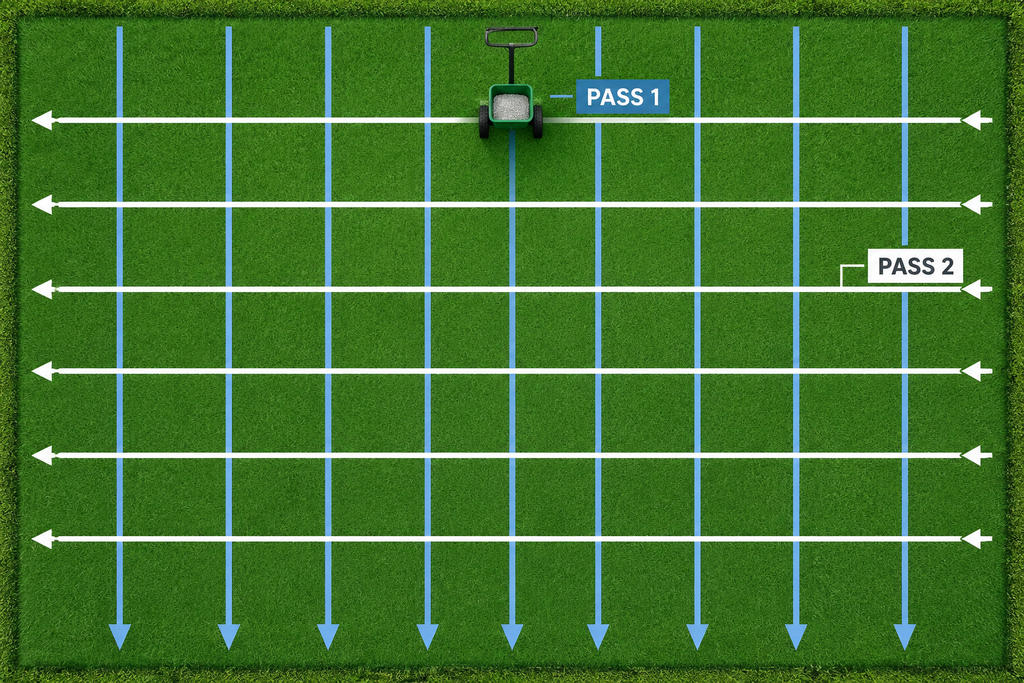
- Divide the required fertilizer into two equal portions.
- Apply one portion in north-to-south passes.
- Apply the second in east-to-west passes.
- Sweep granules from pavement back onto the grass.
- Water the lawn if directed by the label.
Do not assume that one manufacturer’s spreader setting will work on another spreader. Walking speed, equipment condition, granule size, and pass spacing all affect the rate.
When Fertilizer Will Not Fix the Lawn
More nitrogen is not the answer to every thin, pale, or slow-growing Bermuda lawn.
Check for these problems first:
- Shade: Bermuda grass needs abundant direct sunlight. Fertilizer cannot compensate for a shaded location.
- Poor irrigation coverage: Dry sections remain thin even when the lawn receives adequate fertilizer overall.
- Compacted soil: Roots cannot use water and nutrients efficiently.
- Incorrect mowing: Allowing Bermuda to grow too tall and then cutting it severely causes scalping.
- Excess thatch: A thick layer can interfere with water and nutrient movement.
- Soil-pH problems: Nutrients may be present but unavailable to the grass.
- Pests or disease: Additional nitrogen can intensify some disease problems.
Yellow grass with normal growth may need iron rather than more nitrogen. A soil test and correct diagnosis prevent unnecessary applications.
Leaving finely chopped clippings on the lawn also returns nutrients to the soil. Remove heavy leaves and debris that block sunlight; this guide to cleaning up a yard efficiently explains how to clear turf without creating unnecessary damage.
Should You Use Weed-and-Feed?
Use weed-and-feed only when the lawn needs fertilizer at the same time the target weeds need treatment.
A spring pre-emergent may be required before Bermuda grass is ready for nitrogen. Combining the two can cause you to apply fertilizer too early. Products containing post-emergent herbicide may also be unnecessary when only a few weeds are present.
Separating fertilizer and weed control gives you better control over timing and allows spot treatment. If you use a combination product, confirm that the herbicide is labeled for Bermuda grass and for the weeds present.
FAQs
Is 10-10-10 fertilizer good for Bermuda grass?
Only when a soil test supports equal applications of nitrogen, phosphate, and potash, on an established lawn with adequate phosphorus, 10-10-10 adds nutrients the grass may not need.
Is 16-4-8 a good Bermuda fertilizer?
Yes, if the soil needs phosphorus and potassium. It is less suitable when soil phosphorus is already adequate or local rules restrict phosphorus applications.
Can I apply fertilizer to Bermuda grass every month?
Monthly feeding may be appropriate in long growing seasons, such as the low-desert Southwest, when using the regional rate. It can supply too much nitrogen in cooler regions. Follow your annual nitrogen target rather than applying fertilizer monthly by default.
Is liquid or granular fertilizer better?
Granular fertilizer is generally easier to measure across a large lawn and offers more slow-release choices. Liquid fertilizer is useful for small or irregular lawns but requires consistent spraying to prevent missed or overlapping areas.
Should I fertilize before or after rain?
Do not fertilize before heavy rain. Apply when the soil has adequate moisture and use light irrigation afterward only when required by the product label.
Can high-nitrogen fertilizer burn Bermuda grass?
Yes. Applying too much, spreading unevenly, or using quick-release nitrogen on drought-stressed grass can cause fertilizer burn. Measure the lawn and calculate the nitrogen rate before application.
Final Recommendation
For most established Bermuda lawns with adequate soil phosphorus, choose a high-nitrogen, phosphorus-free fertilizer with potassium, such as a 32-0-10 or 15-0-15 formula. Use 16-4-8 only when testing confirms that phosphorus is needed.
Apply 0.5 to 1 pound of actual nitrogen per 1,000 square feet after full green-up, then remain within the annual range recommended by your local extension service. Correct product choice matters, but accurate measurement and regional timing determine the result.