


Bouquet Flower Rose Guide: Which Roses Make the Best Bouquet?
A search for bouquet flower rose might mean you want a dozen red roses delivered, a loose arrangement for your dining table, or the name of the peach rose you saw in a photograph. Those are different choices. The easiest way to narrow them down is to decide what the bouquet is for, then choose its rose shape, color, and size.
For a classic gift, standard long-stem roses make a clear statement. For a softer home display, try garden-style or spray roses, alone or with a few supporting flowers. If a particular flower has caught your eye, ask for its variety name: “peach garden rose” describes a look, while Juliet identifies a named cut rose.
A good bouquet should also be practical. It needs to fit its vase or the recipient’s space, arrive when it is needed, and contain healthy stems that still have time to open.
Start with the bouquet you want to see
An all-rose bouquet lets the color and form of the roses carry the display. A tight bunch of matching red roses looks formal and deliberate. Cream roses can look calm against a dark table. Several shades of pink or peach make an all-rose arrangement feel less uniform while keeping its focus.
A mixed flower bouquet with roses has a different character. The roses are usually its largest blooms, while smaller flowers and foliage give them breathing room. This works particularly well when you want a bouquet to look natural in a living room rather than to announce a single occasion.
The container changes the result as much as the flower choice. A narrow vase gathers a few stems into a compact shape. A wide vase allows the roses to lean outward. A low arrangement belongs on a table where people need to see across it; taller flowers can make more sense on a console or mantel.
If you’re giving the flowers to someone else, think one step beyond the photograph on the florist’s site. Will the recipient have a vase? Is there room for a large arrangement? A smaller bouquet that can be displayed easily may be a better gift than one that looks impressive only while wrapped.
Rose types you’ll find in bouquets.
People often ask for “rose names” when they first need to know the type of rose. These three types produce noticeably different bouquets.
| Rose type | What it looks like in a bouquet | Choose it when you want |
|---|---|---|
| Standard rose | Usually one prominent bloom on a stem, with a defined outline | A classic, orderly bunch or a few striking stems |
| Spray rose | Several smaller blooms on branching stems | A lighter arrangement with more small flowers and movement |
| Garden-style cut rose | A fuller, often layered or ruffled-looking bloom | A soft, abundant focal flower |
These are descriptions of form, not promises about scent or vase life. Roses vary within each group. A photograph of a fully open bloom also won’t tell you exactly how it looked when it first arrived.
Place the second generated image here, after this comparison. It shows standard roses, spray roses, and full garden-style blooms side by side.

Named roses worth knowing
A named variety helps when you want a particular color, shape, or fragrance and are speaking to a florist who can source it. It is less useful as a rigid shopping list: a florist may have beautiful roses available that aren’t listed below, while a named variety might require advance ordering.
These examples come from David Austin’s collection of cut roses. They show how much variation “a rose bouquet” can contain.
| Named cut rose | Recognizable look | Bouquet idea |
|---|---|---|
| Juliet | Layered peach-to-apricot petals | A warm bouquet with cream flowers or other soft peach tones |
| Patience | Full ivory rosettes with a pale yellow center; notably fragrant according to its breeder | A light-colored bouquet where scent matters |
| Leonora | Ruffled ivory blooms | A restrained cream-and-green arrangement |
| Tess | Deep red, ruffled flowers | A richer alternative to a bunch of classic-shaped red roses |
| Millicent | Pink blooms that develop softer mauve tones | A pink bouquet with varied color as the flowers open |
| Effie | Creamy buds that open into warm amber and apricot tones | A bouquet built around changing warm colors |

David Austin describes Juliet, Leonora, Tess, Millicent, and Effie in its bouquet collection, and its Patience rose page describes that variety’s scent and ivory color. Those descriptions refer to named florist cut roses. They do not mean that any unnamed peach or ivory rose in a shop is one of these varieties.
There is another distinction home gardeners should know. A rose sold as a cut flower for florists and a rose sold as a plant for your garden are not necessarily the same purchase. Cut roses are grown and supplied for arrangements; garden roses are selected and sold as living plants. David Austin explains the difference between its cut and garden roses. If you want to grow flowers for indoor arrangements, look for a garden rose suited to cutting and to your local growing conditions rather than assuming a florist’s cut-rose name is available as a plant.
For most everyday bouquets, you don’t need to request a variety by name. Asking for “full ivory roses with noticeable fragrance” or “small pink spray roses for a loose arrangement” gives a florist useful direction without depending on one flower being in stock.
Choosing rose colors without following a rulebook
Red roses are widely associated with romance, which makes them an easy choice when you want that message to be unmistakable. But color meanings aren’t instructions. A recipient’s favorite color, the occasion, and the setting are more useful guides.
Pink can range from pale and quiet to vivid and playful. Peach and apricot give a bouquet warmth without the strong contrast of red. Ivory and cream are versatile in home interiors, though they can look different beside pure-white supporting flowers. Yellow brings a brighter, less formal feel.
You can use one color.
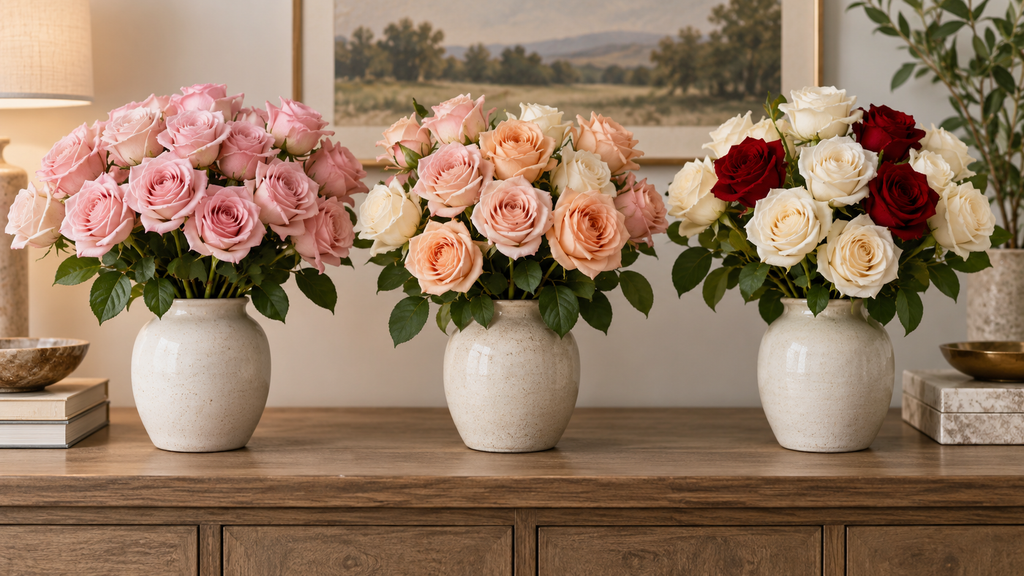
in three ways:
- One consistent shade makes the bouquet look orderly.
- Several shades of the same color add depth while keeping it cohesive.
- A contrasting accent makes one part of the arrangement stand out.
There’s no need to add every color you like to one vase. If the roses already have a distinctive shape, a simple palette lets people notice it.
What flowers look good with roses?
The best companion flower depends on what the roses need. Large, closely packed rose heads benefit from smaller flowers or fine greenery that leave visible space between them. Roses with slender stems can be paired with another prominent flower if you want a more abundant bouquet.
For a gentle arrangement, combine blush or peach roses with small cream or white flowers. For a brighter one, put warm roses near other warm-toned blooms. If you want the roses to remain unmistakably central, use fewer companion stems than rose stems and check the bouquet from several angles. Supporting flowers should fill gaps, not hide the rose heads.
Texture is often more useful than another color. A little branching greenery can break up the round outline of rose blooms. Small flowers can add detail when viewed up close without changing the bouquet’s overall color.
Be careful when ordering a “rose flower bouquet” online. The product name may contain rose even when roses account for only part of the finished arrangement. Read the flower description and size options if the number or prominence of roses matters to you.

How to choose a fresh bouquet in person
When you can see the flowers before buying, examine more than the petals. Look for firm, clean stems, healthy leaves, upright blooms, and clean water where the flowers are displayed. Pass over a bunch with slimy stems, heavily damaged petals, drooping heads, or visible mold.
A rose that has begun to open can give you the pleasure of watching it develop in the vase. One that is already extensively damaged will not improve simply because it is put in fresh water. NC State Extension’s cut-flower selection guidance recommends checking the flowers, stems, leaves, storage water, and stage of opening.
Don’t expect every healthy rose to look like the same tightly closed bud. Different varieties open into different shapes. Look at the condition of the whole bouquet and, when possible, ask when the flowers arrived.
What to check when ordering rose bouquets for delivery
The image is a starting point, not the whole order. Before checkout, find out:
- What size is pictured? A listing may show a larger arrangement than its least expensive option.
- How many rose stems are included? A mixed bouquet can contain fewer roses than its photo suggests.
- Does it include a vase? Wrapped stems and a ready-to-display arrangement solve different needs.
- Are substitutions allowed? Check this especially when a specific rose color or variety matters.
- What is the delivery date and final cost? Review the full checkout total and timing rather than comparing headline bouquet prices alone.
For an important event, a conversation with a florist can be more useful than searching dozens of nearly identical product photos. Describe the occasion, preferred colors, desired rose form, approximate display size, and whether fragrance is important. If you want a named rose such as Juliet or Patience, ask about availability early; don’t assume it can be sourced for last-minute delivery.
Bring a rose bouquet into your home.
Once the flowers arrive, remove packaging that crowds the stems and find a clean vase sturdy enough for the finished arrangement. If the bouquet is too large, divide it between two vases instead of compressing every flower into one opening.
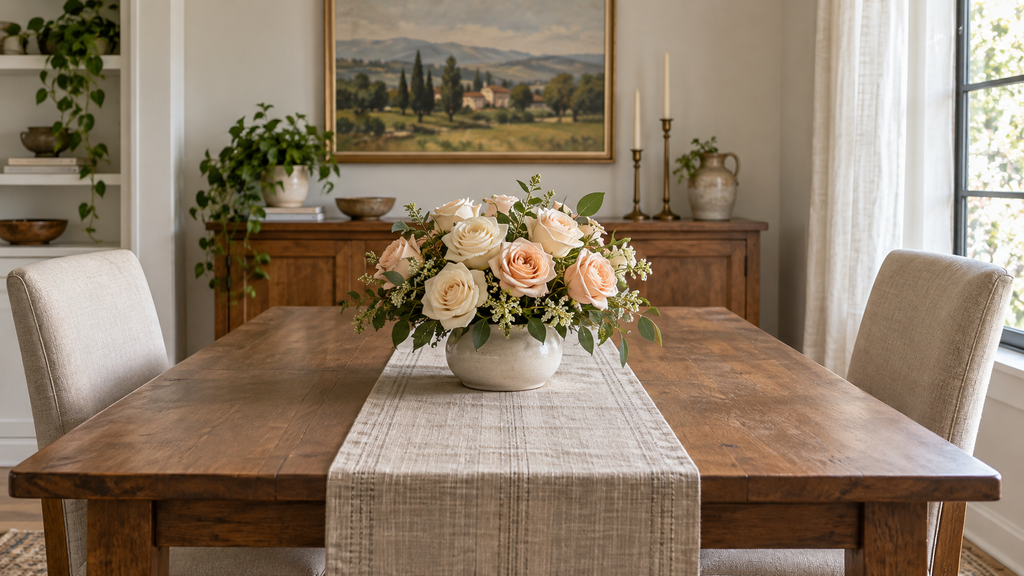
Set the main roses in place first. Angle some stems so the bouquet has a natural outline, then add smaller flowers where there are gaps. Put greenery where it frames the blooms. Turn the vase as you work, and look at it from the place where it will actually sit. An arrangement that looks balanced from above may hide half its flowers when viewed from a chair.
For a dining table, keep sightlines open. On a side table, leave space for things people regularly put down. Near a window, use the daylight to show the flowers, but avoid leaving cut roses in strong direct sun. The arrangement should make the room easier to enjoy, not take over its usable surfaces.
If you want a rose-inspired display that lasts without fresh-flower care, Home Upright’s guide to making flowers from silk explains how to build layered fabric blooms for home decor.
Help cut roses last in the vase.
Fresh flowers benefit from ordinary, consistent care. Start with a clean vase and fresh water. Use clean, sharp shears to make a fresh cut on the stem ends. Remove leaves that would be submerged, because decaying foliage spoils the water. If the bouquet came with commercial flower food, follow the packet’s directions.
Keep the flowers out of direct sun and away from strong drafts and heating or cooling vents. Check the water level, then clean the container, change the water, and recut stems every few days. These measures follow NC State Extension’s care advice for cut flowers.
A mixed bouquet rarely declines all at once. Remove individual flowers as they fade and rearrange what remains. A smaller vase can make the healthy stems look intentional again. There is no single number of days every rose bouquet will last: the flowers’ condition when purchased, their varieties, handling, and care all affect the result.
Frequently asked questions
Does “rose bouquet” mean roses only?
No. It can describe an all-rose bunch or an arrangement in which roses are the main flowers among other blooms. Check the flower list or ask the florist if you want roses to make up most of the bouquet.
What is the difference between a garden rose and a standard rose in a bouquet?
A standard rose describes the familiar cut-flower form with one prominent bloom on a stem. A garden-style rose usually describes a fuller, more layered-looking bloom. The names describe how the flowers look in an arrangement; neither tells you its exact variety.
How many roses are enough for a small bouquet?
There is no minimum. A few well-spaced roses can fill a narrow vase beautifully. Start with the vase and location, then choose enough stems to give the arrangement a balanced outline without crowding it.
Can I ask a florist for Juliet roses?
Yes. Juliet is a named cut rose. Ask whether the florist can source it for your date and what alternatives they recommend if it is unavailable. A request for “peach, layered garden-style roses” also communicates the look you want.
Are rose bouquets always fragrant?
No. Scent varies among varieties and individual flowers. If fragrance is a deciding factor, tell the florist or check the actual stems when shopping in person.
Should I buy a wrapped bouquet or one already in a vase?
Choose wrapped flowers when the recipient has a suitable vase, or you intend to arrange the stems yourself. Choose a vase arrangement when it needs to be displayed immediately. Check the vase dimensions if the flowers are going into a small space.
A bouquet of roses is easiest to get right when you know what matters most: a particular rose shape, color, scent, or place in the home. Use named varieties when you want a specific flower, but let the condition of the stems and the suitability of the finished arrangement guide your final choice.