


Bouquet White Lily Guide: Meaning, Styles, Care & Safety
If you searched for bouquet white lily, you may be choosing flowers for a gift, wedding, sympathy arrangement, or simple home display. The flower looks straightforward at first—large white blooms supported by green stems—but the finished bouquet can look dramatically different depending on the lily variety, number of stems, foliage, supporting flowers, and vase style.
A white lily bouquet can feel formal when arranged almost entirely with lilies, romantic when paired with roses, or more relaxed when mixed with eucalyptus and loose greenery. Different lily groups also create different experiences. According to the North Carolina Extension guide to Oriental lilies, Oriental hybrids are known for large, fragrant flowers, while Asiatic lilies are generally much less scented.
However, one issue matters more than appearance. True lilies can be extremely dangerous to cats. The FDA’s lily safety guidance warns that flowers, leaves, pollen, stems, and even vase water from true lilies and daylilies can cause serious poisoning in cats.
The goal, then, is not simply to choose the biggest or whitest bouquet. A good arrangement should suit the occasion, room, fragrance preference, recipient, and household.
A good white lily bouquet matches the flower type to the setting. Fragrant Oriental lilies work well when you want drama and scent, while Asiatic lilies are a better choice for people who prefer little fragrance. The arrangement should leave enough space for the large blooms to remain visible, and true lilies should never be used in homes with cats.
What Is a White Lily Bouquet?
A white lily bouquet is an arrangement in which white lilies are either the main focal flowers or one of the most visually prominent elements. It may contain only lilies or combine them with roses, lisianthus, baby’s breath, eucalyptus, or other greenery.
The important point is that “white lily” does not refer to one single type of cut flower. The genus Lilium contains many species and hybrids with different shapes, fragrance levels, bloom sizes, and growth habits. According to the North Carolina Extension information on Oriental lilies, Oriental hybrids generally produce larger and more fragrant flowers than Asiatic hybrids.
That difference matters when buying flowers for an indoor setting. A strongly scented arrangement can work beautifully in a spacious entrance or living room but may feel overpowering beside a bed or on a small dining table.
If you are also comparing lilies with roses, HomeUpright’s bouquet flower rose guide can help you understand how flower form, color, and arrangement style change a bouquet’s overall effect.
What Do White Lilies Mean?
White lilies are commonly associated with purity, remembrance, peace, renewal, and solemnity. However, flower symbolism varies by culture, event, and personal interpretation, so no single universal meaning applies to every white lily arrangement.
At a wedding, the flowers may simply support an elegant white or ivory color palette. In a sympathy arrangement, they may be selected to communicate remembrance and respect. In a home arrangement, the owner may have chosen them purely because their large white flowers look striking against fresh green foliage.
For that reason, the occasion and the message accompanying the flowers usually matter more than a rigid flower-symbolism rule.
Which White Lilies Work Best in Bouquets?
Several lily groups can be used in floral arrangements, and the best choice depends largely on fragrance, appearance, and the atmosphere you want to create.
Oriental Lilies
Large, dramatic and often strongly scented. These work well when you want the lilies themselves to become the visual focus.
Asiatic Lilies
Usually much less fragrant, making them useful when you like the lily shape but do not want a heavily scented room.
Trumpet-Style Lilies
Long, elegant flower shapes can create a traditional or architectural look in taller arrangements.
Double or Pollen-Free Types
These can provide a fuller flower shape while reducing the loose pollen associated with conventional lily anthers.
Oriental White Lilies
Oriental lilies are a strong choice when the flower itself needs to dominate the arrangement. Their blooms are large, highly visible, and often fragrant. The North Carolina Extension description of Oriental hybrids notes large, fragrant flowers.
The fragrance is the main consideration. Before ordering Oriental lilies for a hospital room, small office, bedroom, or fragrance-sensitive recipient, ask whether the selected variety has a strong scent.
Asiatic White Lilies
Asiatic lilies make sense when you like the look of lilies but want a lower-scent arrangement. The North Carolina Extension guide to Asiatic lilies describes these hybrids as generally unscented.
They still provide the bold flower form associated with lilies, so they can create plenty of visual impact without filling the room with fragrance.
Double and Pollen-Free Lilies
Some lily cultivars produce fuller flowers with reduced or absent exposed pollen. The Royal Horticultural Society’s lily guidance recommends pollen-free types when loose pollen and staining are concerns.
These flowers can be especially useful in wedding arrangements, table displays, or light-colored interiors where pollen stains would be particularly noticeable.
White Lily Bouquet Styles That Work Well
An all-white lily bouquet produces one of the cleanest and most dramatic looks because there are few competing flower forms. Combining open flowers and unopened buds creates more movement than arranging every stem at the same stage of bloom. Minimal greenery keeps the bouquet formal, while a little more foliage gives it a relaxed home-garden appearance.
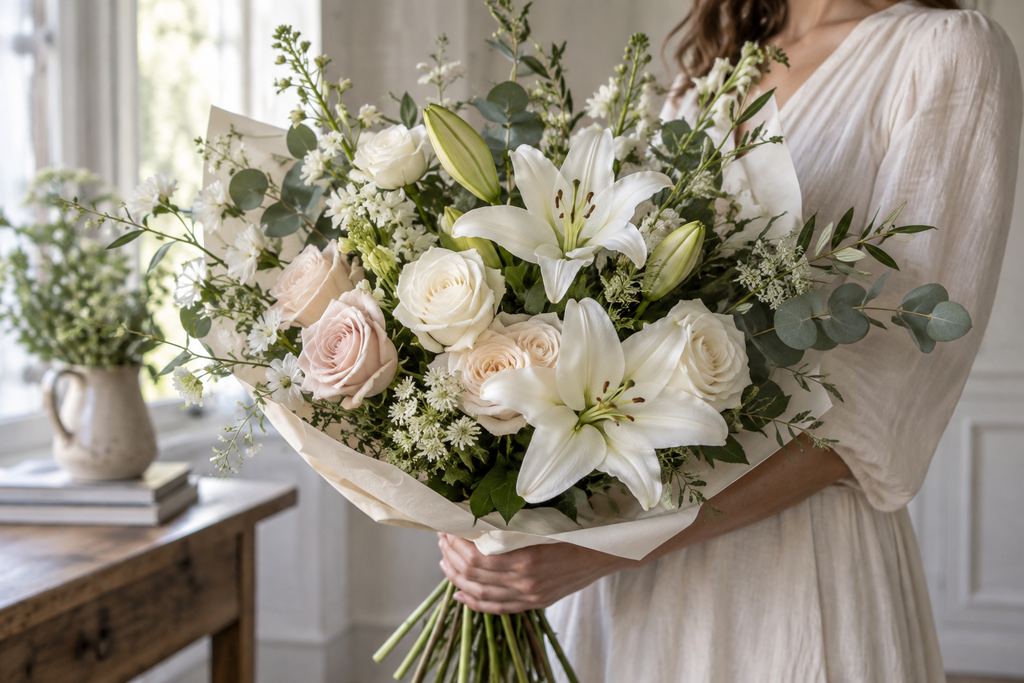
A white lily and rose bouquet creates a softer, more romantic impression. Roses balance the strong geometric structure of lilies because their petals form rounder, layered shapes. White roses keep the arrangement monochromatic, while blush or pale peach roses add warmth without competing heavily with the lilies.
White lilies and eucalyptus create a cooler, more contemporary palette. The soft gray-green foliage contrasts with the large white petals and works particularly well in modern interiors. The arrangement usually looks better when you leave some negative space around the lilies rather than filling every gap with greenery.
Baby’s breath can also work with white lilies because the tiny clustered flowers contrast strongly with the size of the lily blooms. This pairing can feel romantic or traditional, but filler is easy to overuse. Too much baby’s breath can hide the shape of the lilies instead of supporting them.
A mixed white flower bouquet can combine lilies with white roses, lisianthus, chrysanthemums, hydrangeas, or other pale flowers. The strongest arrangements vary flower size and texture so the bouquet doesn’t become one solid mass of white.
How to Choose a White Lily Bouquet for the Occasion
For a birthday or personal gift, a mixed arrangement can feel less formal than an all-lily bouquet. White lilies paired with blush, peach, soft pink, or fresh green elements create a warmer, more relaxed look. If you do not know whether the recipient likes strongly scented flowers, a lower-fragrance lily variety is the safer option.
For an anniversary, pair white lilies with roses to create a more romantic design. You don’t need to follow a strict symbolic color system. Choosing the recipient’s favorite rose color or a shade associated with the occasion can make the bouquet feel more personal.
For sympathy flowers, white lilies are commonly used because they suit restrained white-and-green arrangements. The design itself should match the setting. A vase arrangement serves a different purpose from a standing spray, wreath, or casket display, so tell the florist where the flowers will be used.
For a new home, practicality matters. A medium arrangement in a stable vase is often easier to receive than an oversized bouquet that immediately requires a tall container. Once the bouquet is inside, HomeUpright’s guide explaining whether cut flowers need sunlight can help with choosing a suitable display location.
White Lily Wedding Bouquet Ideas
A white lily wedding bouquet can look modern, romantic, natural, or dramatic depending on the surrounding flowers and greenery.
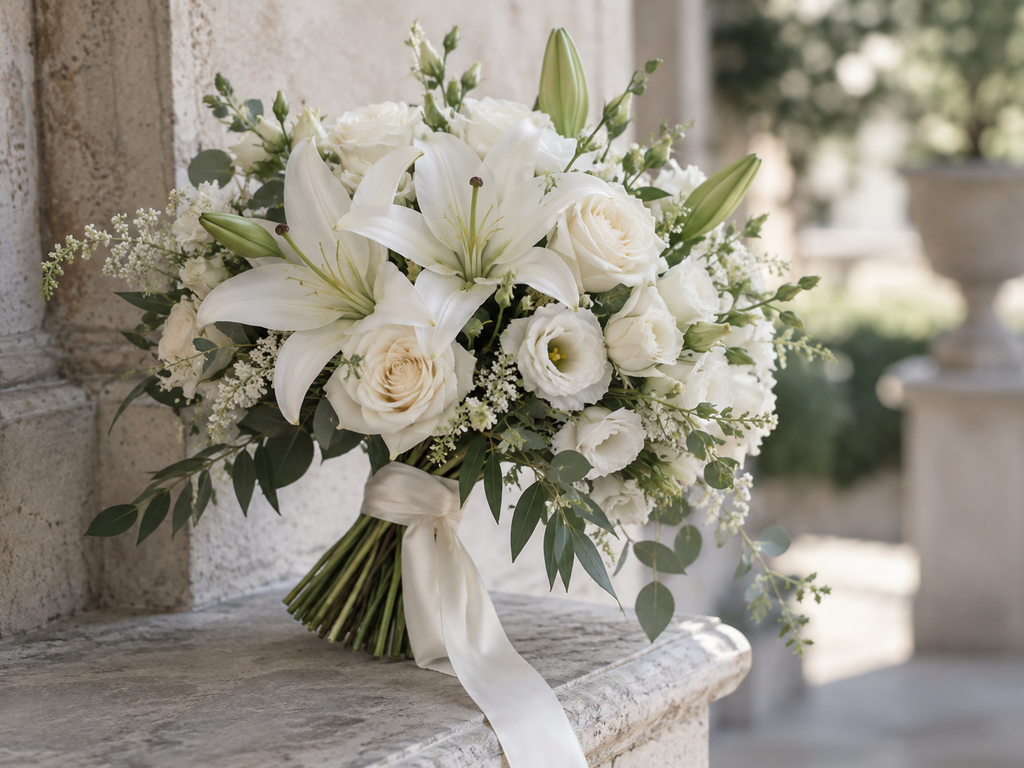
A minimalist bouquet may use only a handful of white lilies with very limited foliage. This works particularly well with detailed wedding dresses because the bouquet does not compete visually with the fabric.
A romantic design can combine lilies with ivory roses, blush roses, or pale lisianthus. Slight variations in white, ivory, and cream help prevent the bouquet from looking flat in photographs.
A garden-style bouquet can use looser greenery, uneven stem heights, and smaller seasonal flowers around the lilies. The goal is an airy arrangement rather than a tightly packed ball of flowers.
For a cascading bouquet, lilies can provide the main focal points while trailing foliage creates movement below them. Because the flowers are large, balance matters; too many lilies on one side can make the design appear visually heavy.
Minimal
A few lilies with clean stems and limited greenery create a refined, modern look.
Romantic
Pair lilies with ivory or blush roses and delicate foliage for a softer appearance.
Garden Style
Use loose greenery, varied stem heights, and smaller flowers to make the bouquet feel less formal.
Cascading
Use lilies as focal blooms while trailing foliage provides length and movement.
How Many Lilies Should Be in a Bouquet?
There is no universally correct number because a lily stem can carry more than one flower or bud. That means stem count and visible bloom count aren’t the same.
A bouquet containing only a few multi-bloom stems can already look substantial. The final size depends on the number of buds per stem, the width of the open flowers, the vase opening, and whether you include roses or other focal flowers.
For a hand-tied bouquet, weight also matters. Large lily stems can become heavy, especially when several flowers are open, so more stems do not automatically produce a better arrangement.
Should You Buy Open Lilies or Buds?
A combination of open flowers and buds is usually the most visually useful choice. Open flowers provide immediate impact, while unopened buds can continue to develop after you place the bouquet in water.
When buying in person, look for firm stems, healthy green foliage, petals without obvious damage, clean-looking water, and buds that appear well developed rather than shriveled or bruised. The University of Illinois Extension’s cut-flower guidance similarly recommends choosing fresh bouquets with healthy flowers and firm stems.
How to Arrange White Lilies in a Vase
Start with a clean, stable vase that is tall enough to support the stems. Lilies can become top-heavy as several buds open, so a lightweight or very short container may become unstable.
Remove damaged foliage and any leaves that would sit below the waterline. Then recut the stems using clean, sharp tools before placing them in fresh water. Place the taller lilies first to establish the basic shape of the arrangement.
After you balance the lily stems, add supporting flowers around them without covering the open blooms. Greenery should frame the arrangement rather than form a dense wall around the flowers. Rotate the vase while arranging so the bouquet works from multiple angles.
Prepare
Wash the vase, remove damaged foliage, and strip leaves that would sit below the waterline.
Cut
Recut the stems with clean, sharp tools so they enter the vase with fresh cut surfaces.
Position
Place the tallest lilies first and rotate the vase as you work so the arrangement remains balanced.
Finish
Add smaller flowers and restrained greenery around the lilies without hiding their open faces.
The University of Illinois Extension advice on extending vase life also recommends keeping foliage out of vase water and starting with a clean container.
For a dining table, consider sightlines. A tall lily arrangement can look great on a sideboard but can be inconvenient in the center of a table if guests have to look around it during conversation.
How to Keep a White Lily Bouquet Fresh
Keeping lilies fresh starts with sanitation. Wash the vase before adding the flowers because residue and microorganisms can affect the water around the cut stems. The University of Illinois Extension flower-care guide emphasizes using a clean vase for fresh bouquets.
Remove only the leaves that would otherwise sit below the water. Submerged foliage breaks down and adds plant material to the water, but you don’t need to strip healthy leaves from the entire stem.
Freshly recutting the stems can help after transportation. Use clean, sharp tools rather than crushing the stems. If the florist includes commercial flower food, follow the dilution instructions instead of assuming that a stronger solution will work better.
Watch the water during the bouquet’s display life. If it becomes cloudy, contains fallen plant material, or develops an unpleasant smell, clean the vase and refresh the water.
Position also matters. The University of Illinois Extension recommends keeping cut flowers away from direct sunlight, heat sources, drafts, and ripening fruit. A bright room with indirect light is usually better than a hot, sunny window.
Should You Remove Lily Pollen?
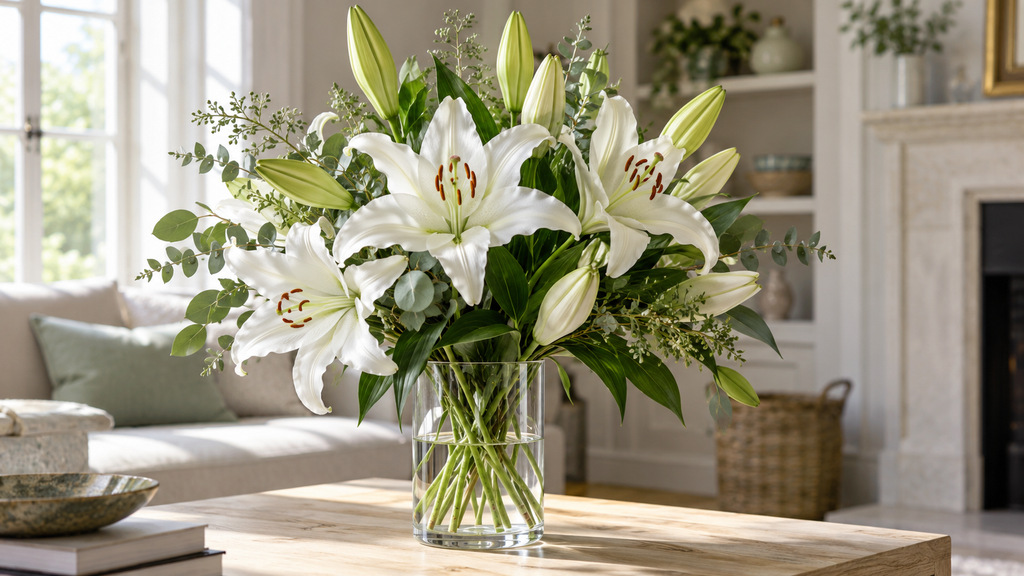
Lily pollen does not have to be removed simply because the flower has opened, but it can stain clothing, hands, tablecloths, and nearby furnishings. Both the North Carolina Extension information on Oriental lilies and the Royal Horticultural Society lily guide note staining as a practical issue.
If you decide to remove mature anthers, handle them before loose pollen falls. Avoid rubbing spilled pollen deeper into fabric because that may spread the stain.
When pollen is a major concern, ask the florist whether a double or pollen-free lily variety is available.
Are White Lilies Strongly Scented?
Some are, but not all.
Oriental lilies are known for fragrance, while Asiatic lilies are generally much less scented. The North Carolina Extension Oriental lily guide notes their strong fragrance, whereas the Asiatic lily guide describes Asiatic hybrids as generally unscented.
That distinction is important when ordering flowers for small apartments, bedrooms, offices, hospitals, or fragrance-sensitive recipients.
Rather than simply asking for “white lilies,” ask the florist which variety is being used and whether it is strongly scented.
Are White Lilies Safe for Cats?
True lilies in the genus Lilium and daylilies in the genus Hemerocallis are extremely dangerous to cats. According to the FDA’s warning about lilies and cats, exposure can occur from the flowers, leaves, stems, pollen, or even vase water.
The FDA identifies Easter, Asiatic, Oriental, Stargazer, tiger, Japanese show, and several other true lilies as dangerous types. The ASPCA’s flower and plant safety guidance also warns that small exposures to Lilium and Hemerocallis plants can cause severe kidney injury.
This means a white lily flower bouquet should never be sent casually to a household when you know a cat lives there.
Common names can also cause confusion. Peace lilies, calla lilies, Peruvian lilies, and lily of the valley belong to different botanical groups and have different toxicology profiles. The ASPCA’s guide to toxic lilies explains these distinctions.
However, a high shelf is not an adequate safety solution for true lilies because pollen and fallen plant material can still become accessible.
Common White Lily Bouquet Mistakes
One common mistake is choosing lilies based entirely on a photograph without checking the fragrance. A photo cannot tell you how strongly a flower smells, so ask the florist whether the selected variety is highly scented.
Another serious mistake is sending true lilies to a cat owner. The FDA’s cat-safety warning makes clear that even small exposures can be dangerous.
The vase can also create problems. Tall lily stems need enough weight and support at the base to remain stable after several flowers open. A narrow, lightweight container may tip or force the arrangement into an unnatural shape.
Overfilling the bouquet is another common design issue. Lilies already have large blooms, so adding too many focal flowers can hide their structure and make the bouquet feel crowded.
Pollen should also be considered before the flowers are placed near light-colored curtains, table linens, upholstery, or clothing because mature lily anthers can release strongly colored pollen.
Finally, avoid placing cut lilies in a hot, sunny window. The University of Illinois Extension flower-care advice recommends keeping cut bouquets away from direct sun and heat.
How to Order a Better White Lily Bouquet
A good florist request describes the bouquet’s purpose rather than trying to control every individual stem. Explain the occasion, approximate size, color palette, fragrance preference, bouquet style, and whether the recipient has pets.
You can also mention whether you prefer a mixture of open flowers and buds, along with the overall mood you want—minimal, romantic, modern, loose garden style, or formal.
Occasion
Explain whether the flowers are for a birthday, wedding, anniversary, sympathy arrangement, or home display.
Style
Describe the look as minimal, romantic, modern, garden-style, traditional, or formal.
Fragrance
Tell the florist whether strong scent is welcome or whether you need a lower-fragrance variety.
Pet Safety
If a cat lives in the home, ask for a lily-free arrangement rather than using true lilies or daylilies.
A simple request might be: “I’d like a medium white lily bouquet with an airy natural shape and restrained greenery. Please use a lower-fragrance lily if available and include a combination of open blooms and buds.”
If you want something permanent instead of a fresh arrangement, HomeUpright’s tutorial explaining how to make flowers from silk can help you create a decorative bouquet that does not require water or regular flower replacement.
White Lily Bouquet vs Other White Bouquets
White lilies are a strong option when you want large, architectural flowers, but they are not automatically the best choice for every white arrangement.
| If you want… | Consider… | Why it works |
|---|---|---|
| Large sculptural flowers | White lilies | The flowers provide strong visual presence with relatively few stems. |
| A classic romantic look | White or ivory roses | Layered rounded flowers create a softer appearance. |
| A lighter garden style | Lisianthus and seasonal fillers | Smaller flowers allow a more delicate and airy arrangement. |
| A lower-scent lily arrangement | Asiatic lilies | They are generally much less fragrant than Oriental lilies. |
| Flowers for a home with cats | A lily-free arrangement | True lilies and daylilies can be extremely dangerous to cats. |
The best bouquet is therefore the one whose flowers, fragrance, scale, safety, and style fit the recipient—not simply the one containing the greatest number of lilies.
Conclusion
A bouquet white lily arrangement works particularly well because lilies have enough size and structure to carry a bouquet without relying on many additional flowers. Oriental lilies can create a dramatic and fragrant display, while Asiatic lilies are generally more suitable when fragrance needs to remain subtle.
Roses can soften the bouquet, greenery can create a more relaxed appearance, and a lily-only design can feel clean and formal. Whatever style you choose, use a clean vase, keep foliage above the waterline, refresh the water when needed, and display the flowers away from strong heat and direct sunlight.
The most important limitation is pet safety. According to the FDA’s guidance on lily poisoning in cats, do not use true lilies or daylilies in a household with cats because the flowers, pollen, foliage, stems, and vase water can all pose a serious risk.
Frequently Asked Questions
What does a white lily bouquet symbolize?
White lilies are commonly associated with purity, remembrance, peace, and new beginnings. Their meaning can change with the occasion, so a wedding bouquet may communicate something very different from a sympathy arrangement.
Are white lilies good for bouquets?
Yes. Their large flowers make them effective focal blooms in hand-tied arrangements and vase displays. The main considerations are fragrance, pollen, arrangement size, and pet safety.
Which white lilies have less fragrance?
Asiatic lilies are generally much less fragrant than Oriental lilies. If scent matters, ask the florist which exact lily group or cultivar is being used.
What flowers go well with white lilies?
Roses, lisianthus, baby’s breath, eucalyptus, and restrained greenery can all work well. Choose supporting flowers that complement rather than hide the large lily blooms.
How do you keep a white lily bouquet fresh?
Use a clean vase, trim the stems with clean sharp tools, remove leaves below the waterline, use flower food as directed, keep the water clean, and place the bouquet away from direct sun and heat.
Should you remove pollen from white lilies?
It is optional, but mature pollen can stain skin, clothing, table linens, and furniture. If staining is a concern, carefully remove mature anthers or ask about pollen-free varieties.
Are white lilies poisonous to cats?
True lilies in the genus Lilium and daylilies in Hemerocallis are extremely dangerous to cats. If exposure may have occurred, contact a veterinarian or animal poison-control service immediately.
Can white lilies be used in a wedding bouquet?
Yes. They work in minimalist, romantic, garden-style, and cascading wedding bouquets. Discuss fragrance, pollen, weight, bloom stage, and seasonal substitutions with the florist before finalizing the design.