


Can you flush tampons? No. A tampon may disappear from the toilet bowl, but that does not mean it has safely passed through your plumbing, the sewer line, or a septic system. It can absorb more liquid, hold its shape, catch on rough pipe surfaces, and later join other waste to create a blockage.
I understand why the question feels confusing. Toilet paper and tampons can both look soft and cotton-like, and flushing seems cleaner than carrying a used product to a bin. The important difference is that toilet paper is designed to lose strength quickly in water, whereas a tampon is designed to stay together while absorbing fluid.
My simple rule is this: only human waste and toilet paper belong in a toilet. That matches official guidance to flush only toilet paper, and it protects your toilet, household drain, public sewer, and septic system from avoidable trouble.
Can You Flush Tampons Down the Toilet?
No, you should not flush tampons down the toilet. This applies to used tampons, unused tampons, organic cotton tampons, applicator-free tampons, scented or unscented tampons, and products marketed as biodegradable.
A toilet is not a general waste chute. Water utilities design wastewater systems around material that can move and break apart in predictable ways, and feminine products are specifically listed as items that should not be flushed because they absorb moisture and are difficult to break down.
Some people ask, “Can you flush tampons in a toilet if the plumbing is new?” New pipes may be smoother and less damaged than old pipes, but a tampon is still the wrong material for the system. A newer toilet can move the tampon out of the bowl, only for it to later catch in the trap, branch drain, building sewer, pump, or treatment equipment.
The same answer applies when someone searches “can u flush tampons” or “do you flush tampons.” The safe answer is no, and the correct destination is a lined trash bin.

Why Tampons and Toilet Paper Behave Differently
The easiest way to understand the risk is to compare what each product is designed to do. Toilet paper should soften and separate when wet, while a tampon must absorb liquid without falling apart during use.
A tampon usually contains absorbent fibers held in a compressed shape, often with a strong withdrawal string. Once wet, the fibers swell, and the string can catch on joints, scale, tree-root intrusion, grease, wipes, or an existing partial blockage.
This is why the phrase “it flushed fine” can be misleading. The flush only proves that the toilet had enough water and force to move the tampon past the visible bowl; it does not prove that the tampon reached a treatment plant without causing trouble.
Toilet Paper vs. Tampons in Water
| Feature | Toilet Paper | Tampon |
|---|---|---|
| Main purpose | Wipe and disperse after flushing | Absorb fluid and remain intact |
| Reaction to water | Loses strength relatively quickly | Absorbs liquid and expands |
| String or long fibers | No withdrawal string | String and strong fibers may snag |
| Correct disposal | Toilet | Trash bin |
| Risk to septic systems | Expected when used normally | Adds a non-digestible solid |
The contrast is not about whether a tampon contains cotton, rayon, or a mix. Even a plant-based or biodegradable material may need far more time and different conditions to decompose than it will receive while moving through a toilet drain.
That is also why “biodegradable” does not mean “flushable.” A product can eventually break down in a managed composting or environmental setting and still be capable of blocking a pipe within minutes, hours, or days.
Are Tampons Flushable if the Package Seems to Suggest It?
In normal household use, are tampons flushable? No. Current tampon disposal instructions tell users to wrap used tampons and put them in the garbage, and to discard applicators rather than flush them.
Packaging can cause confusion because older habits, regional instructions, vague symbols, or terms such as “biodegradable” may be perceived as permission. Your safest decision is to follow the wastewater rule rather than an assumption based on the material’s appearance.
What About “Flushable Tampons”?
The phrase “flushable tampons” appears in search results, but that does not make the category safe for standard plumbing. A tampon’s job is to absorb and stay together, which directly conflicts with the rapid dispersion needed for a reliably flushable product.
My recommendation is to treat every tampon as non-flushable unless your local wastewater authority gives a specific written instruction for a specific product. In practice, most public guidance uses a much simpler rule: flush only bodily waste and toilet paper.
What About Applicators and Wrappers?
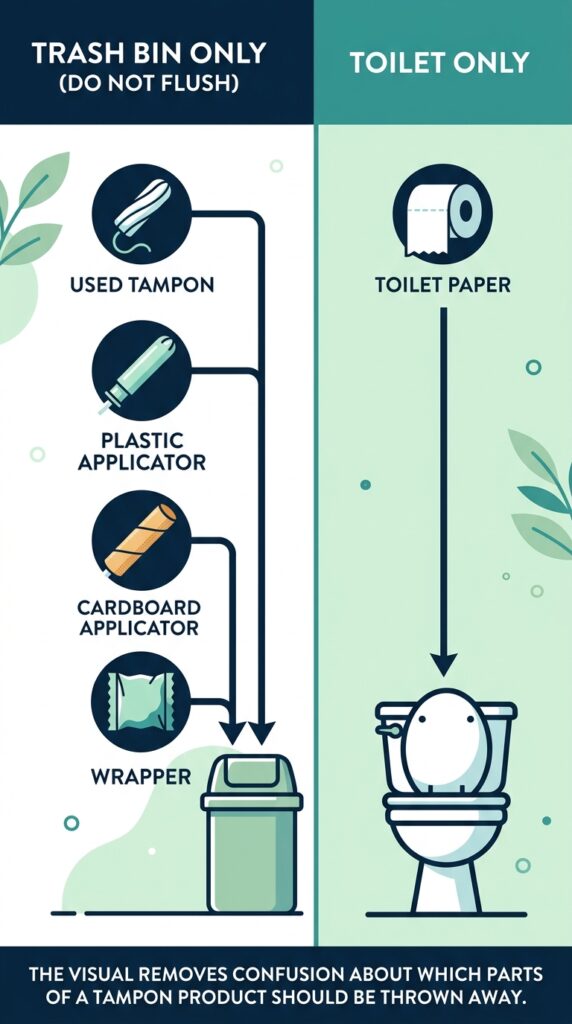
Plastic applicators should always go in the trash. Cardboard applicators may look more paper-like, but they can still be dense, coated, slow to soften, and capable of lodging in a toilet trap, so they belong in the trash too.
Standard wrappers should also be discarded. Do not assume that a wrapper is safe because it is thin, and do not flush any packaging unless an authority responsible for your wastewater system explicitly accepts it.
What Happens When You Flush a Tampon?
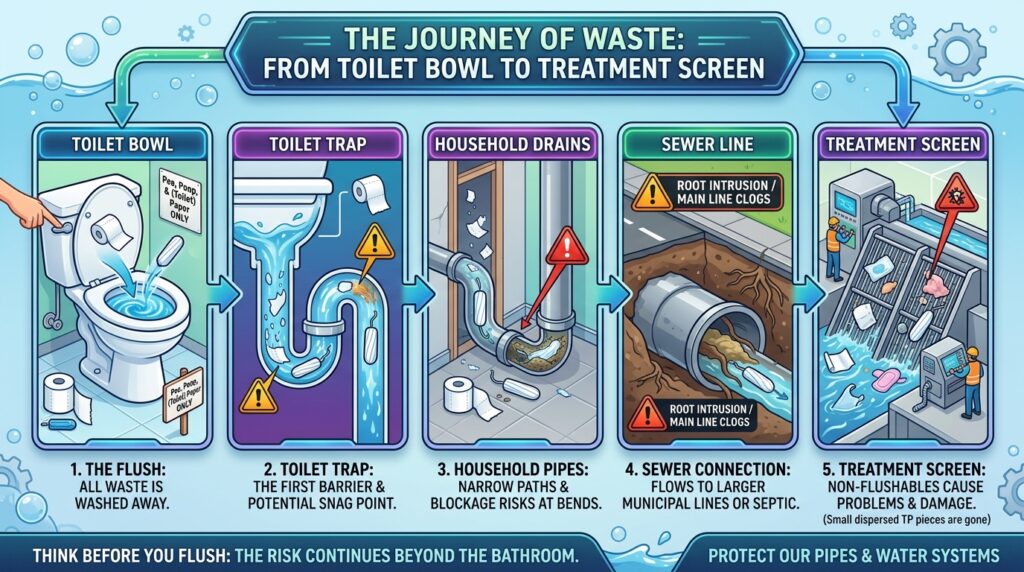
The path starts in the toilet trap, the curved internal passage that helps keep sewer gases out of the bathroom. A strong flush may carry the tampon through that bend, but it can also stop there, creating an immediate toilet clog.
If it passes the trap, it enters a smaller household branch drain and then a larger building sewer. Along that route, it may catch on a pipe joint, mineral buildup, corrosion, an offset connection, invasive roots, grease, wipes, or another tampon.
The problem often grows in layers. One tampon may form a snag point, then toilet paper and other solids collect around it until the pipe narrows enough to slow drainage or stop it completely.
Municipal systems can face the same issue on a larger scale. Utility guidance explains that non-dispersing items can tangle, clump, and contribute to sewage backups, even when individual items travel beyond the home.
Immediate Clog vs. Delayed Clog
An immediate clog is obvious. The water rises, drains slowly, or refuses to leave the bowl right after the flush.
A delayed clog is easier to miss. The toilet may work normally for several uses, then begin gurgling, draining slowly, or backing up after the tampon becomes part of a larger obstruction.
Where a Flushed Tampon Can Cause Trouble
- Inside the toilet trap, the tampon may swell or turn sideways, blocking the narrow passage.
- In a household drain, the string or fibers may catch on a rough surface or on existing debris.
- In the building sewer, several non-dispersing items can collect and restrict flow throughout the home.
- In a septic tank, the tampon adds a solid that the system is not designed to digest or send to the drainfield.
- At pumps or screens: Material that reaches public infrastructure still has to be removed and managed.
Is It Bad to Flush Tampons Just Once?
Yes, it is bad practice, but one accidental flush does not automatically mean your toilet will overflow or your sewer line will fail. Risk depends on the tampon’s size, how saturated it was, your toilet’s trap design, pipe condition, drain slope, existing buildup, and whether your home uses a septic system.
The useful response is neither panic nor denial. Do not keep flushing to “push it through,” and do not add other materials in the hope that they will carry it away.
A Practical Risk Guide
| Situation | Likely concern | Best next step |
|---|---|---|
| Tampon is still visible | It may be retrievable before entering the trap | Put on gloves and remove it carefully |
| Tampon disappeared and toilet drains normally | It may have moved into the drain | Avoid repeat test flushes and monitor closely |
| Water rises or drains slowly | It may be in the trap, or a partial clog may exist | Stop flushing, shut off water if needed, and use a toilet auger or plumber |
| Toilet gurgles or clog returns | Blockage may be farther down the line | Arrange professional drain inspection or clearing |
| Several fixtures back up | Possible building sewer or main-line problem | Stop using water and call a plumber promptly |
| Home uses septic, and this happens repeatedly | Extra solids may accumulate in the tank or lines | Contact a septic professional for system-specific advice |
Accidentally Flushed a Tampon? Do This Now
If you accidentally flushed a tampon, start by staying calm and watching the toilet. One mistake is manageable, but repeated flushing can cause more water and waste to back up behind an obstruction.
Step 1: Do Not Flush Again Just to Test It
A second flush may turn a partial blockage into an overflow. Wait and observe whether the water returns to its normal level without bubbling, rising, or draining unusually slowly.
If the bowl is already high, turn the shutoff valve behind the toilet clockwise. You can also remove the tank lid and close the flapper if the toilet is actively refilling and you need to stop water quickly.
Step 2: Retrieve It Only if It Is Clearly Reachable
If you can still see the tampon near the bowl outlet, put on disposable gloves and remove it gently. Do not reach blindly deep into the trap, and do not use a sharp object that may scratch porcelain or push the tampon farther away.
Place the retrieved tampon in a small bag, seal or wrap it, and put it in the trash. Wash your hands thoroughly after removing the gloves.
Step 3: Check for Early Warning Signs
For the next several uses, pay attention to the toilet’s normal behavior. A new slow swirl, higher water level, weak flush, bubbling sound, or repeated need to plunge can indicate a developing restriction.
Also listen to nearby drains. Gurgling in a sink, tub, or another toilet may suggest that air and wastewater are struggling to move through a shared line.
Step 4: Use the Right Tool if the Toilet Starts Clogging
A flange plunger can help with a soft toilet-paper clog, but plunging a solid non-dispersing object may push it deeper. A toilet auger gives you more control because its cable is designed to reach through the toilet trap and may hook or break up the obstruction.
When the water is high and you are unsure what caused the blockage, follow the safety steps in this guide to unclog a toilet without a plunger when the water is high. For a known tampon obstruction, however, retrieval with a closet auger or professional removal is usually more sensible than adding soap, baking soda, or extra water.
Step 5: Know When to Stop DIY Work
Call a plumber if the toilet remains slow, the clog returns, an auger does not clear it, wastewater appears in another fixture, or multiple drains are affected. Stop using sinks, showers, washing machines, and dishwashers if water is backing up across the home.
Do not pour a harsh chemical drain opener into a toilet containing a suspected tampon. Chemicals are unlikely to make a strong absorbent product disappear quickly, and they can create a splash or exposure hazard for anyone who later opens the line.

Signs a Tampon May Be Clogging Your Toilet or Drain
A blockage does not always begin with a dramatic overflow. Small changes in sound, speed, and water level can reveal trouble before wastewater reaches the bathroom floor.
Watch for a pattern rather than one unusual flush. Toilets can occasionally drain differently due to ordinary waste, but recurring symptoms after flushing a tampon warrant attention.
Common Warning Signs
- The bowl fills higher than usual, then slowly drops.
- The flush sounds weak, hollow, or unusually long.
- Bubbles rise from the toilet after the water settles.
- The toilet needs frequent plunging even with normal paper use.
- A nearby tub or shower drain gurgles when the toilet flushes.
- Water appears in a lower drain when another fixture is used.
- A sewage smell develops near the toilet or floor drain.
- More than one toilet becomes slow at the same time.
A single slow toilet usually indicates the toilet trap or a nearby branch line. Several affected fixtures may indicate a deeper building-sewer problem, especially when the home’s lowest drain backs up first.
Red Flags That Need Prompt Professional Help
Raw wastewater on a floor is a sanitation issue, not just an inconvenience. Keep children and pets away, avoid direct contact, stop water use, and contact a plumber or drain-cleaning professional.
You should also act quickly if the home has only one usable toilet, if a vulnerable person depends on the bathroom, or if a septic alarm activates. Waiting can turn a localized obstruction into damage to flooring, walls, cabinets, or belongings.
Can You Flush Used Tampons in a Septic Tank?
No. Can you flush used tampons into a septic system? The answer is especially clear because the tank relies on settling, microbial treatment, and controlled liquid flow rather than serving as a container for all types of household waste.
The official septic-system care guidance says to flush only human waste and toilet paper and specifically lists feminine hygiene products among items that can clog the system and contribute to failure.
A tampon entering a septic tank does not become harmless. It may settle into the sludge layer, remain as a solid, tangle with other material, interfere with a baffle or filter, or move where solids should not go if the system is overloaded or poorly maintained.
Why Septic Systems Need Extra Care
A septic system is your property’s wastewater treatment system. Repairs can involve pumping, line clearing, filter service, drainfield investigation, or replacement work, so prevention is far cheaper and less disruptive than treating the toilet as a trash can.
Homeowners who are still learning how the parts fit together may find this overview of well and septic system costs useful. It shows why small daily habits can protect a much larger investment underground.
What to Do After One Accidental Flush on Septic
Do not add septic additives or chemicals to dissolve the tampon. Continue normal, water-conscious use while watching for slow drains, gurgling, odors, wet ground near the drainfield, or a septic alarm.
One accidental tampon does not always require an emergency pumping visit. Repeated flushing, existing system problems, overdue maintenance, or new symptoms justify a call to a licensed septic professional who can assess your particular tank, filter, lines, and drainfield.

The Safest Way to Dispose of a Used Tampon
Proper disposal can be clean, discreet, and low-stress. The standard method is to wrap the used tampon in toilet paper or its original wrapper, place it in a lined bin, and wash your hands.
Manufacturer guidance recommends that users wrap used tampons and put them in the trash. The applicator and ordinary wrapper should go into the trash as well, unless local recycling guidance clearly accepts a clean packaging component.
At Home
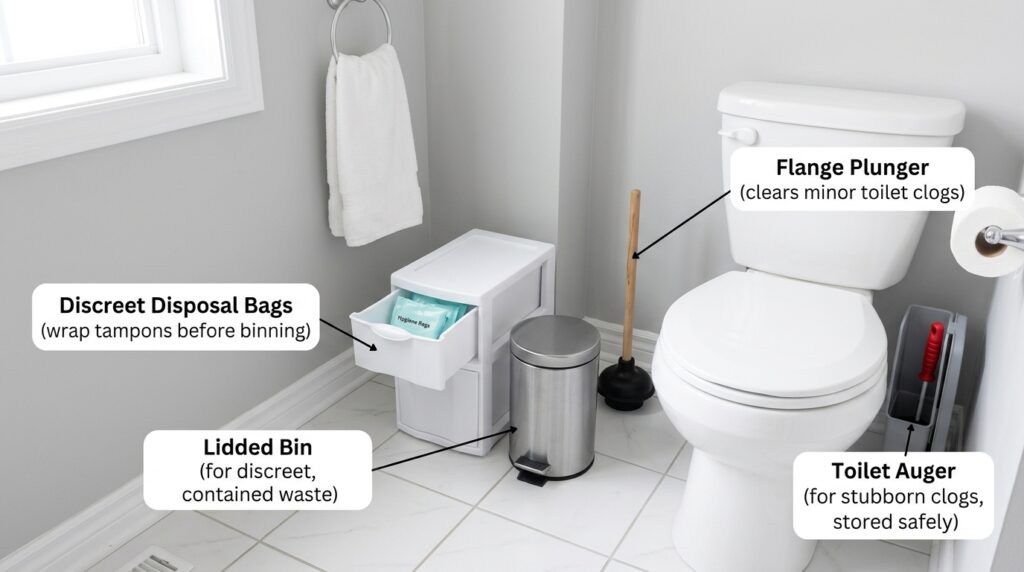
Keep a small lidded trash can within reach of the toilet. A removable inner bucket or fitted liner makes cleaning easier and reduces the chance that someone will flush a tampon because the bin feels inconvenient or exposed.
Empty the bin regularly, especially in warm rooms. A small disposal bag can help contain moisture and odor, but avoid excessive layers of plastic when a simple paper wrap and bin liner are enough.
In a Public Restroom
Use the sanitary disposal unit inside the stall when one is available. If there is no bin, wrap the tampon well, place it in a small opaque disposal bag, and carry it to the nearest trash can.
While Traveling, Camping, or Staying With Someone
Do not assume that another home, hotel, rental, RV, boat, or campsite has plumbing capable of handling non-flushable products. RV and marine sanitation systems are often even less forgiving than household drainage.
Pack used products out in a sealed waste bag when no suitable bin is available. Follow site-specific waste rules and never leave menstrual products in a toilet, pit, natural area, or fire ring.
A Better Bathroom Disposal Setup
The best prevention strategy is not a warning sign. It is a bathroom arrangement that makes the correct action easier than the wrong one.
My recommended setup is simple: a lidded bin close to the toilet, a fitted liner, a small supply of disposal bags, and a proper toilet tool stored nearby. This removes the privacy, odor, and convenience problems that often lead people to flush tampons.
What to Buy and Why
| Item | What to look for | Main benefit | Possible drawback |
|---|---|---|---|
| Small lidded trash can | Foot pedal, removable bucket, easy-clean surface | Discreet and convenient disposal | Needs regular emptying |
| Fitted bin liners | Correct size and leak-resistant seams | Faster, cleaner bin changes | Adds disposable material |
| Opaque disposal bags | Compact pack and secure closure | Useful in public restrooms or travel | Extra cost and waste |
| Flange toilet plunger | Extended rubber flange for toilet drains | Better seal than a flat sink plunger | May not retrieve a solid object |
| Closet auger | Protective tube and toilet-safe cable | Reaches through the trap with more control | Requires careful handling and storage |
| Disposable gloves | Correct fit and puncture resistance | Cleaner retrieval and cleanup | Should be discarded after use |
A lid matters more than a decorative design if privacy and odor are your main concerns. A foot pedal is helpful because it lets you open the bin without touching the lid after removing a tampon.
For a shared bathroom, explain the rule without embarrassment. A simple note inside a cabinet or on the bin can say, “Please place tampons, pads, wipes, and applicators in the trash.”
What Not to Do After Flushing Tampons
Panic often leads to actions that increase the risk of an overflow or make professional work harder. The most important mistake to avoid is repeatedly flushing a toilet that is already draining slowly.
Avoid These Common Mistakes
- Do not keep flushing: Each flush adds more water and waste behind a possible obstruction.
- Do not use a sharp improvised tool: Metal edges can scratch porcelain, damage a wax seal, or push the tampon deeper.
- Do not pour boiling water into the bowl: Sudden heat can damage porcelain, and hot water will not reliably dissolve a tampon.
- Do not mix drain chemicals: Combining products can produce dangerous fumes, heat, splashes, or reactions.
- Do not assume a plunger removed the object: The toilet may drain because the tampon moved farther into the line.
- Do not ignore repeated gurgling: Recurring symptoms can signal a growing obstruction rather than a harmless one-time event.
- Do not flush the applicator next; it creates another solid object for the same pipe to carry.
The “out of sight, out of mind” response is understandable, but plumbing problems often develop where you cannot see them. A few minutes of observation and the right tool are safer than aggressive guesswork.
Environmental and Community Impact of Flushing Tampons
The first concern is usually the household toilet, but the impact can continue after material leaves private plumbing. Wastewater facilities use screens and other processes to remove solids that should never have entered the system.
Non-flushable waste can contribute to equipment problems, maintenance work, sewer blockages, and overflows. Public guidance warns that preventable backups can threaten health and consume resources that utilities need for normal wastewater treatment.
A tampon placed in the trash will usually enter the solid-waste stream. That is not a perfect environmental outcome, but sending it through wastewater infrastructure does not make the waste disappear; it may simply move the handling problem to pipes, pumps, screens, workers, or waterways.
Are Organic Tampons Better for Plumbing?
Organic cotton may matter to a buyer for material preference, farming practices, skin comfort, or packaging goals. It does not change the disposal rule because the used tampon still absorbs liquid, retains a dense shape, and requires more time to break down than a flush provides.
Choose period products based on your health needs, comfort, budget, and environmental priorities, but separate that buying decision from toilet safety. “Organic,” “natural,” “plastic-free,” and “biodegradable” are not synonyms for flushable.
Lower-Waste Alternatives
Reusable menstrual cups, washable pads, and period underwear can reduce the number of single-use products you discard. They also require cleaning, storage, comfort, and learning considerations, so the best option is the one you can use safely and consistently.
If you continue using tampons, a thoughtful disposal setup still makes a meaningful difference. Use the least packaging that keeps disposal hygienic, empty bins regularly, and never flush a product to avoid putting it in the trash.

Expert Tips to Prevent Tampon-Related Clogs
The most effective plumbing advice is usually behavioral rather than technical. If the bin is easy to reach and the household rule is clear, there is little reason for a tampon to end up in the toilet.
Use a “Toilet Paper Only” Rule
Teach every household member that the toilet accepts only human waste and toilet paper. This single rule is easier to remember than separate debates about tampons, wipes, tissues, cotton swabs, floss, applicators, paper towels, and cat litter.
The same rule is supported by public wastewater guidance, which lists tampons and many other common bathroom items among things to keep out of toilets.
Store the Correct Plunger
A flat cup plunger is designed for sinks and flat drains. A flange plunger has an extended section that fits over the toilet outlet, creating a stronger seal.
Keep one in each bathroom if possible. In an emergency, a nearby tool is much more useful than the perfect tool stored in a garage, basement, or locked utility room.
Keep a Toilet Auger for Solid-Object Clogs
A closet auger is more appropriate than a sink snake for navigating a toilet’s curved trap. Choose one with a protective guide tube so the cable does not scrape the visible porcelain.
Use it slowly and stop if you feel hard resistance that does not change. Excessive force can damage the toilet or push an object into a less accessible part of the drain.
Pros and Cons of Throwing Tampons in the Trash
Throwing used tampons away is the standard safe method, but readers often worry about smell, visibility, pets, children, and waste. Those concerns are real and can be managed without using the toilet as a disposal system.
Pros
- Protects the toilet trap, household drains, sewer line, and septic system.
- Follows manufacturer and public wastewater guidance.
- Avoids pushing absorbent fibers and strings into plumbing infrastructure.
- Makes waste visible and removable, rather than hiding a growing clog.
- Works in homes, offices, schools, hotels, and most public restrooms.
Cons
- Requires a bin close to the toilet.
- Can create odor if the bin is open or emptied too slowly.
- May feel less discreet in a shared bathroom.
- Uses a liner, wrapper, or disposal bag.
- Requires planning when a restroom has no sanitary bin.
The disadvantages are setup problems, not reasons to flush. A small lidded bin, regular emptying, opaque wrapping, and travel disposal bags solve most of them at low cost.
Frequently Asked Questions
1. Are You Supposed to Flush Tampons?
No, you are not supposed to flush tampons. Wrap the used tampon in toilet paper or its wrapper and place it in a lined trash bin.
The same rule applies to applicators and standard wrappers. A toilet should be used for human waste and toilet paper only.
2. Can You Flush Tampons in a Toilet if You Live in an Apartment?
No. Apartment plumbing often connects many fixtures and homes to shared stacks and sewer lines, so one blockage can affect neighbors as well as your own bathroom.
Use the trash bin provided or create a small lidded disposal setup. Report recurring gurgling, slow drainage, or backups to property management promptly.
3. Is It Bad to Flush Tampons if They Are Small or Light Absorbency?
Yes. A smaller tampon may present less material than a larger one, but it is still designed to absorb and remain intact rather than disperse like toilet paper.
Size changes the degree of risk, not the disposal rule. Put every absorbency level in the trash after use.
4. What Should I Do if I Accidentally Flushed a Tampon but the Toilet Is Not Clogged?
Do not repeatedly flush to test the line. Use the toilet normally and cautiously while watching for slow drainage, a rising bowl, weak flushing, bubbling, or gurgling in nearby fixtures.
If symptoms appear, stop flushing and use a toilet auger or call a plumber. Homes with septic systems should also watch for alarms, odors, or unusual drainfield conditions.
5. Can You Flush Used Tampons That Say Biodegradable?
No. Biodegradable refers to eventual breakdown under suitable conditions, not to safe movement through a toilet, household drain, sewer, pump, or septic system.
Dispose of biodegradable tampons in the trash unless the product and your local waste authority provide another approved non-toilet method. Never treat a green marketing term as plumbing permission.
Final Answer: Do You Flush Tampons?
Do you flush tampons? No. Whether someone asks Can you flush tampons, can you flush tampons down the toilet, can you flush used tampons, or ” Are tampons flushable, the safest answer stays the same: wrap them and place them in the trash.
If you have already flushed one, do not panic and do not keep testing the toilet with extra flushes. Retrieve it only when it is clearly visible; watch for early warning signs; use a toilet-safe auger when appropriate; and call a plumber when drainage slows, the clog returns, or several fixtures are affected.
Set up a lidded bathroom bin today so the correct choice is easy every time. Your plumbing, septic system, neighbors, wastewater workers, and future self will all benefit from that one small habit.