


Walnut Hardwood Flooring: Is It the Right Choice for Your Home?
Walnut hardwood flooring has a depth of color that most other domestic woods need stain to achieve. Its chocolate-brown heartwood, lighter sapwood, and flowing grain can make an ordinary room feel warmer and more refined without relying on a dramatic finish.
Its appearance is only part of the decision, though. American black walnut is softer than oak and can show dents in an active household. Brazilian walnut is exceptionally hard, but it is a completely different species with different pricing, sourcing, and installation considerations. Engineered walnut may offer greater dimensional stability, but its real walnut surface does not automatically become more scratch-resistant.
Before choosing walnut flooring, decide which “walnut” you are buying, where it will be installed, and how much visible wear you can accept.
Quick Answer
Walnut hardwood flooring is a strong choice for homeowners who prioritize rich natural color, distinctive grain, and a premium appearance. American black walnut is moderately durable but softer than red oak, white oak, maple, and hickory. Hence, it suits bedrooms, home offices, and moderate-traffic living spaces better than rough, high-impact areas.
Choose engineered walnut when installation conditions require greater dimensional stability or when the floor will be installed over concrete. Choose solid walnut if you want the greatest future refinishing potential and have a suitable wood subfloor with stable indoor conditions.
Key Takeaways
- American black walnut and Brazilian walnut are different species, not different grades of the same wood.
- American walnut has a Janka hardness rating of approximately 1,010, making it softer than common oak flooring.
- Brazilian walnut, commonly called ipe, is considerably harder but can cost more and be more difficult to cut and install.
- Engineered walnut is more dimensionally stable, but its walnut wear layer can still dent or scratch.
- Walnut changes color with light exposure and generally becomes lighter and more golden with age.
- Matte finishes, varied grades, and sensible maintenance can make everyday wear less noticeable.
- Obtain samples and compare them in the actual room before ordering because walnut varies significantly between boards.
- Walnut flooring commonly falls toward the premium end of hardwood-flooring budgets.
What Is Walnut Hardwood Flooring?
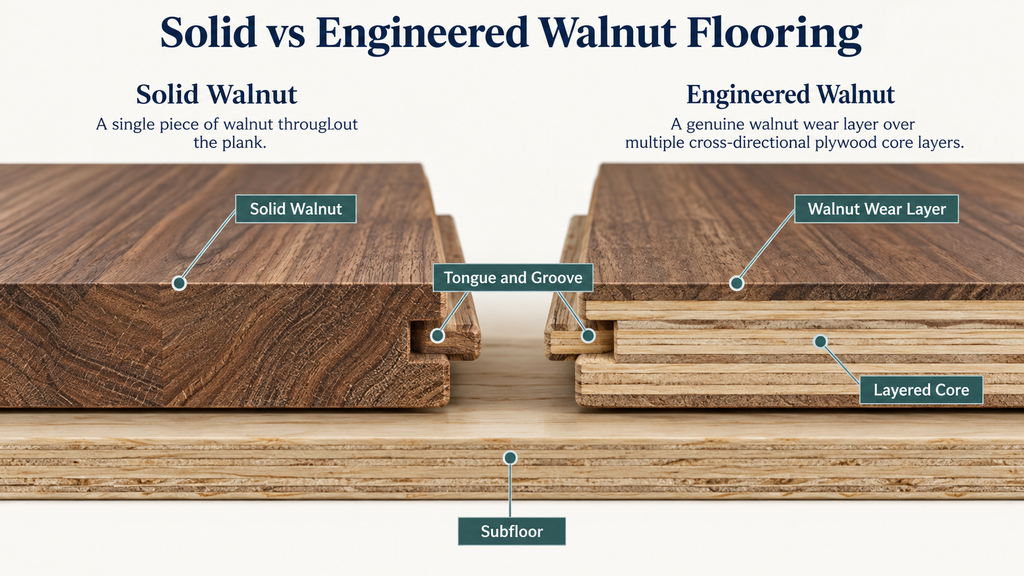
Walnut hardwood flooring has a visible surface of real walnut wood. A solid walnut plank consists of walnut throughout its thickness, while engineered walnut has a walnut veneer bonded to a layered plywood or wood-composite core.
Natural American walnut flooring may contain:
- Chocolate and medium-brown heartwood
- Cream, tan, or pale sapwood
- Straight, wavy, or gently swirling grain
- Occasional knots and mineral streaks
- Noticeable color variation between boards
These variations are natural, not manufacturing defects. The selected grade determines how much sapwood, color variation, and character appear in the finished floor.
Walnut-look laminate and luxury vinyl are not walnut hardwood flooring. They use a printed or photographic walnut design over a different core material. They may be practical alternatives, but you shouldn’t describe them as real walnut floors.
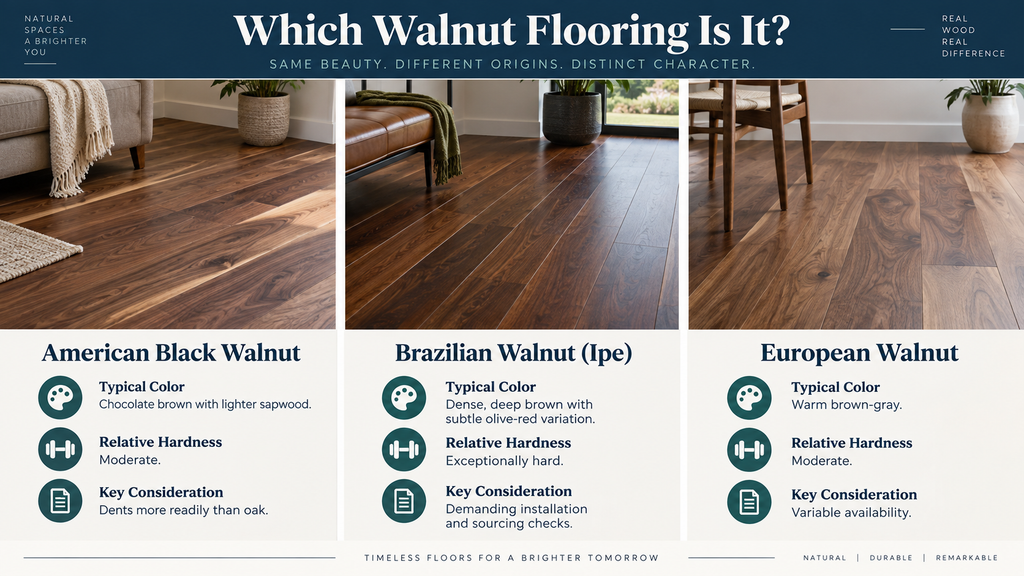
American Walnut and Brazilian Walnut Are Not the Same
One of the most important buying decisions is also one of the easiest to overlook. “Walnut” can refer to woods with very different performance characteristics.
American black walnut
American black walnut, usually sold simply as American walnut or black walnut, is Juglans nigra. It is valued for its deep brown heartwood, subtle grain, and natural color variation.
With a Janka rating of approximately 1,010 pounds-force, it is softer than red oak, white oak, hard maple, and hickory. That does not make it unsuitable for flooring, but it does mean dropped objects, pet claws, and narrow furniture feet can leave marks more easily.
Brazilian walnut
Brazilian walnut usually refers to ipe, most commonly Handroanthus species. It is not a true walnut in the botanical sense. The name describes its appearance and trade category rather than a close relationship to American black walnut.
Ipe is exceptionally dense and considerably harder than American walnut. It can resist dents well, but its density makes it heavier and more demanding to cut, fasten, and finish. Installation may require specialized blades, drill bits, adhesives, and professional experience.
European walnut
European or English walnut is generally Juglans regia. Its color can range from warm tan to gray-brown, with occasional darker streaking. Supply, grade, and appearance vary, and it may be less common in standard flooring collections.
Asian walnut
The name “Asian walnut” is used inconsistently in flooring marketing. It can refer to different species or trade names rather than one standardized walnut product.
Ask for the botanical species, country of origin, and technical data. Do not judge the floor by the word walnut alone.
| Flooring name | Typical identity | Approximate relative hardness | Main appeal | Important concern |
|---|---|---|---|---|
| American black walnut | Juglans nigra | Moderate | Deep natural brown and flowing grain | Dents more easily than oak |
| Brazilian walnut | Ipe species | Exceptionally hard | High density and strong wear resistance | Cost, sourcing and difficult installation |
| European walnut | Juglans regia | Moderate | Warm brown-gray variation | Less standardized availability |
| Walnut-look flooring | Laminate or vinyl | Depends on product | Walnut appearance without real walnut | Cannot be refinished like hardwood |
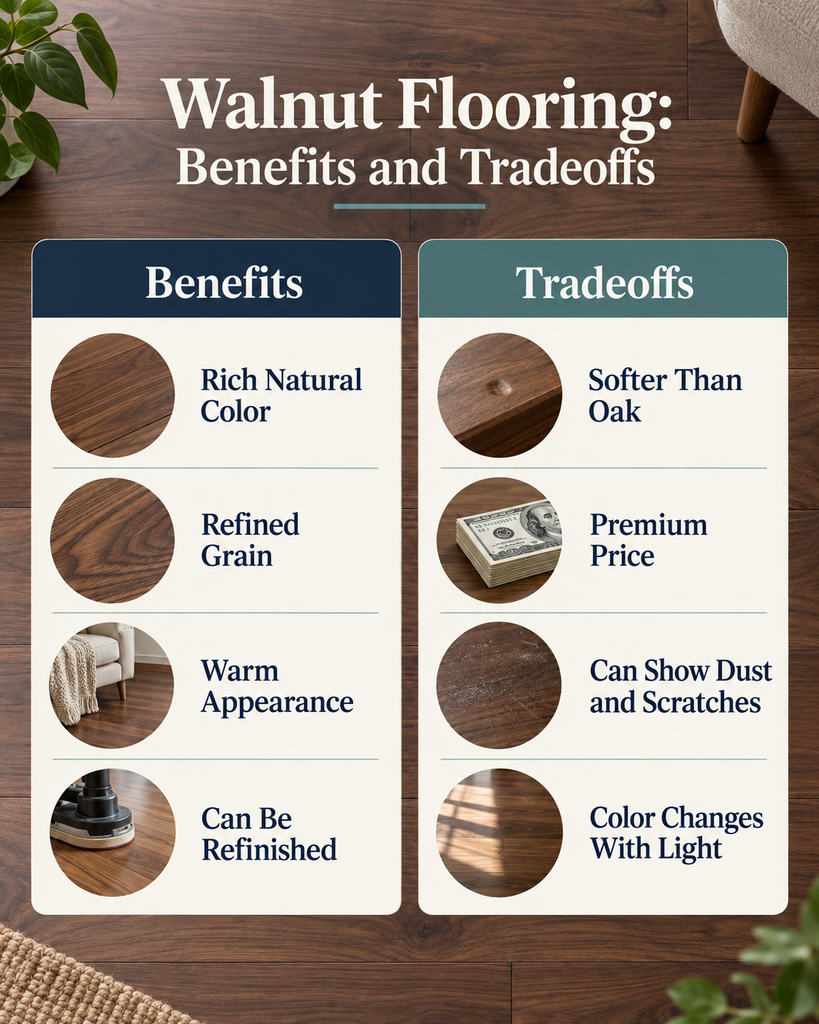
Walnut Flooring Pros and Cons
Walnut can be an excellent floor when its natural strengths match the room. Its disadvantages become more noticeable when buyers choose it solely because they like a showroom sample.
Advantages of walnut hardwood flooring
Naturally rich color
American walnut offers a dark brown color without requiring a heavy stain. Its natural variation gives the floor depth that can be difficult to reproduce with a uniformly stained lighter species.
Distinctive but restrained grain
Oak has a prominent grain that can dominate a room. Walnut’s grain is generally smoother and quieter, although individual boards may contain waves, curls and dramatic contrast.
This makes walnut suitable for contemporary, transitional and traditional interiors.
Comfortable visual warmth
The brown, amber and occasional purple undertones can make bedrooms, libraries, dining rooms and living spaces feel warmer. Walnut works particularly well with cream, warm white, muted green, brass and natural stone.
Good dimensional stability
American walnut is generally considered dimensionally stable compared with many other hardwoods. Good stability can reduce movement, but it does not eliminate the need for correct acclimation, moisture testing, and indoor humidity control.
It can be refinished.
Solid walnut can generally be sanded and refinished multiple times when sufficient wood remains above the tongue-and-groove joint. Engineered walnut may also be refinished, but the number of times depends on the thickness of its real-wood wear layer.
Natural variation can create character.
Select-grade walnut can produce a more uniform dark floor. Character grades include more sapwood, knots, and tonal changes. Those variations can make everyday wear less conspicuous than it would be on a perfectly uniform, glossy surface.
Disadvantages of walnut hardwood flooring
American walnut is relatively soft.
American walnut’s beauty does not make it exceptionally hard. With a Janka rating around 1,010, it falls below red oak at roughly 1,290 and white oak at about 1,360.
High heels, large dogs, dropped cookware, and furniture without protective pads can dent or scratch it.
It usually costs more than oak
Walnut is less widely available than common oak flooring and is often treated as a premium material. Select grades, long boards, and wide planks can increase the price further.
Dark floors can reveal surface debris.
Dark brown flooring can hide some stains, but light-colored dust, pet hair and crumbs may stand out. Direct sunlight can also emphasize fine scratches in a glossy finish.
Its color changes with exposure
American walnut commonly lightens and develops warmer, more golden tones as it ages. Flooring beneath a rug may change at a different rate from exposed areas, creating temporary color variation when furniture or rugs are moved.
Board-to-board variation can be substantial.
A small sample may not represent the full order. Natural walnut can include dark heartwood, pale sapwood, and changing grain patterns in the same carton.
Repairs can be difficult to match.
New walnut may initially appear darker than an older floor that has lightened. Replacement boards and spot repairs may need time and careful finishing before they blend convincingly.
Is Walnut Hardwood Flooring Durable?
Walnut flooring can last for decades when installed correctly and maintained properly. However, longevity and surface hardness are not identical.
A floor can remain structurally usable for a long time while accumulating dents, scratches, and color changes. American walnut is durable enough for residential flooring, but it develops visible wear more readily than harder domestic woods.
The Janka hardness test measures the force needed to press a steel ball into wood. It helps compare dent resistance, but it does not measure every aspect of floor performance.
Actual durability also depends on:
- Finish type and quality
- Plank construction
- Wear-layer thickness
- Wood grade
- Subfloor preparation
- Installation quality
- Indoor humidity
- Foot traffic
- Pet size and activity
- Cleaning habits
- Use of rugs and furniture pads
A high Janka rating does not make a floor scratch-proof. Scratches often affect the finish before they reach the wood.
Does Engineered Walnut Flooring Resist Dents Better?
Not necessarily.
Engineered walnut flooring uses a real walnut veneer over a stable core. The layered construction can make the plank less vulnerable to expansion, contraction, and certain forms of warping, but the top surface is still walnut.
If two floors have comparable American walnut surfaces and finishes, the engineered version is not automatically harder to dent simply because it has a plywood core.
Engineered construction helps most with:
- Dimensional stability
- Installation over concrete
- Wider plank formats
- Below-grade installations approved by the manufacturer
- Some radiant-heating applications
- Flexible floating, glue-down or nail-down installation options
Surface durability depends more on the walnut species, finish, and treatment of the wear layer.
Solid vs Engineered Walnut Flooring
Neither construction is universally better. The room, subfloor, and long-term plan should guide the choice.
| Feature | Solid walnut flooring | Engineered walnut flooring |
|---|---|---|
| Construction | Walnut throughout | Walnut wear layer over a layered core |
| Installation | Commonly nailed or stapled | May be nailed, glued or floated |
| Concrete subfloor | Usually requires additional preparation | Often better suited when approved |
| Moisture-related movement | More sensitive | Generally more stable |
| Refinishing | Usually offers greater potential | Depends on wear-layer thickness |
| Below-grade use | Generally avoided | Some products are approved |
| Radiant heat | Product-specific and often restricted | More approved options may be available |
| Lifespan | Can be very long | Depends heavily on construction and wear layer |
| Surface denting | Depends on walnut species | Depends on walnut species |
For a larger flooring project, HomeUpright’s guide to planning hardwood flooring work can help you assess room conditions, preparation, materials, and contractor questions before installation begins.
How Thick Should an Engineered Walnut Wear Layer Be?
The wear layer is the visible walnut above the engineered core. A thicker layer generally provides more future refinishing potential, although the exact number of possible sandings depends on the product and the refinisher.
When comparing engineered walnut, ask for:
- Total plank thickness
- Walnut wear-layer thickness
- Core construction
- Number and direction of core layers
- Approved installation methods
- Finish system
- Residential warranty
- Radiant-heat approval
- Below-grade approval
- Refinishing restrictions
Avoid relying on total plank thickness alone. Two boards can have the same overall thickness but very different amounts of usable walnut at the surface.
How Much Does Walnut Flooring Cost?
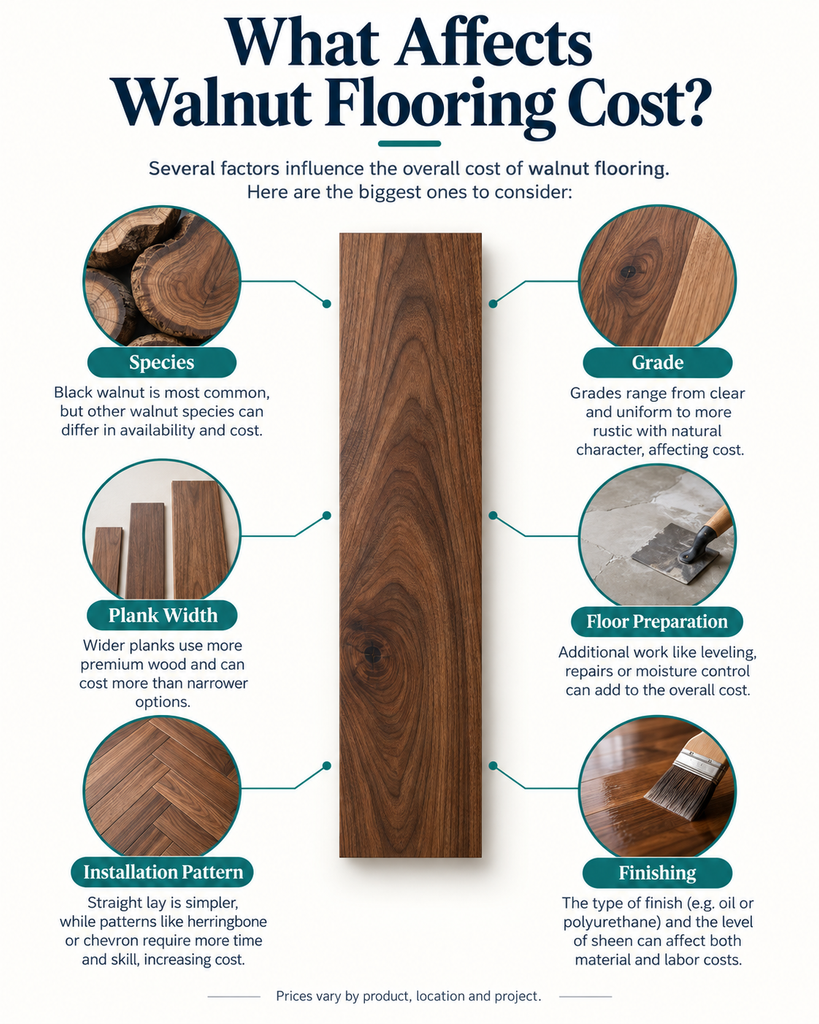
Walnut flooring cost varies significantly because “walnut” covers several species, constructions, grades, and plank formats. As a broad planning range, walnut flooring material may cost approximately:
| Walnut flooring type | Approximate material range |
|---|---|
| American walnut | $6–$12+ per square foot |
| European walnut | $7–$14+ per square foot |
| Brazilian walnut | $9–$18+ per square foot |
| Premium wide-plank or select-grade walnut | May exceed these ranges |
| Walnut-look laminate or vinyl | Usually less than genuine walnut |
These figures are not live quotations. The ranges are consistent with current walnut flooring cost comparisons, but actual prices can move outside them.
General installed hardwood flooring can range from roughly $6 to $25 per square foot, according to current hardwood flooring installation cost estimates. Walnut frequently falls toward the upper half of that range, especially when the project uses select-grade material, wide planks, or a custom finish.
Costs buyers frequently overlook
The flooring itself is only part of the budget. A complete estimate may include:
- Delivery and indoor storage
- Flooring waste allowance
- Removal and disposal of existing flooring
- Subfloor leveling or repair
- Moisture testing
- Underlayment or vapor control
- Adhesive, fasteners and trim
- Stairs and transitions
- Custom vents
- Acclimation time
- Site finishing
- Furniture moving
- Baseboard removal and reinstallation
Complex layouts, borders, stairs, herringbone patterns, and unusually wide planks can increase labor costs.
How much extra flooring should you order?
A straightforward installation commonly requires an additional material allowance for cuts, defects, and future repairs. The appropriate percentage depends on the room shape, plank grade, installation pattern, and manufacturer instructions.
Simple layouts may need less extra material than diagonal, herringbone or highly selective installations. Ask the installer to calculate the allowance rather than automatically applying one percentage to every project.
Keep a few unused boards after installation. Matching the same species, grade, width, milling, and finish years later can be difficult.
Which Walnut Grade Should You Choose?
Flooring grade mainly affects appearance, not simply quality.
Select or clear grade.
Select walnut generally has more uniform heartwood, fewer knots, and less pale sapwood. It creates a controlled, elegant look but usually costs more.
Natural grade
Natural walnut includes broader variation in color and grain. It offers a balance between refinement and visible wood character.
Character or common grade
Character flooring can include knots, mineral marks, sapwood, and stronger color changes. It suits rustic or relaxed interiors and may make small dents less noticeable.
Before ordering, ask what the supplier’s grade actually permits. Grade names are not always used identically between manufacturers.
Review several full-room photographs and a multi-board sample—not one small piece chosen for ideal color.
Is Walnut Flooring Good for Dogs?
American walnut can be used in a home with dogs, but it is not the most forgiving choice for large, active animals. Claws, sudden turns, and grit trapped under paws can mark both the finish and the wood.
Walnut may still work if you:
- Keep nails trimmed
- Place washable runners in high-traffic paths
- Use a matte or low-sheen finish
- Choose a grade with natural color variation
- Wipe up water promptly
- Keep grit away from entrances
- Accept some natural patina
- Avoid dragging heavy pet equipment or crates
The finish matters considerably. Manufacturer guidance on hardwood flooring for dogs notes that even harder species can scratch and recommends considering finish and texture, not hardness alone.
If a perfectly unmarked surface is essential, American walnut may cause frustration. A harder species, textured finish, or high-quality walnut-look resilient floor may be more practical.
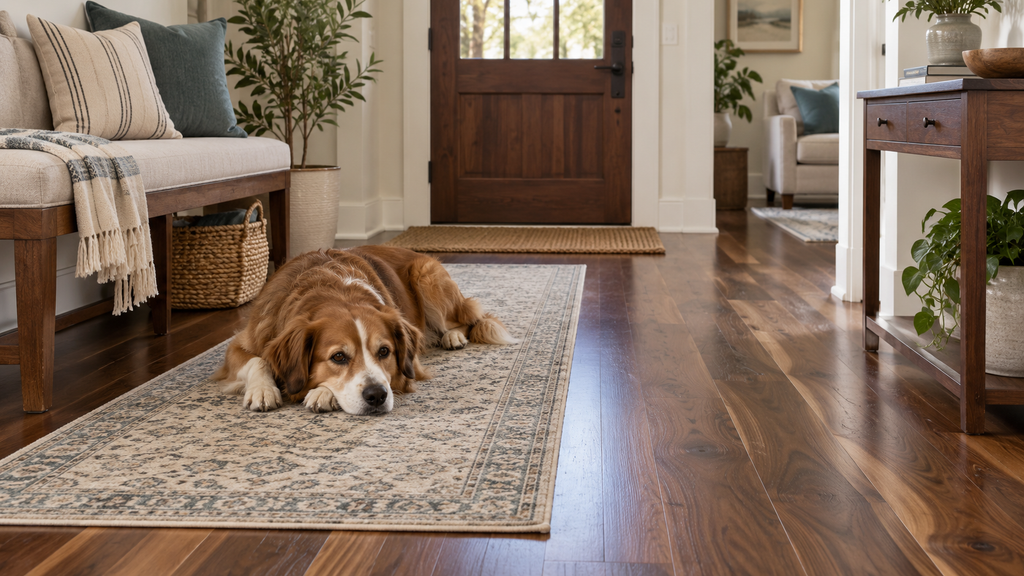
Is Walnut Flooring Suitable for Busy Rooms?
The answer depends on which walnut you choose and how the room is used.
Bedrooms
American walnut is an excellent visual match for bedrooms. Traffic is usually moderate, and the warm color creates a calm, grounded appearance.
Living rooms
Walnut can work well in a living room when furniture has protective pads and entrance grit is controlled. Rugs can protect conversation areas, although they should occasionally be repositioned to reduce uneven light exposure.
Dining rooms
Dining chairs can produce repeated scratches. Use large, secure felt pads and replace them when they collect grit or become compressed.
Kitchens
Walnut can be installed in a kitchen, but spills, dropped cookware, and heavy traffic increase the risk of damage. Engineered construction may improve dimensional stability, but it does not make the walnut surface waterproof.
Entryways and mudrooms
American walnut is less forgiving in areas exposed to wet shoes, sand, and concentrated traffic. Durable mats and frequent grit removal are essential.
Bathrooms
Real walnut flooring is generally a risky bathroom choice because standing water and repeated humidity changes can affect the wood and its installation. Only use a product when the manufacturer specifically approves that environment.
Basements
Solid hardwood is generally not the preferred below-grade option. Certain engineered walnut products may be approved for basements when moisture conditions, subfloor preparation, and installation methods meet the manufacturer’s requirements.
Does Walnut Flooring Change Color?
Yes. American walnut commonly lightens over time, especially when exposed to daylight. Its deep brown can become warmer and more golden, while newly covered areas may retain a darker appearance.
To manage color changes:
- Request an aged or ultraviolet-exposed sample when available.
- Move rugs and furniture occasionally during the first year.
- Use blinds or curtains during periods of intense direct sunlight.
- Choose ultraviolet-resistant window treatments where appropriate.
- Expect newly installed replacement boards to look different initially.
- Avoid assuming the showroom sample represents the floor’s permanent color.
This color evolution is natural. It should be treated as part of walnut’s appearance rather than automatically considered damage.
What Finish Is Best for Walnut Flooring?
The best finish depends on how much maintenance, sheen, and repairability you want.
Water-based polyurethane
A quality water-based polyurethane generally preserves walnut’s natural color more clearly and produces less ambering than many oil-based coatings. It is available in several sheen levels and usually dries relatively quickly.
Oil-based polyurethane
Oil-based polyurethane can deepen the wood’s warmth and amber tone. It normally dries more slowly and produces stronger odors during application and curing.
Hardwax oil
Hardwax-oil finishes create a natural, low-sheen appearance that complements walnut. Some allow localized maintenance, but they typically require a specific care routine and compatible cleaning products.
Factory-applied finish
Prefinished flooring may use highly durable multi-layer coating systems. It reduces onsite finishing time, although beveled board edges and future repair methods differ from a site-finished floor.
A satin, matte, or low-sheen finish often works well on American walnut because it reflects less glare and makes small scratches less obvious than a high-gloss surface.
Should You Stain Walnut Flooring?
Walnut’s natural color is usually its main attraction, so many homeowners choose a clear or lightly tinted finish. Dark stain can reduce the contrast between heartwood and sapwood, but it may also hide the natural variation for which walnut commands a premium.
Always test the complete finishing system on several boards. Walnut’s natural color range means one sample is not enough.
If you are considering a much darker result, HomeUpright’s guide to choosing and applying black wood stain explains how undertones, surface preparation, and finish can change the outcome.
Walnut Flooring vs Oak
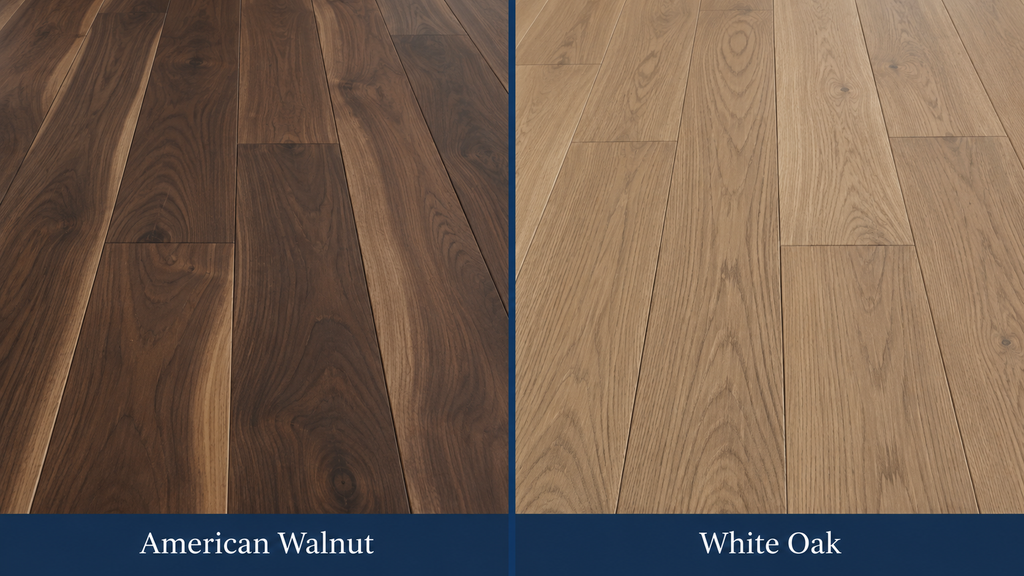
Oak is the practical benchmark for many hardwood-flooring decisions because it is widely available, relatively hard, and offered in numerous stains and grades.
| Feature | American walnut | White oak |
|---|---|---|
| Janka hardness | About 1,010 | About 1,360 |
| Natural color | Deep brown with pale sapwood | Tan to light brown |
| Grain | Smooth, straight or gently wavy | More prominent and linear |
| Dent resistance | Moderate | Better |
| Price | Usually premium | Often more economical |
| Stain flexibility | Often left natural | Accepts many color directions |
| Light-related change | Tends to lighten | Often warms or ambers |
| Best fit | Design-led, moderate-traffic spaces | Versatile whole-home use |
Choose walnut when natural brown color and subtle grain are the priority. Choose oak when you want greater dent resistance, broader availability, and more stain flexibility.
American Walnut vs Brazilian Walnut
American and Brazilian walnut suit different buyers.
| Feature | American walnut | Brazilian walnut |
|---|---|---|
| Botanical relationship | True walnut | Common trade name for ipe |
| Appearance | Chocolate brown with flowing grain | Deep brown with olive or reddish variation |
| Hardness | Moderate | Exceptionally high |
| Workability | Easier to cut and machine | Dense and more difficult to work |
| Weight | Moderate | Heavy |
| Cost | Premium | Often premium or higher |
| Best use | Appearance-focused interiors | Projects prioritizing hardness |
| Main concern | Dents and scratches | Installation difficulty and responsible sourcing |
Brazilian walnut is not automatically the better purchase. Its hardness can be valuable, but the floor must still be dried, milled, installed, and finished correctly.
When buying imported wood, ask for species documentation and credible chain-of-custody information. The FSC certification system is one way suppliers can demonstrate that forest-based materials have moved through a verified supply chain.
How to Clean Walnut Hardwood Floors
Walnut does not require an unusual cleaning routine, but excess water, abrasive debris, and unsuitable chemicals can damage the finish.
Routine care
- Sweep with a soft-bristled broom.
- Vacuum using a hard-floor setting without an aggressive beater bar.
- Remove grit near entrances.
- Wipe spills promptly.
- Use a cleaner approved by the flooring or finish manufacturer.
- Apply cleaner to the mop rather than pouring it onto the floor.
- Keep furniture pads clean and securely attached.
Avoid
- Steam mops unless expressly approved
- Soaking wet mops
- Abrasive powders
- Steel wool
- Harsh alkaline cleaners
- Undiluted vinegar
- Oil soaps not approved for the finish
- Wax over a non-wax coating
- Dragging furniture
The correct cleaning method depends on the finish, not only the wood species. Keep the product and finish information supplied with the floor.
Can Walnut Hardwood Flooring Be Refinished?
Solid walnut can generally be refinished when enough wood remains above the tongue-and-groove joint. An experienced professional should inspect the floor before sanding, especially if it has already been refinished.
Engineered walnut may be refinished when its wear layer is thick enough. Thin-veneer products may allow only light abrasion and recoating rather than full sanding.
Before refinishing, confirm:
- Wear-layer thickness
- Previous sanding history
- Depth of scratches and dents
- Board stability
- Moisture condition
- Compatibility of the new finish
- Whether color variation will become more visible after sanding
Deep dents may not disappear without removing too much wood. Sometimes accepting a small mark is safer than aggressively sanding the entire floor.
What to Check Before Buying Walnut Flooring
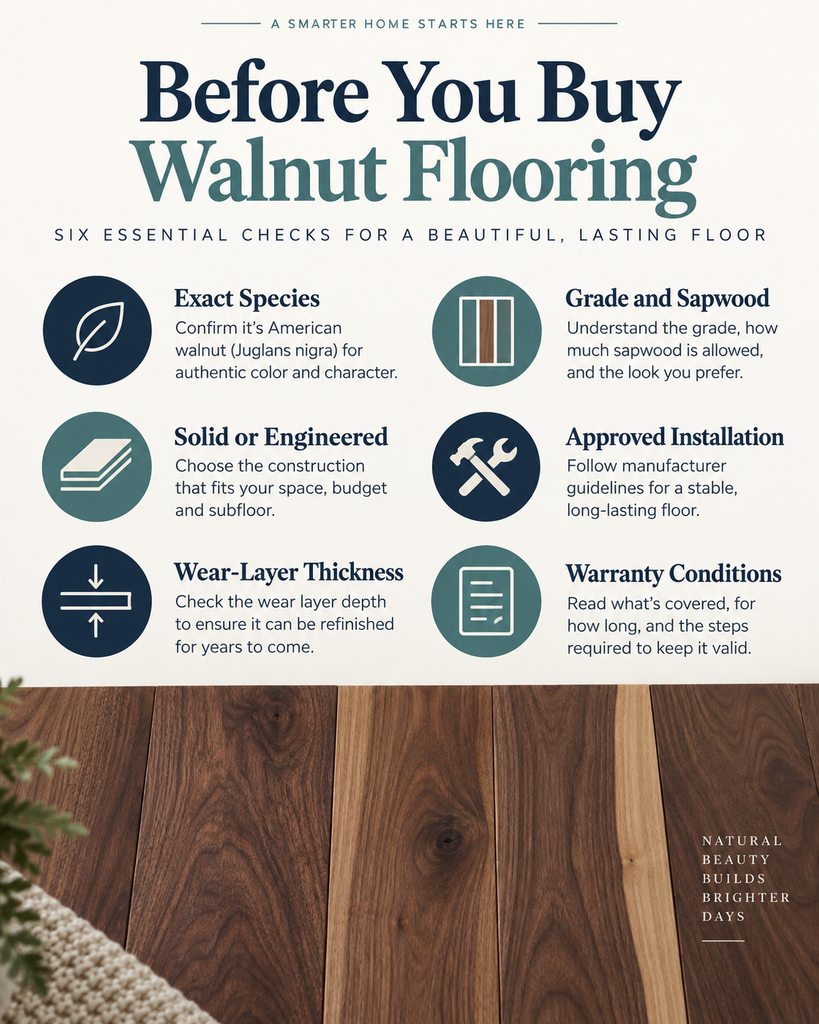
Do not order based on color alone. Ask the seller or installer for clear answers to the following questions.
Species and sourcing
- What is the exact botanical species?
- Is it American, European, or Brazilian walnut?
- Where was it harvested and manufactured?
- Is sourcing documentation available?
Construction
- Is the flooring solid or engineered?
- What is the total thickness?
- How thick is the engineered wear layer?
- What material is used in the core?
Grade and appearance
- How much sapwood is allowed?
- Are knots, filled defects, and mineral marks permitted?
- Are full-room installation photographs available?
- Can you inspect a multi-board sample?
Dimensions
- What are the plank width and thickness?
- Are lengths fixed or random?
- What is the average board length?
- Are unusually short boards common in the grade?
Finish
- Is it prefinished or unfinished?
- What finish system is used?
- What sheen is available?
- How should scratches and localized damage be repaired?
Installation and warranty
- Which installation methods are approved?
- Can it be installed over concrete?
- Is it approved below grade?
- Is it approved over radiant heating?
- What humidity range must be maintained?
- What actions can void the warranty?
Common Walnut-Flooring Buying Mistakes
Assuming all walnut is equally hard
American black walnut and Brazilian walnut behave very differently. Verify the species rather than relying on the product name.
Choosing engineered flooring only because it sounds stronger
Engineered construction improves stability. It does not automatically make an American walnut surface harder.
Judging the floor from one small sample
Walnut can contain dramatic color variation. Review multiple boards and full-room photographs before ordering.
Ignoring natural color change
The installed floor may not remain as dark as the showroom sample. Ask how the product changes with daylight and age.
Choosing high gloss for an active home
Glossy finishes reflect light and can make scratches, dust, and footprints more visible.
Focusing only on the material price
Subfloor preparation, stairs, removal, trim, and installation can significantly change the final cost.
Buying without spare boards
A future repair can be difficult to match if the original product or grade is discontinued.
Is Walnut Hardwood Flooring Worth It?
Walnut flooring is worth considering when its natural appearance matters more to you than maximum dent resistance. Few domestic woods provide the same chocolate-brown color and smooth, flowing grain without a dark stain.
It is a particularly good fit when:
- You want naturally dark real wood.
- The room receives moderate rather than punishing traffic.
- You appreciate natural color and grain variation.
- You are comfortable with some patina.
- Your budget can accommodate a premium material.
- You can maintain stable indoor conditions.
It may not be the best choice when:
- Large active dogs use the room heavily.
- Dropped objects and narrow heels are common.
- You expect the surface to remain flawless.
- The room frequently receives standing water.
- You want the lowest-cost hardwood option.
- You need a simple match for an existing oak floor.
Frequently Asked Questions
Is walnut a good hardwood for flooring?
Yes. Walnut is a suitable residential flooring material with naturally rich color and attractive grain. American walnut is softer than oak, however, so it is better for homeowners who accept some dents and patina.
Does walnut flooring scratch easily?
American walnut can scratch and dent more easily than harder species such as white oak and hickory. A strong finish, matte sheen, entrance mats, clean furniture pads, and trimmed pet nails can reduce visible damage.
How hard is walnut flooring?
American black walnut has a Janka hardness rating of approximately 1,010 pounds-force. Brazilian walnut, or ipe, is much harder, but it is a different species rather than a harder variety of American walnut.
Is engineered walnut flooring real wood?
Yes, if it has a genuine walnut wear layer. The surface is real walnut bonded to a layered core. Walnut-look laminate and vinyl use a printed design and are not engineered hardwood.
Is walnut flooring more expensive than oak?
Walnut usually costs more than common red or white oak because it is less widely available and is often sold as a premium flooring material. Grade, board length, plank width, and finish can increase the difference.
Is walnut flooring suitable for kitchens?
It can be used in kitchens, but spills must be wiped promptly and dropped cookware may dent American walnut. Confirm that the selected product, finish, and installation system are approved for the room.
Does walnut flooring fade?
American walnut generally becomes lighter and warmer with exposure to light. Rugs and furniture can temporarily create uneven coloration by shielding sections of the floor.
Is walnut or oak better for dogs?
Oak is usually more resistant to dents than American walnut. Finish, texture, sheen, and the dog’s size and activity still matter, so no natural wood floor is completely scratch-proof.
Can walnut flooring be installed over concrete?
Solid walnut usually requires an appropriate wood subfloor or another manufacturer-approved system. Many engineered walnut products can be glued or floated over properly prepared concrete, but moisture testing and product approval are essential.
How long does walnut hardwood flooring last?
A well-installed walnut floor can remain usable for many decades. Its actual service life depends on product construction, wear-layer thickness, moisture control, maintenance, and the number of times it can be refinished.
Final Thoughts
Walnut hardwood flooring is not the toughest or least expensive wood floor, but those are not the only reasons to choose a material. American black walnut offers deep natural color, graceful grain, and a warmth that is difficult to imitate with stained oak.
The key is to buy it with realistic expectations. American walnut will show wear more readily than oak. Brazilian walnut offers far greater hardness but introduces different cost, installation, and sourcing considerations. Engineered walnut improves dimensional stability without making the walnut surface immune to dents.
Compare full-size samples in your room, verify the species, inspect the grade, and ask for the wear-layer and warranty details in writing. When walnut’s appearance suits the home and its limitations suit the household, it can be a distinctive floor that becomes more personal as it ages.