



I ruined a bamboo floor once. Not badly, but enough to notice. I mopped it the same way I mopped my old tile kitchen, with a wet string mop and whatever spray cleaner was under the sink. Within a few months, there were dull patches near the sink and a faint white haze along the seams where water had crept between the planks. That was my crash course in how to clean bamboo flooring the right way, and it’s the reason I’m writing this guide instead of just repeating what every other blog already says.
Bamboo floors are not the same as regular hardwood, even though they look and feel similar underfoot. They react differently to water, to acidic cleaners, and to the tools you drag across them. If you want your bamboo wood floors to still look good in ten years, the cleaning method matters as much as the flooring itself.
In this guide, I’m going to explain the exact routine I use now, the mistakes that got me there, the products that actually work, and the ones that quietly wreck the finish. I’ll also cover things most articles skip, like why the vinegar advice online is so contradictory, what strand bamboo flooring needs that solid bamboo doesn’t, and a real answer to whether bamboo flooring is waterproof (spoiler: no, and the details matter).
What Makes Bamboo Flooring Different From Regular Hardwood
Bamboo isn’t actually wood. It’s a grass, which is part of why bamboo floors behave differently from oak or maple when mopped. The stalks are sliced, treated, and pressed under heat and adhesive to form planks, and that manufacturing process is exactly what creates the sensitivity to moisture and harsh chemicals that trips so many people up.
There are three main types of bamboo flooring you’ll run into, and they don’t all clean the same way.
- Solid bamboo flooring is made from strips of bamboo glued together side by side. It’s the most traditional style and the most sensitive to standing water.
- Engineered bamboo flooring has a bamboo veneer layered over a plywood-style core. It resists humidity changes better than solid bamboo, which matters if your home swings between dry winters and humid summers.
- Strand bamboo flooring is made by shredding bamboo fibers, compressing them under intense heat and pressure, and binding them with resin. This is the hardest and most water-resistant type, often rated harder than oak, but it still isn’t immune to damage from the wrong cleaner.
I didn’t know these distinctions when I bought my first bamboo floor. I assumed “bamboo” meant one product, and I only learned about strand bamboo flooring after asking my installer why my sister’s floor felt so much harder underfoot than mine. If you don’t know which type you have, check your receipt, your manufacturer’s paperwork, or the underside of a spare plank if you kept one.
Is Bamboo Flooring Waterproof? Here’s the Honest Answer
This is one of the most-searched questions about bamboo floors, and most articles offer a mushy non-answer. So let me be direct: standard bamboo flooring is water-resistant, not waterproof. There’s a real difference, and it comes down to time.
Bamboo can typically handle a spill for a limited window, usually cited as somewhere between 20 and 30 hours depending on the finish and manufacturer, before the moisture starts soaking into the fibers and causing warping or discoloration. That’s not permission to leave puddles around. It just means you have a grace period if you clean up quickly, which most solid hardwoods don’t offer at all.
There’s an important exception, though. Some newer product lines are genuinely waterproof, not just water-resistant. Rigid-core engineered bamboo, sometimes marketed under names like AquaGuard, uses a stone-plastic composite or HDPC core beneath a bamboo veneer, which makes the entire plank resistant to standing water in a way traditional bamboo never will. If you’re shopping for new flooring for a bathroom or laundry room, this is the category to look for, not standard solid or strand bamboo.

I learned the water-resistance limits the hard way with a leaking dog water bowl that sat against the baseboard for what I assume was most of a weekend while I was traveling. The plank never fully warped, but it developed a slightly raised edge that I can still feel under my socks if I know where to look. If you have pets, I’d genuinely recommend checking out my notes on removing pet hair from carpet, since many of the same daily habits that protect carpet from pet messes also protect bamboo floors from scratches and spills.
Why Bamboo Floors Show Dirt and Damage Faster Than People Expect
Here’s something almost no other article mentions, and it’s the reason I take my own routine so seriously now. Bamboo floors, especially lighter-colored ones, show dust and grit visually much sooner than a dark oak or a busy-patterned floor would. That’s not a flaw in the product. It’s just physics and contrast working against you.
Because of that visibility, a lot of people assume their bamboo floor is dirtier or more fragile than it actually is, when really they’re just seeing normal daily dust that would be invisible on a different floor color. The flip side of that is real, too. Because grit shows up faster, it also gets walked on and ground into the finish faster if you don’t sweep regularly, which means the visual sensitivity of bamboo actually works in your favor as an early warning system, as long as you respond to what you’re seeing.
I noticed this myself within the first week of having bamboo installed. My old tile floor could go three or four days between sweeps and look fine. My bamboo floor showed a faint dusty haze by day two, in the exact same house, with the exact same foot traffic. That visual feedback loop is actually what pushed me into a more consistent daily routine, and it’s part of why my floor looks better now than it did in year one, even though it’s older.
What Bamboo Floor Cleaning Actually Costs
People often assume dedicated bamboo or hardwood cleaners are a significant ongoing expense compared to just grabbing a generic all-purpose spray. In practice, the cost difference is smaller than you’d think, especially once you account for concentrate options.
A standard ready-to-use spray bottle of a pH-neutral hardwood cleaner typically runs about $10–$20 and covers a few hundred square feet with weekly mopping for a couple of months. Concentrated versions cost more upfront but dilute into several gallons of usable cleaner, which usually works out to a lower cost per mop over a full year. A castile soap solution is the cheapest route by far, often just a few cents per mopping session, though you’re trading a bit of convenience and shelf-stable dilution accuracy for that savings.
Compare that to the cost of professional refinishing, which can run into the hundreds or thousands of dollars depending on square footage, and the math on spending an extra few dollars a month on the right cleaner becomes pretty easy to justify.
What You’ll Need Before You Start Cleaning
You don’t need a huge cleaning kit for bamboo floors. In fact, less is more here, since the biggest risk to your floor is usually the wrong tool, not too little effort.
Here’s what I actually keep on hand:
- A soft-bristle broom or a vacuum with a bare-floor setting and no beater bar
- A microfiber dust mop for daily dry cleaning
- A flat microfiber wet mop, ideally a spray mop style, not a string mop
- A pH-neutral bamboo floor cleaner made for hardwood or bamboo
- A few soft microfiber cloths for spot cleaning
- A humidity monitor, which sounds unnecessary until you realize how much dry winter air can shrink bamboo planks

That vacuum note matters more than people think. Standard upright vacuums often have rotating brush heads called beater bars, designed to lift fibers from the carpet. On a bamboo floor, that same aggressive brushing action can leave fine scratches across the finish over time, which is why manufacturer guides consistently warn against using a beater-bar vacuum on any hard flooring, bamboo included.
How to Clean Bamboo Flooring, Step by Step
This is the routine I follow now, broken into daily, weekly, and monthly habits. I found that treating bamboo floor care as a system, rather than one big cleaning session, made a bigger difference than any single product ever did.
Daily: Quick Dry Cleaning
Every evening, or every other evening if I’m honest, I run a microfiber dust mop or a soft broom across high-traffic areas. This isn’t about deep cleaning. It’s about catching the grit and dust before it gets ground into the finish by foot traffic, since that fine grit is what causes most of the dulling and micro-scratching you see on older bamboo floors.
If there’s a spill, I deal with it immediately, not at the end of the day. I blot it with a dry cloth first, then go over the spot with a barely damp cloth if needed. Speed matters more than the product you use for this step.
Weekly: The Actual Mop
Once a week, I do a proper damp mop using a pH-neutral bamboo floor cleaner diluted according to the label. I spray the solution lightly onto the floor in small sections rather than pouring it directly, then go over each section with a well-wrung microfiber mop.
The mop should feel almost dry to the touch, not wet. If you can see standing liquid on the floor after you’ve mopped a section, you’re using too much water, and that’s exactly how moisture works its way into the seams between planks.
I mop in the direction of the grain, which the folks at Bona’s own bamboo floor cleaning guide also recommend, since it hides minor swirl marks better and matches how the fibers naturally sit.

Image prompt: A close-up, eye-level shot of someone mopping a bamboo floor with a flat microfiber spray mop, following the visible grain lines of the planks, with light catching the slight sheen of a freshly cleaned section next to a duller, not-yet-cleaned section. Suggested ALT text: “best way to clean bamboo floors weekly mopping in direction of grain”
Monthly: A Deeper Clean and Inspection
Once a month, I get down and actually look at the floor, checking baseboards and corners for dust buildup, checking around the kitchen sink and pet bowls for any early staining, and giving the whole floor a slightly more thorough pass with the cleaner. This is also when I check the humidity in the house, since bamboo, like other wood-based flooring, expands and contracts with seasonal humidity changes, and keeping indoor humidity in a stable range helps prevent gaps or cupping.
How to Clean Bamboo Flooring Naturally
A lot of people search for how to clean bamboo flooring naturally, hoping to skip commercial cleaners altogether, and I get the appeal. Here’s where I land after trying both sides of this debate myself.
Clean Bamboo Flooring with Baking Soda
Skip it for routine mopping. Baking soda is mildly abrasive, and while that’s fine on a stovetop, it can leave faint scratches on a bamboo finish over repeated use. Several flooring care guides explicitly list baking soda alongside vinegar and ammonia as ingredients to avoid on bamboo.
Clean Bamboo Flooring with Vinegar
This is genuinely the most contested cleaning tip in the entire bamboo flooring space, and I want to be straight with you about why. Some flooring companies and retailers like Bob Vila’s guide flatly say vinegar is unsafe for bamboo because of its acidity, while other sources, including a cleaning feature from The Spruce, note that heavily diluted vinegar (about a quarter cup per gallon of water) is sometimes used on sealed hardwood floors without issue.
My honest take, after testing a diluted vinegar solution on an inconspicuous corner of my own floor for about two months: it didn’t visibly harm the finish in that short window, but I also didn’t love the slight dulling I noticed compared to the sections I cleaned with a proper bamboo cleaner.
Given that a bottle of pH-neutral cleaner costs less than a nice coffee order, I don’t think the small risk is worth it for something as replaceable as your floor’s finish. If you want a natural-feeling option without the acidity question, a few drops of unscented castile soap in warm, well-wrung water is a gentler middle ground.

Best Bamboo Floor Cleaner Options (What I’ve Actually Used)
If you’re wondering what the best cleaner for bamboo floors is, the short answer is anything labeled pH-neutral and specifically approved for bamboo or unwaxed hardwood. Here’s how a few of the most common options stack up, based on manufacturer specs and my own experience.
| Cleaner | pH-Neutral | Best For | Notes |
|---|---|---|---|
| Bona Hardwood Floor Cleaner | Yes | Weekly mopping | Water-based, biodegradable, no residue, widely recommended by flooring manufacturers |
| Simple Green Multi-Surface Floor Care | Yes | Everyday use, glossy finishes | Plant-based formula without ammonia or petroleum distillates |
| Murphy Oil Soap | Yes, when diluted correctly | Regular maintenance | Needs careful dilution to avoid residue buildup |
| DIY castile soap solution | Yes | Budget-friendly natural cleaning | A few drops per bucket, must be wrung out well |
| Diluted white vinegar (1:4 ratio) | No, mildly acidic | Occasional light use only | Debated safety; use sparingly and spot test first |
Out of everything I’ve tried, Bona’s hardwood cleaner has been my go-to for the past year. It’s formulated with a neutral pH, contains a high percentage of USDA-certified biobased ingredients, and hasn’t left the slightly hazy residue I noticed with a cheaper store-brand spray I used early on. It’s not the only good option out there, but it’s the one that made the biggest visible difference on my own floor.
If you’re specifically dealing with Morning Star bamboo flooring, a common Lumber Liquidators brand, their own bamboo flooring care guide recommends the same pH-neutral, no-wax approach, and it’s worth noting that Morning Star’s strand bamboo lines had a documented history of premature cracking and warping complaints between roughly 2012 and 2019, which resulted in a class action settlement. If you have an older Morning Star floor from that period, gentle cleaning matters even more, since the finish may already be more vulnerable than a newer install.
What Not to Use on Bamboo Floors
This list matters more than the “what to use” list, honestly, because the damage from the wrong product often doesn’t show up right away. It creeps in slowly over months.
- Vinegar and other acidic cleaners, which can dull and discolor the finish with repeated use
- Ammonia-based cleaners, which strip the protective coating over time
- Bleach, which can bleach or discolor the bamboo itself
- Wax-based polishes, which build up in layers and eventually look cloudy and uneven
- Oil soaps used without proper dilution, which leave a sticky, dust-attracting residue
- Steam mops, which force heat and moisture directly into the seams between planks
- Standard string mops or soaking-wet mops, which leave far more standing water than a bamboo floor can handle
- Vacuums with a beater bar, which can scratch the finish over repeated passes
- Steel wool or abrasive scrub pads, which will visibly scratch even a hard strand bamboo finish
The steam mop warning is one people underestimate the most. It feels intuitively “clean” because of the heat, but the combination of moisture and warmth is close to the worst possible pairing for a bamboo floor, and several manufacturer maintenance guides explicitly note that steam cleaning can void a flooring warranty entirely.
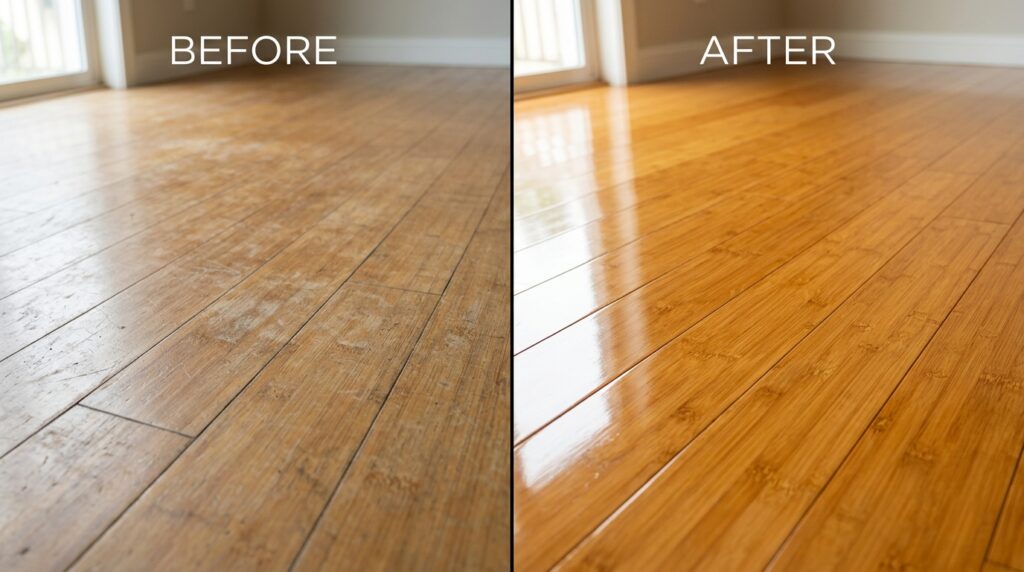
How Can I Make My Bamboo Floor Look New Again?
If your bamboo floor already looks dull, scratched, or tired, you don’t necessarily need to refinish it. Here’s the order I’d try things in, starting with the least invasive.
Step one: A proper deep clean. Most “dullness” is actually just built-up residue from old cleaners, not real damage to the finish. Switching to a pH-neutral bamboo floor cleaner and doing a slow, thorough pass often brings back more shine than people expect.
Step two: A compatible floor polish, applied sparingly. This is where people get into trouble, because not every polish is safe for every finish. If your bamboo has a polyurethane or aluminum oxide finish, which most factory-finished bamboo floors do, you want a polish specifically labeled safe for that finish type, applied in thin, even coats. Over-applying polish is actually one of the most common causes of that cloudy, streaky look people mistake for floor damage.
Step three: Buffing for light scratches. Light surface scratches can often be minimized with a soft buffing pad and a bamboo-safe cleaner, without the need for a full refinish.
Step four: Professional refinishing, as a last resort. If the scratches go through the finish layer or the color is uneven across large sections, that’s usually beyond what mopping and polish can fix, and it’s worth calling in a flooring professional rather than experimenting further on your own.
For stubborn stains specifically, I picked up a genuinely surprising tip from a flooring care resource that I now use myself: a small dollop of real mayonnaise, left to sit on a stain for about fifteen minutes before wiping clean, can lift some stains without the acidity risk of vinegar-based removers. It sounds strange, but the oils in it work similarly to how you’d treat a water ring on wood furniture, and I’ve had it work on a light coffee stain near my kitchen table.
If you’re dealing with stubborn spots from food or drinks rather than general dullness, my guide on removing avocado stains covers a similar gentle-lift approach that works on sealed hard surfaces, too, and it’s a good companion read if kitchen spills are your main problem.
Cleaning Strand Bamboo Flooring vs. Solid Bamboo
Strand bamboo flooring is denser and harder than solid bamboo, sometimes rated well above oak on hardness scales, but that extra durability doesn’t mean it’s immune to the same cleaning mistakes. What changes is the margin for error.
With strand bamboo, you generally have a bit more forgiveness with foot traffic and minor bumps, since the compressed fibers resist denting better. Where it doesn’t get more forgiving is water. Because strand bamboo is made by compressing and resin-bonding shredded fibers, if moisture does get past the sealed surface, it can spread through that dense fiber structure in ways that are harder to dry out evenly, sometimes leading to more noticeable warping than you’d see on solid bamboo with the same spill.
Practically, that means the “wipe it up immediately” rule applies even more strictly to strand bamboo floors, not less, even though the marketing around strand bamboo often emphasizes its toughness.
A Seasonal Bamboo Floor Care Calendar
Bamboo responds to seasonal humidity swings more noticeably than tile or vinyl, so I’ve found it helps to think about care in terms of the calendar year rather than just a repeating weekly checklist.
Spring Bamboo Floor Care Calendar
This is usually when humidity starts climbing again after a dry winter, so I watch for any tiny gaps between planks closing back up, which is normal, and I do one thorough deep clean to remove the grit that built up from winter boots and salt residue tracked in from outside.
Summer Bamboo Floor Care Calendar
Humidity tends to peak here, and this is when I’m most careful about mopping technique, since the air itself is already holding more moisture and the floor has less room to absorb any extra water from an overly wet mop. I run a dehumidifier if the house feels sticky, aiming to keep things closer to that 40 to 60 percent range.
Fall Bamboo Floor Care Calendar
I treat this as a maintenance checkpoint, inspecting furniture pads, checking entry mats for wear, and doing a slightly deeper clean before the dry winter heating season kicks in and makes any existing damage more visible.
Winter Bamboo Floor Care Calendar
Indoor heating significantly dries the air, which can cause bamboo planks to shrink slightly and small gaps to appear between boards. This is completely normal and usually closes back up by spring, but it’s also when I’m most careful about wet mopping, since dry, slightly gapped planks can let moisture seep between seams more easily than in summer.
Cleaning Bamboo Floors vs. Other Common Flooring Types
It helps to see bamboo in context, next to the flooring types people often compare it to when deciding what to install or how to care for what they already have.
Traditional solid hardwood generally requires the same “no vinegar, no ammonia, no steam mop” precautions as bamboo, but it typically has a thicker wear layer, allowing for more sanding and refinishing over its lifetime. Laminate flooring is more water-resistant on the surface than bamboo in short spill situations.
But if water actually gets underneath a laminate plank through a damaged seam, the particleboard core swells permanently in a way that’s often worse than what happens to bamboo. Tile is the most water-tolerant of the group by far and can handle routine wet mopping without the same anxiety, but it’s colder underfoot and far less forgiving if you drop something heavy on it.
Understanding where bamboo sits on that spectrum- tougher than laminate against surface moisture, more sensitive than tile, similar to hardwood in its chemical sensitivities- helped me stop treating my cleaning routine as a guessing game and start treating it as just “hardwood rules, with a slightly shorter grace period for spills.”
Mistakes I Made (So You Don’t Have To)
Beyond the wet-mop disaster I mentioned at the start, a few other lessons stuck with me.
I once used a scented all-purpose spray cleaner because it was already sitting on the counter, thinking “it’s just floor cleaner, how different can it be?” Within a couple of weeks, that section had a faint film that never fully wiped away with plain water, and it took switching to a proper bamboo cleaner and several passes to fully lift it. All-purpose cleaners are often formulated with ingredients like ammonia or fragrance oils that aren’t meant for a sealed wood finish.
I also learned not to trust “damp” by feel alone early on. What felt like a barely damp mop to me was still leaving faint water lines along the plank seams in my kitchen, visible only when the afternoon sun hit the floor at an angle. Now I wring the mop until it feels almost dry, then wring it again.
Lastly, I underestimated furniture pads. I moved a dining chair around daily for months before I noticed four faint half-moon scuffs where the chair legs had been dragging tiny amounts of grit across the finish. Felt pads under every chair and table leg fixed it, and it’s such a small, cheap habit that makes a real visible difference over a year.
Preventive Care That Actually Extends Floor Life
Cleaning technique matters, but prevention does much of the heavy lifting, too, and it’s the part most guides skip in favor of just listing cleaning steps.
- Place a doormat at every entrance to cut down on grit tracked in from shoes
- Use felt pads under all furniture legs, and check them every few months since they wear down
- Keep pet nails trimmed, since long nails scratch bamboo the same way they scratch hardwood
- Avoid rolling office chairs directly on bamboo without a proper chair mat rated for wood floors
- Keep indoor humidity roughly between 40 and 60 percent using a humidifier or dehumidifier as needed
- Remove wet shoes or boots before walking across the floor, especially in winter

If you’re also dealing with carpeted rooms in the same home and wondering about total flooring costs for a renovation, I put together a breakdown in how much it costs to carpet a 10×12 room, which is a useful comparison if you’re weighing bamboo against carpet for a specific room. And if you want more flooring-specific guides beyond bamboo, our Flooring & Tile section covers other surfaces and their upkeep too.
Expert Tips for Long-Term Bamboo Floor Care
A few habits separate bamboo floors that still look great after a decade from ones that look tired after three years.
Always test a new cleaning product on a hidden area first, such as inside a closet or under an appliance, before using it throughout the whole floor. Manufacturers consistently recommend this, and it’s the single easiest way to avoid an expensive mistake.
Rotate rugs in high-traffic zones every few months rather than leaving them in the exact same spot permanently, since UV exposure on the uncovered sections can cause slight color variation over time compared to the shaded areas underneath a rug.
Check your manufacturer’s specific care documentation if you still have it, since some brands, including certain bamboo lines, specify particular approved cleaners by name, and using an unapproved product can technically affect your warranty coverage even if it doesn’t visibly damage the floor right away.
Bamboo Floors in Kitchens and Bathrooms: What Changes
A lot of people ask me whether bamboo is even a reasonable choice for a kitchen or a half bathroom, given everything I’ve said about water sensitivity, and my honest answer is that it can work well, but the cleaning routine needs to get a little more disciplined in those rooms specifically.
In my own kitchen, I added a washable rug in front of the sink and stove, both because that’s where spills happen most and because standing at the sink for long stretches concentrates foot pressure and moisture in one small area. I also switched to wiping down the floor with a barely damp cloth immediately after cooking sessions that involve a lot of splashing, rather than waiting for my weekly mop day.
For a half bathroom, I’d personally lean toward a rigid-core waterproof bamboo product rather than standard solid or strand bamboo, simply because bathrooms involve more routine humidity from showers and sink use, even without an obvious spill. If you already have standard bamboo installed in a bathroom, a bath mat that actually absorbs water, not just a decorative one, and prompt drying after showers make a real difference over time.
Should You Hire a Professional Cleaner, or Handle It Yourself?
For weekly maintenance, I don’t think professional cleaning is necessary for most households, and the routine outlined in this guide takes me under twenty minutes for an average-sized living room and kitchen combined. Where a professional starts to make sense is for that once-a-year deep clean, especially in a larger home, or if you’ve inherited a bamboo floor with an unknown cleaning history and you’re not sure what products were used on it before.
A professional hardwood or bamboo floor cleaning service typically uses commercial-grade pH-neutral products and equipment designed to avoid over-wetting the floor, and they’re also useful for assessing whether a dull section needs a simple polish or something closer to refinishing. If you do bring someone in, it’s worth asking directly whether they have specific experience with bamboo rather than just general hardwood experience, since the two aren’t always treated the same way by every cleaning company.
I once hired someone, mostly out of curiosity, for an annual deep clean, and the biggest thing I took away from watching them work wasn’t a secret product. It was how little water they actually used, even less than what I thought I was already using. That visual lesson changed my own mopping habits more than anything I’d read online up to that point.
Pros and Cons of Bamboo Flooring Maintenance
- Generally easier and faster to clean than carpet, with no deep-cleaning equipment needed
- More water-resistant than most traditional hardwoods, with a real (if limited) buffer time for spills
- Strand bamboo in particular resists dents and scratches well for a plant-based flooring material
- A weekly cleaning routine is quick, usually well under 20 minutes for an average room
- Genuinely sensitive to the wrong cleaning products, more so than some hardwoods
- Not truly waterproof unless you specifically bought a rigid-core waterproof line
- Requires humidity management that carpet or tile simply doesn't need
- Refinishing options can be more limited than solid hardwood, since some bamboo has a thinner wear layer
Troubleshooting Common Bamboo Floor Problems
My floor feels sticky after mopping. This almost always means either too much cleaner concentrate was used, or the mop wasn’t rinsed and wrung out often enough between passes, leaving a thin film of diluted product behind. Go over the area again with a clean, barely damp microfiber mop and plain water, then dry it immediately with a soft cloth.
There’s a cloudy white patch that won’t wipe away. This is often a sign of moisture that’s gotten trapped just under the surface finish, sometimes called moisture blushing. In mild cases, gently buffing the area with a dry microfiber cloth can help, but if the patch persists, it’s worth having a flooring professional take a look before it spreads.
I see small gaps between planks that weren’t there before. In most cases, especially if this shows up during winter, it is completely normal seasonal shrinkage due to lower indoor humidity, and it typically closes back up on its own once humidity rises again in spring or summer. It only becomes a real concern if the gaps are large, uneven, or don’t close up seasonally at all.
There are faint scratches in a walking path across the room. This is usually grit being dragged underfoot rather than a single dramatic event, and it’s the clearest sign that daily dry mopping needs to become more consistent. A light buffing with a bamboo-safe polish can sometimes minimize the visual impact of shallow surface scratches.
The floor looks dull no matter how often I clean it. Before assuming the finish is failing, try switching cleaners for a month, since residue buildup from an incompatible product is a far more common cause of persistent dullness than actual finish wear.
Quick Reference: My Bamboo Floor Cleaning Checklist
I keep a version of this taped inside a cabinet near my cleaning supplies, and it’s genuinely what keeps me consistent when I’m tired and just want to skip the routine.
- Daily: dry mop or sweep high-traffic areas, wipe up any spills the moment you notice them
- Weekly: damp mop with a pH-neutral bamboo or hardwood cleaner, mopping in the direction of the grain
- Monthly: inspect baseboards, corners, and furniture pad wear, check humidity levels
- Seasonally: deeper clean before and after heating season, watch for gap changes between planks
- Always: wring the mop until it feels nearly dry, never let liquid pool on the surface
- Never: use vinegar as a default cleaner, steam mops, wax polish, or a beater-bar vacuum
A Short Glossary for Bamboo Flooring Terms
A few terms keep showing up in bamboo flooring care guides, and I found the whole topic much easier to navigate once I actually understood what they meant.
pH-neutral refers to a cleaner that sits right around neutral on the acid-alkaline scale, meaning it won’t chemically react with or degrade a polyurethane or aluminum oxide finish the way an acidic cleaner like vinegar can.
Wear layer is the top protective coating on a bamboo plank, and its thickness determines how many times, if any, the floor can be sanded and refinished before the underlying bamboo is exposed.
Strand-woven describes bamboo that’s been shredded into fibers, compressed under heat and pressure, and bonded with resin, resulting in a denser, harder plank than traditional solid bamboo strips glued side by side.
Equilibrium moisture content is the point at which a wood or bamboo product’s internal moisture level matches the humidity of the surrounding air, and it’s the underlying reason why bamboo planks expand and contract seasonally.
FAQs
What is the best cleaner for bamboo floors?
A pH-neutral cleaner made specifically for hardwood or bamboo, like Bona’s hardwood floor cleaner, is generally considered the safest and most effective everyday option, since it won’t strip or dull the factory finish the way acidic or ammonia-based cleaners can.
How can I make my bamboo floor look new again?
Start with a proper pH-neutral deep clean to remove residue buildup, then consider a bamboo-safe polish applied in thin coats if the floor is still dull afterward, and save full refinishing for scratches that go through the finish layer.
What not to use on bamboo floors?
Avoid vinegar, ammonia, bleach, wax-based polishes, oil soaps applied without proper dilution, steam mops, and any vacuum with a beater bar, since all of these can dull, discolor, or physically scratch the finish over time.
Can bamboo flooring be mopped?
Yes, but only with a well-wrung, barely damp microfiber mop and a pH-neutral cleaner. A soaking wet string mop is one of the fastest ways to cause warping or discoloration along the plank seams.
How to clean bamboo flooring with vinegar?
Some sources suggest a heavily diluted mix of a quarter cup of white vinegar per gallon of water for occasional light cleaning, but the safety of this method is genuinely debated among manufacturers, and I’d personally reserve it for rare use only, sticking to a proper bamboo floor cleaner for regular mopping.
Is there a bamboo floor cleaner and polish I can use together?
Yes, but they should generally be treated as two separate steps rather than a single combined product, since applying polish over cleaner residue can trap dust and create a cloudy film. Clean and fully dry the floor first, then apply a bamboo-compatible polish sparingly, checking that it’s labeled safe for your floor’s specific finish type.
Final Thoughts
Cleaning bamboo flooring really comes down to two habits: keep it dry, and keep it neutral. Wipe up spills fast, mop with barely damp microfiber rather than a soaking-wet one, and stick to a pH-neutral cleaner instead of reaching for whatever acidic or ammonia-based spray is already under your sink.
I wish someone had told me this before I ruined that first section of floor near my sink. If you’re just starting out with a new bamboo floor, or trying to rescue an older one that’s lost its shine, start with the weekly routine above and give it a month. It’s a small time investment that pays off in a floor that still looks good years down the road.
If you’re tackling other stubborn household messes alongside your flooring routine, our Cleaning section has more real, tested guides like this one, worth a look while you’re already in cleaning mode.