


How to Remove Pet Hair From Carpet (15 Real Fixes)
You love your dog. You love your cat. You do not love finding their fur woven into your carpet like it’s part of the weave now.
If you’ve already vacuumed twice this week and your carpet still looks like a second animal is living in it, you’re not doing anything wrong. Pet hair behaves differently from regular dirt. It doesn’t just sit on top of carpet fibers. It wraps around them, grips on with static electricity, and works its way down toward the backing where a normal vacuum pass barely touches it.
This guide covers everything: the tools worth buying, the home remedies that genuinely work, the ones that are a waste of your time, and the step-by-step process to get your carpet fur-free, including car carpets, cat hair, and even human hair, which behaves almost the same way once it’s embedded in fiber.
Let’s get into it.
Why Pet Hair Sticks to Carpet So Stubbornly (The Science Bit)
Most articles skip this part, but understanding why pet hair clings so hard actually helps you pick the right method, instead of guessing.
Two things are working against you:
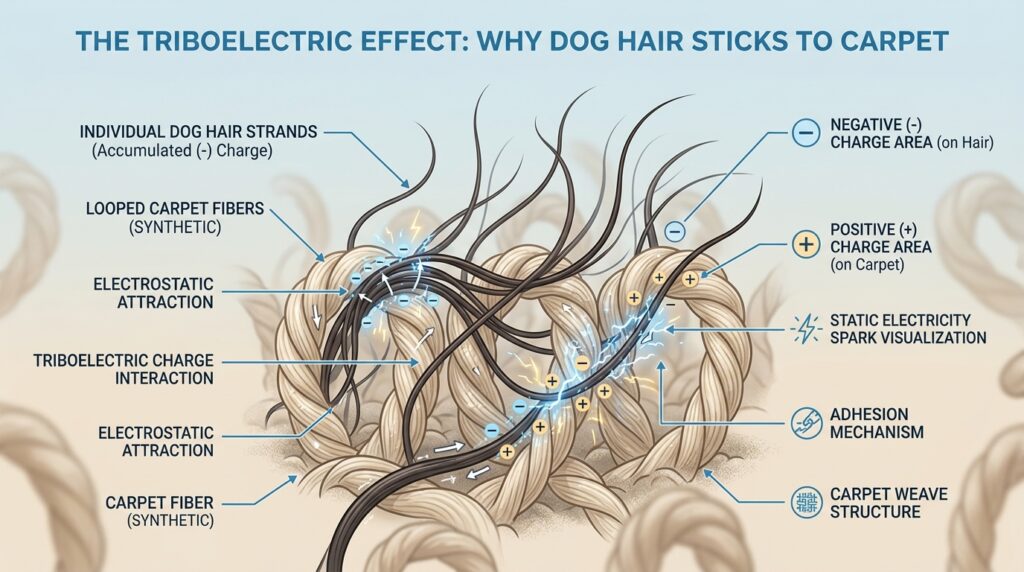
1. Static electricity (the triboelectric effect). Every time your pet walks, rolls, or brushes against carpet fibers, friction transfers electrons between the hair and the carpet. This is the same phenomenon that causes a balloon to stick to your hair, known scientifically as the triboelectric effect. The result is that pet hair becomes electrically charged and physically attracted to carpet fibers. It’s not just sitting there; it’s clinging on.
2. Fiber type and humidity. Synthetic carpets (nylon, polyester, and olefin, which make up most carpeting in American homes) hold onto static charge far longer than natural fibers like wool because they don’t absorb moisture well. Dry indoor air (common in winter when heaters run constantly) makes this worse, since moisture in the air is what normally helps static charges dissipate.
This is why pet hair seems so much worse in winter, and why misting your carpet lightly (with water or a diluted fabric softener solution) before cleaning genuinely works — it’s not an old wives’ tale, it’s basic physics. You’re neutralizing the static charge that’s gluing the hair to the fibers in the first place.
Quick-Answer Table: Best Method by Situation
If you’re in a hurry, here’s the short version. Full instructions are below.
| Situation | Best Method | Time Needed |
|---|---|---|
| No vacuum available | Rubber glove or squeegee | 5–10 minutes |
| Deeply embedded hair | Carpet rake + vacuum combo | 15–20 minutes |
| Small spot or stairs | Lint roller | 2–5 minutes |
| Whole-room deep clean | Pet-specific vacuum | 20–30 minutes |
| Car carpet and seats | Rubber squeegee + damp gloves | 10–15 minutes |
| Cat hair (fine, clingy) | Rubber broom + fabric softener spray | 10–15 minutes |
| Ongoing prevention | Regular brushing + carpet protector spray | Daily/weekly |
Best Tools for Removing Pet Hair From Carpet
Before we get into home remedies, let’s talk tools, since the right one saves you a genuine amount of time. Below is an honest breakdown, including where each tool falls short.
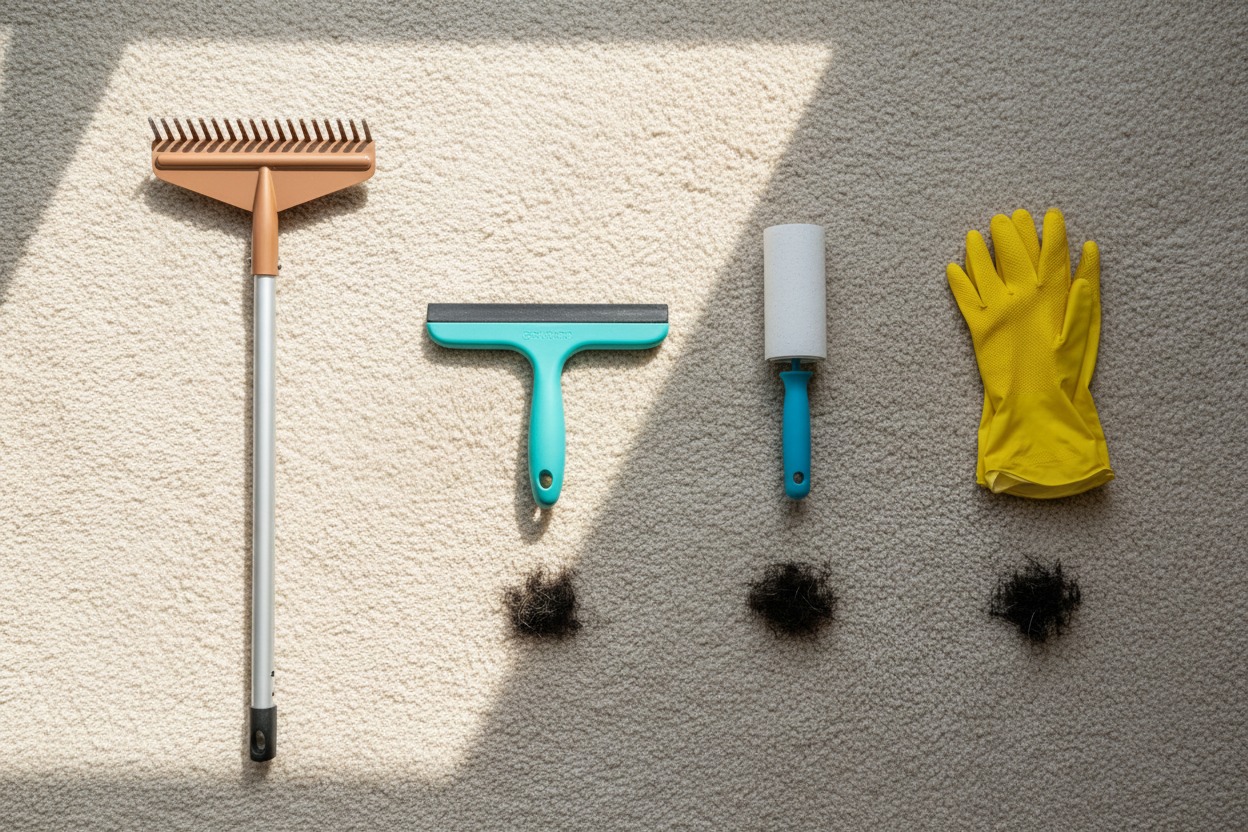
1. Carpet Rake for Pet Hair
A carpet rake is probably the most underrated pet hair remover. It looks like a small broom with stiff, angled bristles (often made of rubber, silicone, or metal) designed to dig into the carpet pile and drag embedded hair to the surface.
How to use a carpet rake:
- Work in small sections, pulling the rake toward you in short, firm strokes.
- Go with the direction of the carpet pile first, then against it to loosen deeper hair.
- Collect the loose hair by hand or vacuum it immediately afterward.
Pros:
- Reaches hair, a vacuum alone can’t lift
- Works on stairs, rugs, and car carpet
- No electricity or batteries needed
Cons:
- Not ideal for delicate loop-pile or Berber carpets. It can fray the loops.
- Requires physical effort (this is a workout for your arms)
2. Pet-Specific Vacuum Cleaner
Not every vacuum is built for fur. Standard vacuums often clog, scatter loose hair instead of collecting it, or lack the suction to pull hair from deep pile.
Look for these features when choosing one:
- A motorized brush roll or turbo head: spinning bristles physically lift embedded hair; suction alone isn’t enough
- HEPA filtration — traps pet dander and allergen particles as small as 0.3 microns, according to filtration standards referenced by the EPA’s guidance on indoor biological contaminants
- Tangle-resistant rollers: so you’re not cutting hair off the brush every ten minutes
- Strong sealed suction, not just a high wattage number on the box (wattage alone doesn’t tell you much about actual pickup power)
3. Rubber Broom or Squeegee
Rubber creates a strong static charge on contact, which makes it genuinely excellent at lifting hair without any moisture or chemicals. It’s the closest thing to a “cheat code” for pet hair.
4. Lint Roller (Long-Handle Version)
Regular lint rollers work fine for small areas, sofas, and stairs, but for carpet specifically, look for the long-handled versions made for floors. They cover more ground without you having to bend over.
5. Rubber Gloves
Cheap, already in your house, and surprisingly effective. More on this below.
Best Tool for Removing Dog Hair From Carpet: Pros and Cons Compared
Since this comes up constantly, here’s a direct comparison table so you can decide what to actually buy.
| Tool | Best For | Avg. Cost | Reusable | Works Without Vacuum |
|---|---|---|---|---|
| Carpet Rake | Deep, embedded hair | $10–$25 | Yes | Yes |
| Rubber Broom/Squeegee | Quick daily upkeep | $8–$20 | Yes | Yes |
| Pet Vacuum | Whole-house deep clean | $150–$500 | Yes | No |
| Lint Roller | Small spots, stairs | $5–$15 | Refills needed | Yes |
| Rubber Gloves | Emergency/no-tool situations | $2–$5 | Yes | Yes |
| Fabric Softener Spray | Loosening static hold | $3–$8 | Yes | Combine with a vacuum |
If you’re only buying one thing, get a carpet rake. It’s cheap, works with or without a vacuum, and handles the deepest, most stubborn fur that other tools miss.
How to Remove Dog Hair From Carpet Without Vacuum
Vacuum broken, or just not near an outlet? These methods use nothing but static, friction, and household items, and honestly, some of them outperform a weak vacuum anyway.
Method 1: Rubber Gloves
- Slightly dampen a pair of rubber or latex gloves.
- Rub your hands across the carpet in one direction using firm, short strokes.
- Watch the hair roll up into clumps in front of your hand.
- Peel the clumps off and toss them, then repeat over the area.
This works because the rubber’s texture, combined with moisture, creates enough friction and grip to physically pull hair loose from the fibers.
Method 2: The Squeegee Trick
A window squeegee (yes, the kind used for glass) is one of the most effective carpet rakes for pet hair alternatives you probably already own.
- Hold the squeegee at a slight angle.
- Drag it across the carpet in one direction only, applying light pressure.
- Hair will bunch up in visible rolls ahead of the blade.
- Sweep or pick up the rolls as you go.
Method 3: Balloon Static Trick
It sounds silly, but it works on small areas.
- Inflate a balloon and briefly rub it against a wool sweater or your hair to build up a charge.
- Hold it a few inches above the carpet and slowly lower it.
- Loose hair will lift and stick to the balloon’s surface.
This is best for small spots, not whole rooms. Patience runs out fast here.
Method 4: Fabric Softener Spray
- Mix 1 part fabric softener with 3 parts water in a spray bottle.
- Lightly mist the carpet — don’t soak it.
- Let it sit for 5–10 minutes so the softener breaks the static bond holding hair to fibers.
- Brush or sweep the loosened hair into a pile.
Always spot-test first on an inconspicuous area, especially on light-colored or wool carpets, since some softeners can leave a faint residue or discoloration.
Method 5: Baking Soda
- Sprinkle a thin, even layer of baking soda over the affected area.
- Let it sit for 10–15 minutes.
- Brush or sweep before collecting. Baking soda also absorbs pet odors, which is a nice two-in-one benefit.
Method 6: Pet or Hair Brush
A stiff-bristled pet brush, or even your own hairbrush, works surprisingly well on smaller carpeted areas like stairs.
- Brush the carpet in the same motion you’d use on your pet’s coat.
- Clear the bristles of collected hair every few strokes.
- Repeat until no more hair collects.
How to Remove Pet Hair From Carpet at Home (Full Step-By-Step Process)
Here’s the complete process combining tools and techniques for the most thorough clean, whether you’re doing a weekly maintenance clean or tackling months of buildup.
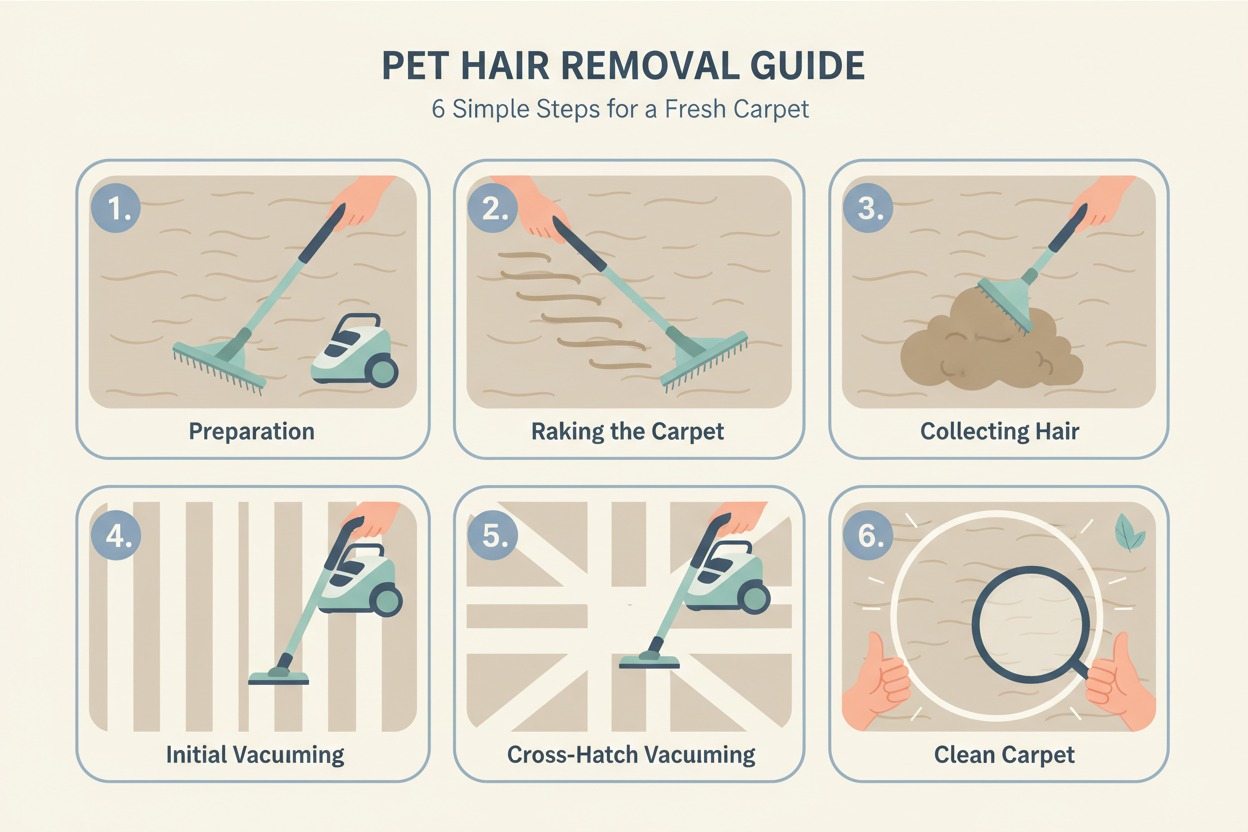
Step 1: Clear the room. Move furniture, toys, and anything blocking full floor access.
Step 2: Pre-treat with a rubber broom or carpet rake. Loosen embedded hair before vacuuming. This single step dramatically improves how much your vacuum picks up, since a large amount of pet hair sits below the surface, where suction alone struggles to reach.
Step 3: Apply baking soda or fabric softener spray if hair is heavily embedded. Let it sit for the recommended time.
Step 4: Vacuum in a cross-hatch pattern. Go over the area in one direction, then again in the perpendicular direction to your first pass. This overlapping pattern catches hair lying in different directions that a single pass misses.
Step 5: Empty the canister or check the bag often. A full bag or canister loses suction quickly, especially when fine pet hair clogs the filter.
Step 6: Clean the brush roll. Cut away any wrapped hair with scissors or a seam ripper so the next pass works at full strength.
Step 7: Spot-check edges, corners, and baseboards. Use the crevice tool here. This is where vacuums typically leave the most hair behind.
How to Remove Cat Hair From Carpet (It’s Different From Dog Hair)
Cat hair is finer and shorter, and it clings more strongly to carpet fibers than most dog hair, which makes it feel like it “disappears” into the carpet rather than sitting on top of it.
What works best for cat hair specifically:
- Rubber tools over bristle tools. Because cat hair is so fine, rubber’s static grip outperforms stiff bristles, which tend to push the hair around rather than lift it.
- Lower vacuum height settings. Cat hair tends to sit closer to the base of the fiber, so raise the brush height only slightly, or use suction-only mode on looped carpet.
- More frequent light cleaning over occasional deep cleaning. Since cat hair sheds in a steady trickle rather than dramatic seasonal bursts (though cats do shed more heavily in spring and fall), staying ahead of it with short, frequent sessions beats waiting for a big cleanup.
- Damp rubber gloves work particularly well on cat hair in tight spaces like under furniture, where a rake can’t fit.
How to Remove Human Hair From Carpet Without Vacuum
Human hair behaves a lot like pet hair once it’s in carpet. It wraps around fibers and holds on through static. But it tends to be longer and can tangle into visible strands rather than a fine layer.
- Use a rubber squeegee or broom in one consistent direction — long human hair rolls up into clumps quickly this way, often faster than pet hair does.
- Try a lint roller for shorter areas, like around a vanity, bathroom mat edges, or a bedroom carpet near a hairbrush station.
- Damp rubber gloves work exceptionally well on human hair, specifically, because the strands are long enough to wrap fully around your fingers as you go.
- Avoid regular sweeping with a straw broom — it tends to just relocate hair rather than lift it, since bristle brooms don’t generate the static charge needed to release hair from carpet fibers.
Best Way to Get Dog Hair Out of Carpet in Car
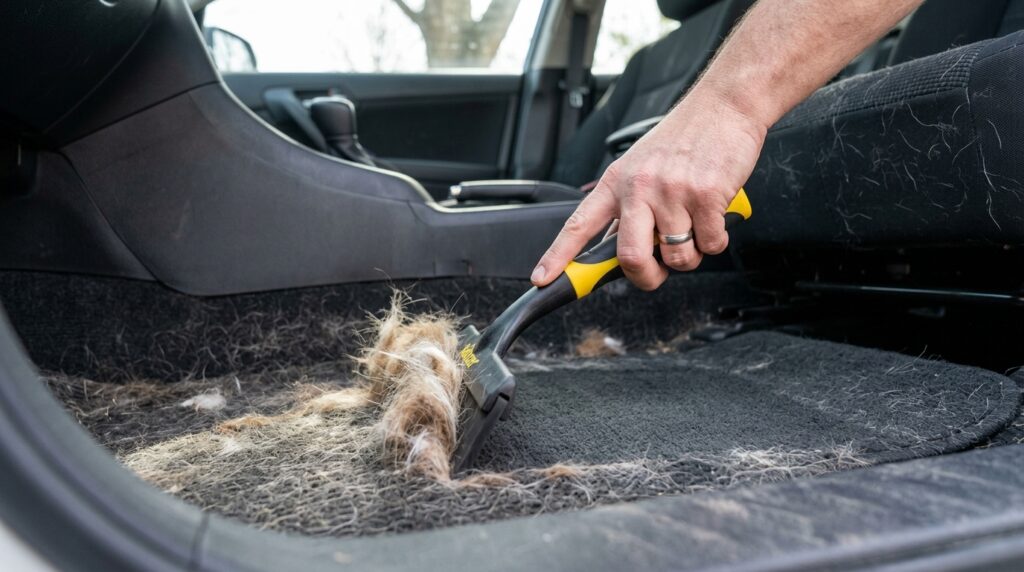
Car carpet is its own challenge. It’s often a shorter, denser weave, packed into tight spaces around pedals, seat tracks, and door sills — areas a full-size vacuum simply can’t reach.
Here’s the process that actually works in a car:
- Start with a rubber squeegee. Because car carpet is usually low-pile and dense, a squeegee’s flat rubber edge outperforms most other tools for this job. Drag it toward you in short strokes.
- Use damp rubber gloves for seat rails and pedal areas. These tight gaps trap huge amounts of hair that a squeegee can’t reach.
- Follow with a handheld vacuum with a crevice tool for the loosened piles and edges.
- Finish with a lint roller on the seats if hair has transferred there, too.
- Spray a light mist of fabric softener solution on floor mats (remove them from the car first) to loosen ground-in hair before shaking or vacuuming them out.
Car interiors tend to trap more static-charged hair than home carpet, partly because vinyl and rubber trim generate extra static through friction from getting in and out of the vehicle. So don’t skip the squeegee step even if you’re short on time.
Which Carpet Types Resist Pet Hair Best
If you’re choosing new carpet as a pet owner, fiber type matters more than most buying guides mention.
| Carpet Type | Pet Hair Resistance | Why |
|---|---|---|
| Cut pile (short) | High | Less surface area for hair to grip and tangle into |
| Loop pile / Berber | Low | Loops trap and hide hair deep between fibers |
| Frieze (twisted) | Medium | Textured, but hair can hide in twists |
| Polypropylene/Olefin | High | Low static absorption, hair sits closer to surface |
| Wool | Medium-High | Naturally more static-resistant due to moisture retention, but fibers can trap hair |
| Nylon (dense, short) | High | Common pet-friendly choice; durable and easier to rake |
Shorter, denser cut-pile carpets made of synthetic fibers are generally the easiest to keep hair-free, since there’s simply less depth for hair to burrow into.
Pet Hair, Dander, and Indoor Air Quality (Why This Matters Beyond Looks)
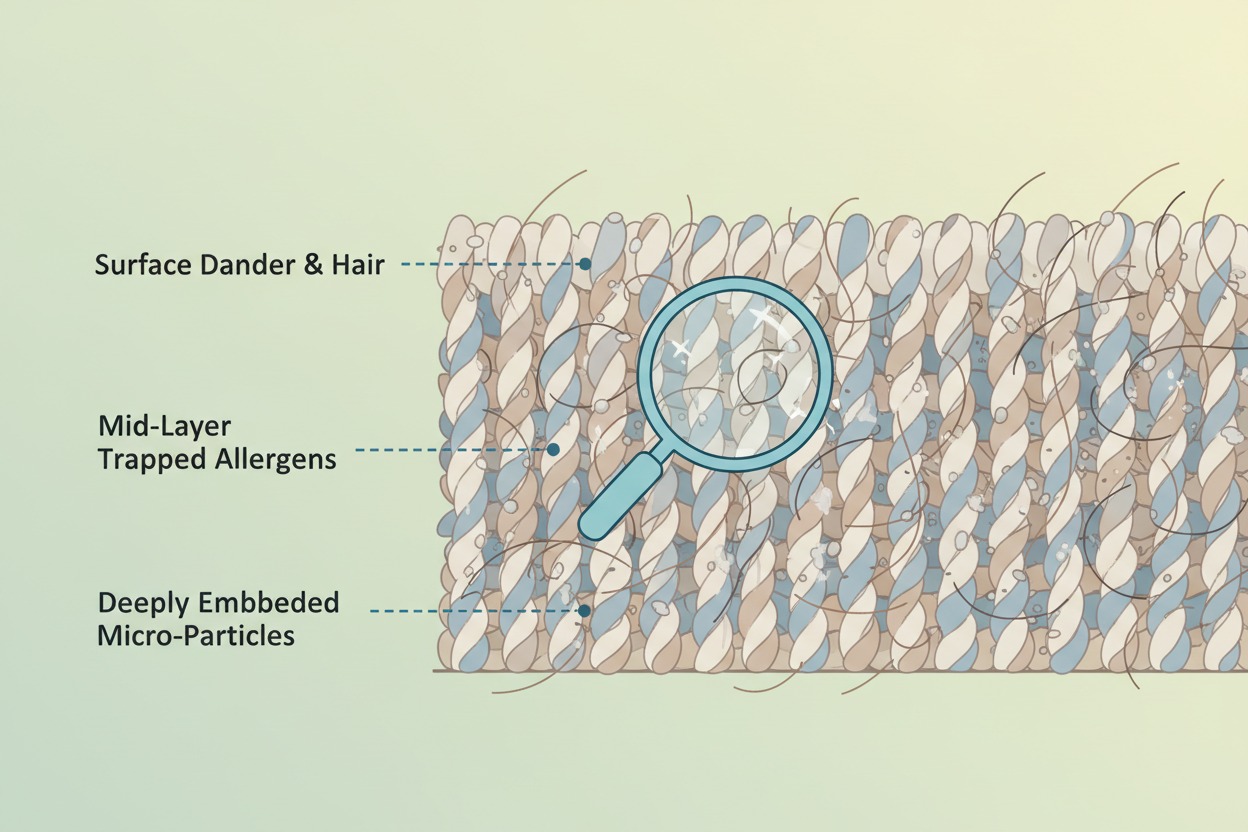
This part rarely gets covered in pet hair guides, but it’s worth knowing: carpet isn’t just holding onto visible hair — it’s also a major reservoir for pet dander, the microscopic skin flakes that come off alongside fur.
According to the Asthma and Allergy Foundation of America, roughly six out of ten people in the U.S. are regularly exposed to cat or dog dander, and it’s one of the most common indoor allergy triggers. The tricky part is that dander is sticky and clings to soft surfaces (carpets, upholstery, and bedding), often settling in far more than it stays airborne, according to findings cited in the EPA’s indoor air quality research.
This is exactly why removing visible hair isn’t the whole job. A carpet that “looks” clean can still be holding a significant amount of settled dander deep in the pile. Regular vacuuming with a HEPA-filtered vacuum, combined with the raking and static-release methods above, addresses both the visible fur and the invisible allergens hiding underneath it.
If anyone in your home deals with allergies or asthma, pairing a HEPA air purifier with your cleaning routine can help, since purifiers manage what’s airborne while cleaning tackles what’s settled. According to IQAir’s allergen-control guidance, one doesn’t replace the need for the other.
Prevention: Stop Pet Hair Before It Ever Reaches the Carpet
Removing hair is only half the battle. A few consistent habits cut down how much ends up embedded in your carpet in the first place.
- Brush your pet regularly, ideally a few minutes daily during heavy shedding seasons (spring and fall for most breeds). Catching loose hair on a brush means it never reaches the floor.
- Wipe paws at the door. This also reduces dirt that mats hair into the carpet, making it harder to remove later.
- Wash pet bedding weekly. Bedding is a hotspot for hair and dander that gets constantly tracked onto nearby carpet. If the bedding smells musty even after washing, mildew may be contributing to the problem. Our guide on removing mildew smell from towels covers the same fix for pet blankets and towels.
- Use a carpet protector spray after deep cleaning to reduce how much new hair bonds to the fibers.
- Keep humidity moderate indoors. Since dry air worsens static cling, a humidifier in high-traffic rooms during winter can genuinely reduce how aggressively hair clings to your carpet.
- Vacuum on a schedule, not just when it looks dirty. Hair that sits for weeks compacts deeper into the pile and gets significantly harder to remove.
- Rotate area rugs regularly and consider washable, removable rugs in high-shedding zones. For washable ones, a routine similar to our ” How to Dry Clean at Home ” guide works well for rugs that can’t go in a standard washer.
Expert Tips (What Most Guides Leave Out)
A few practical notes worth knowing before you start:
- Work dry-to-wet, not wet-to-dry. Always loosen hair with a dry tool (rake, squeegee, rubber gloves) first, then follow with any damp method. Wetting matted hair first often glues it deeper into the fibers instead of loosening it.
- Direction matters more than pressure. Pulling a rake or squeegee in one consistent direction outperforms scrubbing back and forth — back-and-forth motion tends to just redistribute hair rather than lift it out.
- Cold, dry days are the worst days for pet hair. If you’re planning a deep clean, doing it on a more humid day (or after running a humidifier for an hour) will genuinely make the hair easier to lift, thanks to reduced static.
- Don’t oversaturate carpet with any liquid method. Excess moisture trapped in carpet padding can lead to mold growth over time, which creates a bigger problem than the hair ever was.
- Replace vacuum filters on schedule. A clogged HEPA filter loses effectiveness well before it looks visibly dirty, and pet hair significantly accelerates clogging compared to regular household dust.
Common Mistakes to Avoid
- Using a straw broom. It just relocates hair instead of lifting it. You need static or suction, not sweeping.
- Skipping the pre-treatment step. Going straight to vacuuming without first raking or loosening the hair means you’re only getting the surface layer.
- Over-relying on lint rollers for large rooms. They’re excellent for spot treatment but wildly inefficient (and expensive for refills) across an entire carpet.
- Ignoring the vacuum’s brush roll. A roller wrapped in old hair loses most of its lifting power, even if suction still sounds strong.
- Using too much fabric softener. A little breaks static bonds effectively; too much can leave carpet fibers feeling sticky or attracting more dust over time.
If your carpet has other stubborn spots beyond hair, like dripped wax from a candle that went sideways, our guide on how to remove candle wax from any surface and the fabric-specific version, how to remove candle wax from fabric, walk through that separately, so you’re not mixing cleaning methods.
FAQs
1. What removes pet hair from carpet the fastest?
A rubber squeegee or carpet rake removes hair the fastest for spot cleaning, since both use friction and static to lift hair in seconds rather than minutes. For whole rooms, a pet-specific vacuum with a motorized brush head covers the most ground in the least time.
2. Can I remove pet hair from carpet without buying anything new?
Yes. Damp rubber gloves, a spray bottle with diluted fabric softener, and baking soda are the three most effective no-purchase methods, and most households already have at least one of them on hand.
3. Why does my carpet still have hair right after vacuuming?
This usually means the hair is embedded deeper than suction alone can reach, or your vacuum’s brush roll is tangled and no longer spinning effectively. Raking or using a rubber tool before vacuuming solves this in most cases.
4. Is cat hair harder to remove than dog hair?
Generally, yes. Cat hair is finer and shorter, so it burrows deeper into the carpet pile and clings more strongly due to static electricity, especially in dry indoor air. Rubber-based tools tend to outperform bristle tools when it comes to cat hair.
5. How often should I deep clean the carpet in a home with pets?
A light maintenance clean (vacuum plus rake) once or twice a week, with a deeper treatment (baking soda, fabric softener spray, or professional cleaning) once a month, keeps most pet-owning homes ahead of buildup without letting hair compact into the fibers.
Final Thoughts
Pet hair in carpet isn’t really about “cleaning harder”. It’s about using the right combination of static, friction, and suction, in the right order. Start with a dry tool to loosen hair, follow up with vacuuming or a damp method to lift what’s left, and stay consistent with prevention so it never builds up as badly again.
Try the carpet rake and squeegee methods first if you’re dealing with heavily embedded hair. They solve the exact problem that a vacuum alone usually can’t. And if allergies are a concern in your home, pairing this routine with regular HEPA vacuuming will do more for your air quality than either method alone.
Got a stubborn stain alongside the fur? Check out more cleaning guides on Home Upright’s Cleaning section for room-by-room fixes.