


Blue and Purple Flowers: The Best Varieties for Your Garden and Bouquet
Blue and purple flowers can make a garden feel cooler, deeper, and more peaceful while providing strong contrast against green foliage. Some varieties produce clear blue blooms, while others fall somewhere between violet, lavender, indigo, and purple depending on the cultivar, growing conditions, and light. This guide covers beautiful blue and purple flowers for gardens, containers, bouquets, and weddings without treating every similarly colored plant as interchangeable.
Color alone should not determine which flower you grow. Sun exposure, drainage, climate, mature size, flowering season, and moisture needs often matter more than whether a bloom is labeled blue or purple. Choosing plants for the conditions you actually have usually produces a healthier and more attractive display.
What to know
- Delphinium, iris, salvia, hydrangea, lavender, and clematis are among the best-known blue and purple flowering plants.
- Many flowers sold as blue actually contain noticeable violet, lavender, or purple tones.
- Choose plants according to sunlight, drainage, climate, and moisture requirements rather than color alone.
- Blue and purple flowers work particularly well with white, blush, cream, silver-green, and soft pink flowers in bouquets.
- Flower color can vary among cultivars, so check the exact plant label before purchasing.
18 Beautiful Blue and Purple Flowers to Know
The best blue and purple flower names include familiar garden plants and less common choices that add different heights, textures, and flowering periods. Some are compact plants suited to the front of a border, while others form tall spikes or climbing vines. The following selections offer a range of options rather than several plants that all serve the same role.
1. Delphinium
Delphiniums are among the most dramatic blue and purple flowers because their tall stems carry densely arranged blooms above the foliage. Depending on the cultivar, flowers may appear blue, mauve, purple, lavender, pink, or white, and some flowers have a contrasting central eye. According to the Royal Horticultural Society’s delphinium growing guide, these plants work particularly well toward the back of perennial borders where their height can become part of the overall design.
Give perennial delphiniums a sunny position with fertile, well-drained soil and protection from strong winds. Taller varieties often need support because heavy flower spikes can bend or fall during wind or rain. Their strong vertical form also makes them useful as cut flowers when you want height in an arrangement.
2. Lavender
Lavender combines purple-blue flowers with aromatic gray-green or silver-green foliage, so it stays attractive even when the flowers aren’t the main focus. Depending on the type, flowers can range from deep purple and purple-blue to mauve, pink, or white. The RHS lavender growing guidance explains that lavender performs best in sunny positions with freely draining soil.
Lavender generally dislikes heavy, persistently wet ground, so it should not automatically be grouped with moisture-loving blue flowers just because their colors match. If you are considering soil amendments for lavender or other garden plants, HomeUpright’s guide explaining whether coffee grounds are good for plants can help you decide whether a particular amendment is appropriate. Matching soil conditions to the actual plant is more important than using the same treatment across an entire flower bed.
3. Iris
Iris flowers are easy to recognize because of their distinctive petal structure and upright, sword-like foliage. Depending on the species and cultivar, they can produce blue, violet, purple, white, yellow, and multicolored flowers. Their strong architectural leaves also give a border shape before and after the main flowering display.
Do not assume every iris requires identical growing conditions. Bearded iris generally favor sunny, well-drained positions, while other types are adapted to considerably wetter soils. Check the species or cultivar before planting so an attractive blue iris doesn’t end up in the wrong location.
4. Hydrangea
Hydrangeas are useful when you want large clusters of blue or purple flowers rather than narrow spikes or individual blooms. Certain bigleaf hydrangeas can develop pink, purple, or blue coloring depending partly on soil chemistry and the availability of aluminum to the plant. However, not every hydrangea changes color this way, so the effect should never be assumed for all species or cultivars.
Hydrangeas can create substantial visual weight in a landscape, making them effective near foundations, along mixed borders, or as flowering shrubs behind smaller perennials. Their cut flower heads also work well in larger arrangements where one stem can provide considerably more volume than a small individual bloom. If you are exploring more plants in this family and other H-named flowers, HomeUpright’s guide to flowers that start with H provides additional choices.

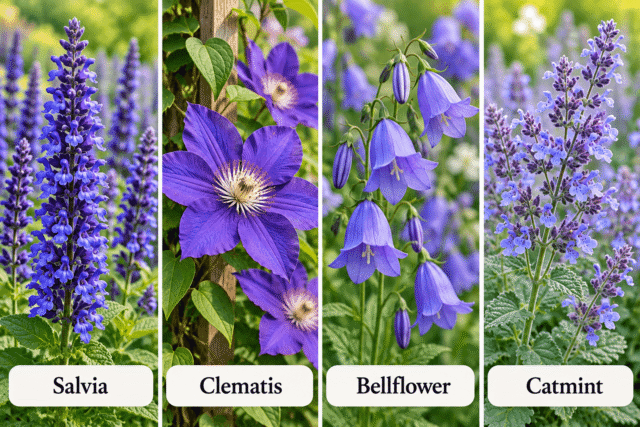
5. Salvia
Salvia gives you upright flower spikes that can visually connect taller plants with lower-growing flowers in a mixed border. The genus includes many species and cultivars, and flower colors range from purple, violet, and lavender-blue to true blue shades and other colors. Some varieties also attract bees, butterflies, and other visiting insects.
Growing requirements differ among salvias, so identify the plant rather than buying according to flower color alone. For example, the Missouri Botanical Garden profile for Salvia lyrata describes it as a plant suited to average to moist soil in full sun, with lavender-blue flowers appearing above the foliage. That differs from some Mediterranean-type salvias adapted to drier locations.
6. Clematis
Clematis can bring blue and purple flowers vertically onto fences, trellises, arches, and other supports. Depending on the variety, blooms may be small and delicate or large and showy, and the range includes lavender, violet, deep purple, and blue-toned cultivars. A climbing form is particularly useful when your planting bed has limited horizontal space.
Before choosing one, check the mature size and pruning group of the cultivar you are considering. Different clematis types flower on different growth and may require different pruning schedules. Selecting a cultivar for its mature behavior is more useful than simply purchasing the darkest purple flower available.
7. Bellflower
Bellflowers, or Campanula, include compact edging plants and taller perennial forms. Their blooms are commonly blue, violet, purple, or white and often have the bell-like shape suggested by the common name. Depending on the species, they can work well in cottage borders, rock gardens, edging schemes, or mixed perennial beds.
Because the genus includes plants of very different sizes and habits, always check the botanical name and plant label. A low-growing bellflower and a taller border campanula cannot be used interchangeably just because both produce blue-purple flowers. Matching the mature plant to its intended position prevents crowding later.
8. Catmint
Catmint creates a softer blue-purple effect than plants with large individual flowers. Its small blooms usually appear on numerous stems above gray-green foliage, giving the plant a hazy appearance from a distance. That makes it useful for edging pathways, softening hard landscape lines, or filling spaces beneath taller flowering plants.
Many catmints prefer sunny locations and well-drained soil once established. Their loose growth can also balance the rigid vertical lines of delphinium, allium, or ornamental grasses. Instead of using every plant as a focal point, catmint works particularly well as the layer connecting larger garden features.
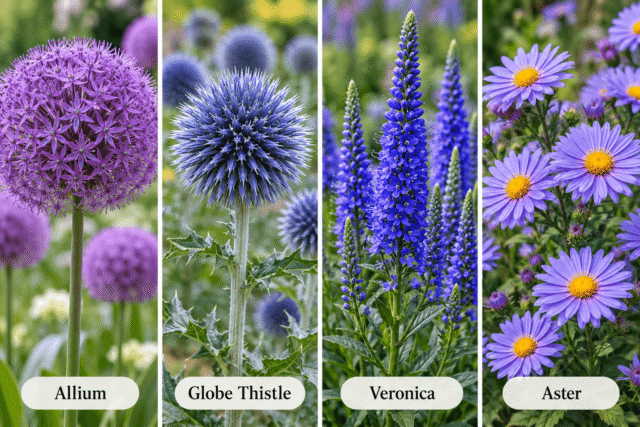
9. Allium
Ornamental alliums are known for rounded flower heads composed of many small individual flowers. Purple is especially common, although shades range from pale lilac to dark violet and some cultivars flower in white or other tones. Their spherical shape contrasts strongly with flat daisies, loose lavender spikes, and broad hydrangea flower heads.
Most ornamental alliums grow from bulbs and perform best when their drainage and light needs are met. Their foliage can start to look tired while the flower stems remain attractive, so surrounding perennials can help hide aging leaves. They work especially well when repeated throughout a border rather than appearing as a single isolated plant.
10. Globe Thistle
Globe thistle, or Echinops, produces distinctive spherical flower heads that often appear steel blue or blue-violet. The spiky texture looks very different from the softer petals of hydrangea, iris, or clematis. This makes globe thistle particularly useful when a blue-and-purple garden needs more visual texture than another flower color.
The RHS blue-and-purple pollinator planting guide includes Echinops ritro ‘Veitch’s Blue’ among plants that support pollinator-friendly gardens. Its blue flower heads also remain structurally interesting after the brightest flowering period. Combining different flower shapes can support a broader range of visiting insects while creating a more layered garden.
11. Veronica
Veronica, commonly called speedwell, is available in several blue and purple flowering forms. Many produce upright flower spikes, but their height and overall habit vary by species and cultivar. Deep blue-purple forms can provide color without reaching the dramatic height of a large delphinium.
The Missouri Botanical Garden’s long-blooming perennial guide highlights compact Veronica cultivars with dense blue-purple flower spikes. Their comparatively compact habit shows why cultivar selection matters when planning the front or middle of a border. Look beyond the generic plant name and check mature dimensions before deciding where it belongs.
12. Aster
Asters are particularly useful when you want blue-purple and lavender color later in the growing season. Their daisy-like flowers create a different texture from early-summer spikes and large shrub flowers. Some types can continue the cool-color theme when many spring and early-summer flowers have finished.
The exact flowering period depends on the species, cultivar, and local climate. Asters can also be helpful in pollinator-oriented plantings because their flowers provide accessible floral resources for insects. In a planned border, pairing late-flowering asters with earlier blue and purple plants helps extend the season rather than creating one short burst of color.
13. Phlox
Phlox includes many flowering plants, with colors ranging from white to pink, purple, and violet-blue. Taller garden phlox can produce rounded clusters above leafy stems, giving beds and borders substantial mid- to late-season color. Some blue-named cultivars appear more violet or purple depending on the light, which is a useful reminder that flower color descriptions are not perfectly standardized.
The RHS blue-and-purple planting guide includes blue-violet phlox among plants suitable for a cool-colored pollinator scheme. This sort of cultivar can bridge the visual difference between clearly purple lavender and more obviously blue flowers. Check local growing conditions and disease resistance when selecting garden phlox rather than relying on the photograph alone.
14. Cornflower
Cornflower is a familiar choice for a clearer blue appearance, although selected forms also come in other colors. Its fringed petals and relatively informal growth make it a natural fit for cottage-style gardens, cutting gardens, and meadow-inspired planting. Blue cornflowers also pair particularly well with white, yellow, pink, and purple flowers.
Cornflowers can contribute a lighter, less formal appearance than large hydrangeas or tall delphiniums. They are especially useful when you want flowers for cutting without turning the entire bed into a formal display. In mixed arrangements, their smaller flower heads can fill spaces between larger focal blooms.
15. Lobelia
Lobelia is a useful option when you need blue or violet color closer to ground level or spilling from a container. Many bedding types form masses of relatively small flowers rather than a few large blooms. Their scale makes them suitable for window boxes, hanging containers, edging, and the front of ornamental beds.
Growing requirements vary by lobelia type, so don’t treat all forms as identical annual bedding plants. Some are compact seasonal plants, while others are perennials with very different mature sizes and moisture preferences. Check the full plant name before deciding how and where to grow it.
16. Violet
Violets naturally fit a blue-purple planting scheme because violet itself lies between familiar blue and purple color descriptions. Flowers may range from deep violet and purple to pale lavender, blue-violet, white, yellow, or combinations of these shades. Their relatively small size can make them useful below shrubs or at the front of more relaxed planting schemes.
The word “violet” covers multiple species and should not be treated as one single garden plant. Some are valued ornamentals, while others spread readily under suitable conditions. Checking the species and local behavior is especially important before introducing a plant you expect to stay in one small patch.

17. Columbine
Columbines, or Aquilegia, produce distinctive flowers with backward-pointing spurs and come in many colors, including shades of blue and purple. Their unusual flower shape can break up a border filled with standard daisies, rounded flower heads, and upright spikes. They look especially natural in cottage-style and woodland-influenced gardens.
Different species and hybrids vary in height, flower color, and preferred conditions. Their relatively delicate form works well among ferns, spring bulbs, and softer-textured perennials. The RHS guide to growing cut flowers also recognizes Aquilegia as a useful option for arrangements.
18. Dwarf Larkspur
Dwarf larkspur, Delphinium tricorne, is a native perennial found in parts of the eastern United States. The Missouri Botanical Garden’s dwarf larkspur profile describes its spring flowers as violet-blue to purple and notes a typical height of about one to two feet. This makes it different in scale and growing behavior from the tall hybrid delphiniums commonly seen in formal perennial borders.
It performs best where its soil, moisture, and climate requirements are suitable, rather than wherever blue color happens to be needed. The plant prefers fertile, well-drained soil and can appreciate some afternoon shade in hot summer conditions. Consider its native range and regional climate before selecting it.

Are There Flowers That Are Truly Both Blue and Purple?
Yes, some flowers naturally sit very close to the visual boundary between blue and purple. Delphinium, salvia, phlox, iris, veronica, and several other plants can produce cultivars described as blue-purple, violet-blue, mauve, lavender, or indigo. Even horticultural references sometimes use more than one color term because the perceived shade changes with cultivar, lighting, flower age, and viewing conditions.
This explains why a flower shown as blue in a catalog may look more violet in your garden. Digital photographs, screens, shadows, sunlight, and nearby colors can all change the way a bloom appears. If exact color matching matters for a wedding or landscape project, view the actual flowers before making a large purchase rather than relying solely on an online photograph.
How to Choose Blue and Purple Flowers for a Garden
Begin with growing conditions rather than color. Record how much direct sun the location receives, whether the soil drains quickly or remains damp, and approximately how much space the mature plants can occupy. Once those conditions are clear, you can narrow your blue and purple flower choices to plants that actually have a reasonable chance of thriving.
Next, consider height and plant shape. Delphiniums provide strong vertical lines, hydrangeas create large rounded masses, catmint forms softer low mounds, and globe thistle adds rounded structural flower heads. Using several forms together usually creates more depth than planting a collection of flowers with the same height and silhouette.
Flowering season matters as well. Spring-blooming plants can be followed by early-summer delphiniums, summer lavender and salvia, and late-season asters to maintain color for longer. A garden designed around bloom sequence usually looks more consistent than one where every blue and purple plant reaches peak flowering at the same time.
If you enjoy building gardens around particular flower groups, HomeUpright’s guide to flowers that start with I includes iris and other choices with practical growing notes. You can also explore flowers that start with J for additional blue, violet, and lavender possibilities such as Japanese iris and Jacob’s ladder. These related lists are most useful when you compare plant requirements rather than choosing by name alone.
Blue and Purple Flowers for Bouquets
A blue and purple flower bouquet can be dramatic or very soft depending on which shades and flower shapes you combine. Delphinium can add height, hydrangea can add volume, lavender can add fragrance and loose texture, and smaller flowers can fill spaces between larger focal stems. Green foliage and a small amount of white can also separate similar shades so that individual flowers remain visible.
For a romantic arrangement, combine lavender, violet-blue, soft purple, cream, and blush shades rather than using only the darkest flowers. For a more contemporary look, reduce the number of flower types and repeat a few strong forms with restrained greenery. If you are arranging cut flowers at home, HomeUpright’s guide explaining whether cut flowers need sunlight can help you choose a better location for the finished bouquet.
Cut-flower availability also varies with season and florist supply. The RHS cut-flower growing guide lists flowers suited to different parts of the growing season, including delphinium and asters. Planning by season can therefore be more practical than becoming attached to a single flower that may not be readily available when you need it.
Purple and Blue Wedding Flowers
Purple and blue wedding flowers can support several styles, including romantic garden arrangements, formal designs, rustic celebrations, and softer cottage-inspired bouquets. Delphinium, hydrangea, lavender, iris, clematis, and seasonal supporting flowers can all contribute to the palette. Consider availability, durability, flower size, scent, and season alongside color.
Soft blue, lavender, white, cream, and silver-green foliage often produce a lighter arrangement, while navy-like blue tones, deep violet, burgundy, and dark foliage create a moodier effect. Because genuinely dark blue flowers are relatively uncommon, florists frequently achieve visual depth by combining several blue-violet and purple shades. Discuss exact varieties with the florist rather than assuming a photograph shows an easily available natural flower.
Wedding arrangements also need to work at different scales. A flower that looks beautiful in a hand-held bouquet may be too small to make an impact across a large reception room, while a huge hydrangea head may overwhelm a small boutonniere or delicate table arrangement. Matching stem size and flower form to the job usually produces a more balanced result.
What Colors Look Best With Blue and Purple Flowers?
White and cream are among the easiest companions because they give the eye a visual break between several similar cool shades. Pale pink and blush create a softer romantic combination, while yellow or gold can provide stronger contrast. Silver-green foliage also works naturally with lavender, violet, and blue-toned flowers.
Don’t treat green as background only. Different foliage textures can make two similarly colored flowers look completely different when arranged side by side. Broad leaves, fine gray foliage, grasses, and compact dark-green leaves each create a different effect even when the flower palette remains unchanged.
Common Mistakes When Choosing Blue and Purple Flowers
One common mistake is selecting a flower from a photograph and assuming the real plant will be exactly the same shade. Camera settings, editing, screen displays, flower maturity, and natural cultivar variation can all shift perceived color. When color accuracy matters, look for the cultivar name and compare several reliable descriptions.
Another mistake is planting incompatible species together solely because their flowers match. As explained in the RHS lavender guide, lavender prefers sunny, freely draining conditions, while some other blue-purple plants perform better in more moisture-retentive soil. A color-coordinated planting will still struggle if its plants require fundamentally different conditions.
A third mistake is concentrating only on flowers and ignoring foliage and mature size. Plants spend part of the year without peak blooms, so leaf shape, height, growth habit, and spacing still affect how the landscape looks. A successful border should still have structure when individual flowers finish.
How to Build a Blue and Purple Flower Border
Start by selecting one or two structural plants rather than buying every blue flower that catches your eye. A taller delphinium, shrub-sized hydrangea, or climbing clematis can establish the basic shape, while salvia, lavender, catmint, or veronica can occupy lower layers. Repeating a few plants through the border usually looks more intentional than using one specimen of many unrelated species.
Next, spread flowering periods across the season. Early flowers can hand the display over to summer lavender, salvia, phlox, and later asters rather than leaving a long period without blooms. The RHS blue-and-purple pollinator planting guide similarly recommends combining plants that flower over an extended period.
Finally, leave enough room for mature growth. A newly planted border often looks sparse because young plants have not reached their final dimensions, but filling every gap immediately can create crowding later. Follow mature spacing on plant labels and let neighboring plants develop naturally.
Conclusion
Blue and purple flowers range from towering delphiniums and climbing clematis to fragrant lavender, rounded hydrangeas, compact veronica, and late-season asters. The best choice depends on much more than color, because light, soil, moisture, climate, height, and flowering season determine how successfully each plant performs. Combining several compatible plants can create a garden that moves naturally from blue through lavender, violet, and deep purple.
For bouquets and weddings, the same principle applies: work with flower shape, scale, season, and availability as well as color. Use white, cream, blush, or varied foliage when you need separation between similar shades, and verify individual cultivars when an exact blue or purple tone matters. With that approach, beautiful blue and purple flowers can work as an intentional palette instead of simply a collection of similarly colored blooms.
What flowers are naturally blue and purple?
Delphinium, iris, salvia, veronica, bellflower, cornflower, hydrangea, globe thistle, phlox, and several violets can produce blue, violet, or purple flowers. Exact shades vary among species and cultivars, and many flowers marketed as blue have noticeable violet undertones.
What are the most popular blue and purple flower names?
Some of the most familiar names are lavender, delphinium, iris, hydrangea, salvia, clematis, catmint, allium, aster, lobelia, violet, and bellflower. These plants differ substantially in mature size and growing requirements, so the best choice depends on where you intend to grow them.
What blue and purple flowers are good for bouquets?
Delphinium, hydrangea, lavender, iris, phlox, asters, and seasonal supporting flowers can work well in blue and purple bouquets. Availability varies during the year, so choosing by season and desired flower shape is often easier than requiring one exact variety.
What flowers go well with blue and purple flowers?
White, cream, blush pink, pale yellow, and silver-green foliage are useful companions for blue and purple flowers. White and cream make individual cool-toned flowers easier to distinguish, while yellow provides stronger contrast and blush creates a softer romantic effect.
Are there truly blue flowers?
Yes, some flowers appear distinctly blue, but genuinely blue-looking blooms are less common than purple, violet, or lavender flowers. Cornflower and certain delphiniums, salvias, irises, hydrangeas, and other cultivars can produce convincing blue shades, although lighting and cultivar differences affect how the color appears.
Which blue and purple flowers attract pollinators?
Lavender, delphinium, globe thistle, salvia, phlox, and several other blue-purple flowering plants can attract bees, butterflies, or other pollinating insects. A garden containing different flower shapes and flowering periods can provide a broader and longer-lasting range of floral resources.