


How to Clean Solar Panels on the Roof Safely
The best way to learn how to clean solar panels on the roof is to start with one important rule: stay on the ground whenever possible.
Most light dust can be removed with a gentle rinse. For dirt that does not wash away, use clean water and a soft brush on a telescopic pole. Do not use a pressure washer, a rough sponge, strong chemicals, or metal tools. These can scratch the glass, harm the coating, loosen seals, or push water into electrical parts.
If you cannot reach the panels safely from the ground, hire a trained solar panel cleaner. Wet solar panels and wet roofing create a serious fall risk. Saving a small amount of money is not worth climbing onto a steep or slippery roof without the right training and fall protection.
Quick Answer
The best way to clean solar panels on the roof is from the ground with clean water and a soft brush on a telescopic pole. Work on a cool morning and use gentle water pressure. Avoid pressure washers, rough tools, and strong chemicals because they may damage the panels. If the roof is steep, high, or difficult to reach, hire a trained professional.
Do Your Solar Panels Actually Need Cleaning?
Solar panels do not need to look perfectly polished to work. A thin layer of ordinary dust may have little effect, and rain often removes loose dirt from tilted panels.
Cleaning is more likely to help when you can see:
- Thick dust or pollen
- Bird droppings
- Leaves trapped along the lower edge
- Sticky tree sap
- Coastal salt deposits
- Ash or smoke residue
- Mud left after light rain
- Lichen, moss, or heavy organic growth
- A clear fall in power production that is not caused by weather or shade
Do not judge performance from one cloudy day. Compare output over several clear days with similar weather. If your monitoring app shows that one panel is producing far less power than the others, dirt may not be the real problem. The system could have shade, a wiring fault, an inverter issue, panel damage, or another technical problem.
Routine maintenance can help keep a solar system working well, but cleaning is only one part of that care. Regular system maintenance may also include checking the inverter, wiring, mounting parts, roof condition, and system alerts.

How Often Should You Clean Roof Solar Panels?
No cleaning schedule fits every home.
Many rooftop systems may need little manual cleaning because rain removes loose dust. Other systems need more attention because of their location. Check the panels after long dry periods and after events that may leave heavy dirt behind.
You may need more frequent checks if your home is near:
- A dirt road
- Farmland or open fields
- Active construction
- Heavy traffic
- Industrial activity
- Large trees
- Bird nesting areas
- The coast
- An area affected by wildfire smoke or ash
Flat or nearly flat panels may also collect more dirt because rain does not drain from them as easily. Tilted panels usually shed water and loose debris more effectively.
Instead of cleaning on a fixed date, use three signs: visible buildup, lower-than-expected output, and local conditions. This prevents needless roof work while still dealing with dirt when it begins to matter.
The Safest Cleaning Method for Rooftop Solar Panels
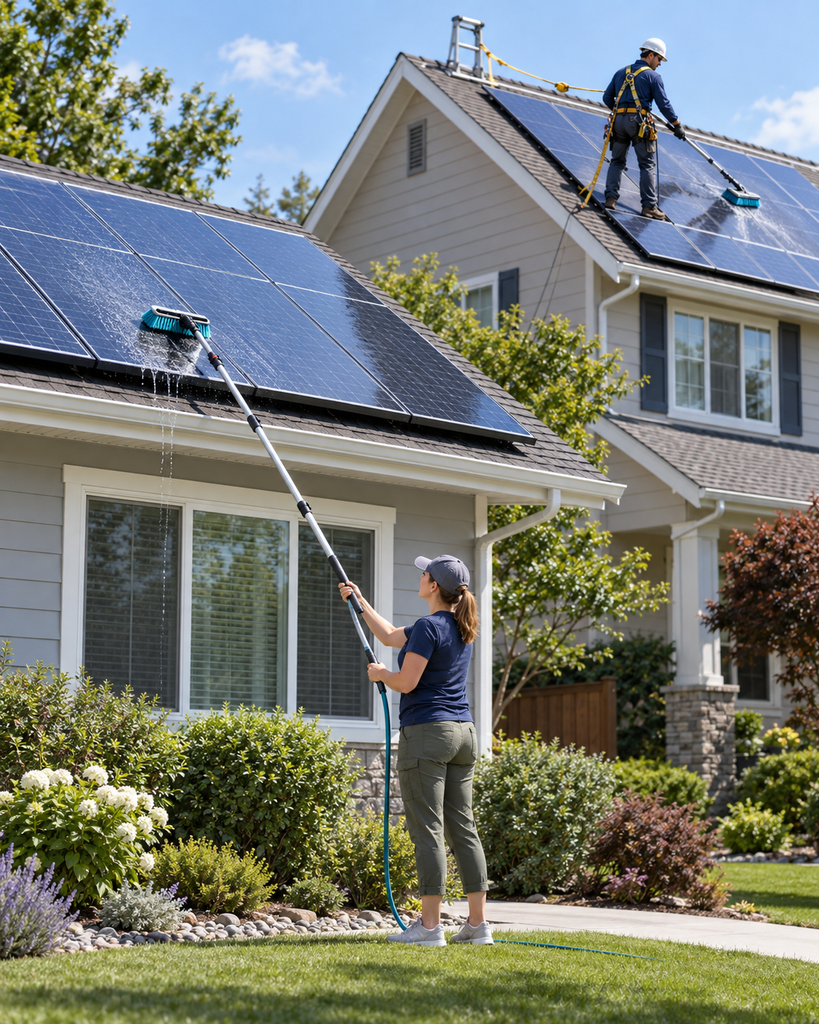
The safest approach is to clean the panels while keeping both feet on the ground. A water-fed telescopic pole can reach many one-story roof systems without a ladder.
A professional should handle the job when:
- The panels cannot be reached from the ground
- The roof is steep, high, wet, weak, or hard to access
- The panels are close to the roof edge
- The home has two or more stories
- Power lines are nearby
- The panels or wires appear damaged
- Heavy growth must be removed
- Birds or animals have nested under the array
- You do not have the correct safety equipment
Water, roof edges, and poorly placed ladders commonly cause serious falls. A roof becomes even more dangerous once rinsing begins.
Turning the system off does not remove the fall risk. It also does not always remove every electrical risk. Solar modules can keep producing direct-current electricity as long as light reaches them. Follow the shutdown steps supplied with your system, but do not treat a switched-off array as harmless.
What You Need for Solar Panel Cleaning
Before buying a complete cleaning kit, check the instructions for your exact panels. Cleaning rules can differ, and using an unapproved product could affect the warranty.
For a basic ground-based cleaning, you may need:
- A garden hose with gentle flow
- A telescopic pole long enough to reach the array
- A soft, non-abrasive brush or cleaning pad
- Clean water
- A clean bucket
- A soft rubber squeegee, if approved
- Eye protection
- Waterproof shoes with good grip
- Clean microfiber cloths for reachable edges only
Plain water is often enough. Official maintenance guidance recommends light spraying, soft tools, and keeping your feet on the ground where possible. It also warns against pressure hoses and harsh chemicals. Review the full panel-cleaning safety guidance before starting.

Is Tap Water Safe?
Tap water may be suitable if it is not very hard and the panels rinse well. However, hard water contains minerals that can leave white spots as it dries.
If your home has hard water, consider using deionized or distilled water for the final rinse. This can reduce mineral marks and may allow the panels to dry without wiping.
Don’t add a homemade cleaner just because the water is hard. Vinegar, glass cleaner, wax, dishwasher products, and household chemicals may not be approved for your panels.
Do You Need Soap?
Start with water alone. If water does not remove the dirt, read the panel manual. Use only a cleaner allowed by the panel maker, and use the smallest recommended amount.
Too much soap can leave a film that catches dust. A film may also cause streaks across the glass. Never guess which chemical is safe for the protective coating, seals, frame, or nearby roof material.
Best Time to Clean Solar Panels
Choose a cool part of the day, such as early morning. A cloudy, mild day can also work well if there is no rain, wind, or storm risk.
Do not pour cold water over very hot panels. A sudden temperature change may place stress on the glass. Hot panels also make water dry quickly, which can leave mineral spots and soap marks.
Avoid cleaning during:
- Strong wind
- Rain or thunderstorms
- Freezing weather
- Very hot afternoons
- Icy or frosty conditions
- Times when the roof is wet
- Periods of heavy smoke or falling ash
Morning dew can soften bird droppings, but it can also make the roof slippery. Stay on the ground and wait until the area where you will stand is dry.
How to Clean Solar Panels on a Roof From the Ground
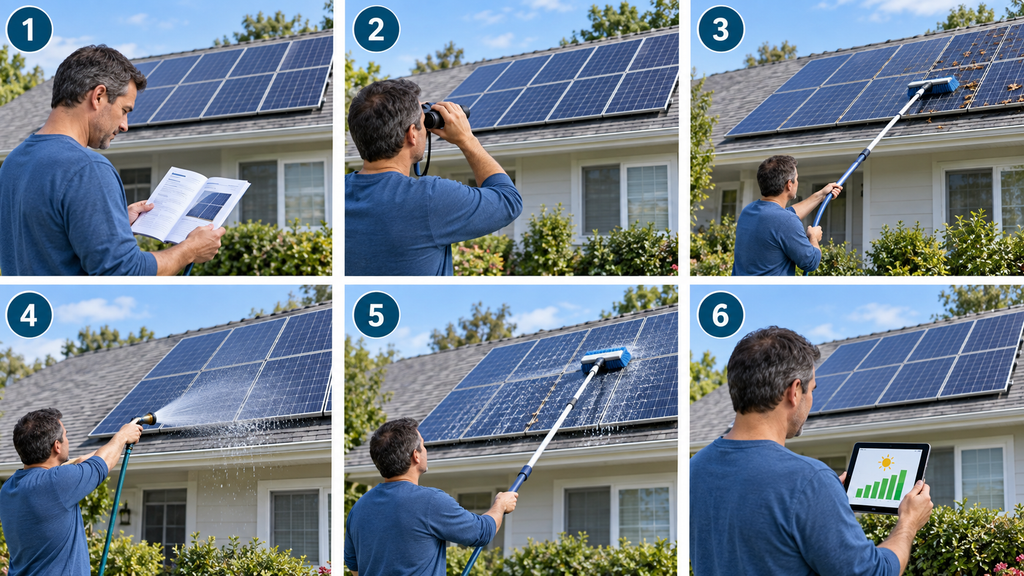
1. Read the Cleaning and Shutdown Instructions
Find the manual for the panels, inverter, and complete system. Check which tools and cleaners are allowed. Also check whether professional cleaning is required to keep the warranty valid.
Follow the official shutdown process if the instructions tell you to switch off the system before cleaning. Solar systems aren’t all turned off the same way, so don’t copy a random switch sequence from another system.
If the labels are missing or the shutdown process is unclear, contact the installer or a qualified solar electrician.
2. Inspect the System Without Touching It
Look at the array from the ground. Binoculars or a camera with zoom can help you see dirt without climbing.
Stop and call a professional if you notice:
- Cracked or broken glass
- Burn marks
- Loose panels
- Hanging or damaged wires
- Open connectors
- Corroded parts
- Water inside a panel
- A loose mounting rail
- Roof damage around the array
- An inverter warning or fault code
Cleaning will not fix these problems. Spraying damaged electrical equipment could make the situation more dangerous.
Plan solar care with your wider home exterior maintenance in mind. Handle a roof leak, damaged flashing, a blocked gutter, or weak roofing material before spraying water around the array.
3. Clear Loose Leaves and Dry Debris
If you can reach the surface safely with a telescopic tool, gently move loose leaves away with a soft brush.
Do not grind dry dirt across the glass. Sand, ash, and hard particles can scratch the surface when pushed with force. Use very light contact, or rinse loose particles away first if the panel instructions allow it.
Never place the pole under wiring or between the panels and roof. Do not try to pull out a bird nest or animal material. Nest removal may involve electrical, fall, disease, and wildlife risks.
4. Rinse With Gentle Water Flow
Use a normal garden hose without a high-pressure attachment. Aim the water at the glass, not under the panels.
Start at the upper part of the array and let the water flow downward. This helps carry loose dirt toward the lower edge.
Keep water away from:
- The underside of the modules
- Cable connections
- Junction boxes
- The inverter
- Roof vents
- Damaged seals
- Open electrical equipment
If the hose cannot reach from the ground, do not climb onto the roof while holding it. A hose can catch around your feet, pull you off balance, and make every surface around you wet.
5. Loosen Stuck Dirt With a Soft Brush
Wet the dirt first and allow it to soften. Then pass a clean, soft brush over the glass with light, even strokes.
Do not press hard. More force does not mean better cleaning. If a mark does not loosen after soaking and gentle brushing, leave it for a professional rather than scraping it.
For bird droppings, apply clean water and let it soften. Repeat the wetting process if needed. Never use a razor blade, metal scraper, steel wool, stiff broom, or rough kitchen pad.
6. Give the Panels a Final Rinse
Rinse away all loosened dirt and any approved cleaner. Pay attention to the lower frame, where dirty water can collect.
If you have hard water, use deionized or distilled water for the last rinse when practical. This helps reduce mineral spots.
Use a soft squeegee only if the panel instructions permit it, and it can reach the surface without hard pressure. Make sure the rubber edge is clean. A dirty squeegee can drag grit across the panel.
7. Let the Panels Dry
Allow the panels to air-dry. Do not lean over a roof edge to wipe water spots. A small mark is less serious than a fall.
Clean your brush before storing it. Dirt left in the bristles may scratch the panels during the next cleaning.
8. Restart and Monitor the System
Follow the correct restart process. Check the inverter or monitoring app for warnings.
Compare energy production over the next few clear days. Do not expect the same output every day because clouds, heat, shade, season, and household system settings can all affect the numbers.
If output remains unusually low, arrange an inspection. The problem may be electrical or mechanical, not dirt.
What Not to Use on Solar Panels
Some cleaning tools work well on concrete or siding but are unsafe for solar modules.
Pressure Washers
A pressure washer can harm seals, coatings, frames, or electrical parts. It may also force water under the panel or make you lose control of the spray. Use a gentle water flow instead.
Abrasive Brushes and Pads
Hard brushes, scouring pads, melamine foam, steel wool, and dirty cloths can scratch the glass or its coating. Even a soft brush can cause damage if sand is trapped in it.
Strong Household Cleaners
Avoid bleach, ammonia, solvents, glass cleaner, degreasers, abrasive powders, and other strong chemicals unless your panel instructions clearly approve a specific product.
Wax and Water-Repellent Coatings
A coating made for car glass or windows may change how light passes through the panel. It may also leave residue or affect the panel warranty. Do not apply wax or a water-repellent treatment without written approval.
Metal Scrapers
Never use a knife, razor, shovel, or metal scraper. These tools can scratch or break the glass. They may also bring you dangerously close to live electrical parts.
Very Hot or Very Cold Water
Water near the outdoor temperature is the safer choice. Avoid sudden temperature changes, especially when panels have been heating in direct sun.

How to Handle Stubborn Buildup
Bird Droppings
Soak the spot with clean water. Wait for it to soften, then use a soft brush with very light pressure. Repeat rather than scraping.
Frequent droppings may point to birds nesting near or under the array. Ask a professional about safe, panel-compatible bird barriers. Do not block ventilation under the panels.
Pollen
Pollen can turn into a sticky film when mixed with a small amount of rain. A full gentle rinse followed by a soft brush usually works better than spraying small areas.
Tree Sap
Tree sap can be difficult to remove without a cleaner. Check the panel instructions before using any product. If the approved method does not remove it, contact a professional.
You may also reduce future buildup by trimming branches that hang near the array. Keep trees at a sensible distance without removing useful shade from other parts of the property. A careful seasonal yard cleanup can also reduce loose leaves and plant debris around roofs and gutters.
Wildfire Ash
Ash may contain fine, rough particles. Do not scrub it across dry glass. Follow local air-quality and cleanup advice, and check the panel manual before rinsing. Heavy ash, damaged roofing, or possible fire damage requires professional inspection.
Snow and Ice
Do not climb onto an icy roof. Do not use a shovel, metal rake, hot water, salt, or ice-melting chemicals on solar panels.
Snow often slides from tilted panels as the surface warms. If removal is truly needed, ask the installer about an approved roof rake or professional service. Keep people and property away from the area below because sliding snow can fall suddenly.
Should You Walk on Solar Panels?
No. Never stand, kneel, sit, or place equipment on a solar panel.
Your weight may crack the glass or damage solar cells, even when the damage is not easy to see. Walking on the panels can also damage seals and create an electrical or fall hazard.
Do not step between panels unless the roof has a marked, load-safe path and you are trained to use it. Roofing materials can crack, dent, or become loose under foot traffic. If you must walk on the roof, complete the work with someone who has proper roof access and fall protection.
When Professional Cleaning Is the Better Choice
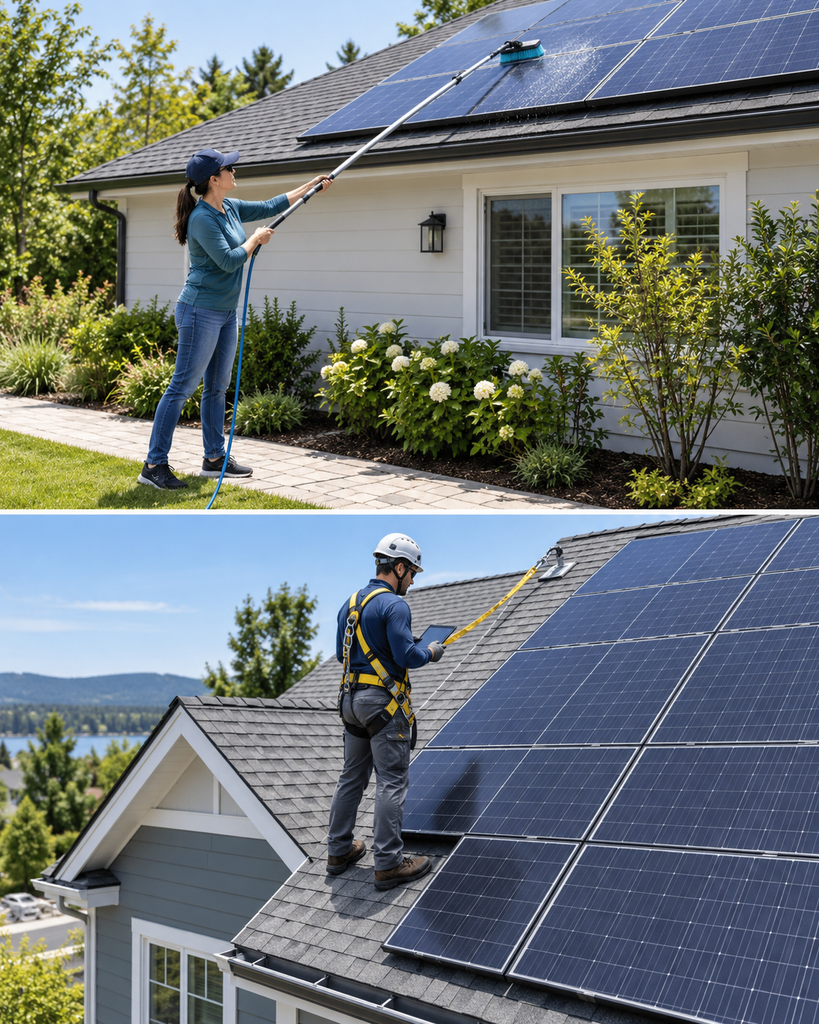
Professional cleaning is usually the right decision for a high, steep, fragile, or difficult roof. It is also safer when the array has stubborn buildup that cannot be reached from the ground.
Before hiring someone, ask:
- Are you insured for rooftop work?
- Do you have experience with solar modules?
- What fall-protection system will you use?
- Will you follow the instructions for my panels?
- What type of water and brush will you use?
- Will you avoid pressure washing?
- Are inspection and cleaning priced separately?
- Will you report cracks, loose parts, or damaged wiring?
- Could this service affect my warranty?
A cleaner may remove dirt, but a qualified solar electrician should check for electrical faults. Ask whether the visit includes cleaning only or a full system inspection.
Frequently Asked Questions
Can I clean solar panels with only water?
Yes. Clean water is often enough for dust, pollen, and light dirt. Use a gentle rinse and a soft brush if needed. Check your panel instructions before adding soap or another cleaner.
Can I use dish soap to clean solar panels?
Use it only if the panel instructions allow it. Some mild cleaners may be acceptable, but too much soap can leave a film that catches dust and causes streaks. Water alone should be your first choice.
Can I use a pressure washer on solar panels?
No. High-pressure water may harm the seals, coating, frame, or electrical parts. It can also force water under the modules. Use low-pressure water from a normal hose.
Does rain clean solar panels?
Rain can remove loose dust from tilted panels, but it may not remove bird droppings, tree sap, thick pollen, coastal salt, or dirt collected along the lower frame. Light rain can also mix with dust and leave muddy marks.
Should I turn off solar panels before cleaning?
Follow your system’s shutdown instructions. Some systems should be switched off before cleaning, but switching them off does not stop modules from producing electricity in daylight. Never touch electrical parts, and never spray damaged wiring or connectors.
Is professional solar panel cleaning worth it?
It can be worth paying for when the panels are visibly dirty, production appears lower, and safe ground-based cleaning is not possible. Professional service is especially sensible for steep roofs, tall homes, fragile roofing, damaged equipment, and heavy buildup.
Conclusion
The best way to clean solar panels is usually the simplest: stay on the ground, use clean water, work with a soft telescopic brush, and avoid strong pressure or harsh chemicals.
First, confirm that cleaning is truly needed. Then check the panel instructions and choose a cool, calm day. If the roof is steep, high, slippery, damaged, or difficult to reach, call a trained professional. Clean panels may support better performance, but protecting yourself, the roof, and the electrical system matters more than making every panel look spotless.